

5 Nearly-Perfect '80s Cars That Almost Everyone Agrees On
When it comes to the 1980s, one thing's for sure — we weren't spoiled for choice when it came to amazing cars. Automotive culture hit an absolute fever pitch all over the world, producing more bangers that can possibly be in a single list. You had American powerhouses like the Buick GNX and C4 Corvette, svelte European sports cars like the Ferrari 308 and Lamborghini Jalpa, supercars like the Porsche 959, SUVs like the 60-series Land Cruiser, homologation specials like the Audi Quattro and Nissan Skyline R31 GTS-R — the list goes on and on.
One thing's for certain: all of these cars retain rampant fanbases to this day, and for good reason. Some of them even shaped the way automotive culture looked for decades, such as the Dodge Caravan introducing the world to the minivan. Then you have icons like the Toyota AE86, a car that unquestionably introduced many a kid to the world of Japanese anime and manga. We can spend all day nerding out about these cars. But what identifies one as perfect?
It's a fairly abstract concept, especially when discussing such noteworthy automotive giants. Perfection doesn't have to do with performance — at least, not entirely. Nor does it have to do with cultural impact; the Lamborghini Countach LP5000 QV is basically the poster child for the '80s, but it certainly wasn't perfect. That's why we're breaking the list up based on car classification — what car is perfect at doing its intended role, and why? Let's take a look.
Compact car: Honda Civic (fourth generation)
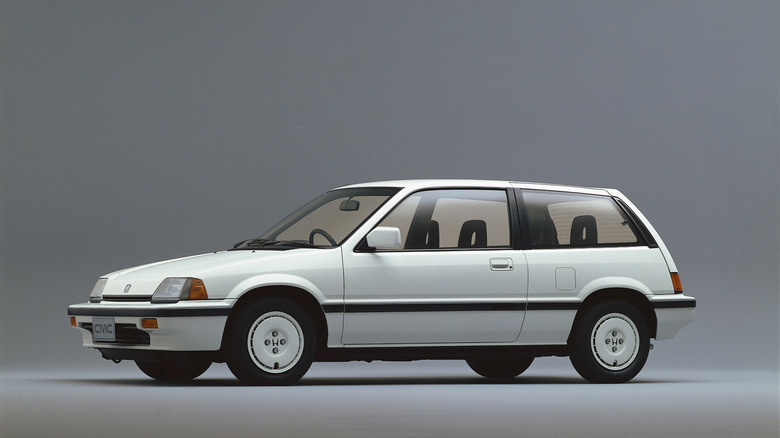
Take a moment and think about how many clean EF Civics you see on the road today. Probably not many — a lot of them are either busted up, modified, or both. You seldom see a genuine nice regular example anymore, and that's a shame, because this car's perfection lies in its simplicity. Produced from 1987 to 1991, the fourth generation EF Civic is easily one of the most barebones cars you can find. It's not exactly fast, nor does it have any options to speak of. Even by 1991, the standard model still didn't come with a tachometer or air conditioning — they were optional.
That's precisely why these things are so beloved; they harken back to a more basic time in automotive design. A late-'80s Civic is the epitome of function over form — a car that is quite literally four wheels, a square body, an engine, a manual transmission, seats, and not much else. People loved it back then as well, with the car being praised at the time for combining an engaging driving experience with the practicality of a modern hatchback.
These days, 1980s Civics of any description — certainly Si's and SiR's — are prized collectors' cars, considered among the best Civics to buy used. The same goes for the Civic-based CRX, which itself garnered attention for its sportiness in a light, well-built package. They even have an entire dedicated subculture in Japan, the Kanjozoku, which prominently races these cars on the highway loop of Osaka. Ultimately, these cars are proof that being basic is actually incredibly desirable if it's done well.
SUV: Jeep Cherokee (XJ)
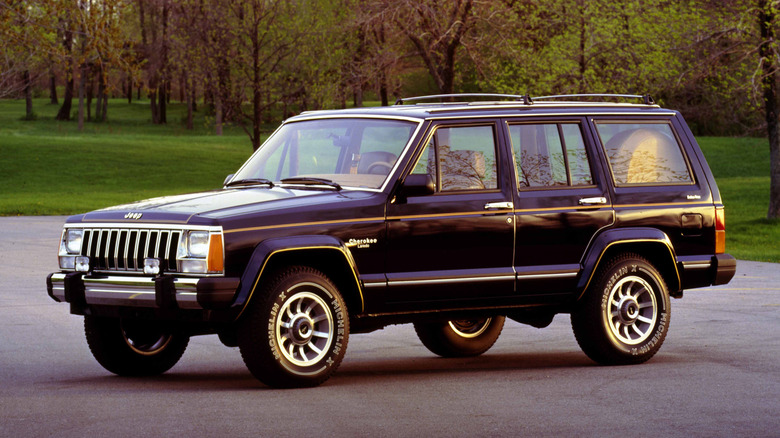
Okay, let's get rid of the elephant in the room: Why this, and not something like a Land Cruiser? That's because of the Cherokee's influence — a Land Cruiser is unquestionably just as capable, if not more so, especially off-road. But the Jeep Cherokee started a trend that's still going strong – the crossover.
Granted, it wasn't the first ever crossover. That title belongs to the AMC Eagle. The Cherokee itself isn't a crossover, either; just about the most crossover thing it has is the unibody construction. Otherwise, it's extremely SUV-like in many respects. Solid axles, that unkillable straight six mated to a manual transmission as standard, two or four doors, a fairly basic interior, and so on. It also has that timeless boxy aesthetic that looks so utterly functional, it still appears contemporary on today's roads, to the point where automakers are going back to boxy to emulate it and other cars in its class.
So why's it nearly-perfect, then? Because it was, and remains, one of the best unibody SUVs of all time. Alongside others like the Chevrolet S10 Blazer and Ford Bronco II, the Cherokee introduced people to the concept of a vehicle with truck capability and passenger car handling. Its coil front springs and lower center of gravity afforded it excellent cargo space, visibility, and less weight in comparison to larger trucks, yet it was — and remains — a superb off-roader. With millions being produced up to 2001, the XJ Cherokee retains a loyal fanbase of countless enthusiasts, further fueled by its durability well beyond 100,000 miles and plethora of parts, both OEM and custom.
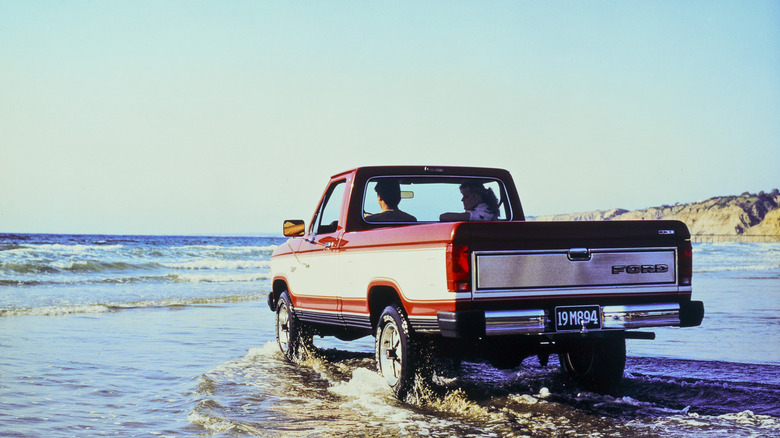
Pickup truck: Ford Ranger
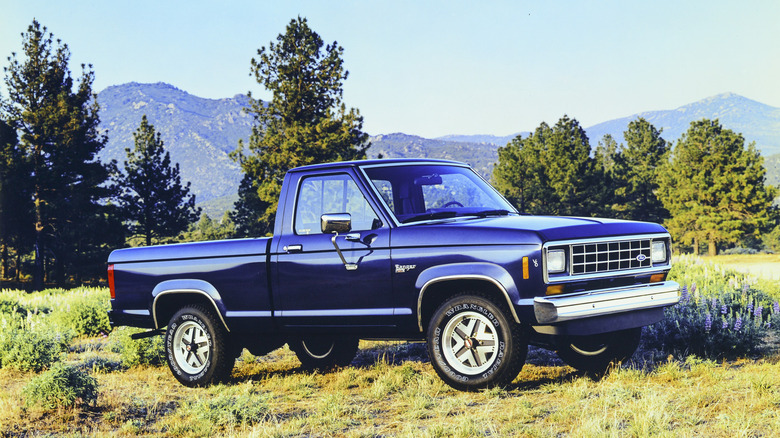
Again, this one might seem controversial because, well, just look at it. The Ford Ranger is positively diminutive in comparison to full-size offerings like the Chevrolet K-series or Ford F-150. Being diminutive was the point — this was all the truck most people would ever need, and that's why it's nearly perfect. In a world where everyone gets pickup trucks for luxury conveniences, people modify them to be as massive as humanly possible, and nearly every example comes with a hefty price tag, let's be honest, what typical job can't be done by this truck?
This was effectively the final era of utilitarian pickup trucks, built to do serious work and little else. The first-gen Ranger epitomizes this concept to the extreme; Ford originally billed it as a truck designed to carry large payloads efficiently. It came with a 2.0-liter four-cylinder that sips gas, an optional 1,600-lb carrying capacity, two different wheelbases, and that's basically it. You get three-abreast seating, and that's about it — base models didn't even have a cigarette lighter, and you might get air conditioning if you're lucky.
Imagine Ford today stating it wanted to build a pickup truck that didn't have a crew cab available, A/C was optional, where you could delete the radio for a rebate, and at best offered a 2.9-liter V6 with 170 lb/ft torque. There would be riots in the streets, and yet, these trucks remain extremely popular, because they are among the finest examples of small, affordable trucks ever built, and likely will ever be built again by a major company, despite the segment's potential.
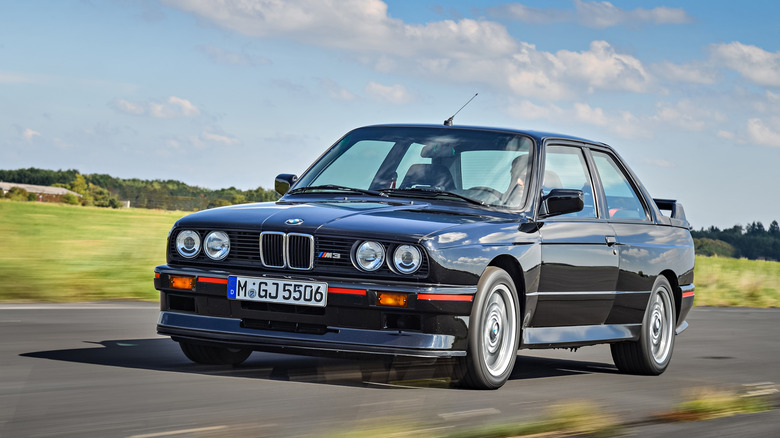
Sports car: BMW M3 (E30)
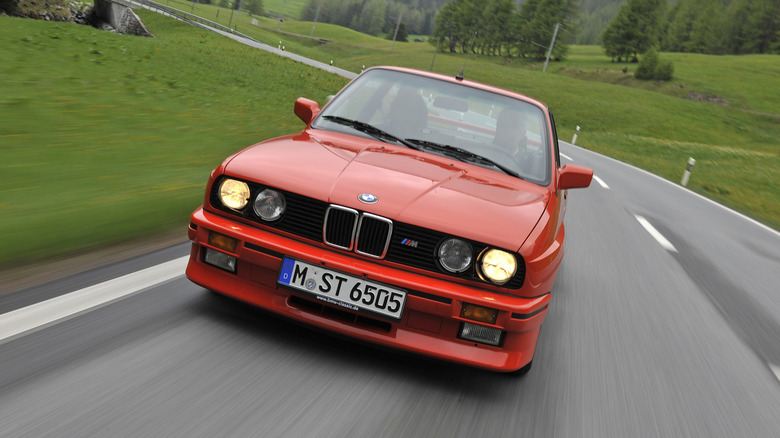
Yeah, this one is obvious. Let's be real, what other sports car eclipses the E30 M3 in terms of influence, driver-focused experience, and racing pedigree? Forget the 1980s, what about just in general? Granted, some people think the E30 M3 is overhyped, but for every naysayer, there's about ten people lining up with wallets in-hand for these things, and that's no accident. At the time of its introduction, the M3 was regarded as one of the best handling cars of all time, with tight and responsive steering, a planted profile, muscular looks, and light weight. Well, surprise, nothing has changed since then.
To be clear, there are cars more powerful than this, both at the time and today — enter the Widowmaker, for example. But the E30 M3 had that special sauce that made every drive a spirited one, and perhaps that's because of its sub-200 hp four-cylinder. Sure, it's not the big, fancy twin-turbo straight sixes we've come to expect of modern M3s. But there's something inherently enjoyable about running out 7,000 RPM and not even breaking laws to do it; this is a car you can comfortably and confidently drive on the limit, not a car where the limit is too high to be practical on the road.
Bluntly, good luck finding an E30 M3 for a reasonable price today. Just one look at any marketplace turns up frankly ridiculous figures for what is, let's be honest, a 1980s sports car. Overpriced? Absolutely. Overhyped? Perhaps. But it also set a mighty high bar for all subsequent sports cars to clear.
Supercar: Ferrari F40
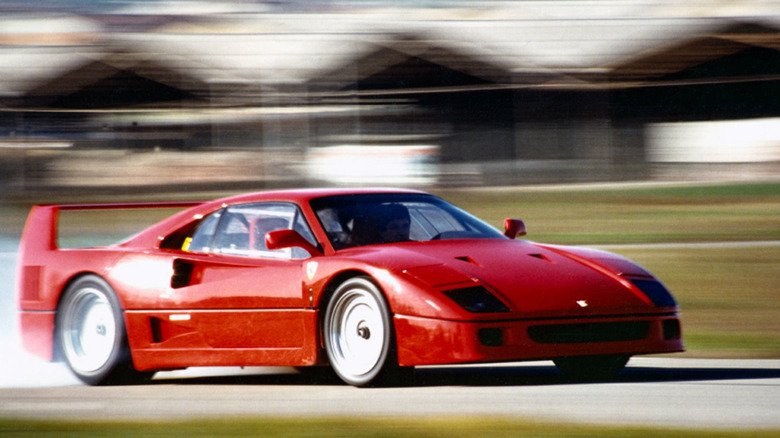
The Ferrari F40 is somewhat of an enigma when you think about it. How many other road cars boast a seven-figure entry price? Now, narrow down that list to road cars without power steering, a radio, or indeed any creature comforts whatsoever. It's unique in its singular purpose: the relentless pursuit of speed, at (almost) any cost, and that formed the F40 in just thirteen months from blueprint to the world's most extreme supercar of its day.
These were, by all accounts, thoroughly uncomfortable monstrosities and require tremendous respect to drive quickly, which has led to more than one high-profile accident over the years. The 471-horsepower twin-turbo V8 takes no prisoners, largely thanks to its absolute uncompromising spartan configuration. In short, the F40 was the 1980s equivalent of a Shelby Cobra S/C.
The main reason why this car is near-perfect is because of that savagery. It's not something that's been replicated many times, save for cars like the Porsche Carrera GT. Reviews at the time cited the F40 as one of the most visceral experiences a driver can achieve. What other car feels like a go-kart, has basically no sound insulation, and reaches 200 mph? There's something inherently terrifying about going that fast with absolutely nothing to save you, as opposed to modern cars that can do that speed but also boast all the assists in the world. Even seasoned racers get brown pants when they step on an F40's throttle — that's what makes it near-perfect.
Our methodology
The basic criteria for this list is as follows: The vehicle must have been introduced between 1980-1989, not a model produced from the 1970s and carried over into the 1980s; they are all production cars from major brands, and they are generally beloved by fans of the era and today.
Obviously, no vehicle is perfect. Even among this list, some are faster, better-equipped, or less expensive than others. Our selection instead revolved around which cars are near-perfect for what they set out to accomplish in terms of functionality. Moreover, each car must be influential and highly-regarded today, with fans and owners alike extolling them for their virtues while acknowledging their shortcomings.
Our sources are mainly historical, i.e. accounts written during the timeframe such as original brochures, newspaper and magazine editorials, and video reviews. We also took into account more modern retrospectives, looking at the cars from a more critical lens.