

Five Common Problems With The Toyota Tacoma
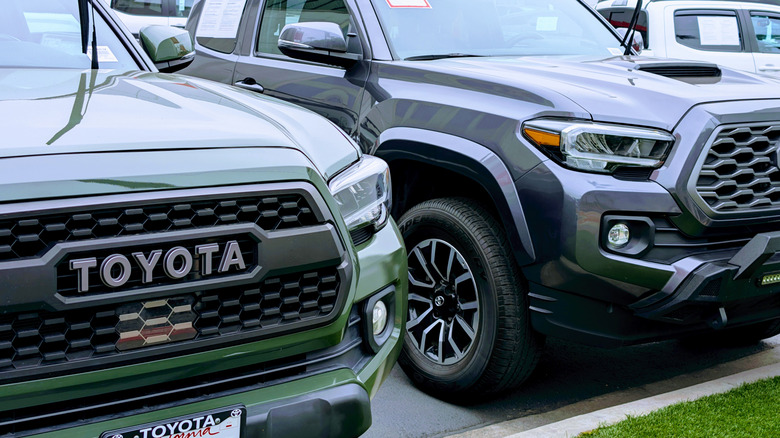
Toyota is not necessarily the first brand that pops to mind when you think about all of the pickup trucks that overpopulate American roads. In a truck market ruled by full-size giants like the F-150, Silverado, and Ram, Toyota has carved out its own lane in the midsize segment since 1995, when the Tacoma was born. According to Toyota, the name is "an homage to the indigenous heritage of North America."
The marketing move was deliberate — Toyota marketed the Tacoma as an all-American pickup truck, built for the people who live and work in it, and that gamble paid off in a big way. In 2025, Toyota sold 274,638 Tacomas — the best year in the nameplate's history, a 42.4% increase over the previous year. The Tacoma has been the top-selling midsize pickup in the U.S. for 21 consecutive years. Those are numbers that the Silverado and Ram would be proud of in their own segment.
Still, sales figures don't tell the whole story. The Tacoma went through four generations, some considerably better than others, and despite Toyota's reputation for reliability and dependability, the road for the Tacoma hasn't always been smooth. Even the best-selling midsize truck in America has its weak spots — and owners have found plenty of them over the years. Here are five common problems with the Toyota Tacoma.
Frame rot (1st and 2nd generation)
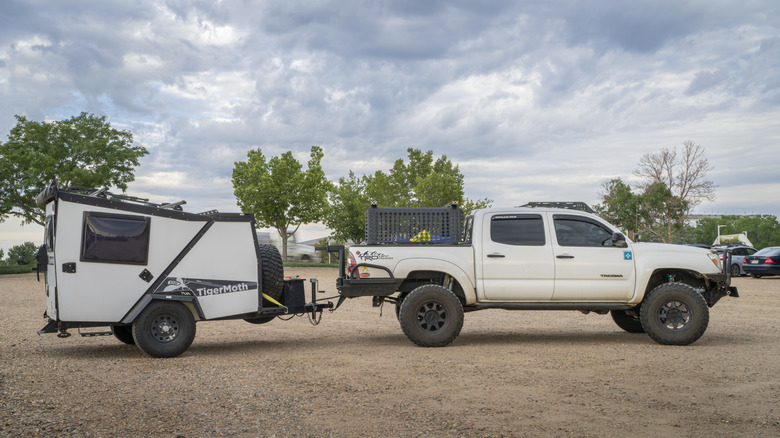
One of the most notorious problems in the Tacoma's early history wasn't mechanical, but structural. For decades, Toyota built its Tacomas with frames that had inadequate rust protection. The consequences ranged from cosmetic corrosion all the way to frames so compromised they were unsafe to drive, leading to Toyota instituting a complete frame replacement recall.
Understandably, some older Tacomas haven't had the replacement, and they are still experiencing these problems. The problem was so severe that it led to Toyota agreeing to a $3.4 billion court settlement in 2016 concerning all 2005 to 2010 Tacomas. However, the Toyota Tacoma years that experienced frame rot issues extend back to even the mid 1990s. Per the settlement, Toyota agreed to set aside $15,000 per vehicle for a replacement, meaning that even out of pocket repairs easily reached into five figures.
The consequences of not carrying out the repair ranged from the spare tire mount separating from the rear-cross member to losing control while driving. The brake lines could fail, and if the truck gets rear ended, the truck can easily be totalled. In some cases, corrosion could cause the fuel tank to drop to the ground. If this happens, the tank can be dragged over the floor and potentially even burst in flames.
Lower ball joint failure (1st Generation)
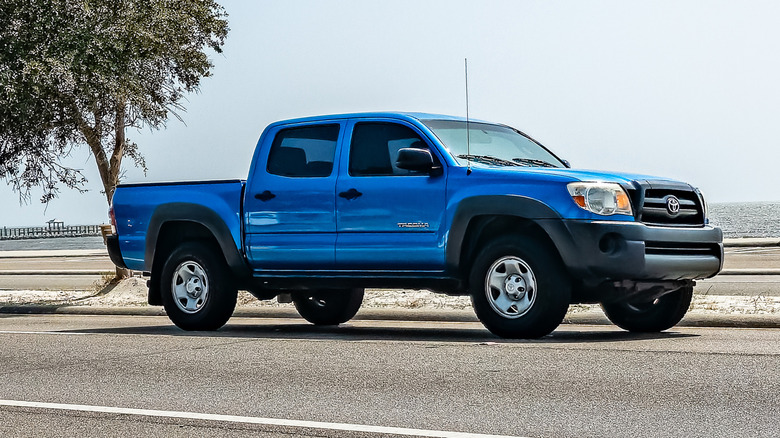
The first generation Tacoma had a serious safety defect hiding in its front suspension. Due to a problem during production and assembly, the lower ball joint surface could become scratched. Over a longer period of time, that scratch could accelerate wear and cause the joint to fail in spectacular fashion, leading a loss of steering control. In July 2005, Toyota issued NHTSA recall 05V225000 covering 768,379 vehicles, including 2001–2004 model year Tacomas.
Owner complaints filed with NHTSA paint a vivid picture of what that actually looked like in practice. In worst instances, the front wheels even detached from the vehicle entirely, some while driving at highway speeds. Dealers replaced the front suspension lower ball joints free of charge. In more lucky instances, the car experienced uneven tire wear, rubbing, tire swelling, or shaking.
And the ball joint defect wasn't limited to the Tacoma alone — the same recall covered the Tundra, Sequoia, and 4Runner of the same era. Problems like these are part of why certain used Toyota models from this period are worth avoiding altogether. Some owners filed NHTSA complaints reporting ball joint failure even after the recall repair had been carried out, with at least one owner explicitly stating the recall repair failed on their 2003 Tacoma.
Rear differential leak (3rd generation)
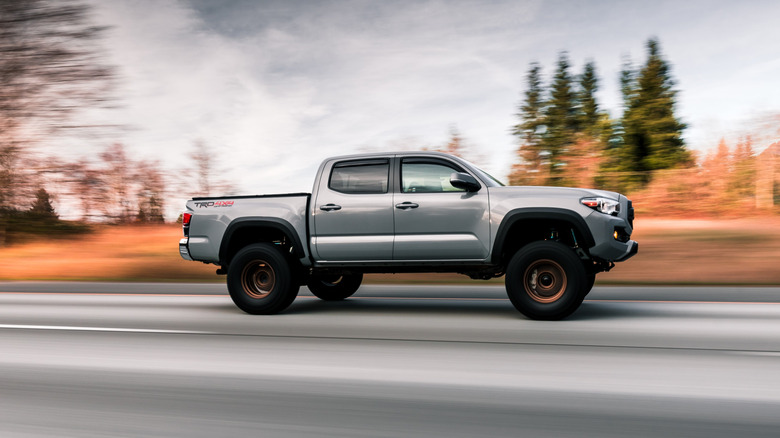
The third generation Tacoma launched in 2016 with a new platform that was still heavily based on the previous generation. It didn't take long for a serious drivetrain defect to surface. On April 27, 2017, Toyota filed a Defect Information Report with the NHTSA and issued a recall H0G (NHTSA 17V285), covering 227,732 2016–2017 Tacoma vehicles.
The problem was with the new BD20D rear differential carrier. In other words, due to a potential sealing surface contact variation, the nuts fastening the differential carrier to the axle housing could become loose. According to the official NHTSA recall document, "If the vehicle is continuously operated in this condition, the rear differential could become damaged, which can result in noise and reduced propulsion. In some cases the rear differential could seize, resulting in loss of control and increasing the risk of a crash." The fix was dependent on whether a leak was present.
If the diff was dry, the repair shop would make sure to tighten the nuts properly. If there was a leak, the gaskets and the nuts would all be replaced. If the problem was particularly bad and the entire differential assembly was damaged, Toyota replaced it free of charge. For those who haven't had the differential replaced, they were/are risking potential loss of control problems that could even lead to a crash. If problems such as these scare you and you are not sure whether to consider one, here are four alternatives to the Toyota Tacoma that fit a similar bill.
Automatic transmission issues (4th generation)
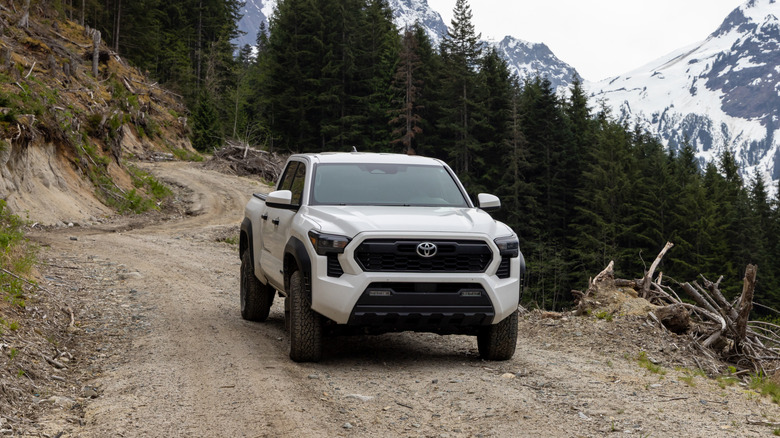
We already noted how the third-generation Tacoma was merely an evolution of the platform, not a revolution. Well, the fourth generation was the exact opposite — a new turbocharged engine, available hybrids, and a new platform shared with the Tundra and Sequoia. As is often the case with brand new platforms, it had serious problems that blindsided new owners.
Specifically, early fourth-generation Tacomas suffered from transmission failures even on very low mileage, sometimes under 1,000 miles. This, understandably, resulted in complaints. Several reports were officially filed with NHTSA. On September 9, 2024, Toyota issued the TSB T-SB-0076-24 technical service bulletin acknowledging the issue, but stopped short of issuing a full recall. The problems typically included owners complaining about the transmission jumping into neutral, being sluggish, or not wanting to shift out of a higher gear.
The problem apparently involves components in the transmission becoming stuck in an off position. There are no indications as to how widespread the problem truly is, and it seems like the only way to actually solve the problem is if the truck is experiencing P07407F, P079571, P08BA71, P271371, P280771, or P281671 trouble codes. When we looked at the worst Toyota recalls you need to know about, we noted that the automatic transmission problem could cause accidents, and that Toyota does not really treat it as a true recall.
Brake master cylinder failure (3rd Generation)
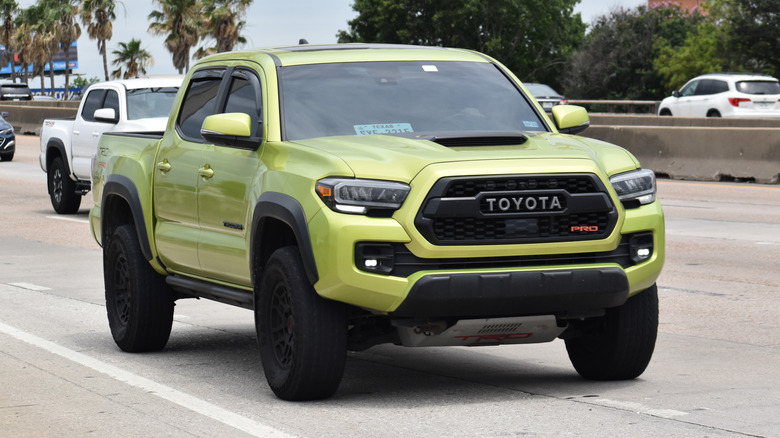
Brakes are non-negotiable — and on certain 2018–2019 Tacomas, Toyota got them wrong from the factory gates. On December 13, 2018, Toyota filed a defect report with the NHTSA, issuing recall 18V888000 covering 44,121 vehicles. According to the recall, improper machining at one supplier facility could leave a master cylinder seal without its correct chamfer, eventually causing an internal fluid leak that reduces front brake performance. Drivers encountering this issue apparently exeperienced the brake pedal going all the way down to the floor.
In the real world, this could lengthen the distance the truck needed to stop safely, which could lead to accidents. On CarComplaints, 311 complaints have been listed noting problems with the 2019 Tacoma brakes. The severity rating is listed at "Really Awful," and the site notes incidences of crashing and injury. It is a similar story with the 2018 Tacoma, where the same severity is listed with a total of 296 complaints.
One of the more worrying aspects is that the average mileage at which problems occurred were 6,866 miles for the 2018 Tacoma, and 3,336 miles for the 2019 Tacoma. To make the problem even more worrying, the 18V-888 Safety Recall Report noted that as many as 90% of vehicles are estimated to experience the defect. Overall, the Toyota Tacoma is able to last a long time when properly maintained, but only if problems such as these have been successfully dealt with.
Methodology
The Toyota Tacoma has over 100 recall entries in NHTSA's recall database across four generations, meaning that picking five issues here was not an easy thing to do. Because of that, we focused on issues with the greatest severity and scale. Additionally, every generation had to be represented at least once, so no single era of the Tacoma's history is overrepresented or ignored.
Each issue on this list carries a real-world documented risk of loss of control or crash. Affected vehicle counts range from 44,121 (brake master cylinder) to 768,379 (ball joint), reflecting how widespread they were. The transmission issue for the very latest Tacoma is the one exception without a full recall, but it was widespread enough for Toyota to acknowledge it via a formal technical service bulletin, so it was included.
Recall numbers, vehicle counts, and defect descriptions were verified against NHTSA's database, with complaint volume and mileage data from CarComplaints and CarProblemZoo, and additional context from MotorTrend, AutoEvolution, Autoweek, BBC, USA Today, Motor1, Toyota, and Consumer Reports.