

If You Grew Up In The '90s, You Definitely Remember These Cars
If you grew up in the '90s, you grew up in what now feels like a completely different world. Friday nights meant wandering the aisles of Blockbuster Video, Saturday mornings belonged to cartoons and cereal, and the family phone was permanently attached to the kitchen wall. It was a decade before streaming, smartphones, and video shorts took over everyday life.
Cars were part of that world too — and they had personalities all their own. Hybrids and EVs didn't exist yet. Apple CarPlay was still science fiction. "Ambient lighting" meant flipping on the dome light, and if your car had a CD changer in the trunk, you were basically living in 2020. Cars had cool pop-up headlights, tactile buttons, and multi-color aftermarket head units — some of our favorite car features of the 1990s we still sometimes yearn for.
What the era lacked in technology, though, it made up for in character. The cars of the '90s were loud, boxy, quirky, colorful, and unforgettable. Some of them filled every suburban driveway and high school parking lot in America. Others were dream machines plastered across bedroom walls and featured in racing games, movies, and music videos.
Whether you actually owned one or just rode in the backseat, these vehicles became part of the soundtrack of a car enthusiast growing up in the '90s. The sounds, the smells, the analog dashboards lit up at night — you remember it. Here are some of the cars that defined the decade.
Honda Civic
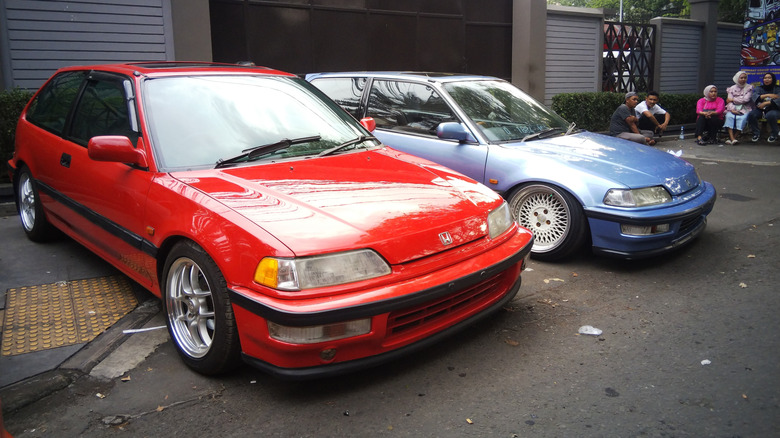
For a high school kid, seeing a 90s Honda Civic in a parking lot was as common as seeing the sun. It was cheap, reliable, economical, and even cool. It was a car loved by both moms and aspiring tuner enthusiasts. With more than 12.3 million units sold since its debut in 1973, the Civic was America's best-selling small car for a better part of five decades. The 90s Civic was also a first car for many drivers, and that is a connection that rarely ever fades.
The Honda Civic was also a blank canvas for the 90s generation. Those that love cars would lower them, put a loud "fart can" exhaust, stickers, and aftermarket wheels. The fourth generation of the Civic, which ran until 1991, was the first one that Mustang and Camaro buyers actually considered as an alternative, and that is what makes it the best Honda Civic generation to date. The 90s Civic was also incredibly flexible. It could serve as easily as a tuner's dream as it could an ideal first car, a show pony, or even a racer.
Equipment-wise, this generation also got body-colored bumpers, front disc brakes, a five-speed manual, and even a rear anti-roll bar. Passing on from the fourth generation of the Civic, the fifth generation which came in 1992 pushed that envelope even further. Bolt-in engine swaps and a double-wishbone suspension were wrapped in a more streamlined design. Overall, the 90s Civic was a car that represented the decade's enthusiasm for affordable cars the best, and that is why so many of us remember it.
Ford Explorer
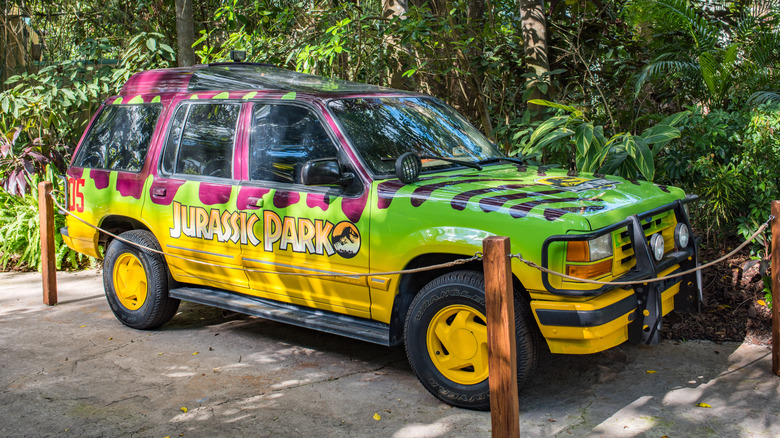
Nowadays, we see crossovers taking over every driveway in America. However, back in the 1990s, that's exactly what the Explorer was. According to The Driving Line, "there's almost no doubt you knew someone who owned a first generation Explorer. They were everywhere." The first generation of the Explorer came to be in 1991 and it replaced the Bronco II. In many ways, the first-gen Explorer is a big reason why SUVs became as popular as they are now.
By 2005, Ford managed to sell 5 million Explorers, a figure that was so strong that it pushed the rest of the car industry toward making more SUVs. This was also the time families were starting to move away from wagons, and Ford's timing with the Explorer was perfect. By the turn of the millennium, SUVs and crossovers squeezed station wagon sales dry, and that was the end of the family station wagon. This was the era the Explorer dominated.
A staple of countless drop-offs, soccer games, grocery runs, and family vacations, it became the American suburban symbol. When we looked at the best years for the Ford Explorer, we chose the first-gen Explorer as the best of all because it could do everything. Cars that define eras are rarely a coincidence. The Explorer was also the tour vehicle in Steven Spielberg's 1993 "Jurassic Park," cementing its place in one of the most iconic movies of the decade. The 90s Explorer was simply everything a family of the time wanted, and that is why you kept on seeing it.
Dodge Viper
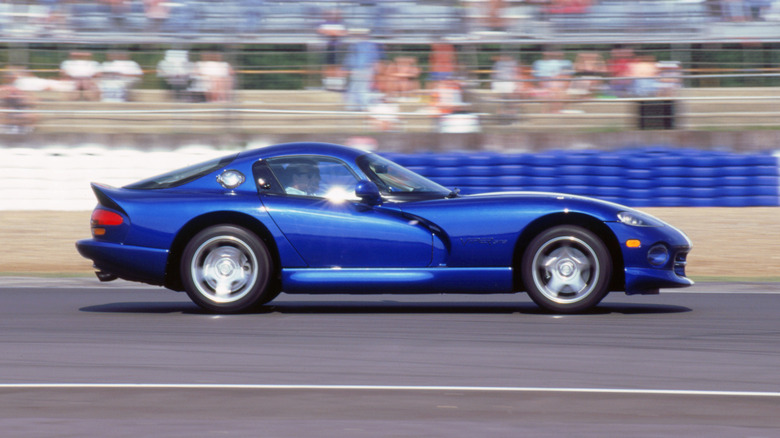
You simply can't talk about iconic 90s cars without mentioning at least one poster wall car, and in this category, the 90s Dodge Viper was unavoidable. As Jalopnik put it, "one of the defining models of late-millennial poster vehicles was the Dodge Viper GTS." The Viper launched with one of the biggest engines ever put in a car. An eight-liter V10 producing 400 horsepower and 465lb-ft of torque. No ABS, no traction control; the car was so focused it barely even had windows.
The Viper also had the type of notoriety that kept it relevant for other reasons. It was always a handful, and the consequences of getting it wrong were serious. As it only weighed 3,000 pounds and it was paired with a V10 without any safety aids meant the car could go at any time you press the gas. Its image was on countless bedroom walls, but it was also known for meeting walls at high speed. As Doug DeMuro concluded when he reviewed one, "it is amazing that this car ever got green lighted for production — nothing like this would ever be manufactured in today's world."
That's the Viper, a car so wild it was hard to believe they even built it. Completely nuts, completely '90s. Granted, the Viper may not be the car you kept on seeing as often as a Civic or an Explorer, but the difference is that when you saw it and if you were a car enthusiast, it stayed with you. And you also saw it on evening news when it got crashed and your dad told you the world had gone mad.
Dodge Grand Caravan
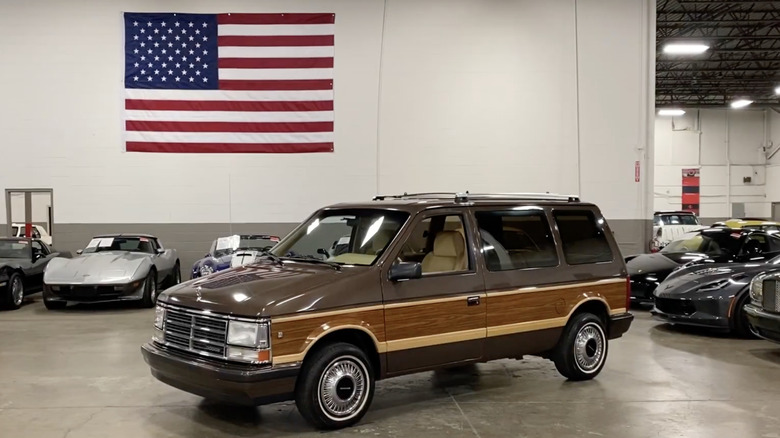
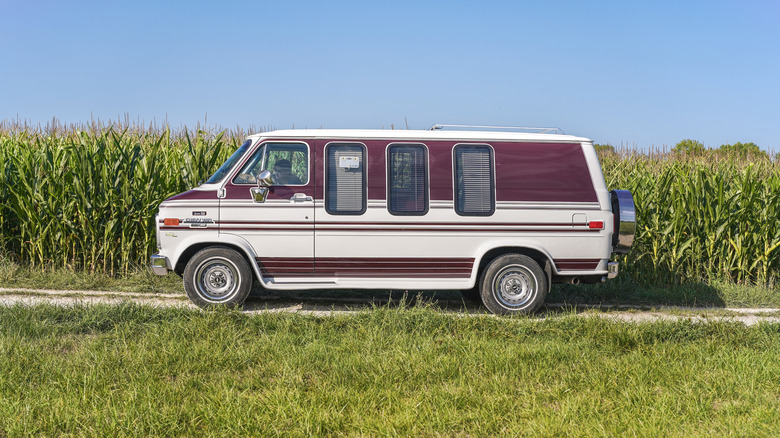
When we talk about soccer mom vans, the Grand Caravan might be the final boss. It wasn't a glamorous or exciting vehicle, but it was the one used by devoted parents to go everywhere, whether it was to work, school plays, sports practice, or on road trips to Disneyland. Even beyond the chores, the Grand Caravan was a cultural phenomenon. It was so successful and well regarded that it even won the 1996 MotorTrend Car of the Year Award. Compared to the Viper, hardly any aspiring auto enthusiast fantasized about owning a Grand Caravan, but they probably fantasized about owning that Viper while being driven around in the back of a Grand Caravan.
According to an AutoBlog article in 2020, "the kid-hauler has sold less than 100,000 units in a year in the U.S. only twice since 1985, topping six figures for the last four years." For countless '90s kids, memories of childhood happened inside one. Sliding doors, cloth seats, packed back rows, and the sound of siblings arguing during long road trips became part of the experience. The Grand Caravan may not have been a dream car, but few vehicles are more instantly tied to growing up in the '90s.
After SUVs like the Explorer tanked minivan sales in the late 1990s and 2000s, the Grand Caravan managed to dodge the executioner's axe for a while, but the numbers kept falling. Dodge eventually discontinued it in 2020, ending a 37-year production run filled with memories. The kids who spent their childhoods arguing with their siblings in the back row are now old enough to have kids of their own — and the Grand Caravan is set to rest.
Chevrolet Camaro
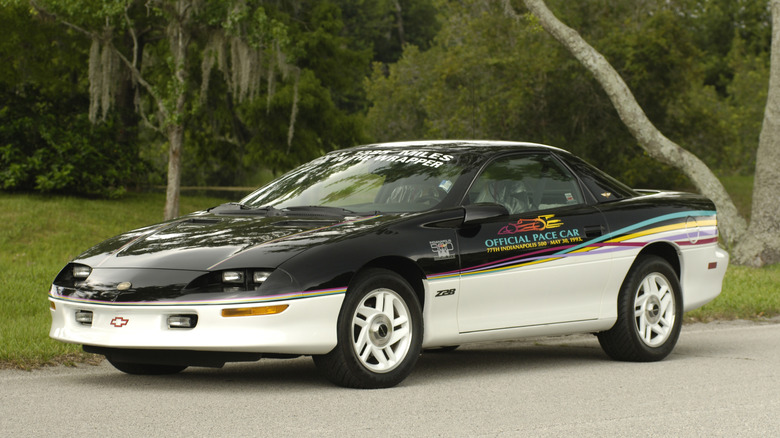
The fourth-generation Chevrolet "Catfish" Camaro arrived in 1993 with a look that was low, wide, and unmistakably aggressive. Right around the time the Catfish Camaro came to be, the iconic 1997 LS1 engine arrived, along with 275 horses under the hood. Further trims gave the V8 Camaro a power output of up to 330 horsepower. Best part, it was a relatively affordable car, and it made engine noises that turned uninterested 90s teenagers into car guys that spend their days reading Car & Driver articles as a pastime.
The Catfish was also known for doing absolutely nothing in a strip mall parking lot on a Friday night. That was the Camaro's natural habitat. If you grew up in the '90s, you knew exactly whose Camaro that was; everybody did. Except in California where the Catfish was used by the highway patrol, easily making it one of the coolest police cars in America. Sadly, by 2002, declining sales forced Chevrolet to pull it from production — a move that felt like the end of an era for anyone who grew up watching them idle at red lights.
In total, the estimated number of Catfish Camaros sold was around 612,000. The Catfish also came with an optional T-top roof — two removable glass panels that let you hear that V8 a little better and feel like the coolest person in the parking lot. For a car enthusiast growing up in the 1990s, stuff like that mattered.