

Mazda Vs. Toyota Depreciation: 10 Popular Models Compared
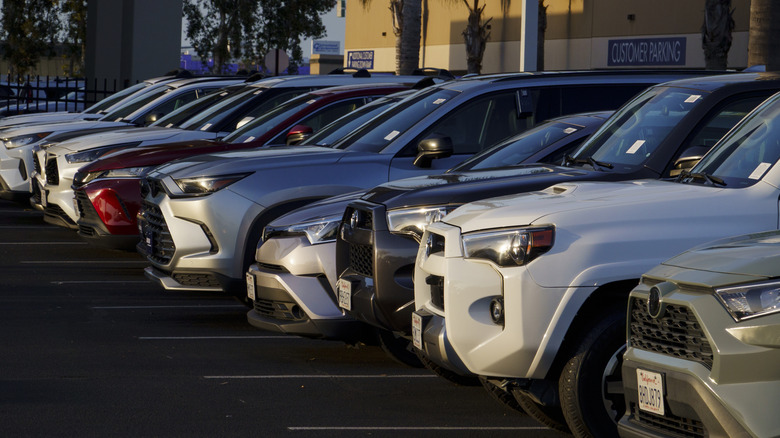
Comparing Toyota against Mazda makes for an interesting case study, no matter which angle you take. Both are well-established Japanese automakers with loyal customer followings, and despite Toyota being the larger car maker by far, both companies have several models that compete directly against each other.
Further complicating the comparison between these two auto companies is the fact that Toyota and Mazda share a close corporate relationship. Toyota does not own Mazda entirely, but the two companies have increasingly worked together on products, including sharing hybrid technology and even building joint factories to construct their vehicles.
It's likely no surprise, then, that Mazda's offerings are generally every bit as well-regarded as Toyotas — and compare favorably in terms of depreciation, too. While Toyota has always been known as a winner when it comes to retaining value, in many cases, a comparable Mazda actually isn't far behind. Below, we've compared the resale values of 10 models across five vehicle segments, ranging from three-row SUVs to sports cars.
Mazda CX-5 vs. Toyota RAV4
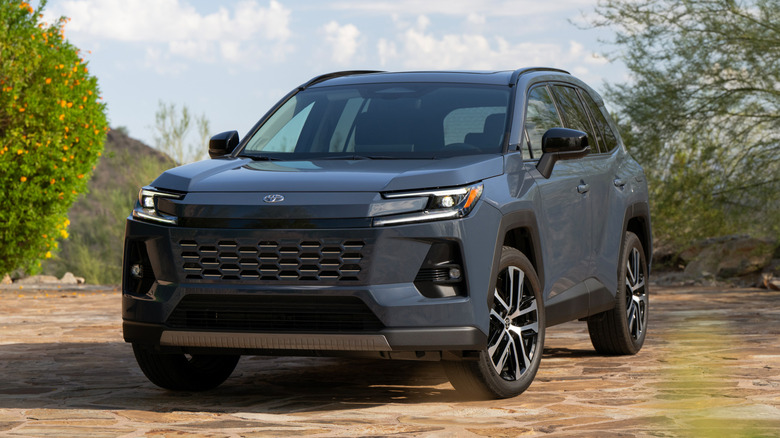
Compact crossover SUVs are a key part of the American car market, and the Toyota RAV4 is well established as a sales champion in this market segment. Mazda's CX-5 crossover is not to be overlooked, though, and has long been recognized for its stylish exterior and fun-to-drive personality. Does the CX-5's driving appeal carry over to its resale value, though?
Using the common five-year depreciation rate as a yardstick, CarEdge has the Mazda CX-5 depreciating 39% from its original price. This is a decent number, but in this category, the CX-5 is beaten pretty soundly by the RAV4, which comes in with a five-year depreciation number of just 28%. Elsewhere, iSeeCars backs this up with similar numbers — 25% for the RAV4 and 37.9% for the CX-5.
The RAV4's significant edge here might not have anything to do with being the "better" SUV, though. Since 2016, Toyota has made a hybrid powertrain available that delivers both better power and better fuel economy than the gas version, while Mazda has stuck with a conventional gas engine for the CX-%. This could be changing soon, as Mazda is planning to bring a hybrid version of the new CX-5 to the market for the 2027 model year. It will be tough to catch up to the RAV4, though, which moved to a standard hybrid powertrain with its 2026 redesign.
Mazda3 vs. Toyota Corolla
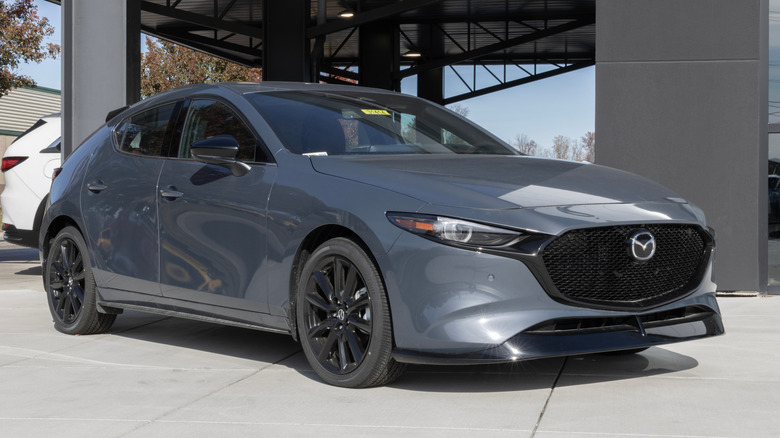
Despite the high volume of SUVs and crossovers sold these days, sedans and compact cars still have a sizable market in America. Mazda discontinued its mid-sized Mazda6 sedan, which was a rival to the Toyota Camry, back in 2022, but it still offers the Mazda3 as its entry-level model. The Mazda3's Toyota equivalent is the Corolla, and both cars are offered in both four-door sedan and five-door hatchback body styles.
The Toyota Corolla already starts with an affordable price tag and, per CarEdge, is expected to depreciate by just 33% after five years of ownership, making it a highly sensible new car choice. The Mazda3 sedan isn't far behind, though, with an average depreciation of 38% after five years. Similarly, Edmunds gives a five-year-old Corolla a slight edge over the Mazda3.
Despite their similarities in resale value, there are some big differences that separate the Corolla from the Mazda3. Most crucially, Toyota offers the Corolla with both traditional gasoline and hybrid powertrains, and positions it as a more utilitarian, mainstream compact car option. Meanwhile, as we found during our recent time driving the 2026 Mazda3, Mazda's compact offering continues to stand out in the segment thanks to its upscale interior trimmings and its available 2.5-liter turbocharged engine. Of course, there's also the fire-breathing Toyota GR Corolla hot hatch, but that car doesn't share a whole lot either mechanically or price-wise with the humble compact it's based on.
Mazda CX-30 vs. Toyota Corolla Cross
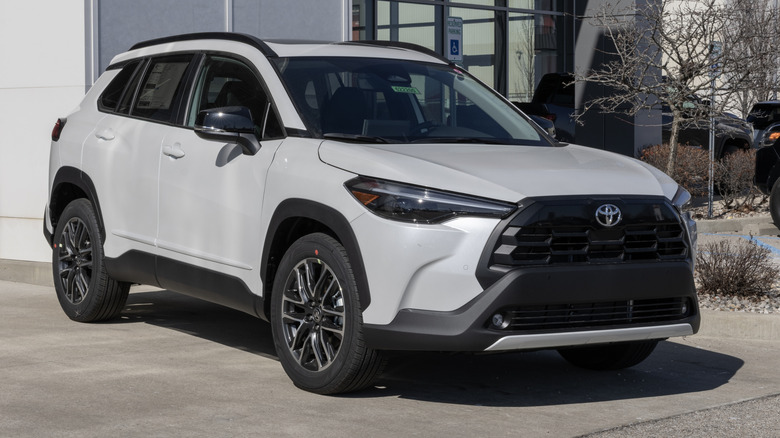
If you like the compact size and affordable price tags of the Mazda3 and Toyota Corolla but want an SUV-like profile, don't worry; both companies have you covered. Mazda offers its CX-30 subcompact SUV, which, for all intents and purposes, is a higher-riding Mazda3 hatchback with standard all-wheel drive and some additional body cladding. Toyota, meanwhile, offers the Corolla Cross SUV, which, despite its Corolla name, actually looks more like a scaled-down version of the RAV4 than a lifted Corolla.
We think the Toyota Corolla Cross is one of the best budget new car picks out there right now — and the value proposition extends to its resale value as well. CarEdge shows the Corolla Cross as having an impressive average depreciation of just 30% after five years, while the Mazda CX-30 lags behind the Toyota with a 36% figure. The five-year resale numbers from iSeeCars tell a similar story, with the Corolla Cross having a slightly bigger advantage at 26.7% to the CX-30's 35.6%.
Each of these SUVs takes a different approach to the segment, with the Corolla Cross offering an available hybrid model that delivers excellent fuel economy numbers for a small SUV. The Mazda CX-30, on the other hand, doesn't offer a hybrid powertrain but has a turbocharged 2.5-liter engine in the CX-30 Turbo, alongside the naturally aspirated 2.5-liter in other versions. This helps make it one of the most athletic small SUVs available.
Mazda CX-90 vs. Toyota Grand Highlander
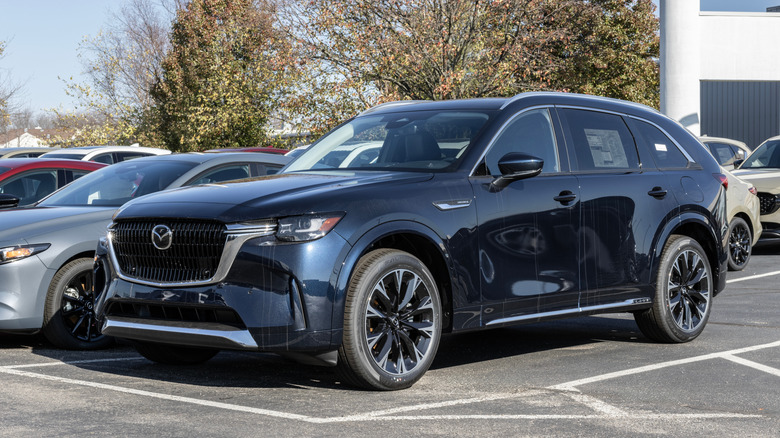
The Mazda CX-90 is a large, three-row SUV that represents Mazda's push into a more upscale market position. The flagship SUV delivers on this, too, with our review of the CX-90 appreciating the combination of luxury-grade refinement and Mazda's typical engaging driving dynamics. As for a Toyota competitor, the company's three-row Grand Highlander is probably the model most likely to be cross-shopped against the three-row CX-90.
When it comes to resale value, at least, this one is a blowout win for Toyota. As with so many other Toyota models, the Grand Highlander holds its value very well, with CarEdge projecting a depreciation of just 30% from new after five years. In contrast, the Mazda CX-90 shows a fairly substantial expected five-year depreciation of 53%. ISeeCars is more friendly to the Mazda, but it still loses out with a 43.1% figure compared to the Grand Highlander's 30.4%.
Elsewhere, the differences between these two SUV models are also quite stark. For starters, the Grand Highlander is based on front-drive architecture with a base four-cylinder turbo powertrain, while the CX-90 uses a longitudinal engine, rear-drive-based platform with a standard turbocharged inline-six engine. Both automakers offer hybrid powertrains, although the hybrid CX-90 is a PHEV, whereas the Grand Highlander Hybrid has a more conventional setup. Overall, there are lots of reasons buyers might choose the sporty CX-90 over the Grand Highlander, but resale value isn't likely to be one of them.
Mazda MX-5 Miata vs. Toyota GR86
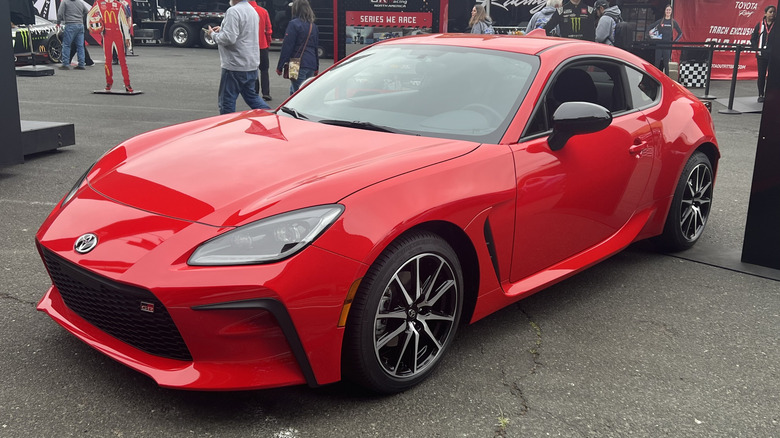
While Mazda's current lineup might be dominated by crossover SUVs, the brand hasn't forgotten about its sports car roots, which are alive and well in the form of the perennially enjoyable Mazda MX-5 Miata. The current generation of the MX-5 delivers fun that's hard to beat at any price. Toyota, however, occupies a similar place in the market with its GR86 coupe. The MX-5 is an open-top two-seater, while the GR86 is a coupe with a small rear seat, but both cars are modern enthusiast favorites that emphasize driving fun over hard performance numbers.
It's not surprising, then, that both sports cars do well when it comes to resale value. Per CarEdge, the ND generation Mazda MX-5 depreciates just 20.7% after five years, while the GR86 comes in right behind with a five-year depreciation rate of 23%. ISeeCars, on the other hand, gives the GR86 the win over the MX-5, though both models again enjoy great depreciation numbers.
Both of these sports cars are small-volume, niche choices, but as their resale values show, demand for used examples of both remains high. It will certainly be interesting to see what happens to both of these models in the future if the speculation that Mazda and Toyota are teaming up for a shared, next-gen sports car platform turns out to be true.
Methodology
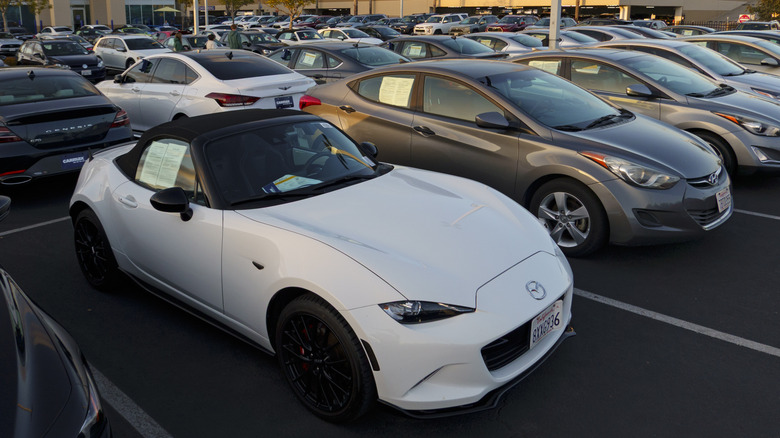
When compiling this list, we first identified Mazda and Toyota models that compete in similar segments at similar price points. We then used forecasted and historical five-year depreciation rates from reputable outlets such as CarEdge, iSeeCars, and Edmunds to compare the resale value of the competing vehicles. Note that individual real-world depreciation figures will, of course, vary based on car condition, mileage, options, and regional market conditions.