

These Common US Driving Habits Could Get You A Ticket In Europe
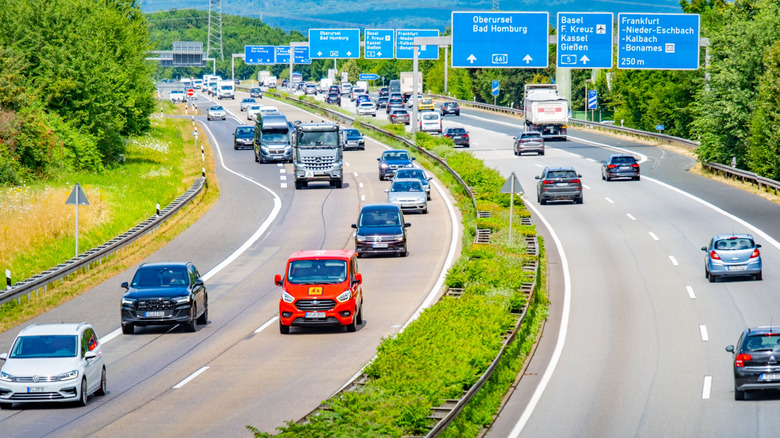
If you live in the United States and travel to Europe, it's often a shock at first just how unfamiliar the road networks might be. Everything is different, from the makes and models of cars to the layout itself, with the roads often built on the same basic geometry as what governed foot traffic for hundreds of years. Signage is different, the markings on the pavement are strange, and, as we'll be discussing in this article certain laws are different, often unintuitively so. And yes, this is going beyond the obvious, like driving on the left in the United Kingdom.
Obviously, the United States has its share of bizarre driving laws. To make it even more confusing, these laws vary from state to state. Similarly, many of the laws we'll address don't cross borders, are enforced in some countries are far more strictly than in others.
Moreover, what we'll be discussing are hard laws across the entire United States, even ones that are de facto hardly enforced. For example, you'll find no state that allows rolling stops, yet you'll find a lot of regions in which people frequently do that. It's pretty much an agreed-upon reality that you can drive 10 mph over the speed limit on notorious roads like the Garden State Parkway, but you'll never find that codified into law. Similarly, you go over to Europe and there's a lot of driving habits that are routinely done which are actually illegal.
Here's where it gets interesting, though: Some of those illegal laws are actually legal in the U.S., which means going over to Europe and driving the same way as you would in America could land you a ticket. Let's discuss a few major ones.
No turning right (or left in the United Kingdom) at a red light

Turning right on a red traffic light is nearly universally accepted across the United States, except if you live in certain parts of the country like New York City or Washington, D.C. where it's illegal (and basically impossible) to do so. Outside of those municipalities, however, the general agreement is that, without a "No Turn on Red" sign or red right-hand arrow, you can turn right on a red traffic light. Some regions even allow left turns on red, provided the driver comes to a complete stop and you're turning into a one-way road. You can throw all that out in Europe, though.
This is one case where it's universal across all of Europe: You cannot turn right on red, period, unless there's a sign or other indication, like a green arrow, that indicates you can proceed. There's no official documentation as to why this rule exists from a philosophical standpoint, so we'll use some common sense instead: European roads are more pedestrian, bicycle-centric, and mass-transit equipped in general versus American roads. The United States prioritized building car-centric cities on grid patterns with wider roads to accommodate larger vehicles. Cars take precedence in the U.S. versus pedestrians in European cities, so it's likely more a matter of safety than anything. Likewise, walkable cities like New York City also have these laws in place for similar reasons.
You need safety equipment on-board, assuming your car is legally roadworthy
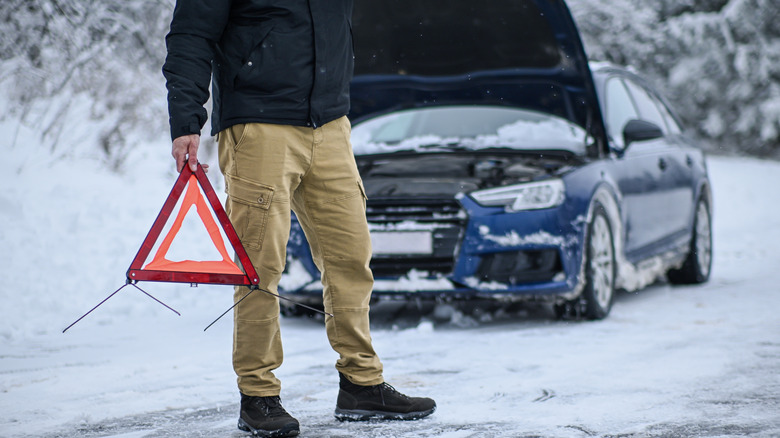
Imagine you got into an accident on a curvy or low-visibility road, of which there are many in Europe. Someone comes around the bend, sees the stricken car, but can't avoid it — such occurrences were likely on the minds of many European lawmakers when they enacted rules governing what types of safety and emergency equipment you absolutely must carry on-board with you. Like most other laws here, these include different items for different countries; for instance, in Norway, Poland, Greece, Sweden, and Hungary, you must also carry a fire extinguisher. But it's nearly universal that you must at least have a regulation warning triangle, high-visibility vest, and first-aid kit. So get in the habit of carrying these items, otherwise be prepared for fines.
Because these reflective triangles were mandated by the United Nations, it's a universally-recognized symbol for a stricken vehicle or other road hazard. The specific law, if you're curious, is ECE R27, which provides a frankly staggering 42 pages' worth of reading about this specific item. But to sum it up, you buy one of these hazard triangles and keep it in your car, and when it breaks down, put it in a place that's visible to other drivers so they know you're there and your car is stationary.
This also comes in addition to other regulations regarding the safety of the vehicle itself; Europe has different laws regarding what constitutes a "roadworthy" car as opposed to the United States. Such regulations are why, for instance, the Tesla Cybertruck isn't permitted in certain countries; its sharp edges can't satisfy the European safety requirements.
You can't use GPS apps to detect speed cameras
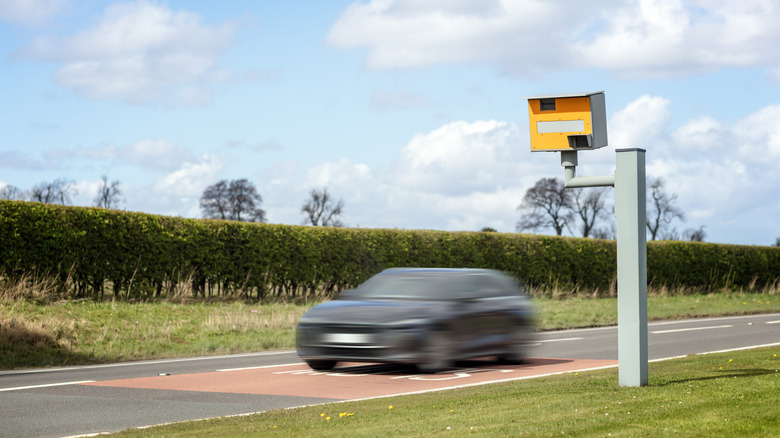
We in the United States enjoy relatively lax laws as far as speed cameras are concerned; not every state allows speed cameras, and of the regions that do, not all of them can issue tickets or gather any sort of data. That said, the data we do have shows that speed cameras help stop speeders, thanks to the liberal implementation of such devices at crucial junctions such as intersections and arterial roads that are prone to speeding. There's an easy way to locate them in the U.S., however: your GPS. It's fairly common on apps and in-car navigation displays — you get a warning of an upcoming speed camera, particularly useful when they're mobile. However, that won't fly in Europe.
Laws differ from country to country regarding the use of these services, but in general, major names like TomTom have different availability restrictions depending on the region. For example, Germany outlawed the service entirely, meaning any speed camera warning must be disabled (though the device itself isn't illegal). France, meanwhile, allows services to use "Danger Zone" warnings, which are more generalized to potential hazards like a stricken car or, in this case, speed cameras.
The speed cameras Europe uses, like the ones in the U.S., use radar technology, LIDAR sensors, lasers, and other equipment depending on the camera model to monitor speed. This opens the door for tattlers and radar detectors, which are considered a legal gray area and subject to different laws varying by country.
Right-of-way laws at intersections and roundabouts are different

Rewind to Driver's Ed: What is the golden rule of a four-way intersection in the United States? You wait your turn and the priority favors the right side, putting the "right" in the right of way. That rule is slightly different in Europe, though, at least in most of Europe where stop signs are less common – priority is instead given to main roads first.
Let's illustrate this better using a theoretical situation. Imagine you have three cars, one of which you're driving. You're going on a main road with no posted stop sign — such occurrences are relatively rare in America, but not so in Europe. Instead, all you see is a yellow square. You approach this mystery unmarked intersection and car number 2 approaches from your right. Meanwhile, car 3 is coming the opposite way, intending to turn left (so pulling in front of you). What do you do?
The answer is that you have the right of way, followed by the driver turning left, followed by the person on the side road. Basically, if you're going straight on an unmarked intersection, you have the right of way — the side road must yield. And if you're the driver on that side road, then priority goes to the right. In this case, you have to wait until the left-hand turn person completes the turn. An easy way of going about this is, if you see traffic and you're on a side road, pretend like there's a stop sign there. Moreover, pedestrians always have the right of way; Europe is more pedestrian-centric, after all.
For a visual breakdown of the regulations, this Swedish driving school provides detailed diagrams and different scenarios.
Blood-alcohol levels are more restrictive, if not banned entirely
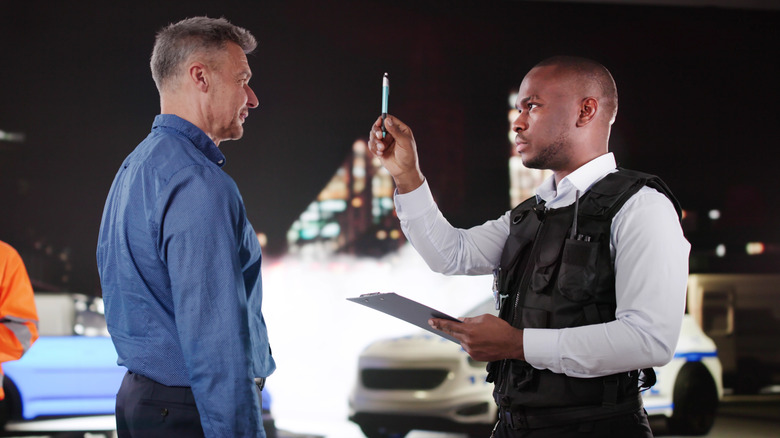
While it's somewhat of a trope that Europeans drink more than Americans do, that certainly does not apply to the roads; Europe is, across the board, far stricter about what constitutes drunk driving. In some U.S. states and districts, such as Florida, Indiana, and Wisconsin, the legal blood alcohol content limit is as high as 0.2% or greater. Of course, it varies state to state, with places like New Jersey being half that amount.
Even so, Europe still puts all that to shame, with a standardized legal limit of 0.05% blood alcohol content, assuming you're not a commercial driver (they face even stricter regulations). And that's just the baseline; places like the Czech Republic, Romania, and Slovakia banned drunk driving entirely, with any blood alcohol level above a perfect 0% being grounds for punishment. In fact, the only place in Europe with higher legal limits is the United Kingdom. Excluding Scotland, which defines drunk driving as 0.5g/l, the U.K. has a legal limit for passenger and commercial traffic set at 0.08%.
According to the NHTSA, 11,904 people died in drunk driving accidents in 2024, constituting approximately 29% of all road fatalities per year. This is in stark contrast to countries like Germany, Austria, and Belgium, which often have a fraction of road fatality percentage being related to alcohol. For example, Hungary, a country with a legal limit of 0%, witnessed just 8.2% road fatalities being related to alcohol in 2010, according to a survey conducted by the International Transport Forum.
Moral of the story: Don't drink and drive – yes, even if it's a lawn mower. And in Europe, cut your limit in half, if not altogether.