

Do Traffic Cameras Actually Help Stop Speeders? Here's What The Data Says

We've all seen them, and some of us loathe them. Whether it's those massive structures hanging over the top of highways or innocuous units perched at intersections and traffic lights, speed cameras are a reality of today's roads. But does their presence really ensure safety and speed compliance, or are they just a public nuisance? Of course, there are naysayers in every corner of the Internet saying that such devices aren't helpful at all, or even detrimental to public safety, amid questions about our increasing levels of autonomy and surveillance. It's a hot-button topic, to be certain. But, not surprisingly, their presence is actually making the world safer.
All controversies aside, let's look at the hard facts behind these devices. What is it that speed cameras are designed to do, and do they actually fulfill that purpose? According to official sources and studies, that answer is a resounding yes. Funnily enough, it's no joke getting a speeding ticket in the mail, and the cost of going a few miles per hour slower often outweighs the cost of getting fined. And along with that lowered speeding statistic comes a number of secondary benefits, such as improved safety and less road noise.
You'll find these cameras everywhere, but typically they'll be positioned above arterial intersections or along major highways where they can effect the most benefit for the least monetary cost to operate. Because these systems — for example, highways versus city roads — are very different, they'll have different statistical samples to back their numbers. Let's look at each group and discuss what the cameras' effects are.
Traffic cameras in cities
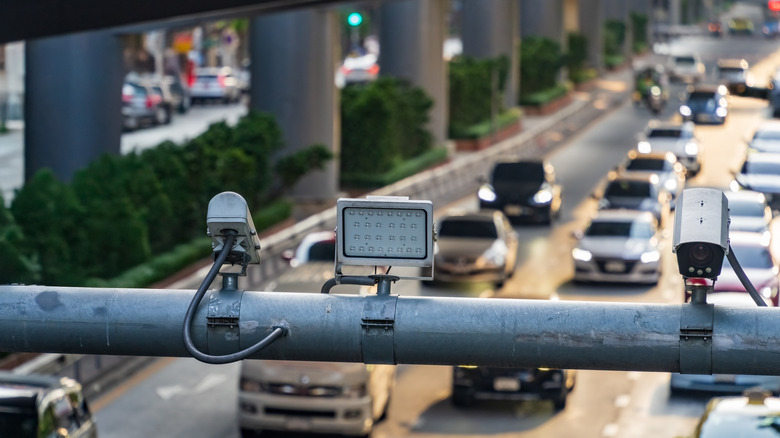
For this example, let's take a look at the most densely populated metropolitan area (and one that's utterly infamous for its taxi drivers), New York City, where even buses can now issue speeding tickets. A comprehensive study conducted by the City of New York following the pandemic revealed a total of around 2,200 traffic cameras in operation around the Five Boroughs, placed in strategic locations such as school zones and major intersections. These cameras were labeled with "Photo Enforced" signs, holding drivers accountable to the speed limit (and other traffic violations such as running red lights).
According to the study, within just a few years, these cameras have reduced speeding violations by 94%, and that's with a fine of just $50, regardless of the vehicle's speed. A $50 violation, in this case, is extremely cheap in comparison to a police-issued court summons, which typically ranges deep into the several hundred dollars (with the added inconvenience of going to court). Moreover, they don't add points on your driver's license — yet people still implicitly obey them, for the most part.
Because of the frenetic nature of New York City's traffic system — especially in Manhattan — cameras that make a 94% dent are a huge boon to public safety. As of March 2026, 349 cities and municipalities across the United States have adopted cameras like these, which both streamline the ticketing system for police and the offender. Speed cameras are also spreading to other major urban centers, with Los Angeles adopting them en masse in late 2025.
Speed cameras on highways
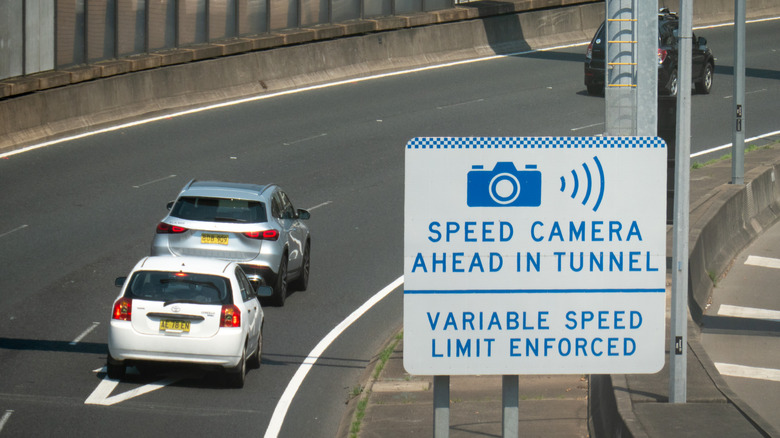
The other major demographic targeted by speed cameras is highway speeders. Cameras are typically located at key places like tolls, construction zones, and arterial junctions; within these zones, the Department of Transportation (DOT) reported substantial drops in accidents and fatal injuries, including a 54% reduction in crashes and a 48% drop in crash-related injuries. A long-term study conducted by the Insurance Institute for Highway Safety found that, within several Virginia counties, an estimated 76% of drivers reduced their speed as a result of seeing the cameras.
These cameras operate in several different ways. There are point-to-point units that rely on a vehicle crossing one beam, then another, and measuring how fast it covers the distance to determine speed. Then there are several types of fixed-point cameras, ranging from ones on the big lattices above highways to cameras in trailers or behind buildings. The mixture of overt and covert placement helps keep drivers in check, according to the DOT. The systems of cameras result in a spillover of reduced speeds across a wide range — in other words, people aren't keen on speeding up immediately after running under these cameras, resulting in a net positive across a wide range.
28 of 51 U.S. jurisdictions have implemented such cameras, though controversy continues to arise regarding their placement and usage, which has stymied their more widespread adoption. Typical arguments center on these cameras' methods of data acquisition, citing privacy violations and false ticketing. Some states use cameras to monitor speeds without the capacity to issue tickets, instead using the data to study key areas for chronic speeding. Others simply monitor traffic with motion sensors, like traffic cameras — though not every light has one.