

Honda's Next-Gen Sedan Design Looks Shockingly Different
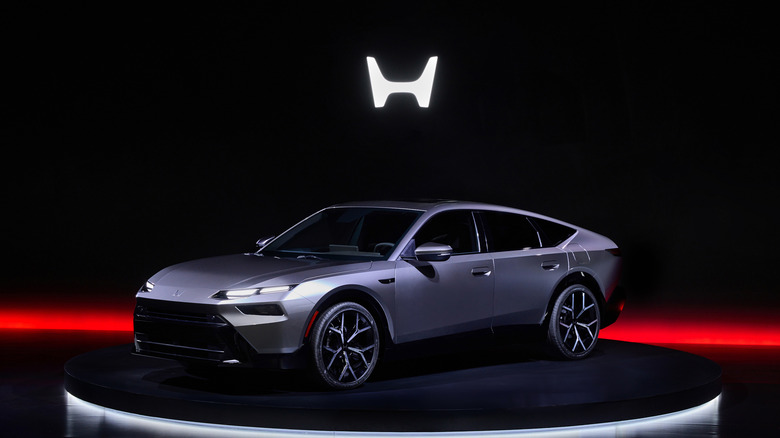
It's safe to say Honda isn't doing well lately. In fact, the Japanese megacorporation's automotive division has suffered such a heavy setback that the company reported a staggering $414 billion loss for fiscal year 2025, with financial experts debating as to whether this could open the door for a potential merge with Nissan. Sure, it's not as big a scandal as what happened with Nissan in 2019. But this still leaves Honda's U.S.-market EV plans by the wayside, and the American segment with vanishingly little hope for any expansion into alternative fuels beyond what we have. Money talks, and that's as true for these companies as anyone else. But we may have a phoenix rising from the ashes soon, in the form of a brand-new concept car.
According to a press release by Honda, a new sedan prototype marks the beginning of what Honda hopes to be one of fifteen — yes, fifteen, new alternative-fuel models primarily for the North American market. It debuted alongside the Acura Hybrid SUV Prototype, representing the crossover and family SUV market segments. In the words of Toshihiro Mibe, global CEO of Honda, "We have made steady progress in the development of hybrid vehicle technologies, where Honda has strengths, based on our belief that hybrid models will continue to be the key to addressing environmental challenges."
These concepts prove that Honda's hands are far from idle despite recent setbacks. Moreover, the keyword in the name here is "Sedan." If Honda truly commits to this, that means the Sedan Prototype may represent a glimpse into the hybridization of beloved models like the Accord, the fastback-type Civic, or the continuing development of the Prelude.
What we know so far
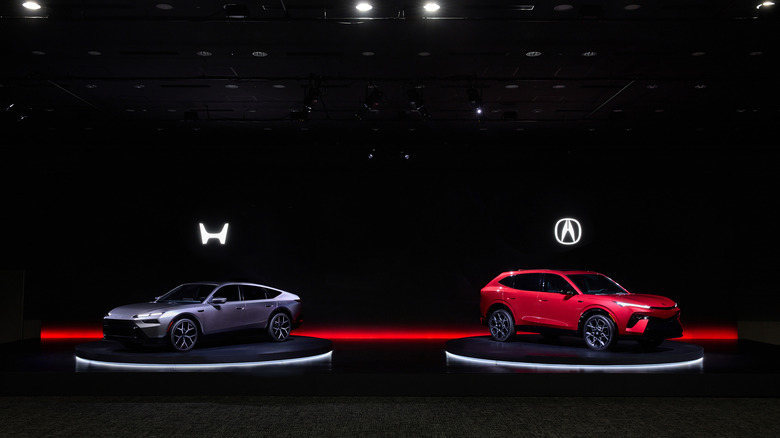
Honda debuted the Sedan Prototype as part of its latest update conference in Japan, alongside the press release that reveals plans for 2027. The highlight here is a total revitalization and integration of the company's adolescent EV and hybrid brackets as part of a goal to improve fuel economy by 10% while reducing hybrid system costs by 30%. Moreover, its new business model will focus primarily on North American markets, with Honda stating a desire to expand into "large-size hybrid models, in the D-segment or above."
To this end, Honda is using the Sedan Prototype as a test bed and showcase for what we could expect from the company in the near-future, with Honda placing special emphasis on its efficiency, driver-centric experience, and advanced technologies. The size of it seems comparable to something like the fastback-type Toyota Crown Crossover, featuring a similarly tapered body shape, large rims on low-profile tires, and a windshield rake evocative of the Civic or Integra. Honda is tight-lipped concerning any details related to the powertrain, sadly.
This model likely represents something built primarily with the United States in-mind, as Honda's press release stated a desire to expand into the kei-car category in the automaker's native Japan, which has no American equivalent — unless you import a JDM example, anyway. Moreover, Honda stated a desire to retrofit all of its plants in North America with the capability to produce hybrid models, anticipating an accelerated demand for fuel-efficient vehicles that don't compromise on size.
Our predictions for Honda's new direction
The North American market is notorious for prioritizing size, with the Ford F-series famously being America's top-selling vehicle for almost 50 years now. That said, it's a stereotype for a reason — older drivers love F-150s, but the newer generations, not so much. New drivers are prioritizing fuel efficiency, budget-conscious buys, and practical urban vehicles over large trucks, and that's likely the segment being targeted by Honda here.
Going back to the name "Sedan," this implies that the Honda Sedan Prototype marks Honda's intent to hybridize and grow (literally and figuratively) its sedan lineup. The recipe is all there — larger cars befitting North American market trends, fuel-efficiency, and inexpensive hybrid technologies.
Moreover, considering the Honda Civic is the newer generations' favorite car, according to Insurify, Honda may well capitalize on that inherent popularity by hybridizing the beloved compact fastback. Moreover, given the Sedan Prototype's size, this may also represent the next-gen Accord without too many changes to the design.
The most startling admission is 15 new hybrid models entering the Honda lineup, implying the automaker is pouring serious money behind the project — which also means it's also a serious gamble. Hybrid (and EV) sales are growing increasingly relevant with the emerging generation's new priorities, and Honda's newest prototype proves that it has the finger on the pulse. Whether it's enough to overcome the company's recent financial troubles is to be determined, but we're hopeful that it'll commit — a budget-conscious hybrid sedan is more than welcome in today's market. Big cars and big changes, certainly, but for better or worse? It's too early to tell. Nevertheless, we're excited either way.