

5 Cheaper Alternatives To The Ford Mustang Boss 429
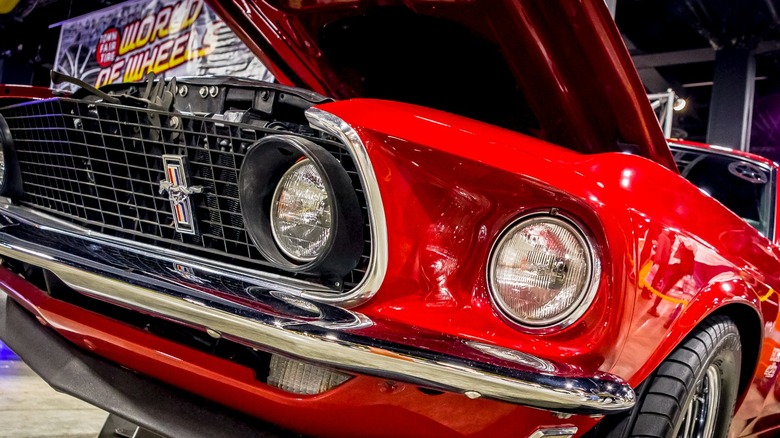
Few muscle cars are pricier and more exclusive than the 1969-1970 Boss 429 Mustang, and for good reason. Ford built just 1,358 units of this exceptionally fast, handsome, and prestigious car, which means that values have gone through the roof. As of March 2026, the average price for a Boss 429, according to Classic.com, is an eye-watering $358,681.
That money gets you one of the most iconic Mustangs ever built, and it's not just for show. These were serious cars built for serious purposes, and the Boss 429 was a Mustang with a NASCAR-derived racing V8 forcefully crammed under the hood. Ford rated this 429 cubic-inch V8 at 375 hp, though the engine's actual output is rumored to be in the 500-hp range. Now, it's still a lot of money, no matter how impressive the engine is, but those high prices also mean that you're spoiled for choice if you want to go for a less expensive alternative.
We're still talking about high-end muscle cars here, with some examples being so rare that you won't find them in any dealer brochure of the day. But the basic principle is the same: These are cars that fulfill a similar role to the Boss 429 — a racing muscle car with license plates — but cost significantly less. You'll still pay six figures for these, but some entries might surprise you regardless.
1970 Pontiac GTO Judge with Ram Air IV - around $90,000
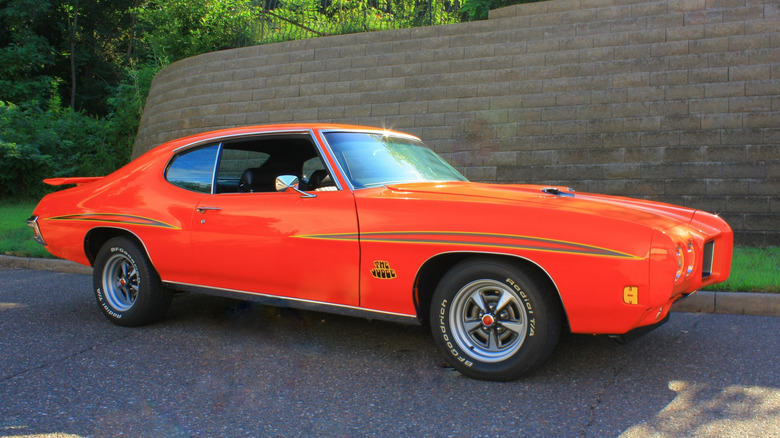
It says a lot when the "budget" option still teases the six-figure mark, but let's be honest, no list of iconic muscle cars is complete without the Pontiac GTO. Granted, there are actually a lot of cheaper alternatives to the GTO, but there's no upstaging something so recognizable. And the top-shelf version is the Ram Air IV-equipped GTO Judge.
What is a Ram Air IV GTO, though? Well, according to the dealer brochure, it's actually worse than the 455-equipped Grand Prix; both engines boasted 370 hp, but the 400 cubic-inch Ram Air IV only produced 445 lb-ft. of torque versus the 500 lb-ft of the 455. Why is the Ram Air IV so desirable, then? Because, like virtually every car on this list, GM under-reported the Ram Air IV's power output, with restored examples posting 400-plus horsepower in modern dyno tests. This was a fairly common practice at the time, usually done to circumvent some manufacturer-specific litigation, insurance, or other weird idiosyncrasy.
All this adds up to a muscle car with a potent engine, one of the most iconic (and intimidating) grilles to grace a muscle car, and an undeniable place in history as the model that birthed the Muscle Era in the first place. Adding on the Judge package drives the price up further, but not astronomically so; Hagerty estimates you'll pay just over $90,000 for a Judge fastback with RAIV and a 4-speed.
1968 Shelby GT500 KR - $220,000 or so
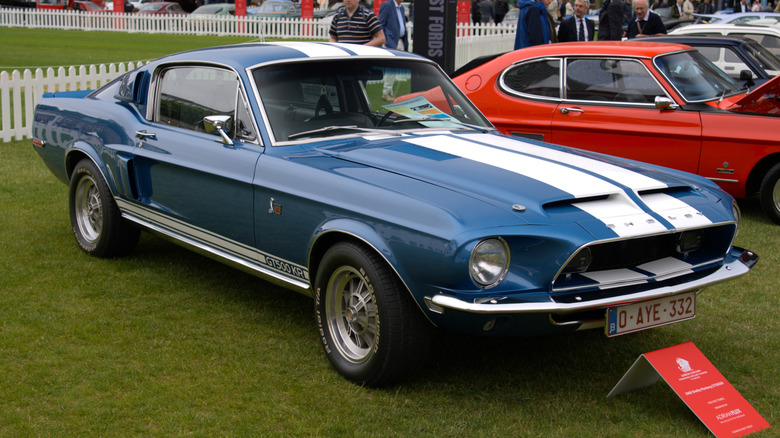
One might assume that anything with the name "Shelby" attached to it will automatically command six-figure prices, but that's only partially true. In fact, Carroll Shelby built a wide array of vehicles outside of the regular Cobras and GT-350s, including many that weren't Fords at all. But then you also have cars like the 1968 GT500 KR, or "King of the Road." Up until the Boss 429, this was the absolute best you could get in a performance Ford, bar none. And, according to Classic.com, it's worth, on average, about $130,000 less than a Boss 429, with an average sale price of $226,717.
The GT500 KR is, effectively, what happens when you take a mid-'60s Mustang and throw a big block at it without changing the rest of the body too substantially. Whereas the Boss is wider and more muscular in general, the GT500 KR still superficially resembles the original Mustang design, just with a longer front. Beneath that front end lies a 428 cubic-inch Cobra Jet V8, yet another engine that was underrated; Ford claimed it produced just 335 hp, but the actual figure was likely north of 400.
Ultimately, it's tough to get any more similar to a Boss 429 than this. They're both big-block Mustangs with racing-inspired V8s and all the character to back them up. A Shelby Mustang is infamously function-before-form, with various add-ons implemented almost solely to make the car faster. From the 8000-RPM tach to the lightweight body panels, GT500 KRs are, like the Boss itself, racing machines in all but name only — and buying one instead of the Boss may still leave you with enough for a Torino GT Cobra side-dish.
1970 Plymouth Hemi 'Cuda - $200,000
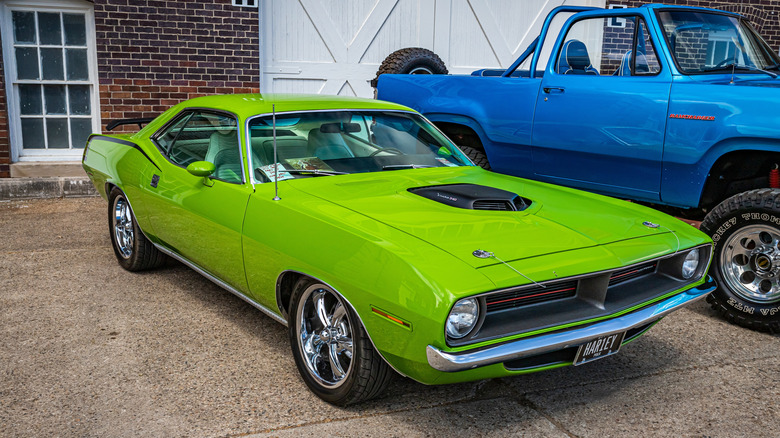
Sure, it's hard to beat the Boss 429 in terms of name recognition, but arguably no muscle car does it better than the Hemi 'Cuda. The name evokes a specific image in the minds of car enthusiasts — bright paint, pony car agility and size, plus the epic roar of that massive 426 Hemi under the hood. Hemi 'Cudas are the quintessential overpowered monstrosities of the muscle car world. In a phrase, they min-maxed for power; everything else was a bonus.
The Hemi 'Cuda, as the name implies, is defined by the engine driving the rear wheels, a 426 cubic-inch V8 supposedly producing 425 hp and 490 lb/ft torque in street trim. In reality, much like the 429, this engine was also underrated, making for one of the lightest and most powerful vehicles in this list. All that adds up to a car that makes even vehicles like the venerable Pontiac GTO look slow by comparison, and by some margin, clearing the quarter-mile in 13.10 seconds at 107.1 mph (the Boss 429 did it in 13.60 at 114 mph).
Prices for Hemi 'Cudas fluctuate wildly, often skewed by models with particularly important historical provenance; some of those have sold for seven figures. But for a clean 1970 example, you're typically looking at prices in the high-$100,000 to mid-$200,000 territory, with several sold within this ballpark in the past year, according to Classic.com. Expensive? Absolutely, but still cheaper than a Boss 429.
1970 Chevrolet Chevelle SS 454 with LS6 Package - $173,000
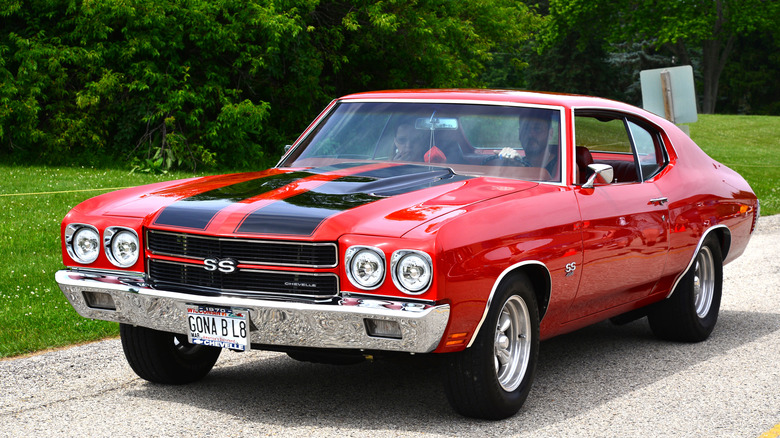
When it comes to big block GM muscle cars, arguably none command as much respect as the Chevelle SS 454. Along with the Hemi 'Cuda and GTO, this is likely one of those models that immediately springs to mind whenever a layperson hears the phrase "muscle car," due in no small part to its massive 454 cubic-inch powerplant. In fact, the Chevelle LS6 marks the definitive endpoint of muscle car power (if you're going by factory ratings), with a quoted power figure of 450 hp. That's 450 horsepower in 1970, in what was ostensibly a relatively common sedan chassis. If that's not peak muscle car, then what on earth is?
This power figure alone makes the LS6-equipped Chevelle SS among the most collectible cars in its class. Even shabby examples of these cars easily break $100,000, with Hemmings estimating an average price of $173,000 for a fastback coupe. Prices can vary depending on options, and the Chevelle has a lot, so your mileage may vary; Classic.com data, for example, shows that a few have sold for over $200,000 in 2024 and 2025.
It's not hard to see why, either. The 454 cubic-inch big block is a monster by itself, and the RPO Z15 option added a hotter camshaft, forged-aluminum pistons, solid-lifter cam, 11.25:1 compression, and more. It's an engine that combines displacement and compression to produce exceptional power, even by today's standards.
1968 L023 Hemi Dart and B029 Hemi Barracuda - under $250,000
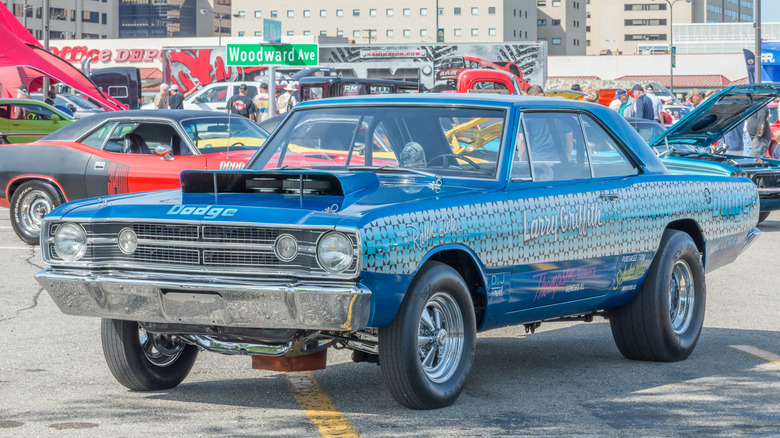
If we're talking high-performance '60s and '70s cars, it's tough to get any more extreme than the infamous Hurst Hemis — no, not the Hemi Under Glass, but rather the Hemi Super Stock. These vehicles, officially the 1968 L023 Dodge Dart and B029 Plymouth Barracuda, respectively, were highly specialized drag cars that Hurst built from partially-assembled chassis. You'll see various total production numbers online from 50 to 150, but the common figure thrown around is about 80 Darts and 70 Barracudas; whatever the true number is, however, these were absolute monsters at the drag strip — and still are today. They effectively monopolized their respective drag racing classes, running deep into 10-second territory with ease.
These were essentially hand-built, single-purpose cars designed to go incredibly fast in a straight line to the expense of literally everything else. Hurst even removed the window mechanism to save weight, and they were all shipped in flat gray primer to let the owners finish them in their livery of choice. It was less of a car and more of a statement, and Chrysler used these machines to utterly dominate the drag strip and showcase the Hemi's prowess. And it worked; they're still raced (and feared) to this day.
The rarity of these cars alone increases their price quite a bit. But their specialized nature, coupled with absolute uncompromising brutality, means they're reasonably affordable — or, well, as affordable as any homologation-special car can be, anyway. Examples have sold for between $150,000 to $250,000 or so, with prices fluctuating depending on the modifications and historical provenance. These include a Sox & Martin B029 that sold for $258,000 and an L023 Dart that went for $200,000, both in 2023.
How we formulated this list
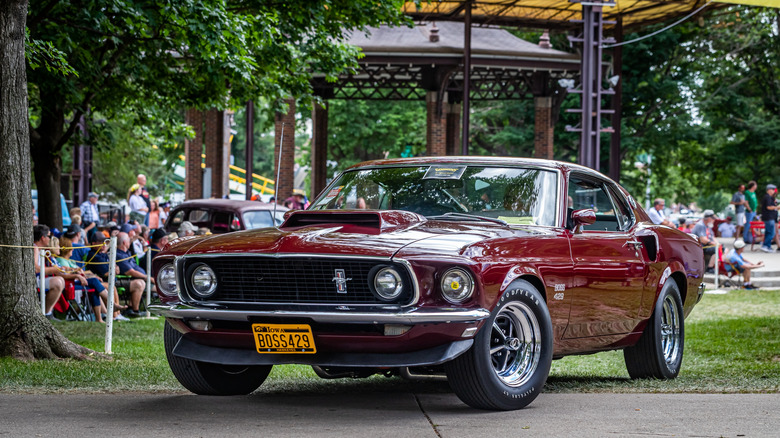
Deciding on Boss 429 alternatives first required defining what makes the Boss 429 special in the first place. These were homologation muscle cars designed to compete in high-level motorsports, boasting big power, iconic body lines, and plenty of race-inspired design choices. We took that formula and extended it to other vehicles that fit the bill. That said, we omitted convertibles; since no Boss 429s were made as convertibles, it would have been unfair to weigh them against the usually higher-priced drop-tops.
Because the Boss 429 represents the top-of-the-line package for Ford performance vehicles in 1969-1970, we focused on cars from this era that were similarly equipped. Meaning, each of these cars is among the fastest factory-built trims of their respective models, with special consideration given to other homologation specials or racing-inspired variants, pony cars, and big blocks.
We sourced our pricing averages from sites like Classic.com and Hagerty to get a general estimate, then eliminated outliers like Concours-quality cars or rolling chassis. With the Hurst Hemis, because of their rarity, we manually filtered through different auctions and came up with our own ballpark figure for an original, unmodified example. These prices represent an average, as it can be hard to take into account all variables such as condition. As such, your mileage may vary at the auction block.