

5 Of The Highest Top Speed Cars Of The 1970s
In the automotive world, the 1970s wasn't an era known for its speed. Quite the opposite, in fact — this was a transitional time in the motoring industry, spurred on by the 1973 Oil Crisis. Cars became so slow that journalists coined the term "Malaise Era". We saw the sharp decline of the muscle car and the rise of the Japanese compact in its place, with big American V8s choked to death with emissions-restricting devices which cut power to fractions of what it was. A lot of 1970s cars were archaic, slow, and many were absolutely hideous. Except that's not the whole story — yes, the majority of cars were quite underpowered, but not all.
In reality, the 1970s was packed with exciting automobiles. Obviously you have proud muscular sports cars from before the Oil Crisis hit, but even after the embargo set in, automakers still committed to making fast cars — and many succeeded. Quite a few sports cars and supercars found their way to market in this era, many of which exceeded speeds of 150 mph and are still considered fast by today's standards. Most generally followed similar design elements as well, with sharp, wedge-shaped designs punctuated by engines numbering between eight to 12 cylinders. But even among these, we'll find numerous exceptions.
These cars represented some of the earliest of their kinds — high-powered grand touring cars, early supercars, and more. We've kept this list tied to cars you can drive on the streets, though that doesn't technically exclude race cars, as homologation specials were a thing at this time. Let's get into it.
1977-1989 Aston Martin V8 Vantage - 170 mph
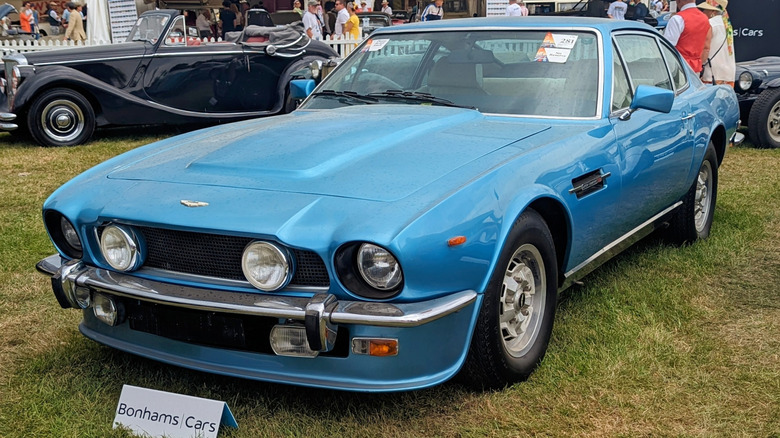
You know we're far from "malaise" when the opening car on our list already equals 2020s performance car specs on paper. Even so, the original Aston Martin V8 Vantage sits at the "slowest" end of our spectrum, which isn't saying much when you consider its specs. Powered by the infamous Lagonda V8 that started life as a racing engine in 1967, the newly-revised 5.3L V8 outputs some 380 hp at 6000 RPM, enough to propel the flagship car to 170 mph with its saloon body (the convertible could only manage 160 by comparison). It's also a hemi engine, believe it or not.
Given that it's a grand tourer, it makes sense for such a car to feature long enough gears and all the power necessary to carry it to these speeds. This was the era where cars like the Lamborghini Countach, Maserati Khamsin, and Ferrari 512 BB competed against one another; the V8 Vantage was Great Britain's answer to these vehicles. And its speed cemented its reputation; this was a car faster in a straight line than a Porsche 911 Turbo (though not as fast accelerating) because of its design philosophy.
When you're driving across European highways, you want a car that can cruise at high speeds while maintaining a relatively lazy RPM. That's what these big V8s were good at; they provide ample power with generous gearing, meaning you don't have to rev the engine like mad to go fast. An understressed engine is a reliable engine; in that sense, the top speed of the V8 Vantage is certainly a selling point, but it wasn't specifically this luxury grand tourer's purpose.
1967-1973 Ferrari 365 GTB/4 - 174 mph
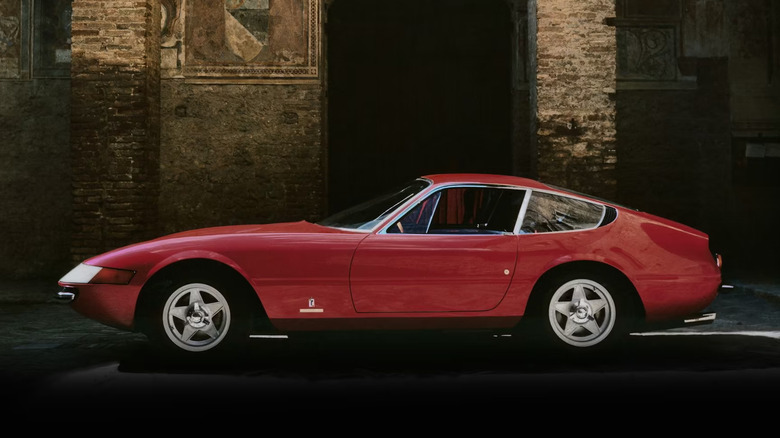
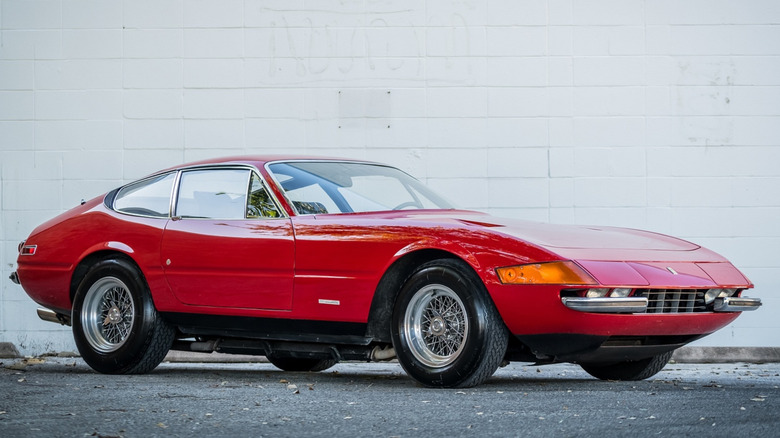
Most people likely know the 365 GTB/4 (and its convertible counterpart, the 365 GTS/4) as the "Daytona," a name popularized by this car's historic 1-2-3 finish at the 1967 24 Hours of Daytona race. And that's no accident — Daytona is a track world-renowned for its high speeds, and Ferrari brought their A-game with the 365. The car's most iconic feature is that absurdly long hood, sculpted into a wedge and shrouding a 4.4L Colombo V12 beneath. The engine was derived from the earlier 275 GTB/4, boasting a twin overhead camshaft (four cams total, hence the "4" at the end of the name) producing a claimed 352 hp. Much like the Aston, this was all mated to a generously-geared 5-speed manual.
This was effectively the Aston Martin but a decade earlier and with four extra cylinders. It was built with a similar ideology in mind, albeit with differing execution — they're both refined grand tourers, though the Ferrari's racing pedigree is far more direct. This was a racecar adapted to the luxury grand touring market, not the other way around. And it shows with its handling characteristics; the massive V12 sits just above the front suspension, making the Daytona handle like a truck at low speeds. But the faster you go, the more the car comes to life, with the engine easily coping with speeds exceeding 150 mph. It's more than happy to provide even greater speeds as well, thanks to the six dual-barrel Weber carburetors that drink fuel from two fuel tanks. Some may see it as a dinosaur, but it's tough to insult what they can't catch. If you owned one in the 1970s, you were living the dream — same goes for these cars.
1971-1973 Lamborghini Miura P400 SV - 180 mph (estimated)
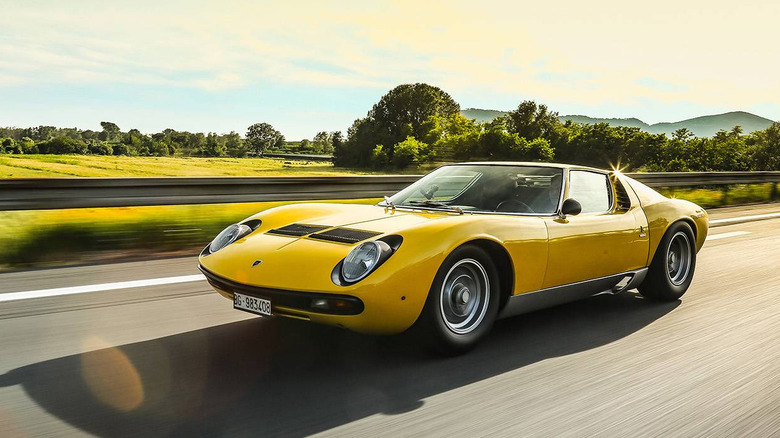
The final and arguably most famous incarnation of the Miura, this marks the definitive edition of Ferruccio Lamborghini's first supercar — and, indeed, one of the first supercars ever built. It was unlike almost anything before it, boasting a mid-engine V12 configuration in a passenger car. Almost all other 1960s vehicles with such a configuration were race cars or oddball concept cars; Lamborghini simply took this idea and ran with it, outdoing the Ferrari Daytona in terms of brashness in the process. This was (and, indeed, remains) a timeless piece of automotive history, not least because of how fast it was.
That said, these 1970s Lamborghinis are a bit hazy in terms of hard figures for top speeds. The Countach in particular is somewhat all over the place, with similar top speed claims to the Miura, whereas others list that car in the mid-160s. Given that we don't have a Countach or Miura on-hand to do top speed runs with, we're lumping both cars together (given that they both have equal top speed claims of 180 mph), but the Miura takes precedence because it's the first to do it.
The Miura's top speed comes from a combination of its exceptional aerodynamic shape, 385-hp output, and light weight; these cars were exceptionally small and slippery, after all. To put it into context, the original 350-hp Miura's top speed was quoted by Lamborghini as 174 mph (280 km/h), and the "SV" in P400 SV means "Super Veloce," literally "Super Fast." The name is not ironic.
1976-1984 Ferrari 512 BB - 187 mph
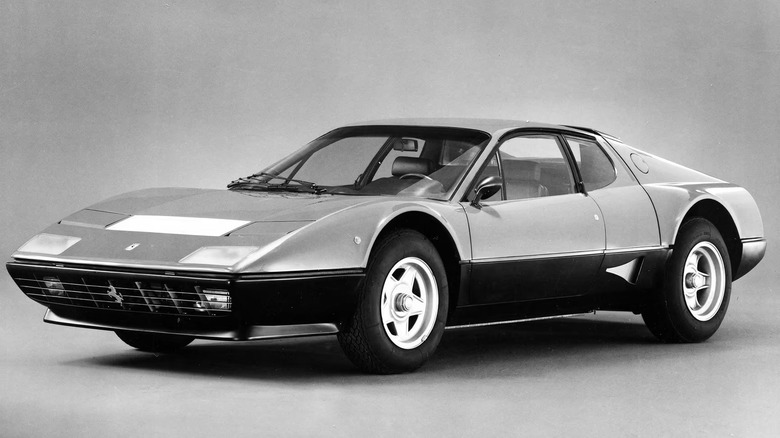
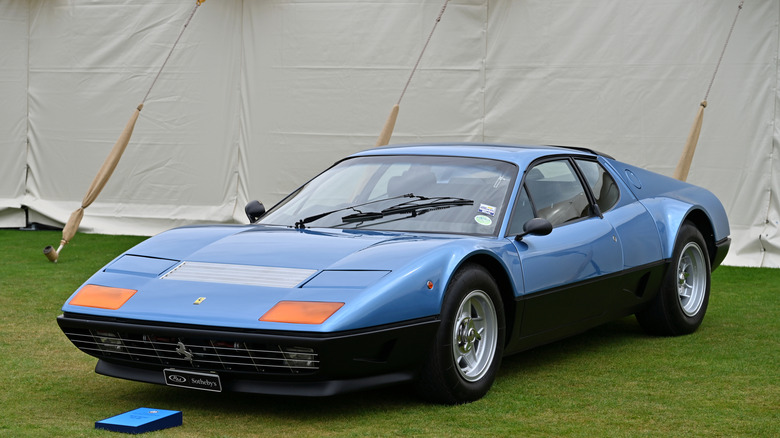
This was the undisputed champion of speed in the 1970s, at least when it came to a normal road car (unlike the one we'll talk about after). And it's a relatively overlooked Ferrari in the grand scheme of things, with the 512 BB somewhat lesser-known in comparison to others like the 308. Even so, it's still faster than almost anything else without modification, even surpassing many brand-new sports cars in terms of outright speed. Ferrari's official quote for this underdog is 302 km/h, or 187 mph, an eye-watering number when you consider that this thing was running on 1970s suspension.
Let's begin with the engine a 5-liter V12 (hence the name 512, 5L V12; the "BB" means "Berlinetta Boxer"). Producing just 340 hp, one might assume that this car was slower than the Miura — that's apparently not the case, at least according to Ferrari. It was essentially the same engine as the 365 GT4 BB, just bored out and featuring various advanced technologies such as dry-sump lubrication and electronic ignition. In other words, it's a mid-engine, more aerodynamic Daytona. No wonder it goes so fast, considering it just takes all the lessons learned from the Daytona and expands on them, American motorsport pedigree included.
The 512 BB's torquier 5L configuration helped iron out the kinks with low-end handling, but it actually may have sacrificed some of that top speed; Autocar's original review, for instance, claimed a top speed of no greater than 163 mph. Other hands-on tests indicate speeds in excess of 190 mph. It could be that all these handmade cars have personalities of their own; regardless, Ferrari's official number rests as the fastest production car in the world at the time.
1970 Plymouth Superbird - 200 mph (with racing gears)
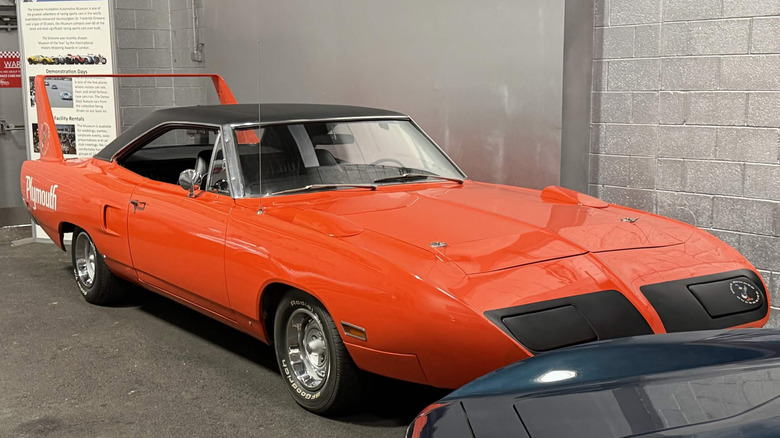
This one has a huge asterisk attached to it; anyone who's a fan of early NASCAR likely will know of the fabled 200 mph top speed run of the Superbird. 200.447 mph at Talladega, to be specific, meaning the 1970 Plymouth Superbird is officially the first production car to break the 200-mph barrier. Except it isn't, because that was a stock car — as in, a NASCAR stock car. Why is it included here, then?
To break this down, let's take a look at the Superbird's factory gears. With the 4-speed, the Superbird came with a Dana 60 with a 3.54:1 rear end, meaning if you plug in the numbers with the factory tire height of 26.57 inches and 1:1 4th gear, you get a theoretical top speed of 156 mph. The NASCAR stock car was, for all intents and purposes, that very same car, just tuned up and fitted with longer gears — these were the days when NASCAR stock cars were far closer to actual stock cars. The Superbird was, effectively, a homologation special — a NASCAR stock car in all but name, with more compliant gears and road tires. Yet it still had the same aero profile and potential as the racer. Richard Petty himself claimed around 220 mph was possible from one of these. One video demonstrates that it could even hang with modern stock cars on the straights.
Okay, everyone at the time hated it because of the radical looks. But it was pure function over form, with an exceptional drag coefficient of 0.31 and a NASCAR-derived 425-hp Hemi (with NASCAR power potential). While not technically the fastest road car, it certainly deserves inclusion for its accomplishments with what's fundamentally a production powerplant and body.
How we created our list
Our main rule here was that we wanted cars that could have license plates fitted in the United States — anything that was a bespoke race car like a Porsche 917, or a heavily-modified road car like a "Moby Dick" Porsche 935, wasn't included. These are representative examples of cars one could theoretically purchase and drive on the streets in the 1970s. These include both production and hand-built cars, along with homologated race cars whose production variants closely match the race variant.
There are several cars on the list with model ranges outside of the 1970s; for those, we chose to only include the actual range within the decade. For example, we looked exclusively at Ferrari 365 GTB/4s produced during and after model year 1970.
We primarily sourced the numbers from manufacturer-stated claims where available, citing numbers directly from the manufacturer's website or contemporary reviews. Claims made by individuals may be cited in the article body, but are not as reliable as verified accounts; as such, our hard figures stick with the actual quoted speeds, as opposed to hearsay. If such numbers are not available on company websites, we instead look for verified period accounts such as record runs, contemporary reviews, or reputable museums for more information.