

5 Reasons The Ford Maverick May Not Be The Right Fit For You
As Porsche is the poster child for the sports car, Ford is the same for the pickup truck. Ever since its very first car, the legendary Model T, was offered with a pickup bed all the way back in 1925, the pickup truck has burrowed into the most famous echelons of American automaking. The vehiclpickup truck itself has become one of the thematic pillars on which the idea of the American country stands on, representing resilience and autonomy, acting as a tool whose purpose can only be fully achieved by a self-starter. Today, the pickup truck still stands stalwart and since its inception, we've seen hundreds of iterations of where the idea of a pickup can go from Tesla's Cybertruck to the Hellcat-powered Ram TRX.
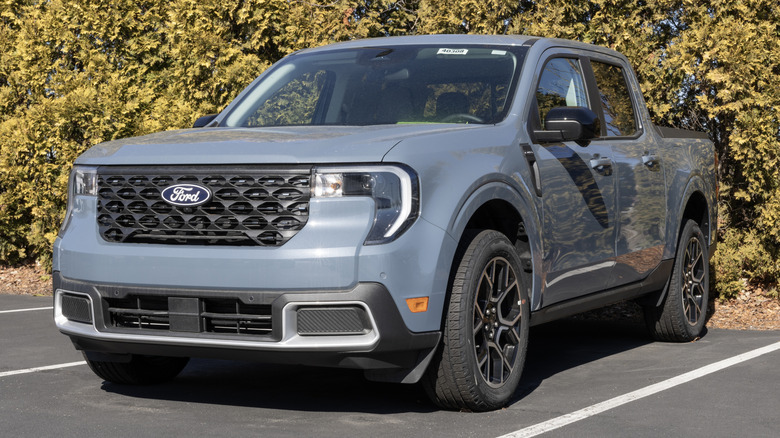
The Ford Maverick is one the more popular recent iterations of the pickup we've seen. Many of the hulking and muscular pickups on the market are far more capable than what a lot of consumers actually need. In our review of the 2025 model, we liked how the Maverick takes the core DNA of the pickup, and makes it more practical for buyers who want something for everyday tasks. However, while this new directive for the pickup class makes it suited for a different demographic than usual, it may not be right for you.
Unibody construction
For purists, the concept of a unibody pickup truck might seem like an oxymoron. Historically, one of the defining characteristics of a pickup truck is a body-on-frame construction. Those wondering which construction style is better, the two approaches reflect differing schools of thought for how a vehicle should come together. Each has its own set of strengths and weaknesses.
In a body-on-frame construction, the main components of a truck that you see — the body — sits on top of a flat skeletal frame, creating two distinctive components. In a unibody construction, more typical of regular cars, the body and frame are one and the same, and there is no meaningful separation in the skeleton or form-building shapes.
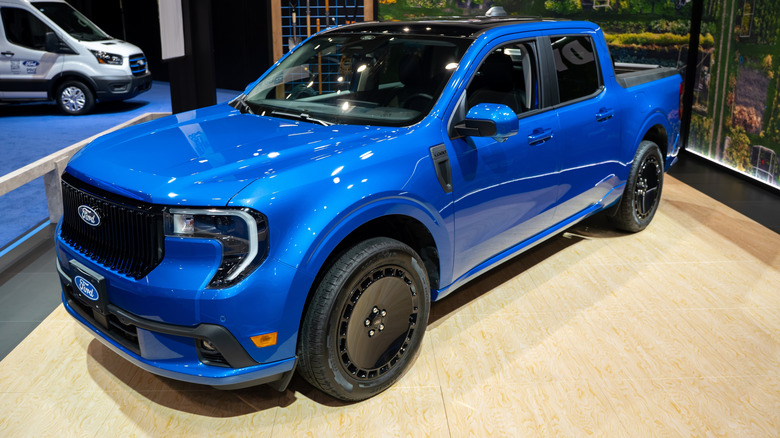
The body-on-frame construction offers a strong and rigid platform, capable of withstanding huge amounts of force or weight from things like hauling, towing, or off-roading. This comes at the cost of weight though, making the construction style very heavy and therefore less fuel efficient. As for a unibody car, the construction is more flexible and much lighter, offering better fuel economy and more flexion on pavement, which absorbs vibrations and makes for a more comfortable ride. The Maverick's use of the unibody construction makes it a more comfortable car for your back and your wallet on everyday drives, blending a generally more "car-like" feel with its pickup truck capabilities. However, this means it trades some heavy-lifting capabilities and off-road prowess.
Smaller bed size
The defining characteristic of the pickup truck is its bed. It bed is perhaps one of the most versatile and uniquely used features on any automobile. It can house the building blocks of projects of every pursuit, the garbage of the pursuit's waste, and often the people behind the projects themselves. For many people, a pickup's utility is directly correlated to its bed size.
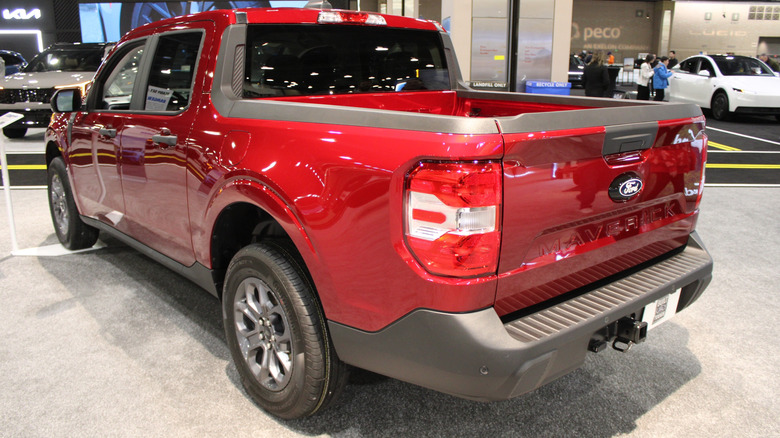
The biggest F-150 beds measure up at 97.6 inches long and 50.6 inches wide, with 77.4 cubic feet of volume. The biggest Maverick beds are smaller — an aspect it shares with many of today's pickups — measuring up at 54.4 inches long and 53.3 inches wide with 33.3 cubic feet of volume. However, to help soften the blow of a smaller bed, Ford equipped the Maverick with what it calls Flexbed.
The Flexbed is essentially an assortment of convenience features to help owners make the most of their bed space, including vertical and horizontal slots for 2x4 and 2x6 boards to organize interior space, a multiple-position locking tailgate, a 120V outlet, a pre-wired 12V circuit, bottle openers, and more. This makes the Maverick's bed prime for all sorts of DIY projects and sufficient for most everyday carrying needs, as long as they don't require a full-size-truck amount of space.
AWD instead of 4WD
Much of the Maverick's novelty comes from its inherent similarities to the average car, and that extends to its drivetrain setup. For the uninitiated, it can be hard to understand why four-wheel-drive and all-wheel-drive aren't synonymous, given most cars (should) have four wheels. However, the difference between the two is pretty significant. Similar to the unibody versus body-on-frame debate, one system is better suited to a road-going car and the other generally better serves a utilitarian pickup's needs.
All-wheel-drive systems dole out power to all four wheels of a car, in varying degrees to the front and rear wheels, and works best on paved roads, where it can help you achieve better fuel economy or performance depending on your car's purpose. On the other hand, four-wheel-drive disperses power evenly between the front and rear wheels, without complicated electronic interference. Essentially, it ensures power delivery is equal across contact points with the ground. This is particularly important in circumstances where not every contact point is, well, making contact with the ground (think, off-roading or driving in other extreme weather conditions).
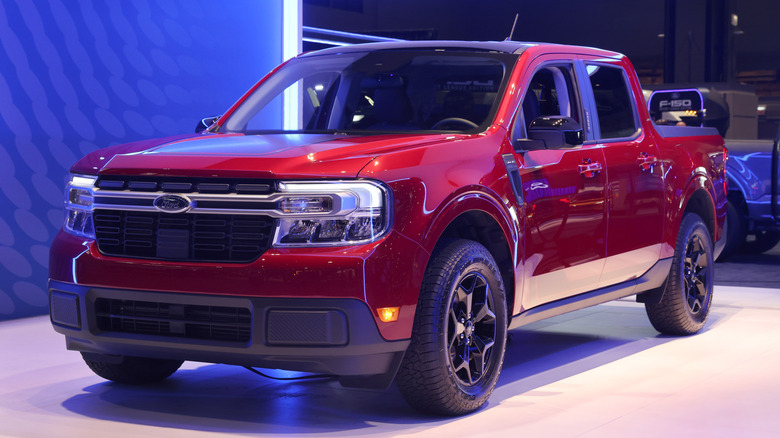
The Maverick's AWD system makes it more aligned with road driving, and still capable of some light off-roading. However, if you anticipate needing your truck to face some of nature's harder challenges, it may be best to look somewhere else.
Towing and payload capacity
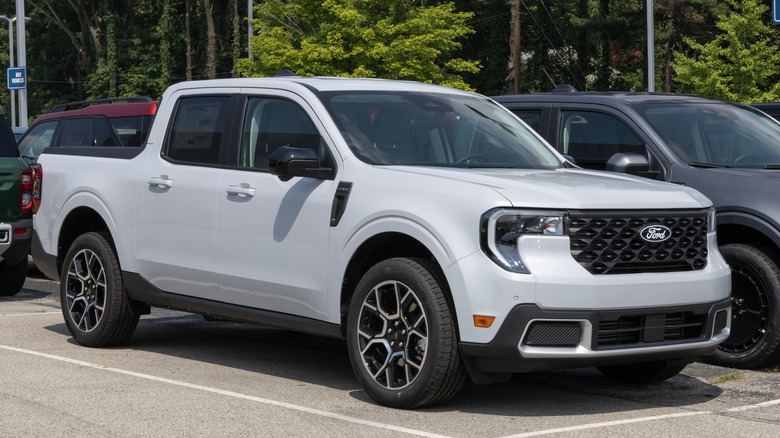
We've discussed the bed space already, but another important utilitarian capability of a pickup truck is how it manages weight. The physical displacement of bed space helps us understand what a full bed might look like, but the weight limits are what defines a truck's abilities — how much it can carry, and how much it can tow. We've all driven down the highway and passed, or been passed by pickups pulling a trailer of tools, a wheeled pen of horses, or even another car behind it. Like payload capacity, the towing capacity can make or break a truck's usefulness depending on the consumer's needs.
To put the Maverick's numbers in perspective, let's compare it to Ford's golden child, the 2025 F-150. At top specs, the F-150 can tow a colossal 13,500 pounds — anything more and you'd probably need a commercial trucking license. The F-150 also has a maximum hauling payload of 2,440 pounds. Top spec Mavericks on the other hand, top out at 4,000 pounds for towing and a 1,500-pound hauling ceiling. The recurring theme here is that these capabilities are likely more than enough for the everyday person who wants to load up the bed or drag something small every now and then. However if you need a lot of muscle, the Maverick may not be right for you.
Powertrain options
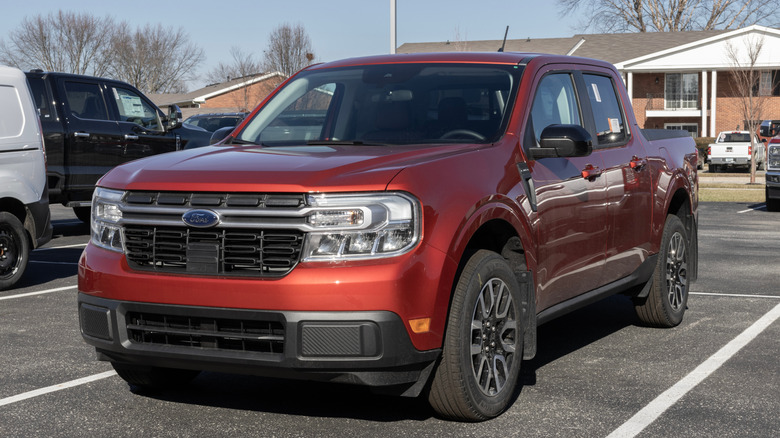
The theme we just mentioned remains present for our final point. In pickup trucks, it's a difficult balancing act to offer an engine that provides enough power and torque to haul your things while also staying relatively fuel efficient. In this department, the Maverick again leans more toward the car-like qualities, offering lower power and better efficiency. For the 2026 model year, Ford only offers two engine options for the Maverick. The first is a hybrid powertrain made up of a 2.5-liter four-cylinder engine supplemented by 2 AC motors which come together to make 190 hp. The other option is a turbocharged four-cylinder, with a higher power output of 250 hp.
The Maverick only has half the cylinders many other pickups offer. A 2026 Chevrolet Silverado for instance comes with a big American V8 that produces 420 hp, well over the max output of the Maverick. This further highlights the difference between a Maverick and most other pickups. What Ford has done is impressive, and intuitive. The usefulness of a pickup is unquestionable, but in the modern day, not everyone needs the excessive capabilities most of them offer, and Ford has effectively adapted to this. Still, for those who actually need a workhorse over a city pony, it's probably best to look elsewhere.