

5 'Bad' Cars We Still Can't Help But Love
There are some cars that people just love to hate for one reason or another. Whether it's because the cars are objectively bad or look like hot garbage, we've collectively hated on certain vehicles since the dawn of the mass-produced automobile.
I myself am guilty of this. I've been a proud car enthusiast all my life, developing my taste since I was a toddler. And even after several decades, certain cars just make me wince when I see them, like I'm swallowing a particularly dry and troublesome pill in the morning. But that's just one side of the coin; after so many years studying and working around cars, I've also grown fond of some cars that are often the butt of car fans' jokes.
This doesn't extend to all of them, of course: I'll openly admit my hatred of massive pickup trucks, boring crossovers, and excessive minimalism. But there are many cars that fans generally consider "bad" that I genuinely find appealing — and for objective reasons, too. In this article, I'll go over some cars that history's slammed and why they've been done way dirtier than they deserve, sticking with the oddballs so I don't regurgitate points about why the Aztek was ahead of its time. Some of these cars are commercial failures, radical designs, or so rough that they're barely a step above prototypes, with plenty of reasons to call them "bad." But that doesn't mean that they can't be appreciated, or even beloved, for the unique traits they bring to the table. Let's dive in and air out the skeletons in my automotive closet.
Ford Mustang II
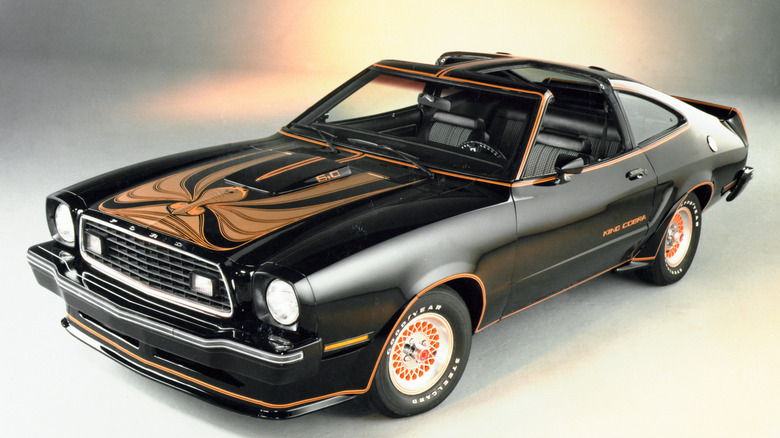
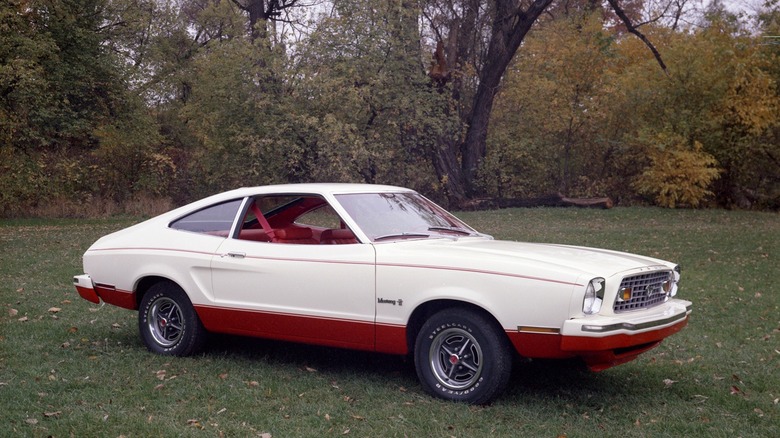
"No, it's not a Pinto. Yes, I know it looks like a Pinto, but I swear it's not a Pinto. See the giant decal on the long hood? Not a Pinto," is surely a conversation that's occurred at least once or twice. And it irritates me so much because the Mustang II is absolutely not a Ford Pinto. Okay, they share some of the subframe and powertrain options, but you have to put the car into the Oil Crisis context here.
For those uninformed, the 1973 Oil Crisis was devastating for the American automotive industry. It effectively gutted muscle cars, transforming automotive culture quite literally overnight. Gas restrictions hit big-block V8s hard, and American automakers had no answers; this led to a huge drop in sales and incentivized people to buy small Japanese imports instead. And just as this era hit, Ford introduced the Mustang II for model year 1974. It was lethargically slow, small, and had a four-cylinder engine as standard. It was also the reason the Mustang name survives today.
Think about it — the 1973 Mustang was a midsize, V8-powered, half-sports, half-luxury coupe. If it continued unchanged into the mid-1970s, its engine would've been choked to within an inch of its life. It would've been saddled with all the restrictions that nearly killed the American full-size coupe, and the name would've gone away with a whimper. The Mustang II's formula was incredibly successful, carrying the brand kicking and screaming through the Malaise Era. People hate it because it was the slowest Mustang; I love it because there would be no more Mustang without it, period. Also, I have to admit the King Cobra's decals look really good.
Second-generation Toyota Prius
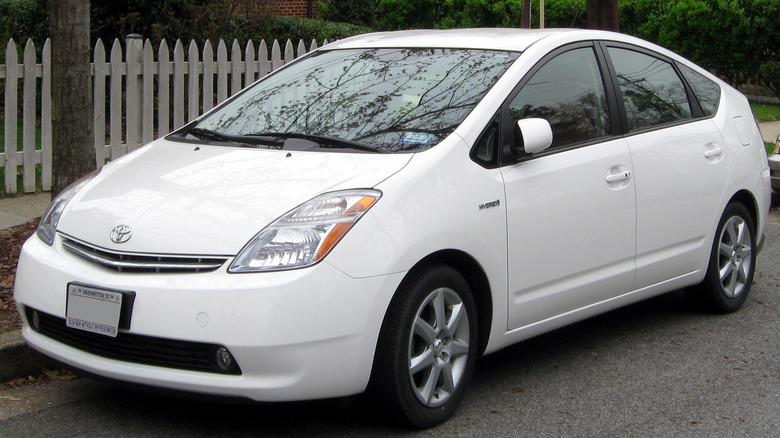
Here's another example of a commercially successful car that the enthusiast community hated on for the longest time, and I genuinely have no idea why. Okay, yes, the Prius is abysmally boring to look at and drive, and it's about as far from "enthusiast" car as one can get. But it's still absolutely something I would daily. Why? It's not because it's exciting — okay, Toyota did race one in Super GT for some reason, but that's beside the point. It's because of what cars are supposed to do.
What is a car, but a box on four wheels that gets you from point A to B? I'm looking at it from an enthusiast's perspective, granted. But if I were buying, say, a refrigerator, I'd buy something that fits enough groceries and doesn't break down constantly. That's the way I see the Prius. It's the automotive equivalent of a boring kitchen appliance, and there's nothing wrong with that.
There were so many memes about the second-gen Prius back in the 2000s and 2010s, and I can see why. Priuses are slow, bland, and thoroughly uninteresting, all of which runs counter to my instinct as someone passionate about cars. But that's hardly the point; they were designed to haul people and their goods frugally, and they are still incredibly good at that. Objectively, it's one of the most practical and economical vehicles money can buy today. I can say, hand on heart, that I'd drive one regularly without complaint, and that's coming from a woman who dailies an R34 Skyline.
Plymouth / Chrysler Prowler
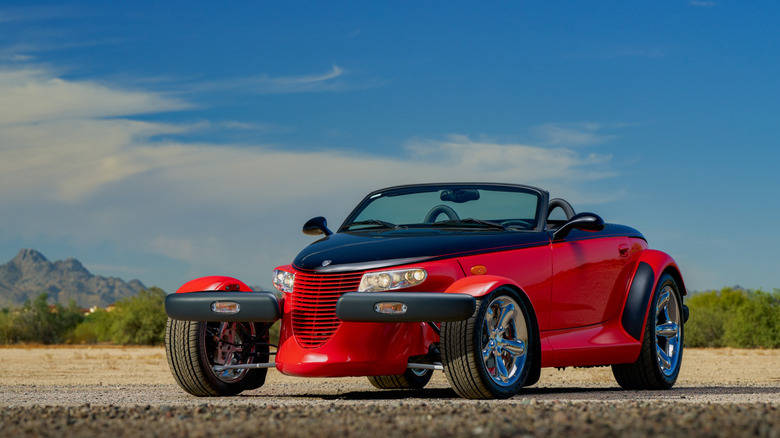
I actually had a die-cast model of one of these growing up, and I distinctly remember the day the suspension fell apart, throwing a plastic control arm under the couch and into the void. I imagine that's how some non-car people see this, what with its kit-car looks. And enthusiasts dislike it because it has the same V6 engine as a minivan, married to a 4-speed slushbox automatic. The Prowler had a wild image, but let's be real: this is no hot rod.
That said, well — just look at it. It's so captivatingly strange that I can't help but love it. The Prowler rode the crest of the retro-futurism wave, punctuated by other famously abhorrent 2000s-era designs like the PT Cruiser and Dodge Nitro. It was billed as a factory hot rod, with a front end that looked like a car that had run into a pencil sharpener. Then you have the protruding front bumpers and wheel arches, further contributing to its bizarreness. And yet, I see a yellow one now and then on the highway, and I still stare at the thing.
Sure, I know the Prowler's V6 is famously lethargic, and I'm aware that it's wildly impractical for anything other than joyriding. Don't get me wrong, I should hate it. But then I see the thing in-person and I'm like, "Oh yeah, that's why I love it." It's the king of wacky '90s excess; the Insane Clown Posse of cars. And that's what makes it special.
Honda Ridgeline
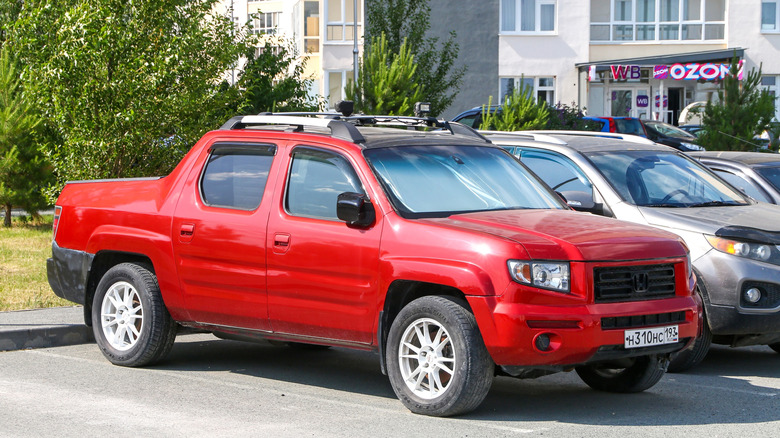
This goes back to my initial criticism of big American pickup trucks, perhaps further colored by my upbringing in suburbia. How much truck does the average American actually need? Statistically, not that much, considering the majority of Americans tend not to use their trucks for truck things. They've evolved from being agricultural and utility vehicles to massive, rolling showcases of technology with front ends that look like rolling garage doors. But back in the day, we had the first-gen Ford Ranger, the Mazda Pickup, the Jeep Comanche — and we liked them.
Now, yes, all of those trucks have more utility than a Ridgeline; they have bigger beds, for one. But that's not the point, since we still have trucks for when we need that. Let's instead take a critical look at what trucks have become in the 2020s. I understand the hate for the Ridgeline because it is indeed a crossover with a pickup bed. But that's genuinely what a lot of these owners use their trucks for, anyway. Basically, we're jamming a square peg into a round hole by using a big pickup to run around and grab groceries when something like the Ridgeline would absolutely suffice.
Ridgelines get hate for lackluster utility compared to purpose-built trucks, but they're not purpose-built trucks — they're daily drivers with pickup beds. They won't break the bank, fit in the average parking spot, and are comfortable and reliable vehicles. I think it's the perfect compromise outside of a ute, offering enough comfort, capacity, and towing capability to satisfy the general non-commercial audience. Just don't mind the weird location of the spare tire.
Vector W8
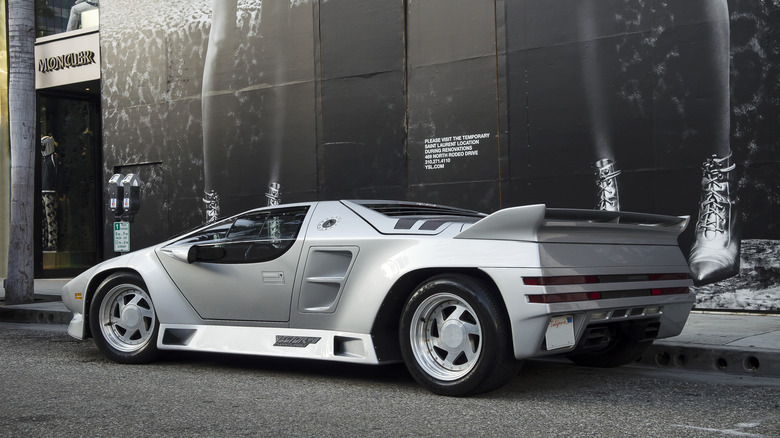
This car is incredibly difficult to describe in a single sentence, but here goes nothing. The Vector W8 was the brainchild of Gerald Wiegert, who built a $450k (in 1989) supercar with a transverse 625-hp V8 coupled to a 3-speed auto from the Oldsmobile Toronado. It's easily one of the most 1980s cars ever. It was also something of a technological marvel, utilizing top-tier materials and components of the era, with an interior that intentionally resembled a fighter plane — well before modern hypercars hopped on that bandwagon. Its vaporwave instrumentation is easily one of the weirdest dashboards ever designed, and that's a bold statement when the Dome Zero exists.
Of course, that didn't stop it from being a bad car. For instance, Car and Driver tested three Vector W8s, and all three broke down in different ways. Those advanced materials? They significantly increased the cost, meaning you'd have paid the equivalent of a million dollars to get a car that only ran properly some of the time.
Nevertheless, I love it. I remember the first time I found out about the W8; I was a little girl playing "Gran Turismo 2" and came across a purple one in-game. I remember thinking it was a knockoff Diablo or something, but it was fast and looked utterly captivating. Then I saw one at a car show, and that was that. Of course, actually owning one of these things would utterly drain my bank account. I imagine it's, frankly, an absolute albatross. But for those rare instances where it works, it'd be as special and rare as coming across an elusive snow leopard.