

11 Niche Ryobi Tools You Probably Shouldn't Waste Your Money On
We may receive a commission on purchases made from links.
It's been said that tools are what separates humanity from the animals. Our ability to manipulate our environment and to create objects which help us to manipulate it better has been the hallmark of our species. What began as simple tools made of wood, bone, and stone has evolved into a complex and growing collection of electrical contraptions big and small.
Over the last quarter of a million years, give or take, humanity has invented a wide range of tools from the mundane to the unusual. Once you get past hammers, screwdrivers, and the other usual suspects, you can find more niche products designed for specific and sometimes specialized jobs. While those tools are cool and can be useful, there's a good chance you'll never need them.
Whether they are purpose-built tools intended for a specific and rare job or they're just overkill for common, everyday uses, these are 11 products you can probably remove from your cart before you get to the checkout stand.
Pumpkin carving kit
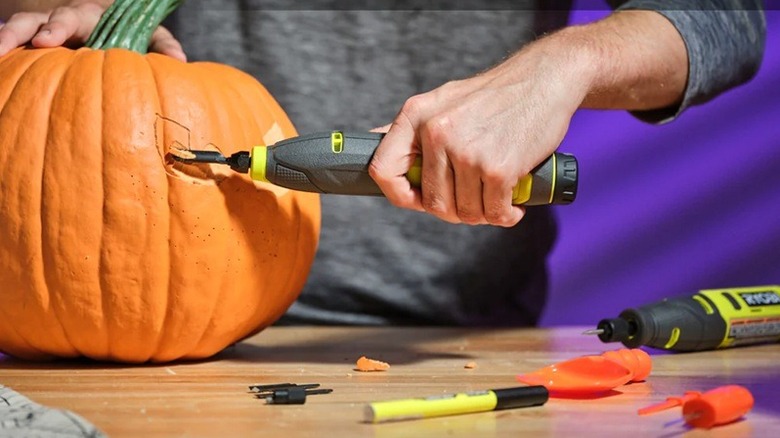
Every autumn, pumpkin carving kits show up on supermarket shelves everywhere. They usually feature a book of patterns and a cheap collection of plastic and metal tools for cutting into pumpkins, scooping out their guts, and carving spooky faces into them. Ryobi's pumpkin carving kit takes things up a notch by introducing a couple of power tools into the mix.
The 2-Tool Combo Kit with Pumpkin Carving Tools is part of Ryobi's USB Lithium line of power tools, with a whimsical twist. The kit includes the USB Lithium Power Carver and the USB Lithium Rotary Tool along with a marker, three different carving blades (straight chisel, u-gouge, and v-gouge), a set of three pumpkin carving tools, an LED tea light, a book of pumpkin stencils, two 2Ah USB Lithium batteries, two USB cables, and a set of 15 rotary accessories for carving, sanding, polishing, and more.
The rotary tool and power carver can be legitimately useful tools for a wide variety of applications, and while they might be the sorts of things you'd use for competitive gourd carving, they're probably overkill for ordinary Halloween activities. Unless you have other uses for these power tools, you can probably pick up the kit from the supermarket and save your money.
Foam cutter
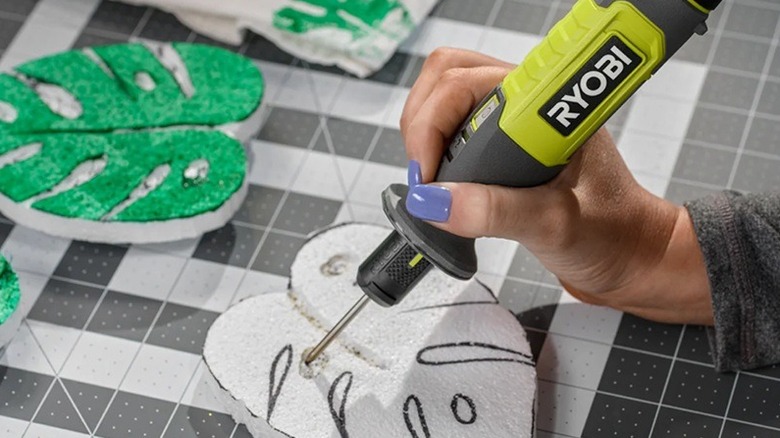
There's a weirdly satisfying ASMR video on YouTube of a person cutting, poking, and carving a foam block with more than a million views, and it's not the only one. We know it's satisfying to hear the foam fall away, but that doesn't mean you should buy a foam cutter.
Ryobi's Foam Cutter uses the company's USB Lithium platform to heat up a thin metal wire or a variety of cutting blades. The kit comes with a nichrome wire just 0.01 inches in diameter attached to a hot wire tip, along with a holing tip and precision engraving tip. The wire is good for carving and shaping foam, the precision engraver can be used for surface details, and the holing tip can be used to cut out shapes or create narrow channels. The tool is also compatible with cutting and scooping accessories, sold separately. The tool has two heat settings and warms up to foam-carving temperatures in about two minutes.
A foam cutter can be useful when making or reupholstering furniture, making mockups during the design phase of a larger project, and more. But unless you're going to make complex cosplay costumes or start a foam ASMR TikTok channel, you can probably leave the foam cutter on the shelf.
Door lock installer
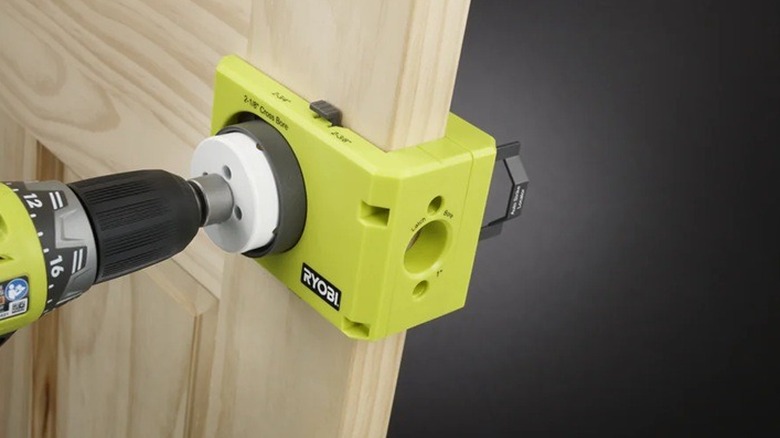
As the name suggests, the Ryobi Wood-Metal Door Lock Install Kit is designed to make a new door ready to accept a doorknob or deadbolt. It works as a template to help you cut the necessary holes for your door hardware to slot through.
The kit comes with the door lock bracket (the template), a one-inch bi-metal hole saw and a 2-1/8-inch bi-metal saw, an arbor with pilot bit, a one-inch wood spade bit, two bronze oxide drill bits in 3/32 and 1/8-inch sizes, and a two-inch double-ended screwdriver bit.
To begin, you adjust the guide to the size of your door. The built-in auto-strike locator slots into the door's existing strike plate. When it settles into place, you can secure the clamp and be confident that your cuts will be properly aligned. It's everything you need to cut the cross-bore hole (through the door) and the latch-bore hole (into the door's edge) to make it ready for a new knob or deadbolt. A door lock installer is probably useful for a home builder or a locksmith, but the average person won't have cause to use one very often, if at all.
Hinge pin remover
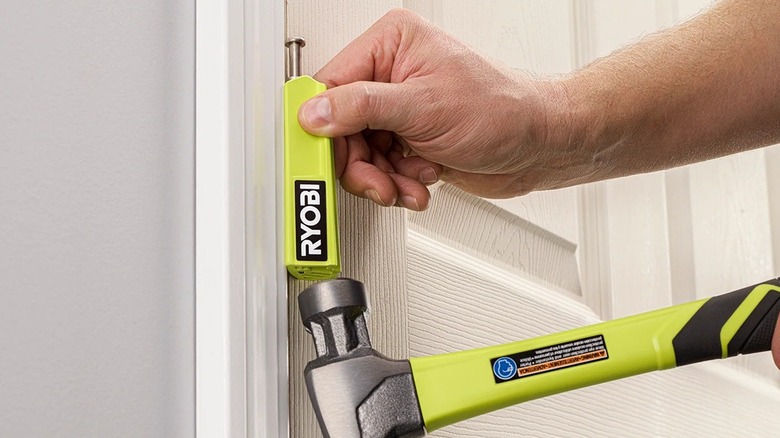
The Ryobi door hinge remover and installer is a specialized tool designed for a specific job. When wrapped around a door hinge, a metal pin in the tool lines up with the hinge pin so you can knock it out with a hammer. It's useful for mounting or detaching doors, but not for much else.
You can slide the tool over the hinge from the top or the bottom, depending on the nature of your hinge, then lightly tap the flat side of the tool with a hammer. If the hinge is rusted, painted, or resists removal, you might need to use a pair of vice grips to twist and loosen the pin. Then, replace the pin remover and try again. Not only does a hinge pin remover simplify the manipulation of hinge pins, it also protects your door, door frame, and walls from damage.
It can be a really helpful tool if you're a contractor, the sort of person who installs or removes doors on a regular basis. But unless that's your day job, or you've got a big renovation coming up, a door hinge remover will probably just take up space in your tool box.
Cable stapler
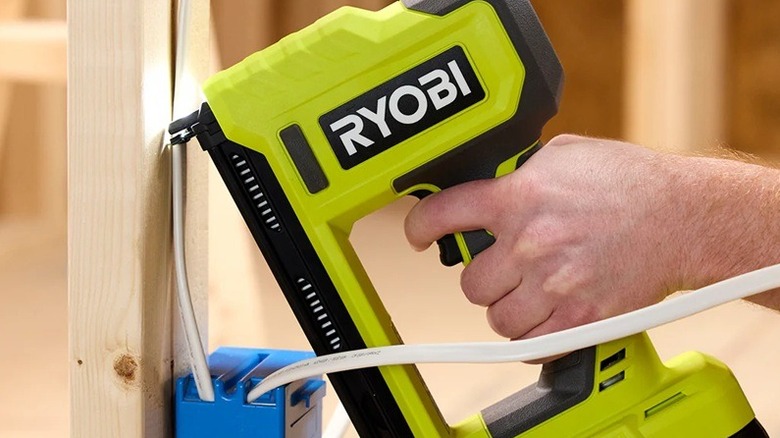
Ryobi's 18V ONE+ Cable Stapler looks sort of like a nail gun's weird cousin. It features a cable guard that slides over several types of wire commonly used in construction projects and rapidly delivers staples to secure those cables in place.
An adjustable cable guard lets you customize the stapler and an LED work light helps you see what you're doing, even when you're working in poor lighting conditions. The stapler can hold up to 40 staples at a time and the staple viewing window lets you see when you're running low at a glance. It runs on Ryobi's 18V Lithium battery platform and can drive an estimated 1,900 staples with a fully charged 2Ah battery.
While the cable stapler can simplify cable organization, you might want to think twice before putting one in your cart. It works exclusively with Ryobi's Cable Shield 1-inch insulated cable staples, so if you go with this tool you'll be locked into an ecosystem and unable to use third-party supplies. More importantly, outside of construction situations when you might be running a lot of cable on a regular basis, you probably won't have much call for one.
Right angle drill
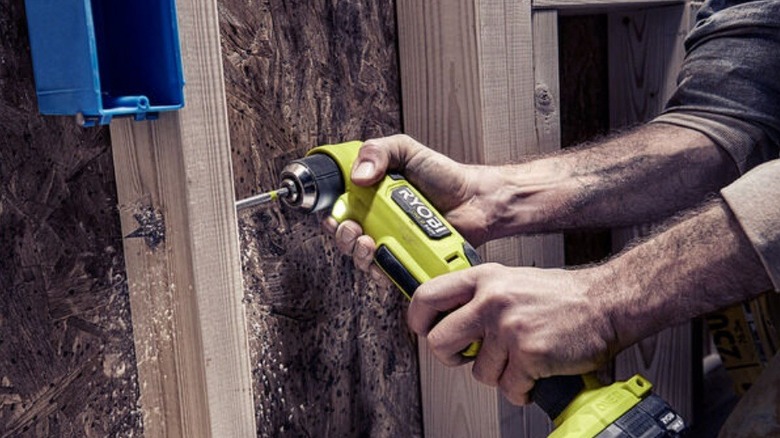
Generally speaking, good right angle drills are significantly narrower than a typical drill, so they can be used in tight spaces. You might see a right angle drill in a contractors tool kit because they can be useful for framing a house, putting up cabinets, and other jobs with minimal clearance. For everything else, a regular drill will probably work just as well.
Ryobi's 18V ONE+ HP Compact Brushless 3/8-inch Right Angle Drill measures 11.5 inches tall and just 3.6 inches long from tip to tail. That tiny package packs a punch, with 350 inch-pounds of torque and a two-speed motor, with top speeds of 450 and 1,700 RPMs. Many of us have a limited budget and limited space for our tool collections, so if you've already got an ordinary power drill, you probably don't need to add a right angle drill into the mix. Unless you're regularly installing cabinets or framing basements, you can probably borrow or rent one of these when and if you need one.
48-inch magnetic box level
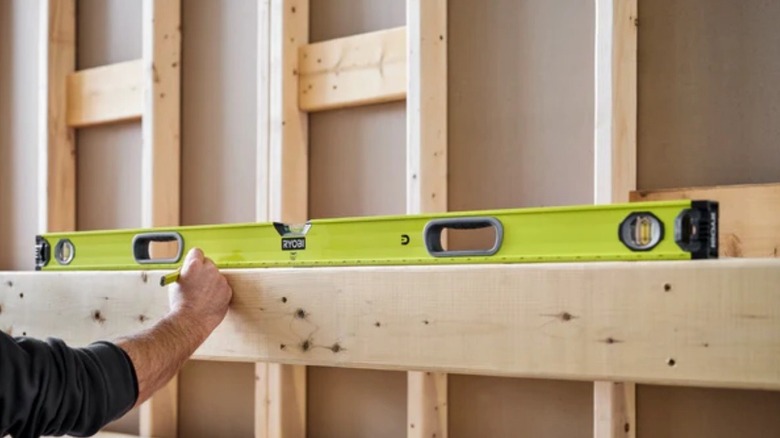
Even if you're not very tool savvy, you've probably used a bubble level to mount a television or hang a picture. Bubble levels can be useful for a wide variety of tasks both professional and amateur, but this one is probably overkill.
As the name suggests, Ryobi's 48-inch magnetic box level is four feet long, providing readings accurate to within 0.05% or within 0.0005 inches of vertical variance for every inch of length. The length of the level also helps to identify any warping present in wood or other materials. It features a strong magnetic base, so you can stick it to metal materials for hands-free leveling, while the integrated ruler markings allow you to measure distances up to four feet without needing a tape measure. On the flip side, a level this long can be unwieldy. For everyday activities, a smaller more manageable level will probably do the trick.
Powered bolt cutter
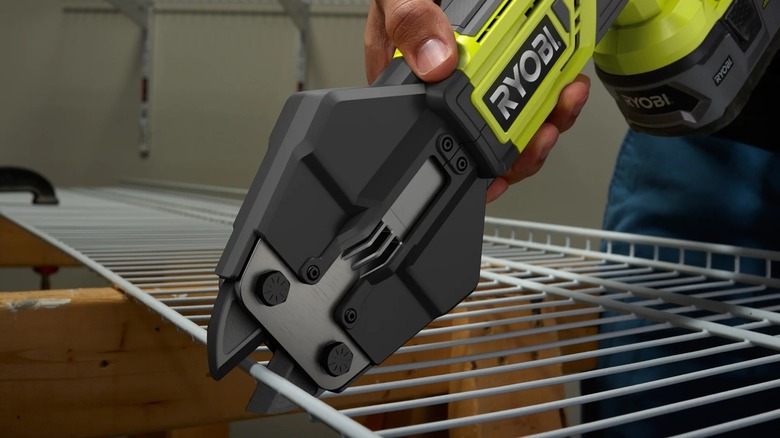
Bolt cutters are basically superpowered scissors for cutting through metal. Ryobi's 18V ONE+ Bolt Cutter has jaw blades made of hot forged steel that latch onto padlocks, chains, fencing, wire shelves, and more, slicing through them with relative ease.
They're designed to handle medium or soft metals up to 3/8-inch in diameter or hardened materials up to 1/4-inch thick. Instead of using your own muscles for leverage like with a manual bolt cutter, this battery-powered gadget has a powered mechanism that pushes the jaws together and pulls them apart. There are two separate buttons for opening and closing the jaws, and the brand claims you get up to 200 cuts per charge with the Ryobi Bolt Cutters, but doesn't specify which battery you'd need.
Cutting through metal is no easy feat and the cutting blades are likely to take damage over time. Fortunately, they can be removed and replaced by unfastening a couple of bolts. All of that said, most of never need a powered bolt cutter. What are you, a bike thief? You probably won't need regular bolt cutters, either. Go ahead and put them back.
Flooring saw
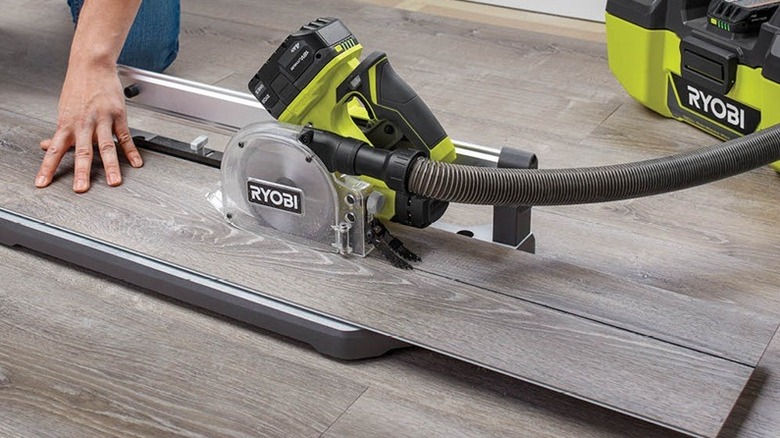
It's not that a flooring saw isn't useful, it's just that you'll probably use it once and then never again. Most people only replace their floors about once a decade, depending on the material and foot traffic.
Ryobi's 18V ONE+ 5.5-inch Flooring Saw Kit features an integrated carrying handle, built-in accessory storage, and a dust port compatible with 1.25-inch vacuum accessories. It also comes packaged with blade wrenches, a push stick, a dust bag, rip fence, crosscut and miter fence, material clamp, a 4Ah 18V ONE+ battery, and a battery charger.
If you're putting in new flooring, you can probably get by with whatever saws you already have, and if not, many hardware stores allow you to rent tools. For most people, a flooring saw is the sort of tool that gets a lot of play for a week or two and then spends years gathering dust. Unless you install flooring for a living, this is probably an investment you don't need to make.
Offset shear
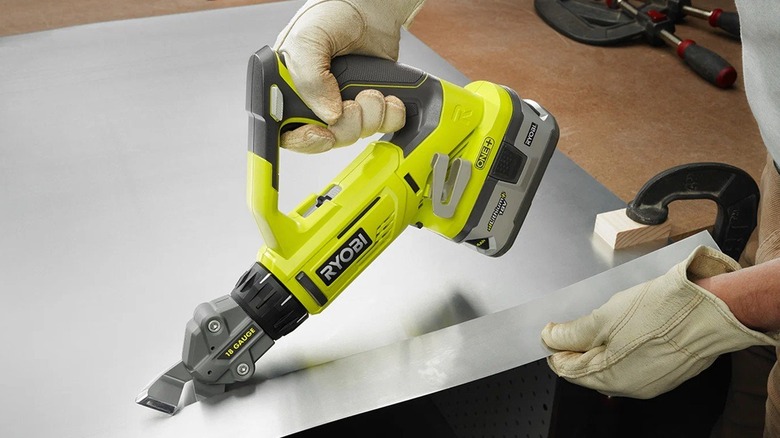
These are probably the most powerful pair of scissors you've seen in a while. Instead of cutting materials like paper and cardboard, the 18V ONE+ 18-gauge offset shears can slice through stuff like sheet metal, vinyl siding, roofing shingles, chicken wire, and more.
The tool runs on Ryobi's 18V ONE+ battery platform and can cut more than 1,000 feet of sheet metal using one of Ryobi's 4Ah Lithium+ batteries. The handle has an overmold grip for comfort and a variable speed trigger. You can also rotate 360 degrees according to your preferences and adjust the blade gap using the included hex wrench.
During use, one of the shear blades remains rigid while the other oscillates up and down, creating a powered scissoring motion. The blades can be replaced over time as they wear down. With these, there are few materials you won't be able to carve up, but unless you're a metalworker, or you regularly build chicken coops, these shears probably aren't necessary. The cutting tools you already have are typically good enough for most materials you're likely to encounter.
Portable cement mixer
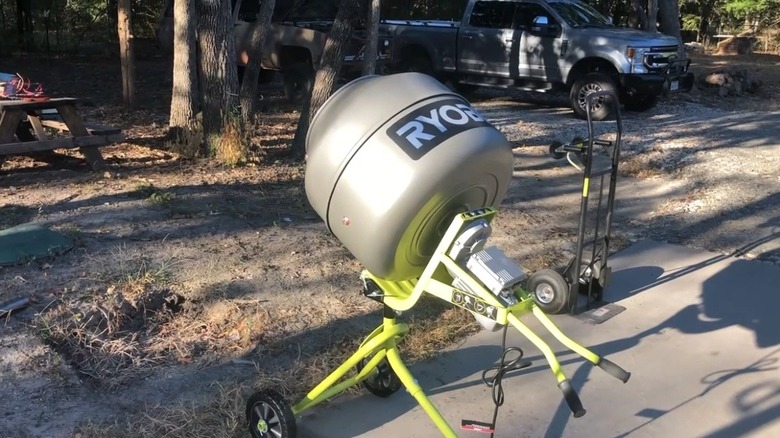
A portable cement mixer is like a small version of those massive spinning cement trucks. We totally get why you might want one, but you'll almost certainly not need it very often.
Ryobi's Portable Cement Mixer has a drum capacity of about five cubic feet and a 0.5 horsepower drive motor to keep the cement spinning. Continuous movement helps delay the setting process to keep your cement liquid and helps to ensure a more even mix and a better pour. A durable steel construction ensures the cement mixer can stand up to worksite abuse and built-in wheels assist with transporting from one place to another.
As the name suggests, a personal cement mixer can make it easier and faster to mix a bag of concrete at home, so you don't have to do it in a wheelbarrow or a bucket. But most of us don't need to mix and pour concrete very often. Unless you're the foreman of a construction site or you've got some big cement-based DIY or repair jobs to complete, you can probably spin the cement mixer around a few times in the store and walk away.