

Nissan Built A Fanbase Of Driving Enthusiasts, Now It Wants To Replace Them With AI
In the early 2000s, Nissan was on a roll. Making full use of the second chance offered by a partnership with Renault, the Japanese automaker brought the Z sports car back to its affordable roots, created an off-road hit in the form of the Xterra, and — after over a decade of trying — finally turned its Infiniti luxury brand into a worthy rival to the German establishment. To an impressionable teenager reading car magazines between classes, Nissan seemed like the coolest automaker around. And that's before it rolled out innovative cars like the R35 GT-R, the first-generation Leaf, and of course, the Murano CrossCabriolet.
It's worth repeating all of this because, while some things haven't changed in the past 20 years, Nissan most definitely has. A Republican-led U.S. government is once again promising the "freedom" of inefficient cars and trucks while driving up gas prices with a Middle Eastern war, but hammered by financial crises and tariffs, Nissan now makes the cars you're more likely to rent than buy.
A year and a bit after desperate merger talks with Honda fizzled out, Nissan stands on stronger financial legs and is preparing for what comes next. The automaker invited SlashGear and other media to its hometown of Yokohama, Japan, to see what its executives have and mind, and why the company deserves a future at all.
All about AI
If there weren't a smattering of cars displayed in its courtyard, it would be hard to tell that Nissan's glassy office tower in Yokohama's pristine Minato Mirai district belonged to an automaker and not a software company. Nissan hopes that, in the near future, people will think of it as a bit of both.
As pitched by Nissan's top executives with charts and videos projected onto a big screen in the building's lobby, the long-term goal is to build so-called "AI-defined vehicles" imbued with next-generation driver-assist systems and user interfaces, including eyes-off driving capability and voice assistants that can proactively adjust settings and plan routes based on what you're saying and what's on your calendar. CTO Eiichi Akashi said Nissan is aiming to have this tech in 90% of the cars it makes eventually.
"This is not AI for AI's sake," Richard Candler, Nissan corporate executive for family, product, and component strategy," insisted during a media roundtable. "We don't want this to take over. We want this to support people's lives." And, of course, make money.
"While the car is in autonomous mode, then you have them captive," CEO Ivan Espinosa noted in a separate roundtable. "So how can I keep them engaged and entertained and, at the same time, monetize these experiences."
Back to the future
Whether the technology will get where Nissan needs it to be remains an open question. Like a host of other automakers and tech companies, Nissan has been working on autonomous-driving tech for over a decade but hasn't found a way to scale it up. Executives now claim AI is the key, and provided a demonstration of what that means in the heart of Tokyo.
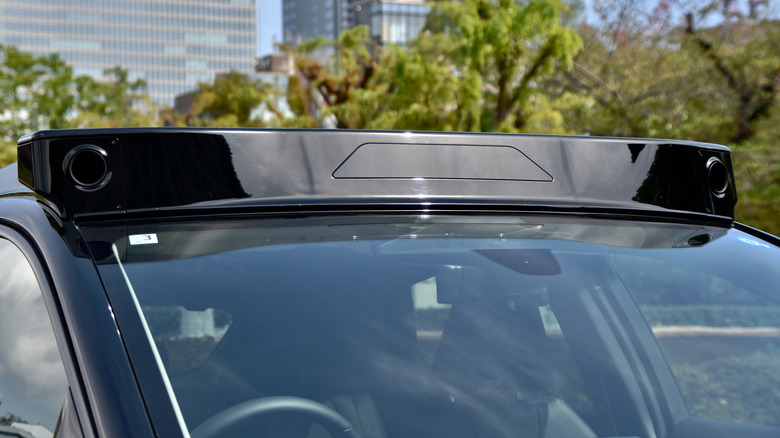
Developed in partnership with startup Wayve, AI software will enable Nissan's next-generation ProPilot system to offer end-to-end navigation on highways and city streets alike. That's made possible by the less-rigid AI model, which can quickly "learn" from the example of human drivers, allowing for quicker rollouts than previous rules-based models, Nissan claims. Due to launch in Japan in the 2027 fiscal year, the next-gen ProPilot uses 11 cameras, one lidar, and five radar sensors, though the AI only works with the cameras because its ability to react to things at longer ranges is limited.
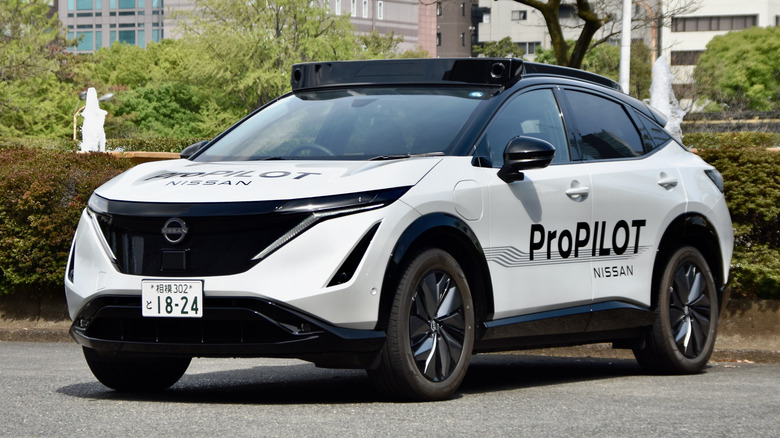
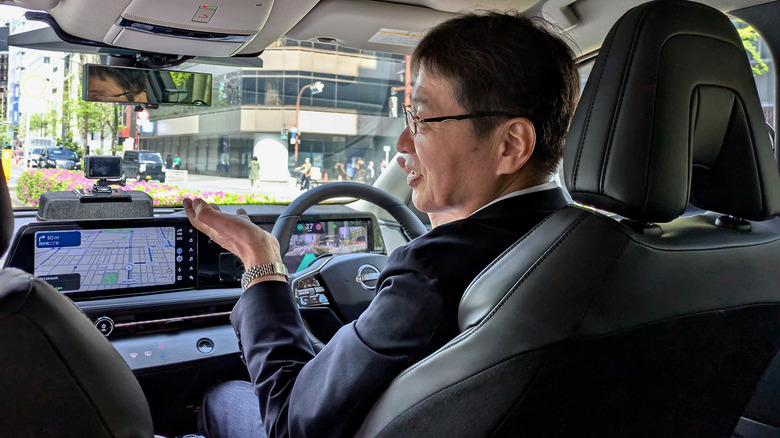
Starting near Tokyo Tower, a modified Nissan Ariya (an EV no longer sold in the U.S.) took me for a ride around Tokyo's crowded Ginza district complete with pedestrians, complicated intersections, and plenty of traffic. ProPilot was able to guide the Ariya smoothly through it all while the driver (a Nissan engineer) chatted with us passengers. It's certainly impressive, but it's also something Nissan was supposed to have ready in 2020. And with Tesla, Mercedes-Benz, and BMW claiming similar door-to-door capability, it's not the distinguishing feature Nissan hopes it will be.
Slop house
Over several days of conversations and presentations, attempts by Nissan executives to explain how they will integrate AI with vehicle cabins, and why that will be beneficial, were even more nebulous.
The automaker claims an in-development system known as AI Partner will encompass a smart voice assistant that can make proactive decisions based on things like what's in a driver's synced calendar, and the conversations between people onboard. Even the omnipresent shipboard computers in Star Trek aren't that nosy, and proposed benefits like being able to reroute around traffic jams (has Nissan not heard of Waze?) and explain roadside points of interest hardly seems worth the loss of privacy.
Perhaps fittingly, this was illustrated with a video that seemed to be made with AI, with all of the weirdness we've come to expect of that imperfect technology. The people may look like aliens impersonating humans, and may have the wrong number of fingers, but at least videos like this are quick and cheap to make. Exactly what you want in a technology controlling your car and organizing your life.
The technology Nissan really needs
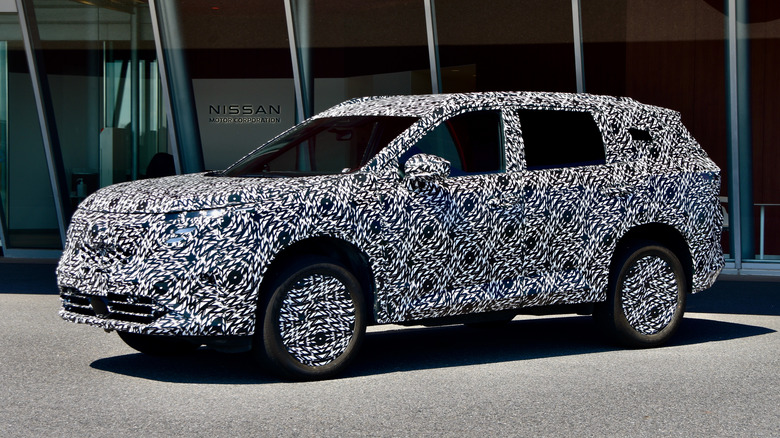
Automakers may be eager to capitalize on the AI zeitgeist, but software can't make a car go. For that, Nissan will increasingly rely on hybrids, with two systems coming to the U.S. over the next few years as Nissan undertakes a major revamp of its lineup. A new family of body-on-frame SUVs—including a revived Xterra—will have a V6 hybrid powertrain to maximize towing capacity. But first Nissan will finally bring its innovative e-Power system to the U.S. in the next-generation 2027 Rogue crossover.
This is the first true series hybrid system to reach production, although Honda's system and the Chevrolet Volt (may its memory be a blessing) powertrain have come close. Unlike parallel hybrid systems, exemplified by Toyota's approach, a series hybrid uses the engine purely as a generator, with all propulsion handled by electric motors. That creates an EV-like feel—complete with one-pedal driving—and potential for more engine-off or low-rpm operation, keeping noise down and fuel consumption minimal in stop-start urban traffic.
The 2027 Rogue gets the third-generation e-Power system (the first launched in Japan in 2016), with an efficiency-optimized 1.5-liter turbocharged three-cylinder engine that drops the variable-compression-ratio system used in the current non-hybrid Rogue. This version is already available outside the U.S. in the Nissan Qashqai, but in the Rogue an electric motor for each axle enables dual motor all-wheel drive.
Hybrid system really puts the e in e-Power
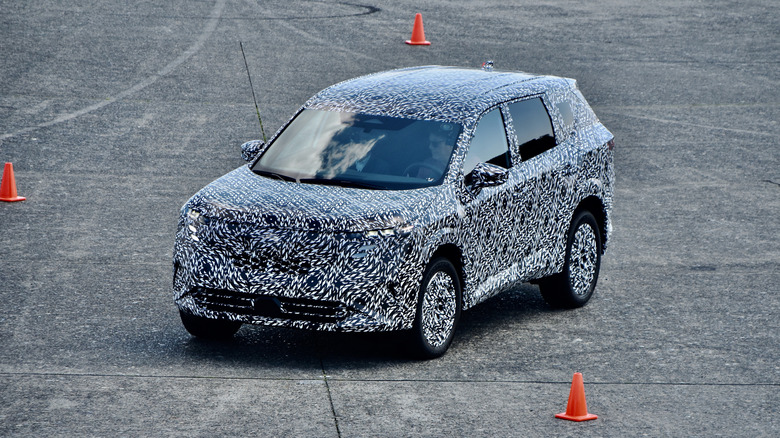
At one of the many Nissan facilities dotting the outskirts of Yokohama, a test track and a pair of cars waited. One was a current-generation Rogue in automotive journalist brown, the other a prototype of the 2027 hybrid model in full camouflage.
Two laps in the outgoing Rogue reconfirm that it's good, but not great, to drive. The engine feels punchier than its number of cylinders suggests, and steering and suspension are composed but only within a narrow envelope. Switching to the 2027 Rogue showed that this crossover was a perfect use case for a hybrid powertrain, and that e-Power does indeed offer something different.
Despite the occasional buzz from under the hood, the Rogue e-Power feels genuinely EV-like in the way it delivers its power. The level of regenerative braking is much greater than conventional hybrids, living up to Nissan's one-pedal drive claim. Nissan also incorporated a trick from the all-electric Ariya's e-4ORCE all-wheel drive powertrain, tying the motors into the chassis-control systems to help modulate pitch under acceleration and braking.
This hybrid system brings a new level of refinement to a category known for basic-ness. Electric-motor propulsion and strong regenerative braking make it easier to control acceleration and deceleration with precision. But we're yet to see EPA fuel-economy numbers, and this test drive didn't involve sustained running at highway speeds, which might generate more engine noise.
Zama keeps the dream alive
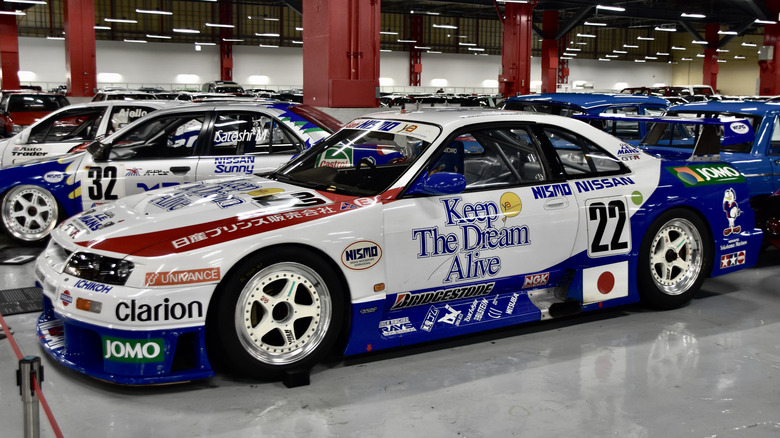
The proof that Nissan can solve these technical issues is housed in a former factory building in the city of Zama. The automaker's heritage collection is a nearly-complete catalog of past production models, as well as concept cars and racers rarely seen outside an auto show display or Gran Turismo menu.
From the humble Datsun 510 to the Skyline GT-R that slayed Porsches on racetracks around the world, the Zama collection is catnip for car enthusiasts. But the rows of 1960s sedans in one corner and sleek race cars in another are a reminder that Nissan's AI push goes against the currents of history. The tech industry has created an expectation of constant game changers, but in the auto industry, gradual evolution is the norm.
Cars like the GT-R and the Silvia and Z sports cars also serve as a reminder that Nissan has the institutional knowledge to make its latest hybrids more than just boring appliances. They inspire passion in the people that build them and the people that buy them, which is what makes cars different from the other machines that enable modern life.
Amid the fleet of race cars sits a 1995 Skyline GT-R LM wearing the slogan "keep the dream alive" on its doors. Nissan's executives should take a good, long look at it whenever they visit Zama.
Too many tech promises?
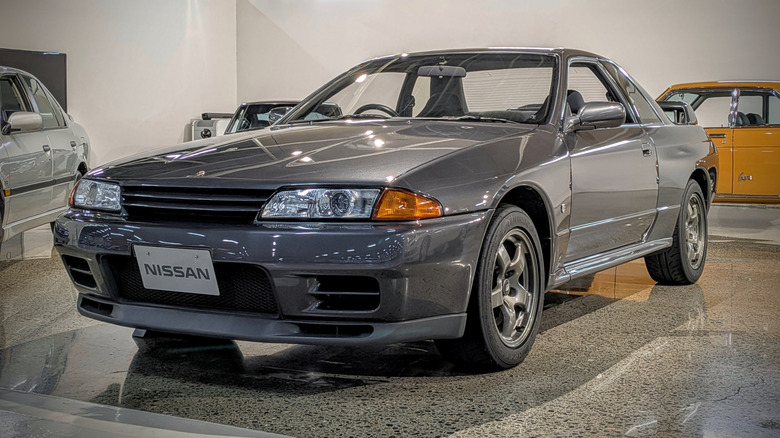
Those executives do seem to realize that sterile talk of convenience and commodified mobility won't be enough. Nissan just announced that it's not only bringing back the Xterra, but launching a "performance-oriented V6 sedan" for Infiniti to conjure the brand's early 2000s glory days. But these new models are mainly fan service.
The 2027 Rogue e-Power hybrid is much more important to Nissan's bottom line. The Rogue is its bestselling model, and a hybrid powertrain is pretty much obligatory in its market segment at this point. If e-Power can deliver competitive gas mileage at a competitive price, it could be the thing that pulls Nissan fully out of its slump, providing leeway for the enthusiast-oriented models while helping to reduce carbon emissions.
On the other hand, Nissan's talk of more-automated driving and AI-infused interiors seems aimed more at investors than customers. There's no firm timeline for when these technologies will be rolled out in the U.S., and while the prospect of a car that does most of the driving for you or an AI butler would be exciting if we were hearing about them for the first time, that's not the case.
Automakers and tech companies have been promising autonomous driving for over a decade, but aside from small-scale ride-hailing, it remains just that. And will people really get as excited about AI chatbots as the actual cars that built the Nissan legend?