

5 Legendary Mopar Cars That Weren't Built By Dodge
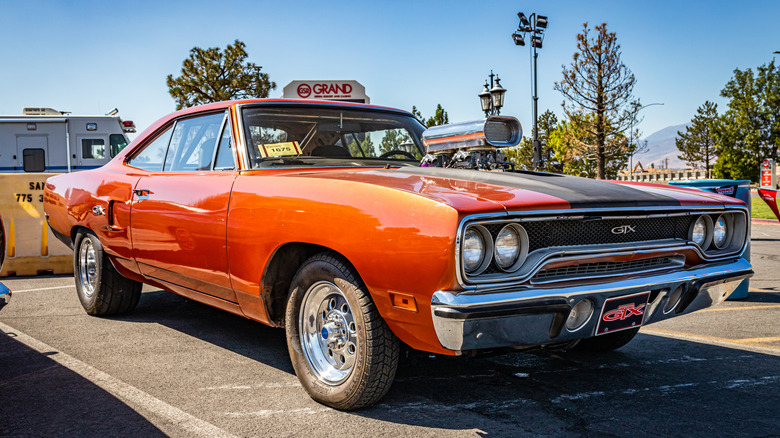
In American carmaking, there are few names that carry the weight Mopar does. The story of Mopar is a long one, dating back to the origins of the Chrysler Corporation. Even in the brand's early years, Chrysler was poised to make itself one of the world's largest automotive manufacturers with a series of acquisitions. In 1928, just three years after Walter Chrysler created the corporation, Chrysler bought Dodge. Soon after, between 1933 and 1937, Chrysler picked up DeSoto and Plymouth as well, and suddenly, Chrysler was at the head of a handful of different brands without a cohesive advertising strategy or overall identity.
Then, in 1937, as the conglomeration was releasing a line of anti-freeze products for their cars, they trademarked the name Mopar. At its genesis, the name, which was simply a portmanteau of motor and parts, was just meant to provide clarity to consumers about who made this anti-freeze product. The Mopar line expanded to include other automotive service products and parts, and it is now colloquially used to refer to cars from the Chrysler family. In the early '60s, Mopar established itself as a producer of performance parts and models that became synonymous with the golden era of muscle cars, and a big chunk of the era's superstars came from brands under the Chrysler umbrella. Most of these well-known Mopars are from Dodge, but Dodge is by no means the sole name behind these legendary machines.
Chrysler 300 Hurst
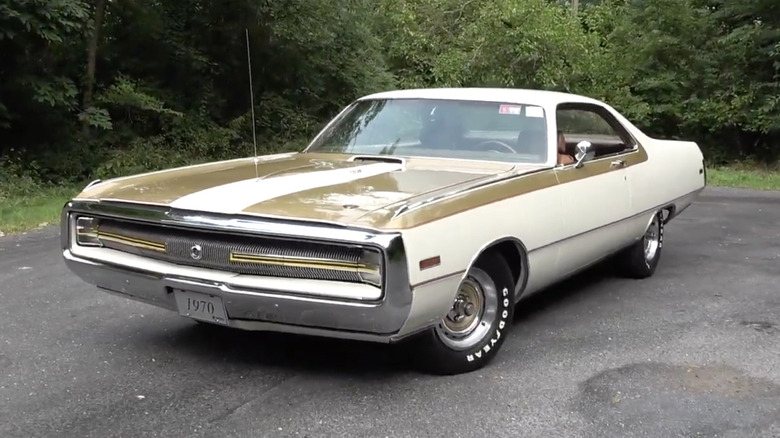
The Chrysler 300 is one of the brand's most recognizable nameplates, and in 1970, the 300 received a bit of special treatment. Enter George Hurst, a man with a passion for drag racing and the founder of Hurst Performance. The inception of the 300 Hurst starts with Jim Wangers, an executive VP at Hurst. He felt that Chrysler's decision to downsize the 300 in its recent model years before 1970 was a mistake, and that the American consumer still wanted something with real presence and Hurst-infused power. He approached Chrysler with the idea of bringing back the big guns, which Chrysler was receptive to, and the project eventually became the 300 Hurst.
The car itself is jaw-droppingly handsome. The 300 Hurst is nonchalant about its huge proportions with its outstretched hood and tail. The front fascia is clean and wide, with horizontal lines that convey confidence and sturdiness extending to the rest of the car's exterior.
The Hurst touch is present everywhere across this car. The 300 Hurst came with disc brakes, white-letter Goodyear tires, and a big, hungry V8 that pumped out a healthy 375 horsepower. The cars were shipped to Hurst to receive further upgrades. Hurst technicians installed various fiberglass exterior parts across the car, such as a hood with a "power bulge." The cars received further cosmetic enhancements in the form of racing stripe decals, golden accents, and a specific 300-H badge.
Plymouth Superbird
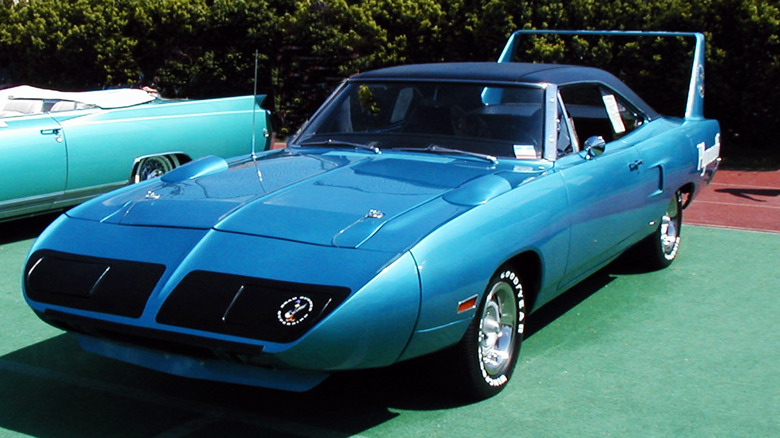
The Plymouth Superbird is the stuff of legend. Older car enthusiasts may recognize it from its NASCAR presence in the early '70s, while young enthusiasts recognize it as Lightning McQueen's light-blue hero in the movie "Cars." To all, though, the Superbird is recognizable for its iconic silhouette created by its drastic aerodynamic elements. Based on the Road Runner, the Superbird smoothed out the long, boxy shapes typical of muscle cars of the day with a shark-like nose cone and tall spoiler. These aerodynamic advancements weren't the only thing making the Superbird super, as it boasted a three-pronged array of muscled-up engine options, including a pair of 7.2-liter V8s with four-barrel and six-barrel carburetors that produced 375 and 390 horsepower, respectively, and a 6.9-liter Hemi V8 with 425 horsepower.
Even the Superbird's inception is drenched in racing pedigree. NASCAR superstar Richard Petty, nicknamed "the King," departed Plymouth for Ford in 1968. Plymouth wanted this NASCAR royal back in its driver's seat, and so it devised an offer, or more literally a car, that Petty couldn't decline. The Superbird proved enough to lure Petty back to Plymouth in 1970, proving Plymouth's automotive honeypot operation successful. Sadly, just a year after its introduction to the consumer market, the homologation rules changed, and production ceased, making it a rare Mopar treasure.
Plymouth GTX
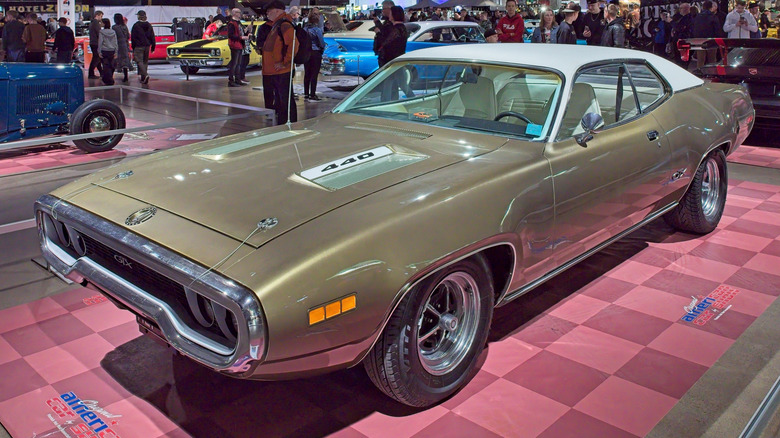
It's not often that the words "gentleman" and "hot rod" are associated, yet the Plymouth GTX was known for just that combination. So what makes the GTX the gentleman's hot rod? Much of the muscle car market at the time — that time being the late 1960s — was occupied by the most raucous and rough-edged cars you could find. But not everyone who wanted the muscle car experience was a fresh-faced kid with no second thought about comfort. For those who wanted more than the bare-bones debauchery of the stripped-down muscle car, Plymouth made the GTX.
Introduced in 1967, the GTX had a short five-year lifespan, sharing its base with the Plymouth Belvedere. Despite the GTX's more reserved character, it was still very much a muscle car. The final 1971 model-year version is the most fully realized GTX. It retains those muscle-car proportions, with a long, bulging hood and swooping roofline. It's aggressive, but very clean with chrome details and uncreased sides, making for a car that is somehow both assertive and gallant.
Under that large hood is a similarly large 7.2-liter V8 that produced 375 horsepower. The GTX's short production run makes it rare, and the 1971 model especially so, with fewer than 3,000 models being produced. The GTX's rarity, styling, and power are all exemplary characteristics of what makes Mopars so special.
Jeep Grand Cherokee Trackhawk
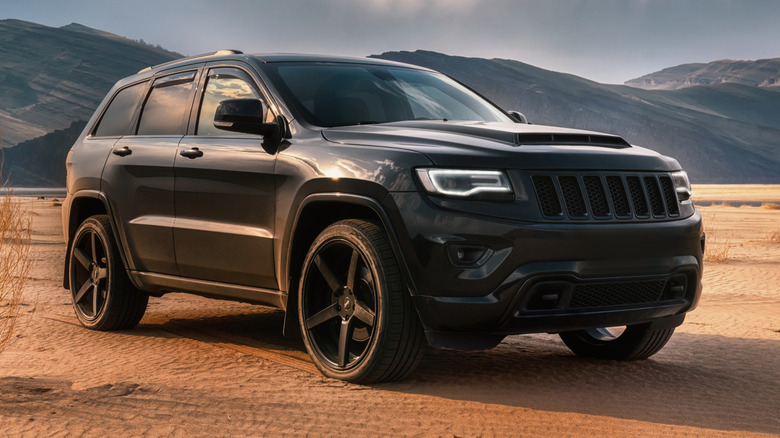
With all of Mopar's blasts from the past, it can be easy to forget that its brands are still producing cars today. Granted, the golden era of truly unhinged American muscle is all but behind us, but there are still some Mopar creations that keep that flame flickering. One such example that sums up the muscle car's unapologetic nature is the Jeep Grand Cherokee Trackhawk. It might seem strange to classify an SUV as a muscle car, but there is no denying the Trackhawk's merits, which begin with a bang in the engine bay. The Trackhawk looks almost regular, but under the hood is Mopar's supercharged 6.2-liter Hellcat V8, which produces 707 blood-boiling horses.
Although the Trackhawk is an SUV, the fact that Mopar decided to bless it with the legendary Hellcat engine is perhaps more in line with the ethos of a muscle car than an actual muscle car. One advantage is the Grand Cherokee's power delivery. The Hellcat engine pushes out an obscene 645 lb-ft of torque, plenty to send you into a ditch or a wall without much effort. However, unlike the rear-wheel-drive behemoths of the past, power is delivered via the Grand Cherokee's all-wheel-drive system, making for more predictable and faster launches that help the Trackhawk hit 60 mph in just 3.5 seconds. This eliminates the quintessential muscle car proclivity for burnouts, but the Trackhawk remains a real Mopar monster through and through.
Chrysler Imperial Crown/Lebaron
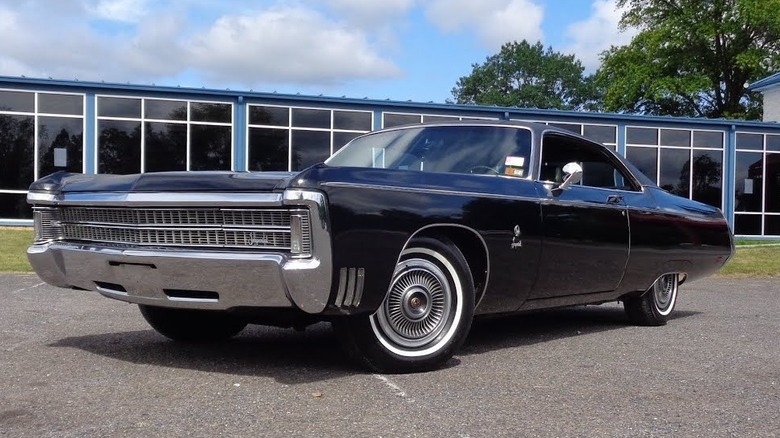
If the only Crown you've ever heard of sits on the head of royals, or comes from Toyota, and LeBaron reminds you of nothing other than a famous basketball player, you might be scratching your head and wondering just what the Imperial Crown and LeBaron are exactly.
The Imperial name has long since disappeared into the fog of the past. In the '50s and '60s, Cadillac and Lincoln dominated the American luxury car market. Chrysler had to respond, and it came in the form of Imperial — a new line of ultra-snazzy Mopar-made American land yachts. Imperial's bread and butter became the Crown and LeBaron.
Imperial's heyday lasted from 1940 to 1970, during which the Crown served as the foundational model, and the LeBaron as the flagship magnum opus. The common denominator between the two cars was an affinity for excess. The Crowns were all big, long, and pretty, and the LeBaron took those good looks and spruced them up even more.
The final LeBaron, produced from 1969 to 1970, was, of course, the ultimate summary of the Imperial lineage. It had beautiful styling paired with some serious Mopar power under the hood in the form of a 7.2-liter V8 that produced 350 horsepower and 480 lb-ft of torque. That power was delivered via Chrysler's Torqueflite three-speed automatic transmission. This behemoth reached 60 mph in 9 seconds. That raw power, combined with buttery smooth driving dynamics and an interior fit for a king, made this Mopar a true last hurrah for the Imperial brand.