

5 Of The Best-Looking Mid-Engined Sports Cars We've Ever Seen
If you talk to sports car fans and enthusiasts, you'll probably hear differing opinions about which is better: front-engined or mid-engined sports cars. Both have their own pros and cons and unique driving characteristics, and the layouts will also impart a certain look, most evident in the radical exterior change the Chevrolet Corvette underwent after its switch from a front-engine to a mid-engine platform.
With their engines mounted behind the cabin, mid-engined sports have a distinct profile that often brings to mind high-end, exotic European supercars. It's a look that survives even when scaled down to less expensive, more mainstream-oriented cars, resulting in some beautiful vehicles. So with that in mind, we've rounded up five of what we think are the best-looking, most handsomely designed mid-engined sports cars of the modern era.
Now, there are countless beautiful (and incredibly expensive) mid-engined exotics that we could include on a list like this, but we've left some of the obvious choices out to keep things interesting. Thus, no exotic Ferraris and Lamborghinis here. Even so, we have a diverse mix of machinery that includes mid-engined offerings from Japan, the United States, and Europe, with engines ranging from modest, low-power four-cylinders to fire-breathing V8s.
Toyota MR2 (second generation)
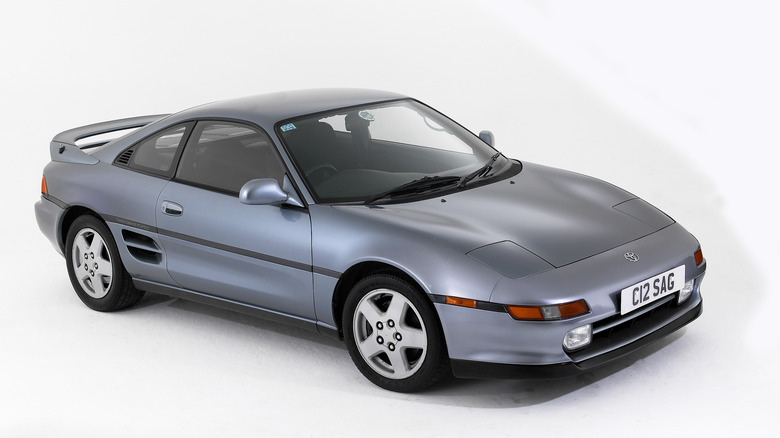
Along with the front-engined Mazda MX-5 Miata, the Toyota MR2 is one of the most popular lightweight sports cars to come out of Japan. The MR2 debuted in the early 1980s and was built over three distinct generations before being discontinued in the mid-2000s. Each generation of the MR2 has its own personality and following, but from a design and performance standpoint, it's the second generation that represents the MR2 at its peak.
The second-generation MR2 debuted in Japan in 1989 and was on sale around the world shortly after. With its wider profile, its flip-up headlights, and distinct side vents, the second-generation car had a more aggressive look that, to some eyes, looks a lot like a scaled-down version of the Ferrari 348. The second-gen MR2 also had the performance to back up its look. Thanks to the 3S-GTE engine under the hood, Car and Driver got the MR2 Turbo to 60 mph in just under six seconds — very impressive by early '90s standards.
To do all this at a relatively affordable price — $20,000 or so for the Turbo in 1990 — shows just how powerful Toyota was during this time. Today, along with the Supra it shared showrooms with, the second-gen MR2 is considered one of the most desirable Toyotas of its time, and especially in turbocharged form, one of the most desirable Japanese sports cars of the '90s.
2004-2006 Ford GT
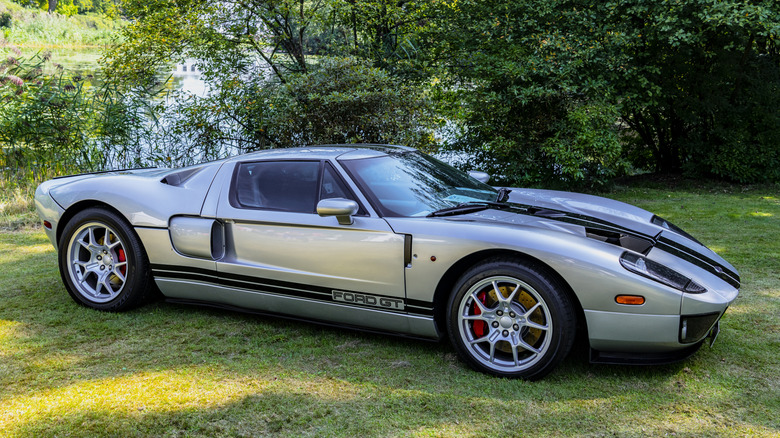
When Ford designers started working on the automaker's mid-2000s Ford GT revival, they had a pretty big head start in creating a beautiful car. That's because the design of the Ford GT was heavily inspired by the attractive and legendary Ford GT40 race car of the 1960s. Still, retro design isn't always as easy as it looks, and it doesn't take much for retro cars to veer into the tacky, but the GT's designers absolutely aced their mission.
The modern road-going Ford GT is a much larger car than the GT40 it's based on, but the lines are so good that you don't realize that until you actually see the two cars side by side. The GT's attractiveness carries over to the interior as well, with a wonderfully executed modern interpretation of 1960s design. Of course, it also doesn't hurt that it's got a mid-mounted supercharged 5.4-liter V8 mated to a manual transmission.
Because the initial design was executed so well, the 2000s Ford GT has never felt dated in the way other cars from its era might. Design-wise, it almost feels like a remastered car from the '60s rather than a product of the 2000s. All of these are reasons why, despite only being a little over 20 years old, the value of the mid-2000s Ford GT has climbed tremendously, with the car now becoming a highly desirable modern classic in its own right.
Lotus Elise
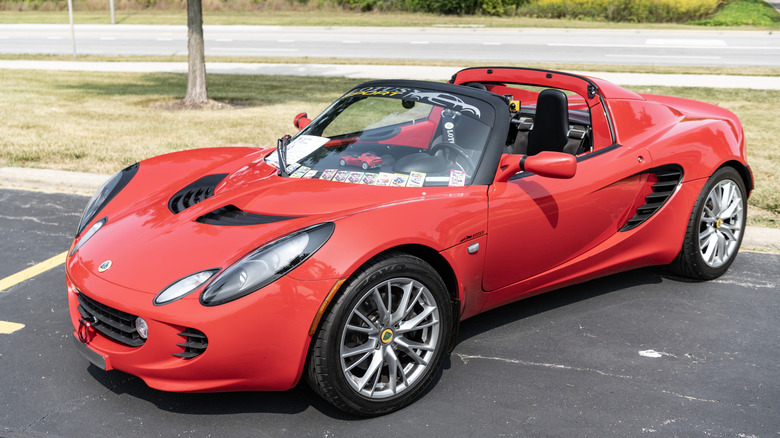
A sports car's appealing design need not be tied to its physical size or amount of horsepower. Case in point: the Lotus Elise. The Elise is considered one of the purest sports cars of the modern era, with a platform and design that stretches back to the mid-1990s. While some could argue that the Elise isn't a traditionally beautiful sports car, much of the Elise's beauty comes from its focus on simplicity. The Elise evolved significantly between its mid-'90s debut and the end of its production run in 2021, but the car never strayed from its mission of delivering lightness and response over all else.
The later variants of the Elise sold in North America use modestly powered Toyota four-cylinder engines, with the Elise's light weight meaning it didn't need massive amounts of horsepower to offer a fast and highly enjoyable sports car experience — part of why drivers love this car. Design-wise, the Elise is all about compact minimalism, and its svelte body lines and distinct round tail lights helped give the Elise its signature look.
Its attractive looks and go-kart-like handling are just a couple of the reasons why both the Elise and its closely-related counterpart, the Lotus Exige, have emerged as genuine modern classics. With its focus only on the essentials, the Elise is the antidote to the high-horsepower, overweight, and often overstyled modern performance car.
Alpine A110
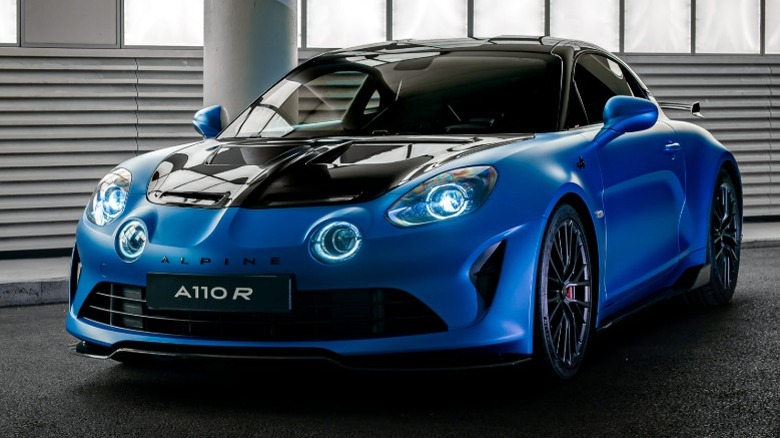
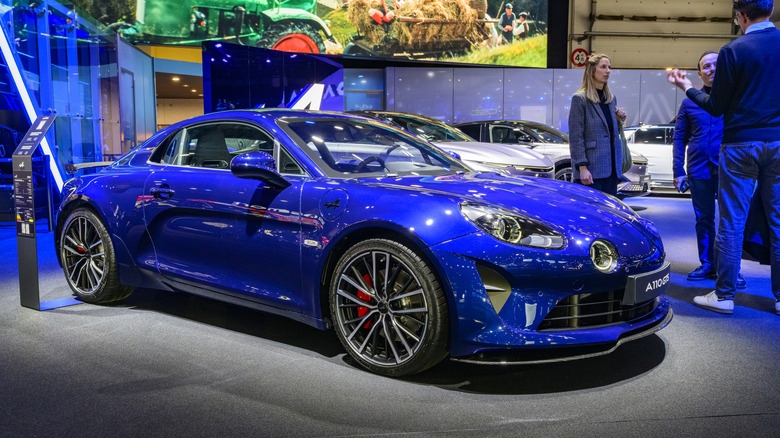
Like the reto-styled Ford GT, the modern Alpine A110 is a modern, mid-engined sports car that might technically be cheating with its good looks. That's because, like the Ford, the A110 is a modern reinterpretation of an iconic 1960s design — and one that happens to be done very well.
The modern Alpine A110 (which is built by Renault) debuted in the late 2010s to wide acclaim as a rival to the Porsche Cayman. Boasting a mid-mounted turbocharged four-cylinder engine and a low curb weight, the A110 took its design inspiration from the original, rear-engined Alpine A110 of the '60s and '70s. Among the styling traits that carried over to the new A110 are the original's quad front headlights and wrap-around rear window.
To this point, the biggest problem with the A110 is that, like other French models, it's not offered in North America. In fact, it might just be the coolest modern performance car that's not currently sold here. There have been rumors and serious speculation that the A110 will eventually make its way to the United States, although we don't yet know whether it will be as a gasoline model or as a next-generation electric Alpine sports car.
Honda/Acura NSX
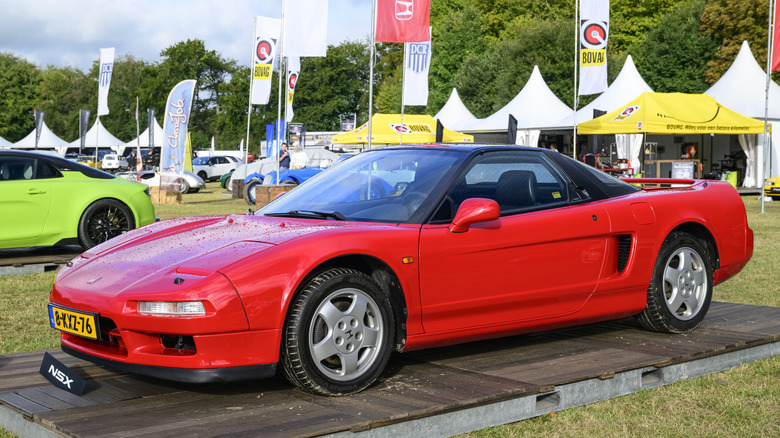
Sometimes a sports car is a hit from the moment it debuts; other times, it ages nicely and becomes a favorite for a new generation of enthusiasts. In the case of the highly unique Honda (or Acura) NSX, it's both. When the NSX first debuted in 1989, the car was a game-changer. It wasn't just an impressive Japanese sports car; instead, it was a bona fide, homegrown Japanese exotic laced with Honda's racing DNA.
Thanks to design choices like an all-aluminum construction and a mid-mounted, naturally aspirated VTEC V6 engine, the NSX had the performance and feel of a Ferrari — but in a more affordable and more reliable package that could be serviced at your local Honda or Acura dealer. In comparison tests, it edged out its more established performance car competitors. Design-wise, the original NSX was somewhat restrained, but its clean lines have aged extremely well, making it a favorite even among those born too late to experience its original run.
When new, the NSX had a relatively affordable price tag for what it delivered, but values have climbed substantially in recent years, with certain examples crossing the $300,000 mark at auction. While many subsequent Japanese sports cars have eclipsed the original NSX's performance benchmarks, its aura is still unmatched.