

12 Interesting Facts You Probably Didn't Know About Home Depot
If someone says "home improvement," one of the first names that pops into your head is inevitably Home Depot. The store has been around since 1979 and epitomizes American do-it-yourself culture. Where else can you have someone cut your wood for you and then grab a burger to go in one place?
It's not without its faults, of course, as there is a long list of things people hate about shopping there. But if you need a 2x4 or some nails, your only other option is probably Lowe's. And, well, that's all there is to say about it, right? Watching paint dry is more interesting than spending any amount of time thinking about Home Depot... until you dig a bit deeper into the brand.
Reading Home Depot's corporate-speak About page is excellent if you want to put yourself to sleep, but we're not going to stop there. There's some fascinating stuff about the company's history. Some good, some bad, some just weird. Here are 13 interesting facts about Home Depot.
There's a Home Depot in all 32 Mexican states
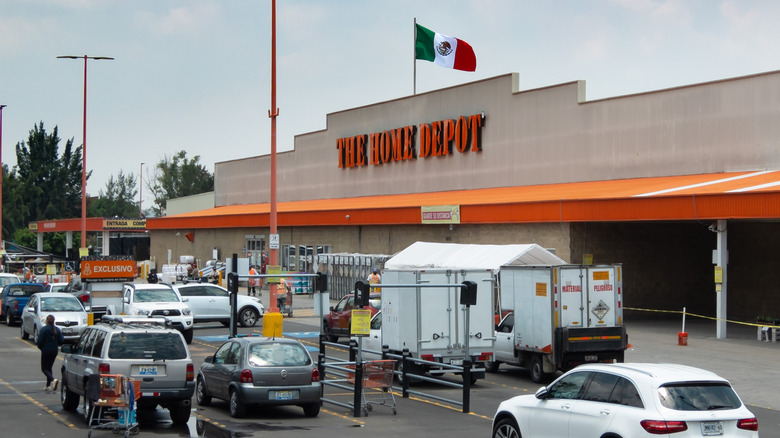
Home Depot seems like a distinctly American thing. You wouldn't ever expect to see one in Russia or Tibet. And that's true for the most part, with over 2,000 stores in the United States, plus almost 200 more in Canada and a smattering in territories like Guam, Puerto Rico, St. Thomas, and St. Croix. No Berlin, Abu Dhabi, or Tokyo locations. But guess what? There are almost as many stores in Mexico as in Canada. 140 as of 2025. No manches, wey.
Home Depot began to stake its territory in Mexico in 2001 with its first store in Nuevo Leon. Then, in 2002, it bought out the Del Norte stores and rebranded them. By 2003, it had stores in 10 Mexican states, and by 2005, 24, for a total of 50 stores. It only took until 2014 for there to be a Home Depot in every state of Mexico, and that includes its online store. Que pedo.
Admittedly, this is probably only a shock to us gringos who sometimes forget there's a world outside the United States. Home Depot is far from the only seemingly uniquely American store with a Latin American presence. Walmart Mexico has over 3,000 stores, for example. So next time you're in Cancun and you need to grout a shower or something, know the Cancun branch isn't far from the beach.
It owns 6 other companies

Like most big companies with humble origins, asking who actually owns Home Depot is going to get you a very predictable answer: shareholders. Home Depot is absolutely not the little mom-and-pop shop that it used to be in the late 70s. As such, it's expanded its reach to gobble up other, smaller brands and stores.
For example, did you know that Husky is one of the tool and supply brands owned by Home Depot? Home Depot also acquired some perhaps lesser-known brands, like Compact Power Equipment Inc. and HD Supply. Many of these acquisitions were big, multi-million or multi-billion dollar buyouts. Even Blinds.com is a Home Depot property.
According to Britannica Money, this expansive growth started not long after Home Depot entered the home improvement market. It already had a pretty corporate growth-at-all-costs strategy by the mid-80s that put it ahead of Lowe's only a decade into its existence. You'll remember that it acquired Del Norte to get its foot in the door in Mexico, for example. The company is powerful today as a result, with a market cap of $372 billion.
Home Depot was not the first name idea
Remember, the Home Depot came into existence in the late 70s, so it's interesting that it has a fairly plain name instead of a goofy one from the time. The thing is, it almost got one. Home Depot could have been "Ye$ You Can $ave." Rolls right off the tongue. A few others that thankfully ended up on the cutting room floor were "SaveX," with a green logo a bit too close to the "Subway" logo, and "MB ValuMart." Then there was "Bad Bernie's Buildall" which would have had a man in a prison uniform as the mascot. Okay, on second thought, that last one would have been pretty hilarious.
Many of these names were seriously considered; you can find illustrated mock-ups showing what the storefronts might look like. The name we know and love today, though, was thanks to investor Marjorie Buckley, who came up with "depot" aspect when seeing a train depot converted to restaurant (via Business Insider). Good choice, Marjorie. So in that light, the stenciled lettering makes sense since you'd see the same on freight cargo boxes or DIY projects.
The Home Depot logo is probably so distinctive because it was designed by the legendary Don Watt. You've probably never heard of him, but you have heard of the brands he's designed; Walmart Super Centres and Sam's Choice, to name a couple. The Home Depot logo has mostly remained the same since its creation to this day — thankfully, it hasn't taken the same journey as the Firefox logo.
The founders were sacked from their home improvement jobs

Corpos love a good comeback origin story. Steve Jobs, one of the first Apple employees, famously quit and returned to Apple almost a decade later. Home Depot has its own get-fired-and-rise-from-the-ashes tale. Founders Bernie Marcus and Arthur Blank got the boot in 1978 when working for the Handy Dan Home Improvement Centers, according to Home Depot. That same year, they envisioned the store we now know while at a Los Angeles coffee shop — the typical "big store, lots of products, best prices," but with the added flair of employees who would provide professional assistance.
The way Home Depot depicts it, it seems like two regular guys losing their 9 to 5s, but in reality, Marcus and Blank were both entrenched in Handy Dan's higher management; Marcus was head of the LA Handy Dans, and Blank was CFO. In their "Built from Scratch" semi-autobiographic novel, both describe how they went in one day expecting a normal meeting and walking out shortly after being unemployed. The reason? It seems the boss, Sigoloff (the aptly named "corporate turnaround expert"), leapt at the chance to do a typical cutthroat, corporate house cleaning.
Marcus and Blank could have pursued legal action, and that's what they were doing until Sol Price (one of Costco's patron saints) told them not to die on that hill, and instead charge it to experience and make his dreams come true. And yes, they did actually cook it up in some coffee shops.
It once released a View-Master DIY reel
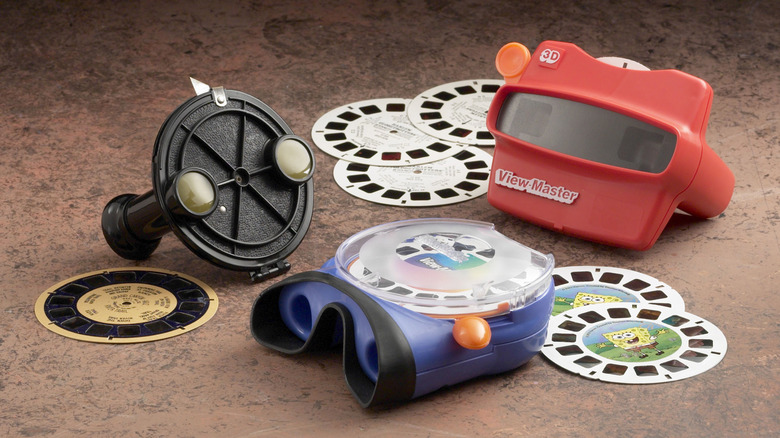
Only 80s and 90s kids (and probably some 60s and 70s kids) will remember the View-Master. This is the stereoscope toy that uses circular reels that produce 3D images, advanced one-by-one with the pull of a lever. Though ironically, it wasn't originally intended for children. The military imagined soldiers using it for spotting and identification. Mattel once collaborated with Google on a Cardboard View-Master, but that seems to be the last of the brand since then. Anyway, not to bury the lede, but Home Depot briefly made one of these, too.
Back in 1995, Home Depot released its DIY super manual "Home Improvement 1-2-3." You can still buy one of these things from Amazon today, though the material may be dated. Basically, this was a fix-everything guide packed with how-tos and pictures.
According to Home Depot, the View-Master was a promotional item for the book, not a cool, 3D stereoscopic DIY guide, unfortunately. We trawled the internet to find anyone who might have owned this or used it, but came up short. Nonetheless, it's a positively goofy 90s idea to imagine someone fixing an engine while peering through a View-Master to follow instructions.
The first customers were literally paid to shop there

In 1979, Marcus and Blank moved to Atlanta, where they'd christen the first Home Depot stores. The first would officially open its doors on June 22nd. According to "Built from Scratch," there was a whole plan for a newspaper ad run; remember, nobody knew about Home Depot back then, so aside from the eyeball traffic of people driving by, they needed to make a big splash, and fast — they were burning money on their leases and payroll, so they couldn't even afford a television ad break. But there was a mix-up in the pipeline, and the ad didn't run the day before, as planned, instead running the day of.
Refusing to admit defeat, they cooked up a plan: give people money to shop there. Foolproof idea, right? Wrong. $700 in ones (that's over $3,000 in today's money) were distributed to anyone who would take them by the founders' own immediate family members. But as Marcus and Blank recount in their novel, some people simply weren't interested. To add insult to injury, they had leftover bills when the day was through. Would you shop at a store you had never heard of if a kid suddenly ran up to you offering a $1 bill in exchange? Probably not. But alas, Home Depot is still around today, and as a consolation prize for the newspaper's gaffe, Home Depot got some back-page ad space.
Somewhat tongue-in-cheek, the very newspaper that was supposed to run this ad all those years ago — the Atlanta Journal-Constitution — wrote an article on this in 2025. They even admitted it, describing it as a "botched ad" that soured what would go on to be an entirely new, one-of-its-kind store. Ironic.
Early stores faked forklift skid marks and full shelves

Remember, Home Depot was new meat competing against the established home improvement stores of the day, probably including its now-bitter enemy, Handy Dan. Failed ad run aside, it needed to make a good first impression. According to "Built from Scratch," the store managers thought that the best thing to do was make the floors sparkle like the Chrysler Building — failing to recognize this was a home improvement environment, where oil, scrapes, and stains are a good thing. This was all on opening day, mind. So they literally raced around in forklifts to create months-worth of skid marks in however many hours they had till opening.
That wasn't all. They also borrowed boxes from a local cabinet company to make the shelves look like they were packed to bursting. Empty paint cans were also stacked tall. It's unclear if this technique was effective, or if any customers accidentally grabbed an empty container — but it's fun to imagine.
That orange color is trademarked
The Home Depot logo has effectively remained identical to the original from decades ago. As established, it's meant to look like something that you would see stenciled on a crate at a rail yard or a DIY job. Simple, effective, and unique. However, Marcus wasn't a fan of the color at first.
So why the color orange, then? Don Watts — the famous designer of the Home Depot logo — may have chosen it because it was cheap to acquire canvas from circus tents. Watts argued that people think of value and energy when seeing it. That, and it probably catches your attention when driving by, and makes it difficult not to find one of those aproned employees.
Home Depot is quite protective (legally speaking) of its branding, from the "depot" verbiage, to the stencil look, to the color they're so well known for. Just try using the word "depot" in a business name and you might get a scary legal letter. Best of all, Home Depot has a trademark for the color orange. No, really. Check it yourself, especially the "prosecution section" detailing entities that have been threatened with legal action for misusing the orange. This is funny, because Marcus initially wasn't huge on the design and color. Now the company even uses the term "breeding orange" to refer to living its values.
Atlanta's Pinewood Studios had its own exclusive Home Depot

Movie sets are not cheap. Some films, like "Saving Private Ryan," built entire fictional towns only for a couple dozen minutes of footage. That all takes a ton of materials, and what's a great place to get all those materials from? Home Depot. In 2014, Home Depot built a location that could only be used by the Fayetteville-based Pinewood Studios in Georgia. No locals could shop there. This studio went on to partake in the production of several Marvel movies, including "Spider-Man" and "The Avengers."
Allegedly, store employees had to sign non-disclosure agreements since movie production staff might be discussing important details about upcoming films, and the occasional celebrity might pop in. Unfortunately, that's all we really know about this unique Home Depot location. Did the set designers walk into Home Depot — one they had all to themselves — and buy their 2x4s like the rest of us? We may never know.
In 2019, Pinewood's parent company seemingly decided to put a pause on the Fayetteville, Georgia, location. The future seemed uncertain. Then, in 2020, plans were made to significantly expand Pinewood Studios but under a new name, Trilith. It's unclear if that Home Depot location is still there, and if so, how much of a role it still plays.
It tried (and failed) at gas stations
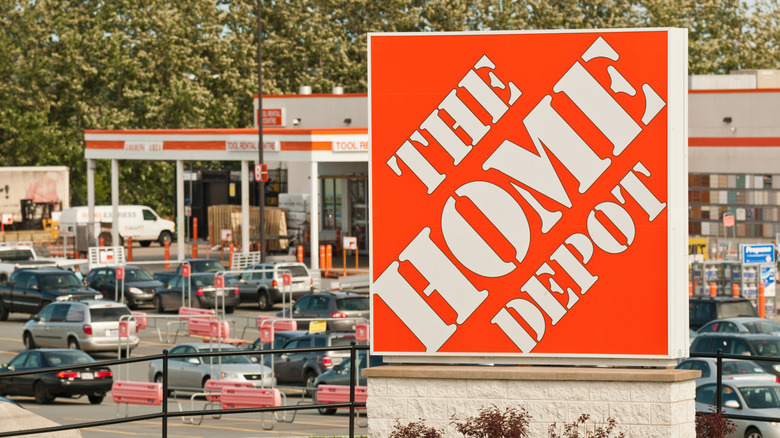
Home Depot seems like the perfect captive audience to sell food, fuel, and car washes. Its customers are often people hungry from hours of manual labor, driving dusty trucks back and forth between project sites. In 2005, it tried to tap this market with convenience store/car wash/gas station combinations called Home Depot Fuel. Basically it was a Home Depot-branded store, with a couple advantages for its special clientele. Pumps designed for larger vehicles, for example.
There were allegedly plans to expand out to hundreds of locations, but years later in 2012, Home Depot Fuel had long since tapped out at six total locations — so if you're wondering why you never saw one back then, that's why. At the time, they spoke positively about the Fuel side of their business, but clearly communicated that they wanted to focus on Home Depot itself. By 2017, it was all over. Home Depot quietly sold off the real estate. For whatever reason, this seeming goldmine of an idea wasn't worth it.
It once had an Olympic athlete hiring program
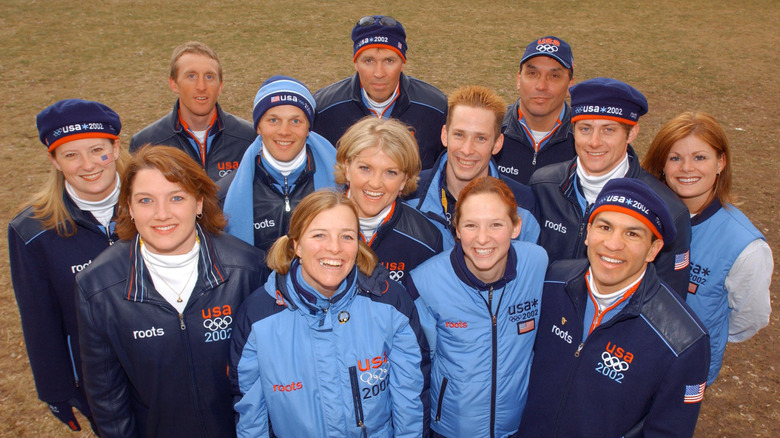
Hiring programs are pretty common with big corporations. They're good PR and offer opportunities to people who need them most. Home Depot instituted the Olympic Job Opportunities Program, or OJOP, for hiring Olympic athletes in 1990. Throughout the 90s, they sponsored the Olympics heavily. According to Home Depot, it had hired 660 athletes by the time the program ended in 2009. Some went on to build their careers with Home Depot.
Admittedly, some of this was for the clout of having Olympic athlete employees. Imagine what it could do for morale if your co-worker were Michael Phelps. The athletes only had to work part-time, but were rewarded financially as if they worked full-time, even getting paid while traveling. This was a huge financial boon for a person who needed both money and time to train. Julia Chilicki told the New York Times in 2000 how important working at Home Depot was for her to compete.
Why did the program end? It's anyone's guess. The answer reported to Reuters in 2009 is pure corporate speak. It wasn't just the athletes; Home Depot has not been an Olympic sponsor for some time now. Years later, after remaining Olympic employees would have been made regular employees without Olympic benefits, The Onion quipped that Home Depot wouldn't give them time off to compete.
There was a cat living at one location for 13 years

In the Bluffton, South Carolina, Home Depot location, a regular customer had been going there for 13 years — but it wasn't a person; it was a cat. The cat — named "Depot" — quite literally lived inside the store, was beloved by employees, and friendly to customers — until one day it was decided the cat had to go. The official reason provided was that she was causing after-hours alarms to go off. The location promised to put her up for adoption in 2014 rather than simply throw her out. Almost 2,000 people signed a petition to let Depot stay.
And guess what? There's a happy ending to this story: they succeeded. Home Depot spokesman Catherine Woodling told the Charlotte Observer that Depot would remain indefinitely unless given a better home. Woodling said people were so desperate to save the cat that she got offers from the other side of the globe to adopt her.
Depot's fate after 2014 is uncertain. By then, she was already at least 13 years old, and sadly, the petition creator reported in 2018 that she had run away before Christmas.