

The 2026 Trailseeker Is The First EV That Really Feels Like A Subaru
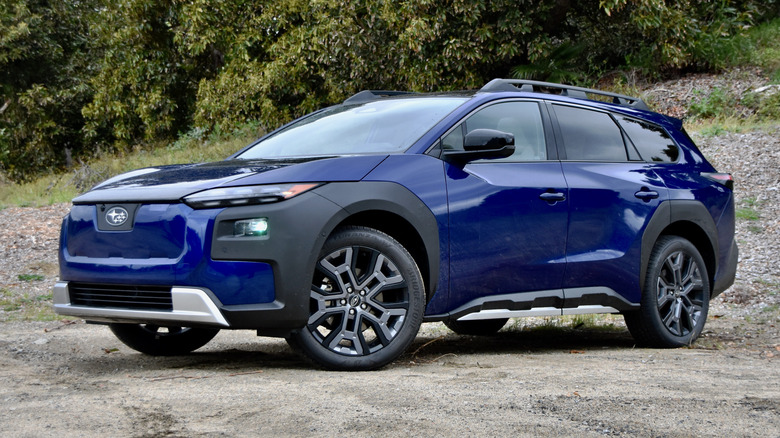
In the rush to create a stable EV market before burning through too much cash, automakers have generally stuck to the lowest common denominator. Small crossover SUVs and big pickup trucks are the most popular segments in the United States market, so they were also the first priority when established automakers started rolling out EVs in earnest. Mass appeal is important, but it doesn't leave much room for creativity or individuality.
The Subaru Solterra and Uncharted are part of that crossover herd, but for its third U.S.-market EV, Subaru is finally trying something different. The 2026 Subaru Trailseeker follows the trail of the Outback—the car that made Subaru a household name on this side of the Pacific—with wagon-like styling and utility. Like Subaru's other EVs, it does have a Toyota twin—the bZ Woodland—but Subaru is quick to note that it did the majority of the work on the Trailseeker.
And it shows. Subaru's many loyal customers will feel more at home in a Trailseeker than in any other Subaru EV to date, making it a nice change of pace from typical electric crossovers.
It looks more like an Outback than the Outback
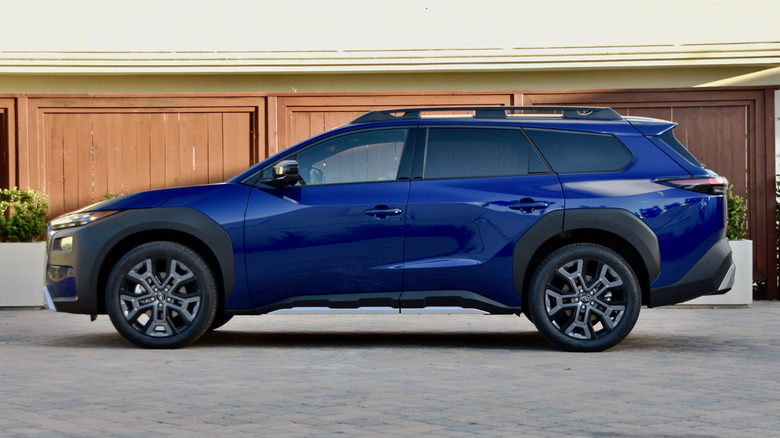
Subaru still calls the Trailseeker and SUV, but its shape is more that of a lifted station wagon. The silhouette instantly calls the Outback to mind, and while it might be a stretch to describe the Trailseeker as pretty, it's a lot less ugly than the current-generation Outback, which has jumped the shark of plastic cladding and rugged styling cues.
There's still plenty of cladding here on the rocker panels and fenders, but it's well balanced with the painted sheetmetal. The Trailseeker's more rounded shape also feels like more of a direct evolutionary step from previous Outbacks, as opposed to the current Outback's deviation into upright angularity. So is the full-width tailgate light bar with "Subaru" lettering, a styling feature from Outbacks of the early 2000s that tugs on Millennial heartstrings. The stamped lettering in the oversize rear bumper of the current Outback, in contrast, is just derivative.
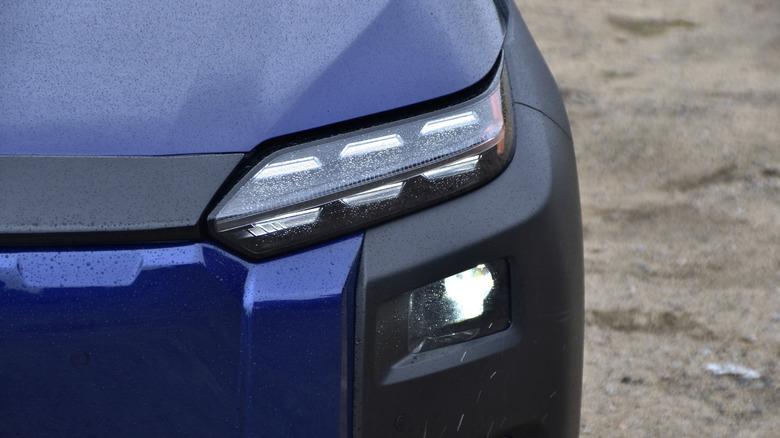
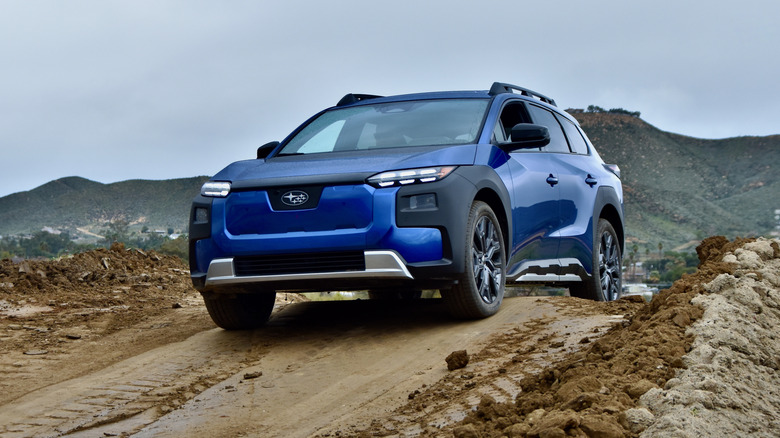
Up front, the Trailseeker has the same phantom grille and six-element daytime running lights (representing the number of stars in the constellation Pleiades, depicted in Subaru's logo) as the Uncharted and the facelifted 2026 Solterra. It looks just as good here, helping distinguish the Trailseeker from its Toyota sibling, although the surrounding cladding looks more like somebody forgot to apply some paint rather than an intentional styling decision.
It hauls more than just cargo
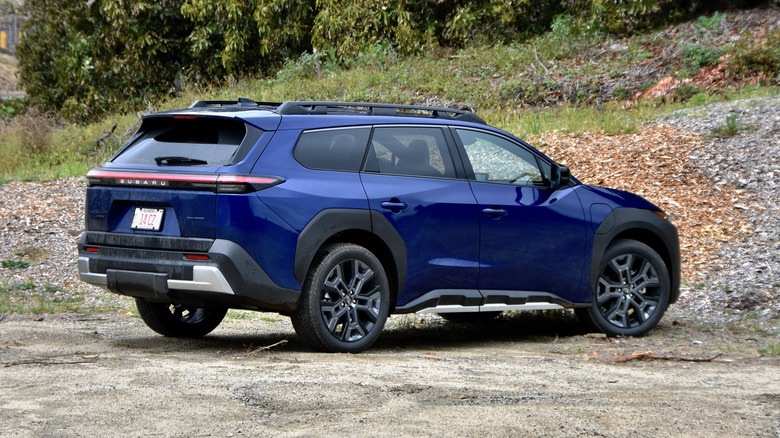
Subaru combined the Outback looks with WRX performance. The standard dual-motor all-wheel drive powertrain produces 375 horsepower—more than you get in a base Hyundai Ioniq 5, Kia EV6, Ford Mustang Mach-E, or Chevy Blazer EV. With the possible exception of some JDM special editions, that makes the Trailseeker the most powerful Subaru production model to date.
It's also the quickest Subaru ever sold in the U.S., with a factory-estimated zero to 60 mph time of 4.4 seconds. Granted, that's only 0.3 second quicker than what Subaru claims the 2026 Uncharted will do with its optional all-wheel drive system. Despite being dimensionally smaller, an all-wheel drive Uncharted actually weighs about the same as a Trailseeker (both tip the scales at around 4,400 pounds), but has a 37 hp deficit. Both EVs use the same 74.7 kilowatt-hour battery pack, so Subaru deserves credit for keeping the larger Trailseeker's weight in check.
The Trailseeker also has 8.5 inches of ground clearance—0.3 inch more than the Uncharted but 0.2 less than a base Outback—and Subaru's typical off-road driving aids. Base Premium models get X-Mode with Snow/Dirt and Deep Snow/Mud modes, hill-descent control, and Grip Control, which holds a set speed while off-roading. Limited and Touring models add a low-angle off-road camera.
It's efficient, but range is still just average
Performance capabilities exceed expectations, but range and charging only meet them. Official EPA ratings weren't available at press time, but Subaru expects 281 miles of range for the Trailseeker Premium and 273 miles for the Limited and Touring, which have larger 20-inch wheels and weigh more.
Those estimates are not far off those of the smaller Uncharted when equipped with all-wheel drive (the front-wheel drive base model is expected to top 300 miles), and on target with competitors. The Mach-E only manages 240 miles with its standard 73-kWh pack and all-wheel drive (it needs an optional 88-kWh pack to reach 300 miles), while the Blazer EV is rated at 283 miles, but with an 85-kWh pack. The EV6 and Ioniq 5 both exceed the Trailseeker's maximum range, but with 84-kWh batteries. And if you want the Ioniq 5 XRT that has the same adventurous spirit as the Subaru, EPA range drops to 259 miles.
A NACS DC fast-charging port enables Tesla Supercharger access and charging at up to 150 kilowatts. That's not very powerful compared to the 800-volt Korean EVs, but the Trailseeker's reasonably-sized battery means a 10-80% charge should still be possible in about half an hour, and preconditioning should make that possible more of the time. Overnight AC charging shouldn't be an issue, either.
It's more fun to drive than expected
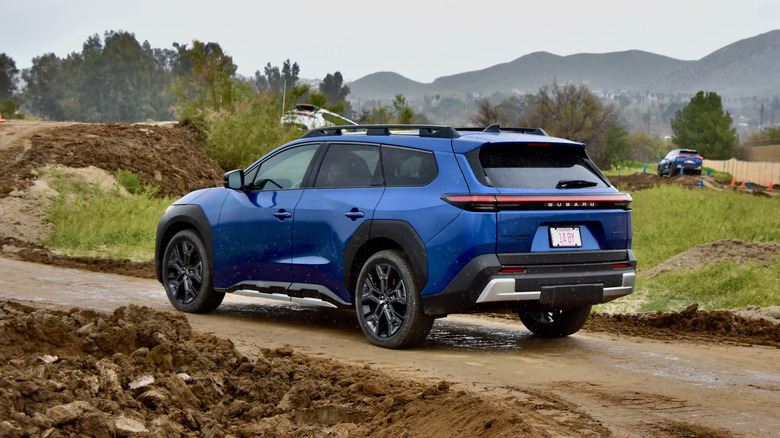
The Trailseeker drives pleasantly different than its platform mates, the Uncharted and Solterra. Where the Uncharted is poised and composed, and the Solterra is ready to shut down fun at every turn, the Trailseeker is playful and eager to get sideways. Despite being the biggest of the three, it's the one that actually tries to channel Subaru's rally heritage.
There's still plenty of grip available for sensible people, but your inner hooligan will appreciate how easily the back end rotates on slick surfaces. It's easy to catch thanks to very responsive steering, which also makes the Trailseeker more nimble than one would expect of a fairly heavy lifted station wagon. That weight is also well-controlled in corners, contributing to that sportier-than-expected character. As in the Uncharted, sharp handling doesn't come at the expense of ride quality, even on the Trailseeker Touring's 20-inch wheels.
Its Toyota bZ Woodland sibling is available with all-terrain tires, but the Trailseeker sticks with all-seasons for now. It still handled a short off-road course without issues, although it seemed close to the limits of what its ground clearance and suspension would allow. It's a great car for seeking the parking lots of hiking trails, but not something you'd want to take off-road for fun.
Its interior is strange but functional
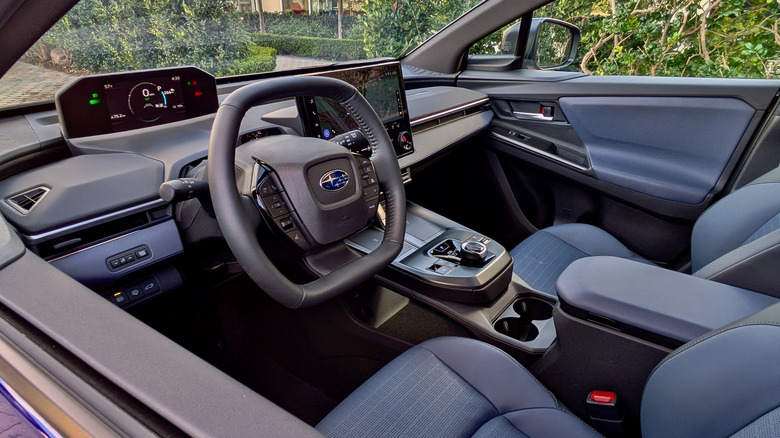
The interior has a lot in common with other Subaru EVs. The small, square steering wheel designed to accommodate a small digital instrument cluster situated at the extreme end of the dashboard, and the jumble of plasticky surfaces are familiar from the Solterra, Uncharted, and their Toyota counterparts. Subaru has a reputation for quirky design elements and plain-but-durable materials, so it's easier to accept these choices in the Trailseeker than in its Toyota doppelganger. The Touring models' blue leather interior also helps. Outside of luxury brands, it's rare to see upholstery that's an actual color.
The Trailseeker has the same infotainment setup as the less-expensive Uncharted, including a 7.0-inch cluster and 14.0-inch touchscreen with wireless Apple CarPlay and Android Auto connectivity, with prominent dual wireless device chargers on either side of its twist-knob shifter. As in the Uncharted, the infotainment system is Toyota-based, so drivers coming from non-electric Subarus will need to get acclimated to a new layout. Other than that, the Toyota interface isn't any better or worse than Subaru's own, which is admittedly a low bar.
Limited and Touring models add a Harman Kardon audio system with sound quality worthy of name branding, and the aforementioned off-road camera. It covers blind spots created by the front end, with multiple views to choose from, but only works at speeds up to 7 mph and doesn't automatically reactivate after you slow back down.
It's as functional as it looks
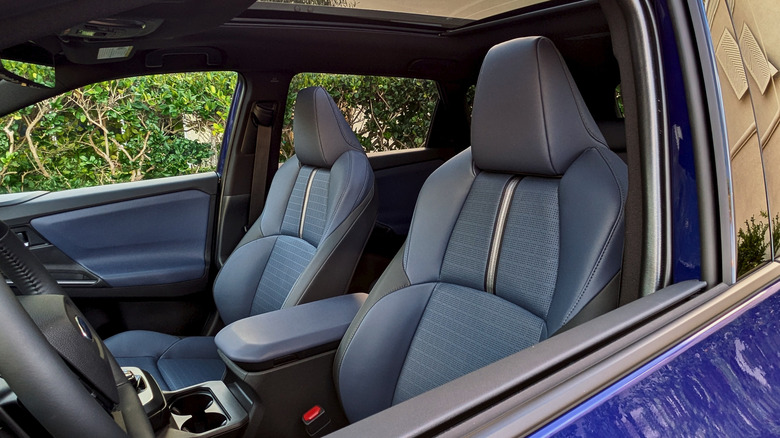
The Trailseeker looks like an Outback, but does it have the utility of one? The styling isn't an illusion; the Outback is 1.6 inches taller than the Trailseeker, and the Trailseeker has a 4.1-inch longer wheelbase, but their footprints are quite close. The Outback's extra height provides a bit of additional headroom in both rows, but surprisingly the Outback also has more rear-seat legroom despite the Trailseeker's longer wheelbase.
Interior space is much closer to other EVs in most respects, but again the Trailseeker, err, trails in rear-seat legroom. The 31.3 cubic feet of cargo space behind the second row and 74.0 cubic feet behind the first row are both much more than competitive EVs offer, however, even if the Trailseeker still has less cargo space than an Outback.
The advantages of a wagon shape also carry over to the Trailseeker. The low cargo floor means loading groceries doesn't turn into a shotput competition, and the liftgate opens to reveal a large, square aperture. Crucially for Subaru owners, there's room for a full-size dog crate in back, and standard roof rails and a 3,500-pound towing capacity mean you're not limited to the space inside the vehicle.
So while it doesn't measure up to the real Outback in all areas, the Trailseeker is definitely the Outback of EVs.
2026 Subaru Trailseeker verdict
The Trailseeker doesn't exactly seek new trails when it comes to pricing. At $41,445, the base Premium trim level costs about the same as many other all-wheel drive EVs. The $45,445 Trailseeker Limited adds 20-inch wheels, a power liftgate, 360-degree camera system, a 120-volt outlet, and upgraded audio, among other features. The $48,005 Touring grade adds a panoramic glass roof, digital rearview mirror, two-tone paint, blue leather upholstery, and leg warmers (to reduce electricity consumption).
The Limited model seems like a reasonable deal. It costs about the same as fully-loaded versions of the Uncharted and Solterra, and while it's missing some features compared to those models, it's well-equipped. The extra space and power is also more than a fair tradeoff for fewer niceties.
With its wagon styling and feisty driving dynamics, the Trailseeker also stands out more in the general EV market. The Toyota bZ Woodland is literally the same car, but it costs just over $5,000 more. The Ford Mustang Mach-E Rally is quicker on pavement and tuned for sideways antics on dirt, but it's even more expensive.
Like the Outback, the Trailseeker fills a niche for shoppers who want utility, but without traditional SUV looks and driving dynamics. That also gives it an honesty that many other EVs—labeled as SUVs for the sake of marketing despite lacking most characteristics of them—lack. Now if Subaru could just improve its range and charging a bit...