

5 Crate Engines More Powerful Than Beefy Factory Motors
Whether it's General Motors, Ford, or Chrysler (now Stellantis), all three of America's big automakers have some serious V8 power in their arsenals these days. And these engines have been used to power all manner of high-performance vehicles, from track-bred Mustangs and Camaros to off-road-capable super pickups. But the cool thing is that you don't need to go out and buy a brand-new vehicle to enjoy this power.
All three automakers have extensive factory performance brands that offer OEM-quality, ready-to-run crate engine packages based on their latest and greatest V8s. They may not always come cheap, but if you've got the budget, with a few clicks of the mouse and the swipe of a credit card, you can have one of these powerful, fully warrantied engines at your door, and soon after, under the hood of your project vehicle.
Even better, these performance brands often go an extra step, adding higher horsepower, factory hot-rodded versions of these crate engines that go beyond the ones found in their production vehicles. Sometimes it's just a bit of computer tuning that gives a slight power bump over the showroom equivalent. In other cases, these engines are thoroughly modified into high-performance weapons that easily outgun anything you'll find in the regular lineup, including in high-end performance vehicles. Below, we've highlighted five different factory crate engine options from all three automakers that elevate things to a level of performance above what you'll find in their production vehicles.
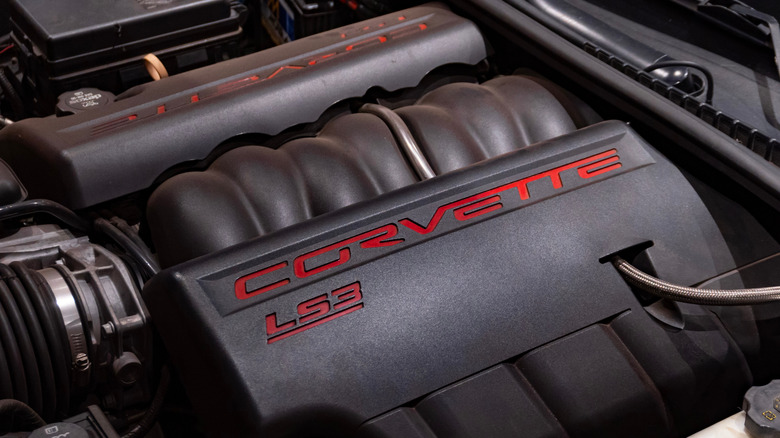
Chevrolet Performance LS376 (525 horsepower) vs LS3 (430 horsepower)
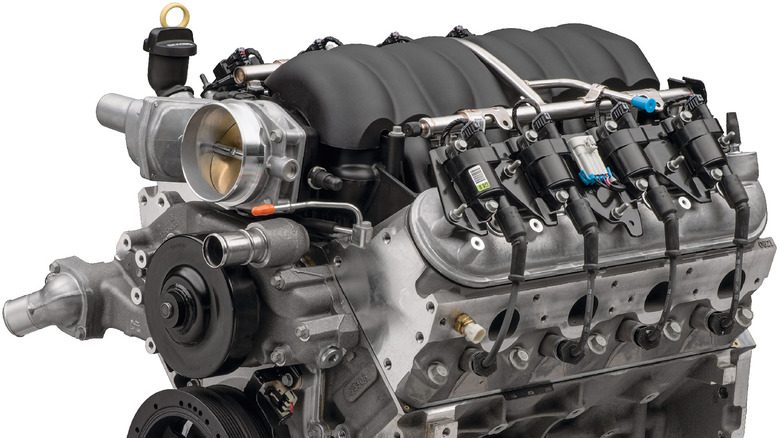
Although General Motors' legendary LS series engines have since been replaced by the newer (but still closely related) LT-series V8s on GM assembly lines, the LS aftermarket scene continues to thrive. And that includes Chevrolet Performance's own line of factory LS-based crate offerings, which range from mild, factory-spec engines to the serious 'LSX' branded race engines geared toward racing applications.
One of these LS family engines that stands out in the lineup is the LS3-based 'LS376' crate motor, which displaces the same 6.2 liters as the familiar LS3, but with a more aggressive camshaft and some other tweaks, which help it make nearly 100 more horsepower than the factory-issue 430-horsepower LS3. In fact, when it comes to high RPM, naturally aspirated power, the LS376's 525 horsepower and 486 pound-feet of torque outgun even the mighty 505 horsepower, 7.0-liter LS7 from the C6 Corvette Z06.
When looking at the power rankings of GM's modern, naturally aspirated V8s, the LS376 motors would be near the top of the heap, only outdone by hot-rodded versions of the now-discontinued LS7, or of course, the exotic, flat plane crank, DOHC LT6 V8 from the C8 Corvette Z06. And with a market price under $12,000, the LS376 is actually quite affordable compared to some of the other engines we've rounded up here.
Ford Racing 5.2 Aluminator (580 horsepower) vs 5.0 Coyote (480 horsepower)
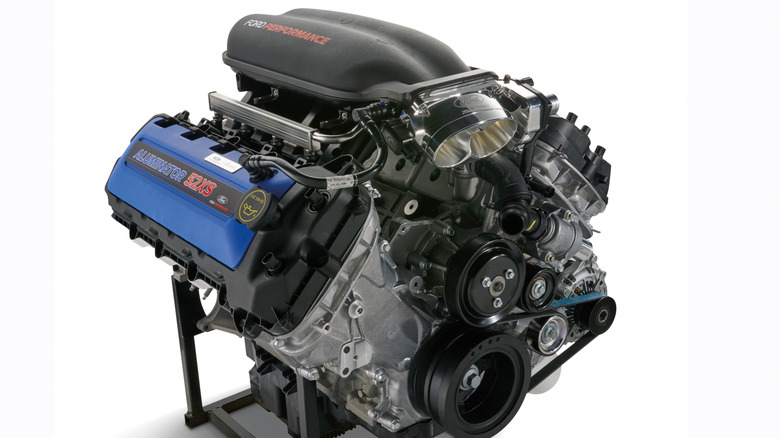
Ford's 5.0-liter Coyote V8 isn't just considered one of the great performance engines of the modern era, the Coyote is simply one of the best V8s of all time. And as you'd expect, the Ford Racing lineup of crate engines includes several different options based on the Coyote, which has powered the Mustang GT since the 2011 model year. The alpha of the Ford Racing Coyote crate lineup is the 'Aluminator' 5.2 XS, which makes a naturally aspirated 580 horsepower and 445 pound-feet of torque. For comparison's sake, that's a full 100 horsepower more than what you'll get in the base 480-horsepower 2026 Mustang GT.
As Ford's most powerful naturally aspirated modular crate motor ever, the Aluminator combines elements of both the standard Coyote and the 5.2-liter 'Voodoo' V8 from the old S550 generation Shelby GT350 Mustang. The major difference between the Aluminator and the 5.2-liter Voodoo is that the Voodoo uses an exotic flat-plane crankshaft, while the Aluminator has a more traditional cross-plane crank.
If there's one drawback to the Aluminator, it's that all these upgraded parts and that big horsepower number do not come cheap. With an MSRP of nearly $30,000, the Aluminator has a price more than double that of Ford Racing's standard, 460-horsepower fourth-generation 5.0 Coyote crate engine.
Direct Connection Hellephant (1,000 horsepower) vs Hellcat (717 horsepower)
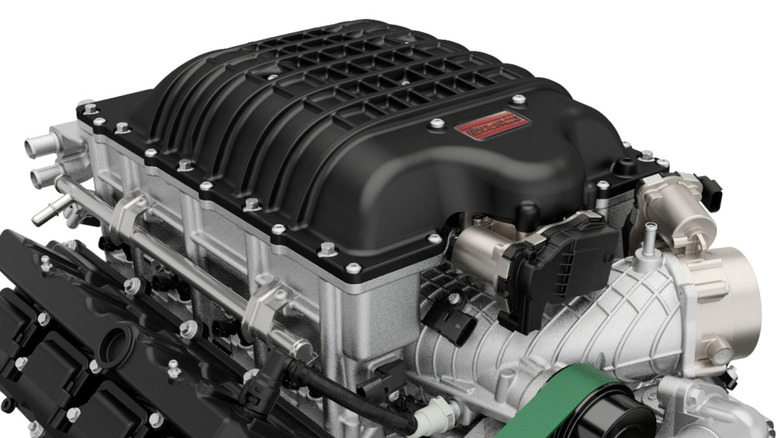
If you want HEMI power for your project vehicle, Direct Connection, Stellantis' factory performance brand, has you covered with a whole lineup of both naturally aspirated and supercharged HEMI V8s. And if it's specifically big, supercharged power you're after, there are a handful of different 6.2-liter Hellcat-based engines to choose from in the crate engine catalog.
By most normal standards, the 'vanilla' 717-horsepower Hellcat/Hellcrate engine should provide more than enough horsepower for any road-going project vehicle, but Hellcats are all about excess, and that's where the heavy hitters like the 426 cubic-inch 'Hellephant' crate motors come in. With a retail price just under $35,000, the recently upgraded and rereleased A30 variant of the Hellephant is rated at a flat 1,000 horsepower and 950 pound-feet of torque.
How does this crate motor compare to factory-issue Dodge muscle cars of recent years? At 1,025 horsepower, the 2023 Challenger SRT Demon 170 edges out the A30 Hellephant narrowly in horsepower, but it needs to be running on an ethanol fuel mix to hit that figure. The Hellephant, meanwhile, thanks to its larger 426 cubic inches, or 7.0 liters, of displacement, makes virtually the same amount of power while running on standard-issue premium pump fuel. Perhaps though, knowing Dodge's wild side, we may yet see the Hellephant make its way under the hood of a production vehicle in the future.
Chevrolet Performance L8P (523 horsepower) vs L8T (401 horsepower)
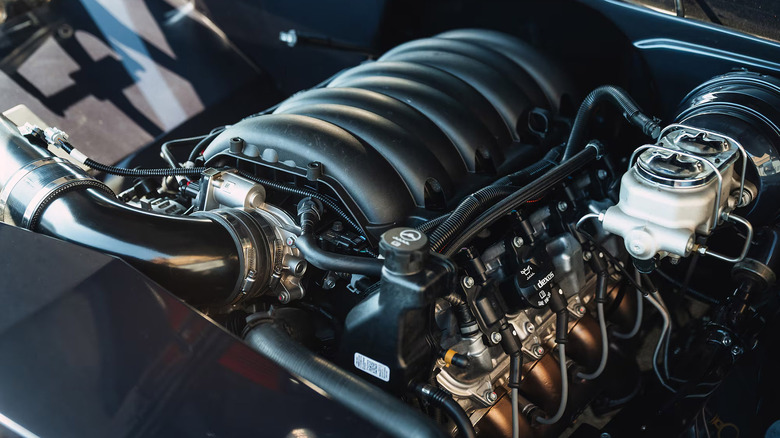
While old-fashioned, 'big block' V8 engines disappeared from the American auto industry years ago, their spirit lives on in modern, high-displacement V8s like GM's 6.6-liter (401 cubic-inch) L8T engine. The L8T comes from GM's LT line of engines, and with its big torque and extra displacement, was engineered specifically for use in large pickup trucks like the Silverado HD 2500. But despite its utilitarian roots, Chevrolet Performance let its engineering team have some fun with the engine to create the 'L8P' high-performance variant.
The L8P crate motor, which sells for around $9,000, displaces the same 6.6 liters as the engine it's based on, but has several upgrades, including a hotter camshaft, higher-flowing heads, and a forged crankshaft. The result is an easy-going 523 horsepower and 543 pound-feet of torque, which is a major jump over the 401 horsepower and 464 pound-feet of the L8T from the Silverado HD.
Because of its heavy-duty truck roots, the L8P makes its horsepower and torque at lower RPMs than you'll find in smaller V8s with comparable output. In other words, if you wanted the modern equivalent of an old-school big block Chevy for your project vehicle, the L8P might be the motor for you.
Ford Racing 7.3 Megazilla (612 horsepower) vs Godzilla (430 horsepower)
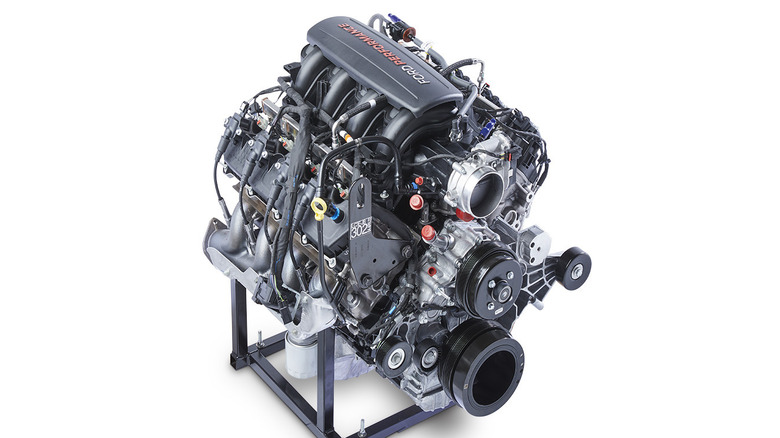
With its massive displacement and old-school, overhead valve design, the 7.3-liter Ford 'Godzilla' V8 is one of the most unique V8 engines available today. And though it was designed to be a workhorse engine for Ford's modern Super Duty pickup trucks, the Godzilla's big power and big torque also make it a desirable powerplant for hot-rodders and project car builders. So naturally, Ford Racing added the Godzilla family to its crate engine lineup.
A 430-horsepower Godzilla-powered project car is cool right out of the box, but for those who want even more from this engine platform, Ford Racing offers the aptly named 'Megazilla' crate engine. This engine takes everything good about the regular Godzilla and amps it up significantly. With an upgraded intake manifold, ported heads, and forged internals, the Megazilla is rated at a fire-breathing 612 horsepower and 670 pound-feet of torque. All without a single turbocharger or supercharger to be found.
In case you were curious, that's an improvement of almost 200 horsepower and 200 pound-feet of torque when compared to the Godzilla motor you'll find in your typical Ford F-250. What about the cost for all of this Megazilla power? You're looking at a little over $25,000, or about two and a half times the price of the standard Godzilla crate engine setup.