

5 Things You Should Know Before Adding Bigger Tires To Your Truck
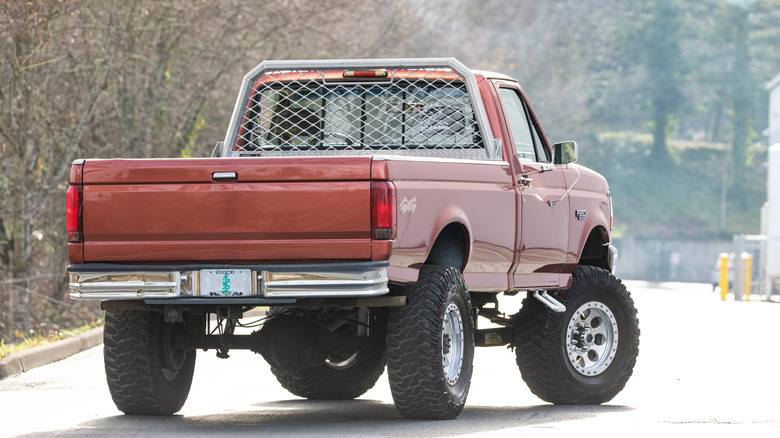
One of the more common functional modifications made to 4x4s and pickup trucks is installing bigger tires. Not only does it drastically alter the aesthetic and feel of the truck, but it's also a crucial upgrade if you're going off-roading in places that require good ground clearance. If you're doing anything from rock crawling to mudding, it's generally mandatory to install some chunky, specialized tires for the job. Each type comes with its own caveats, but generally, you'll find a few common themes. These can exaggerate when you're driving the truck on the road, especially with stuff like the Interco Super Swampers, which aren't really at home on tarmac.
That's not the end of the story, though. Maybe you just want a certain look for a street truck that relies on having a taller silhouette. Maybe you purchased a lifted SUV with bigger tires already on it, or you could be a new off-roader looking for the necessities with something like a factory Jeep. Having bigger tires is a must in all these cases, and regardless what the purpose is, they'll all come with a few obvious, and sometimes less obvious downsides.
In this article, we'll be focusing just on the tire diameter itself, as opposed to the tread. It's almost a given that most bigger tires will have a more aggressive tread profile, but those treads can vary in purpose and design as much as any regular or low-profile tire. Moreover, this will only deal with on-road driving — off-roading is a massive and diverse but niche topic with everyone doing different things with their vehicles, whereas 99% of us will drive on roads at some point. With all that out of the way, let's dive into it.
Wheel rub
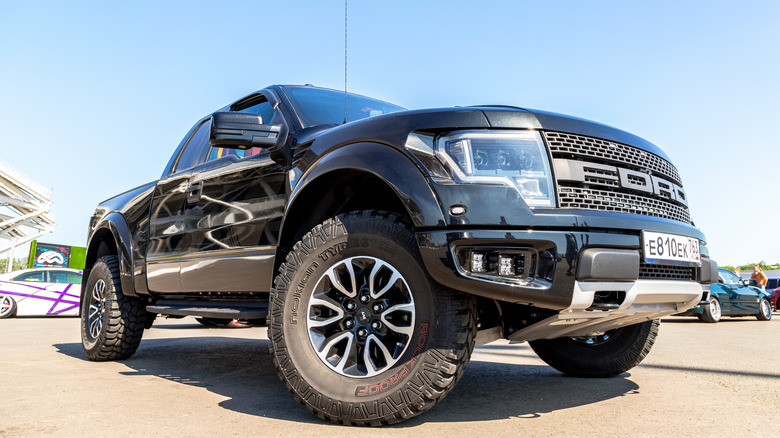
This is highly dependent on how high you lift your truck and whether or not you put on sufficient wheel spacers, but it's not exclusive to these. You might also get wheel rubbing if you put on aftermarket fenders or increase your truck's camber, for instance.
Every vehicle is sized to fit certain tires, with factory 4x4 and SUV rubber generally being on the thinner side when weighed against larger options. This necessitates two things: Making sure the tires have clearance for suspension compression, and for turning the steering wheel full-lock left and right. Failing to do these results in wheel rub, which is when the body of the tire contacts the inside of the wheel well and makes a loud banging noise as the turning rubber presses against it.
What happens next depends on a few factors, but it's universally a bad idea to rub the tire up against stuff regardless; it's basically the same thing as scraping the inner tire wall against a curb. You could damage the inner sidewall or the wheel well itself, though it's generally not catastrophic unless you have debris that punctures the tire or some other freak event. You might also notice a burning rubber smell or shuddering from the wheel as you turn in.
When it comes to bigger tires, the two main fixes for this issue are more ride height and spacers, or modifying the fender geometry. Some trucks pack the wheel arch tightly, so you see people running with cut fenders if they have big tires and a lot of suspension travel to help mitigate this problem.
You may need bigger axles
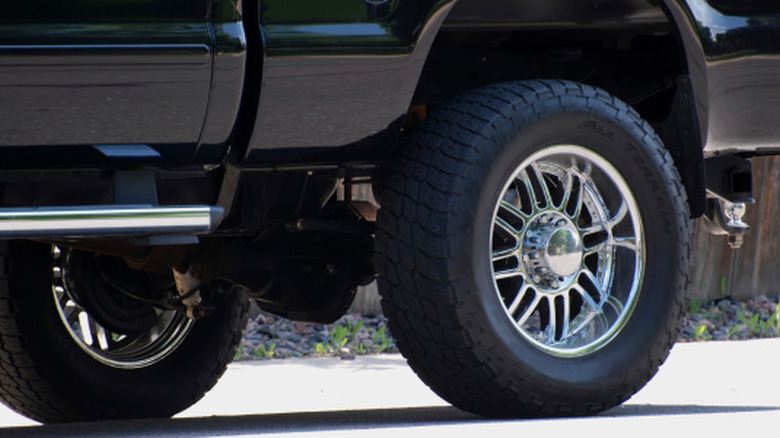
This one is far less obvious at first glance, and it require a little bit of physics knowledge. First, picture the center point of the axle that everything pivots on — namely, the differential. When the car is at rest, the tires, connected to the differential via the axle, exert a certain level of pressure on the drivetrain because of the principle of leverage.
The further away the point of contact with the ground is, the more leverage is being applied to the differential. Imagine a string connecting the center of the differential to the middle of the tire's contact patch; the longer the string, and subsequently the more strain that tire puts on the drivetrain. Car axles are complicated, and they are built to handle forces in specific ways. Changing the tire diameter modifies this, so it's a good idea to go for a bigger axle and driveline components as well.
This generally isn't a problem in the grand scheme, because it's not like every road will be an axle-breaker, but it does mean that your axles will be subjected to more forces when going off-roading, leading to broken axle shafts or wheel hub elements. Moreover, this only compounds with tire and vehicle weight; the heavier one or both of these are, the more force is being imparted upon the axle.
Whenever you see people running massive tires, they typically have massive axles to match for this very reason. You need a beefier drivetrain to handle the weight of the tire and vehicle itself, and that means additional expenses, but it's a lot less expensive than the repair bill if your wheel falls off.
Worse vehicle ergonomics (headlights, seating position)
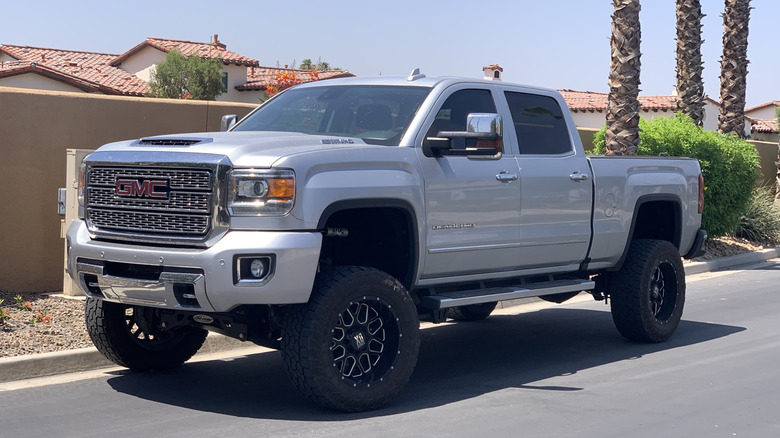
Here's another less talked-about but just as relevant of a talking point, and arguably a concern for safety as much as aesthetics. What happens when you put bigger tires on a truck? The truck sits higher up, especially when paired with a lift kit. Normally that's a good thing, especially if you're an off-roader, but the higher you go, the less roadworthy your truck will be, especially in city traffic, and it has nothing to do with the vehicle's performance or handling. Rather, it all comes down to visibility (or lack thereof).
Let's start with lighting. A truck's headlights are calibrated to function at a specific height from the road surface. Modern headlights are extremely bright, compounded with automakers setting the headlights incorrectly from the factory, causing glare issues for everyone around. In fact, several trucks have been recalled for this very reason, including America's most popular vehicle, the Ford F-Series. Raising the truck means the headlights are now misaligned, and therefore they're effectively shining into everyone else's cabin and blinding other drivers.
Another potential risk factor, especially in more extreme cases, is the driver's visibility being compromised. Pickup trucks in particular are already commonly dogged on for having front ends that are egregiously high up, which is statistically far more dangerous to pedestrians. Adding ride height only magnifies this problem, especially in cities. Therefore, to avoid any safety hazards, care should be taken to only add as much lift as needed, and to always be alert for pedestrians and compact cars. Visibility aids such as panoramic mirrors and cameras can help mitigate this, along with advanced safety tech like pedestrian warning systems.
Speedometer inaccuracies
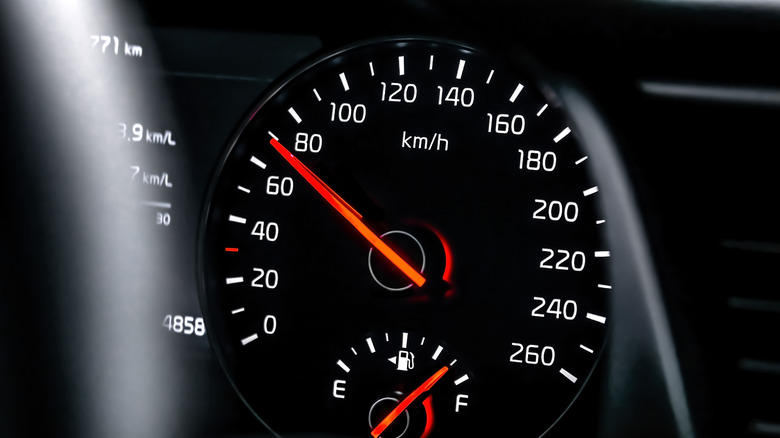
Here's another obvious question — which tire has a bigger circumference, a 31-inch or 33-inch? Obviously the latter, but your truck doesn't know this. In fact, it thinks it's actually going slower than it really is, and all that has to do with how your vehicle's speedometer works.
Speedometers don't operate based off factors like GPS data. Rather, they rely upon either one of two forms of measurement: determining your speed based off the speed of a drive component such as your transmission, or using wheel rotations. In both cases, however, the result is the same, and that's because of how larger tires work. A larger tire has a bigger circumference, so it takes a longer rotational period to complete a single revolution. This means that for two tires rotating at the same speed, the one with the larger circumference is moving slower; 40 mph in a car with bigger tires may, for instance, read as 35 mph.
There are a few methods to mitigate this problem, ranging from just using GPS data off your phone or a device to measure speed, like the Google Maps speedometer (which isn't perfectly accurate, either), down to recalibrating the speedometer itself. Because the problem compounds the faster your truck goes, the reading may be fairly off by the time you get to highway speeds, meaning misinterpreting the math here could easily net you a hefty speeding ticket. Is it a dealbreaker for getting bigger tires? Of course not, but it is a necessity nevertheless, especially if you don't feel like doing math while driving fast.
Altered torque and driveline strain
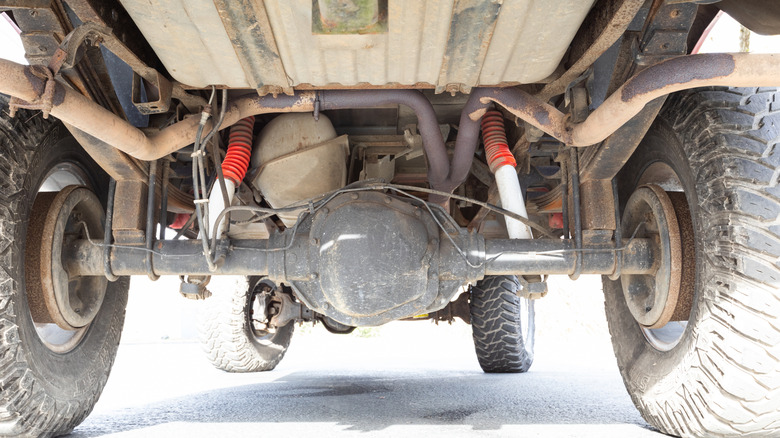
Torque and how it interacts with your drive components is arguably the biggest risk factor in terms of mechanical stress on your truck with lifted tires. As mentioned before, the more tire you have on the truck, the bigger the circumference, and the bigger the circumference, the slower the tire rotates to accomplish the same speed. In short, bigger tires place additional stress on all your driveline components because it requires more torque to move the heavier tires without the leverage advantage of a smaller distance from axle to contact patch. The less revolutions per mile your tire does, the worse this problem gets.
All sorts of issues come as a result of this, and it's by no means exclusive to just trucks. Transmissions, transfer cases, driveshafts, and differentials take the brunt of this pressure — basically, anything in between your engine and the tires themselves. Applying too much torque to one or all of these components leads to extreme levels of wear, both within fluids like gear and diff oil, and the metal itself. Ultimately, this may result in anything from broken teeth on the diff to transmission failure.
Thankfully, the solution is relatively straightforward, albeit pricey: Changing your gear ratios. This means that your transmission turns more per tire revolution, increasing the amount of power available at lower speeds. Remember, your truck doesn't know your tire size, just quickly the tire rotates. Generally, this involves changing your differential to one with a higher final drive ratio, meaning rather than a 3.73, you go for a 4.10, for instance. This may also incidentally help with the speedometer issue because the gears will be rotating at the same relative speed for how fast the car is going.