

The 8 Best Canon Mirrorless Cameras You Can Buy In 2026
We may receive a commission on purchases made from links.
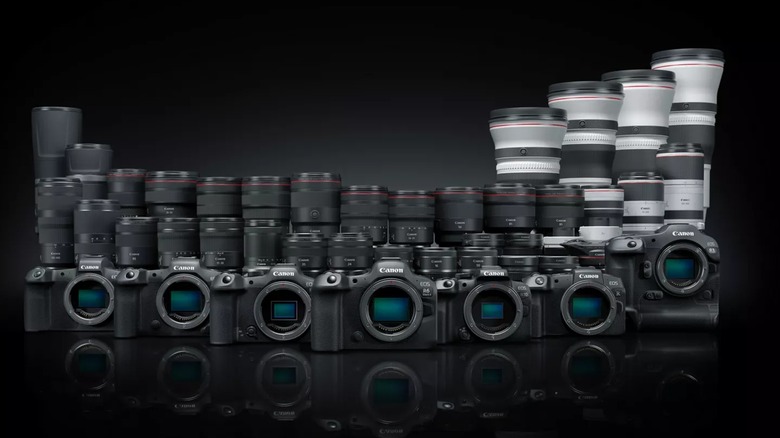
Canon has a strong lineup of mirrorless cameras that caters to everyone from newcomer enthusiasts to 20-year industry veterans. If you've finally decided to step up from your smartphone and want full creative control over your photography, we're listing the best Canon mirrorless cameras you can pick up this year.
We sorted our list by affordability, with the cheapest one on top, then added who Canon said they're best for. That way, you can get a mirrorless camera within your budget that's best suited to your shooting style. Note that "best suited" isn't a hard and fast rule, as most of these gadgets have flexible applications. We're basing the cost on body-only models, as lenses introduce many variables, and any included kit lenses may change.
Canon EOS R100 — best for beginners
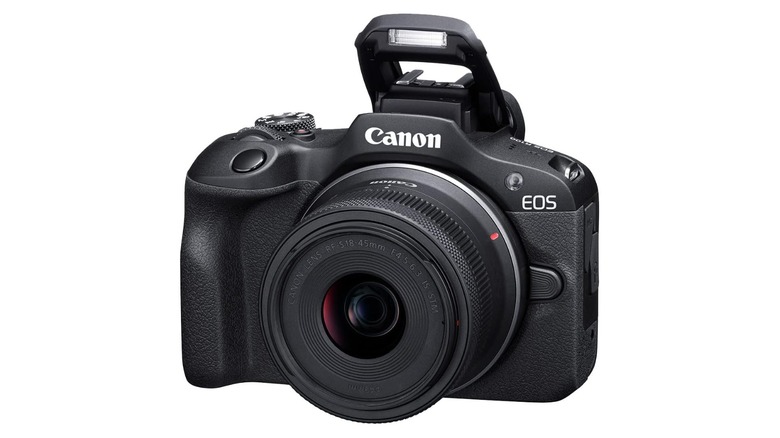
Canon lists the EOS R100 as the best camera for those new to photography, as it's the most affordable mirrorless camera it has on offer and is currently available for $459 on Amazon. If this will be your first camera and you don't want to purchase a separate prime lens, you can get the kit version with the included RF-S 18-45mm f/4.5-6.3 lens for $679.99.
Since this is Canon's cheapest model, you'll miss out on key features. For example, you won't get an articulating LCD screen, making it harder to shoot from different angles while viewing your frame clearly. It also has a lower maximum ISO of just 25600, whereas the other cameras on this list range from ISO 32000 up to ISO 409600.
Despite that, it should be good enough for beginners wanting to start on mirrorless cameras and don't mind the smaller APS-C sensor used on the R100. It also comes with Creative Assist modes that enhance users' photographs without requiring exhaustive technical detail. If you're considering this as your first camera but don't mind using the older DSLR form factor and EF/EF-S lenses, take a look at this cheap yet high-quality digital camera we'd actually recommend instead.
Canon EOS R50 — best for vloggers and content creators
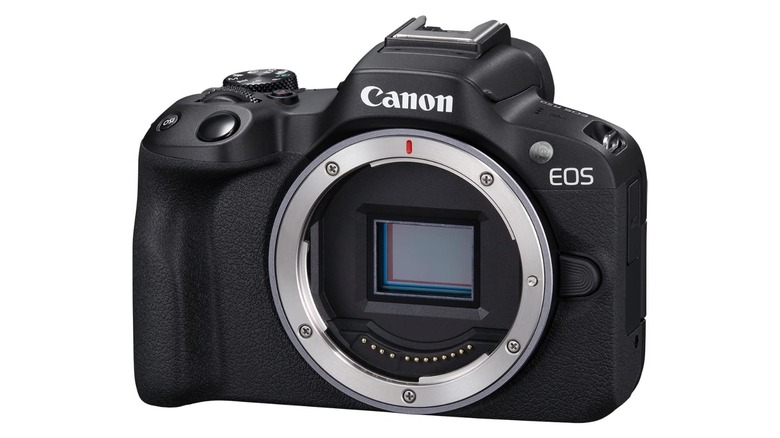
The Canon EOS R50 is a bit more expensive than the R100, costing $779.99 on Amazon for the body. But it will give you several features that are useful for vloggers and content creators. The biggest change you'll notice over the R100 is that the R50 comes with an articulating LCD screen, meaning you can flip it around to the front, making it easier to shoot selfie photos and videos.
The camera records 4K video at 30p without any cropping. It's also compatible with 10-bit HDR video, and you can even attach an external microphone to the body to help ensure that you get clean audio every time you press the record button. Whether you have a live audience and stream directly from the camera or prefer using your laptop to engage with your audience in the chat, this camera can do both with its easy live streaming and webcam capabilities.
One downside of this camera, though, is that it has no in-body image stabilization. That means it will crop the video if you turn on Movie Digital IS and Enhanced IS — inconvenient if you want to maximize the field of view that your lens can capture, but effective if you're only shooting handheld. It also has a rolling shutter issue when panning the camera quickly, making it not so great for high-action recording. But if you're a regular content creator and don't shoot videos of fast-moving subjects, the R50 should offer a good balance between price and function.
Canon EOS R10 — best for travelers
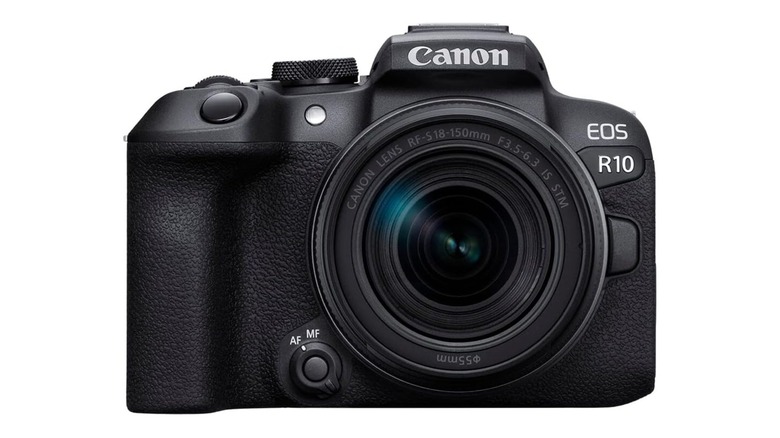
If you're looking to spend around $1,000 on your next camera, the Canon EOS R10 may work. It's priced at $1,099 on Amazon for the body only option and comes with more control options than the R50. This model introduces a second command dial on the top plate, a joystick at the back, extra buttons on the body, and an AF/MF switch. These would make it far easier to change your camera settings, whether you're shooting on full auto or in manual mode.
Cramming all these buttons and controls means that the R10 is larger and slightly heavier than the R50. Although this might sound counterintuitive for travelers for whom packing light is essential, the small sacrifice in mass and volume actually made it easier and more ergonomic to hold and manipulate, especially if you have larger hands. It also weighs 426 grams with the battery already included, which is still within the realm of compact and light cameras like the Canon EOS 250D.
Of course, being this small means that Canon had to sacrifice a few things. This includes a smaller battery and no headphone jack for audio monitoring. Video autofocus is also a bit unreliable, and it does not support Log video capture, so you're better off skipping this camera if you intend to use it for videography.
Canon EOS R8 — best for serious hobbyists
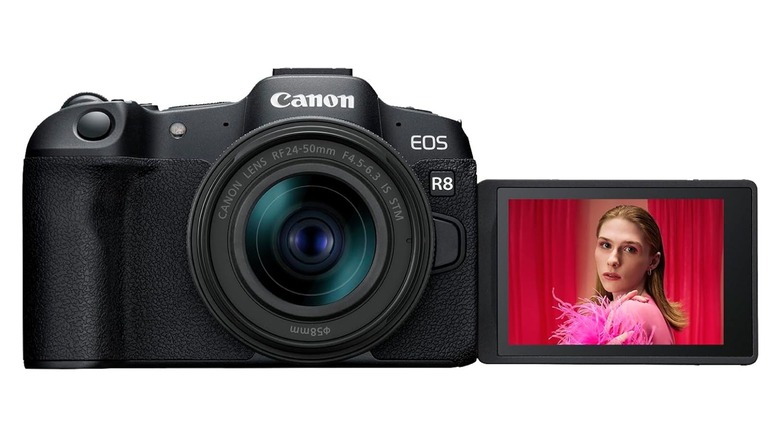
While APS-C cameras could be just as capable as their full-frame brethren, many photographers still dream of owning the latter. That's because their sensor mimics the size of classic 35 mm film, which is significantly larger than the former. That means it offers a wider field of view, which is crucial if you want to capture expansive scenes like landscapes and cityscapes. It also has a narrower depth of field to make it easier for your subject to pop out from the background. More importantly, it has more light-gathering potential, helping reduce noise at high ISOs and low-light situations.
The Canon EOS R8 is the most affordable way to get that ability with this brand, coming in at $1,449 on Amazon. We've reviewed this particular camera here on SlashGear, and we loved the performance it delivers for the relatively affordable price. The camera delivers excellent low-light performance, even at high sensitivity settings like ISO 102400. And if you're into video, you can shoot 4K60 video without any cropping and even go as high as 180 fps if you're willing to reduce the resolution to full HD.
This camera does come with a few compromises, though. The biggest issue we found was that it tended to overheat when you're shooting video at the highest settings. That means you're limited to short clips, and you'll be hard-pressed to record long scenes with the R8. Furthermore, the construction feels cheaper and less tactile than previous models. If you haven't bought Canon lenses and accessories yet, consider our comparison of the Canon R8 and the Nikon Z5II to see which one is better for you.
Canon EOS R7 — best for sports and action photographers
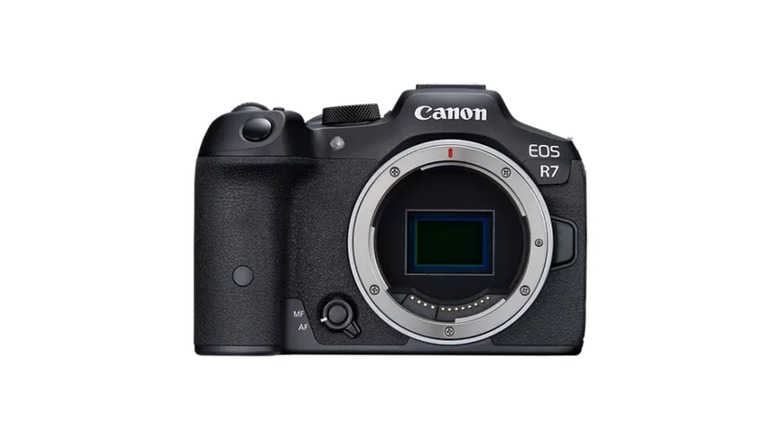
The EOS R7 is Canon's most expensive APS-C camera. Although a few people often associate the smaller sensor with entry-level and beginner cameras, that is not the case for this model. That's because Canon positions this for sports and action photographers who need to get close to the action. It helps achieve this with its 1.6x crop factor, meaning your photos will look nearer on the R7 versus a full-frame camera like the R8. Aside from that, it has a higher resolution of 33 megapixels, allowing greater cropping without losing quality.
This camera is built for capturing action using its continuous drive function, which shoots up to 15 fps when in mechanical mode and 30 fps with a full electronic shutter. This is also the first model with in-body image stabilization, achieving sharp images even in low-light conditions where you need to use a slower shutter speed. Professionals will appreciate the dual UHS-II SD card slot and environmental sealing that protects the camera from light rain, provided you also have a weather-sealed lens.
You can get this camera on Amazon for $1,649, which is about $200 more than the full-frame R8 despite its smaller sensor. Despite that, it's still substantially heavier at 612 grams (versus the R8's 461 grams) and is a bit larger in your hands.
Canon EOS R6 Mark III — best for both photo and video
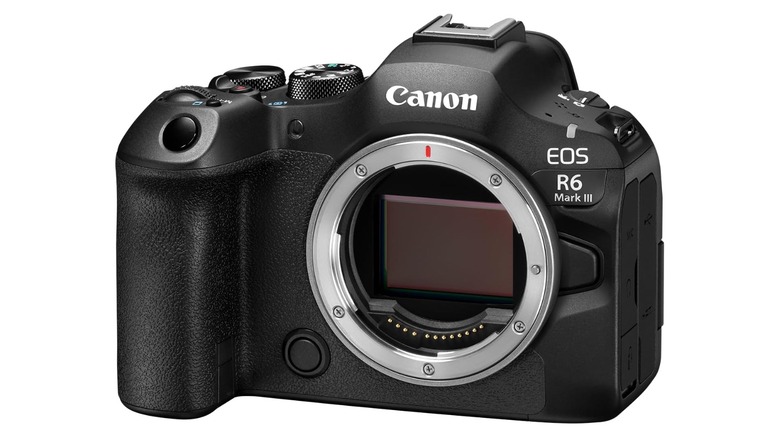
While DSLR cameras were initially built for taking photos, manufacturers eventually gave them video recording capabilities, giving videographers a relatively affordable high-quality recording device. So, if you want to experiment with both functions, Canon recommends the EOS R6 Mark III. As its name suggests, this is the third iteration of the R6 line and is a recent addition to the company's lineup, having been announced in November 2025. We've also now broken the $2,000 barrier, with the camera available on Amazon for $2,799.
This camera is equipped with a 33-megapixel full-frame sensor with a maximum burst rate of 40 fps up to 150 images in both Raw and JPEG, crucial for capturing fleeting moments, while remaining tack sharp with its excellent autofocus capabilities. It can also record video at up to 7K60 and comes with several recording modes and features to help you get the results that you want.
One downside to its extremely high burst rate is that you will fill it up in less than four seconds. So, if you're not careful, you'll fill up its buffer memory, and you'll have to wait until the camera finishes processing and recording everything before you can start shooting again. The camera also risks overheating if you're shooting at the highest possible quality settings, with Canon saying that the R6 Mark III will auto shut off after 23 to 36 minutes of recording. So, if you plan to record video at 4K/60 Fine (oversampled) or higher, it's best that you plan your scenes around this limitation.
Canon EOS R5 Mark II — best for professionals
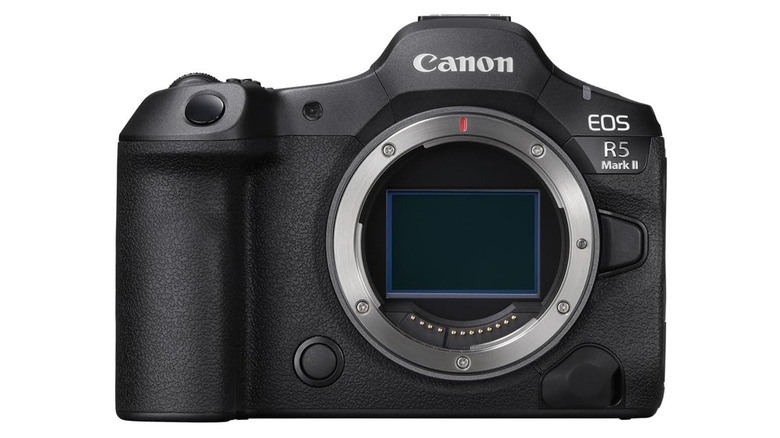
Many professional photographers used to swear by Canon's EOS 5-series camera, as it offered the best balance between features and price. While the introduction of more affordable full-frame models like the R6 Mark III and R8 has since changed the equation, Canon continued developing this model with the Canon EOS R5 Mark II. The company announced this camera in 2024 and is currently available on Amazon at an eye-watering $4,399.
This flagship model comes with a 45-megapixel sensor and muchhigher resolution than the even more expensive R3 and R1 cameras. It also has advanced autofocus capabilities like eye control, which lets you choose the subject the camera will focus on simply by looking at it. But what really makes this the best camera for professionals is that it excels at nearly everything you throw at it, meaning you can expect consistent performance across different shooting situations.
The camera's do-it-all capability comes with trade-offs. Aside from its massive price tag, it weighs a hefty 746 grams with the battery included. If you include the heavy professional lenses that you'd likely attach to a camera that costs this much, you will literally and figuratively feel the weight of owning the Canon EOS R5 Mark II.
Canon EOS R3 and R1 — the ultimate cameras for the most demanding photographers
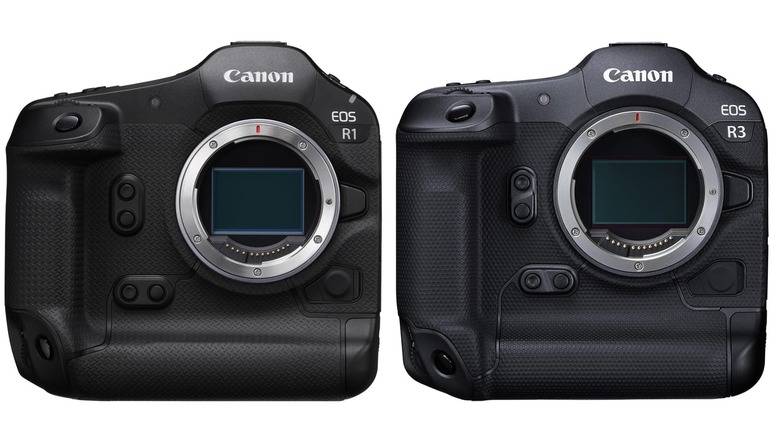
If you demand the best-of-the-best from Canon, the company offers two pro-grade cameras — the EOS R3 and R1. The former arrived in 2021 and is available on Amazon for $4,399, while the latter followed three years later in 2024 and can be had for $6,799 on Amazon. Both of these cameras have a lower maximum resolution than the Canon EOS R5 Mark II, but don't be fooled by that, as it has several features that many professionals would consider indispensable.
For one, it has a top-notch AI-trained autofocus system that can detect animals, people, automobiles, and even motorcycles. Canon also upgraded the viewfinder with an OLED display for more accurate color representation. The R3 has a 5.76M-dot viewfinder, and the R1 gets an even higher-resolution 9.44M-dot viewfinder, delivering sharp, realistic previews.
These cameras also have Wi-Fi capabilities for wireless file transfers, which even the humble R100 already has. But what makes them different is the availability of an Ethernet port, which transfers photos and videos fast. When it comes to storage, the R3 offers two slots — one for SD/SDHC/SDXC (UHS-II) cards and another for CFexpress Type B — while the R1 gives you dual CFexpress Type B slots. This means every photo and video is simultaneously stored in two separate memory cards, ensuring redundancy and avoiding file loss.