

12 Things You're Likely Using Wrong In Your Car

If you own a car, you know there are certain unspoken rules everyone traveling must follow. Some are serious, others are more preferential. They aren't codified; rather, they are passed down almost like tradition. Because a car acts as a mobile sanctuary during a commute or a long trip, it is incredibly easy for anyone to get entirely too comfortable in one. It doesn't matter if you have the most expensive car or a used one — this comfort is exactly where daily driving or riding habits can betray us, whether we are passengers or the drivers behind the wheel.
Taking a closer look at our daily driving habits can be eye-opening. Small adjustments to how we use the features in our cars can drastically help make the car feel clean, and improve our safety, comfort, and overall driving experience. In this guide, we have listed 12 common things that you are likely doing wrong in your car right now.
Dashboard: Don't use it as a footrest
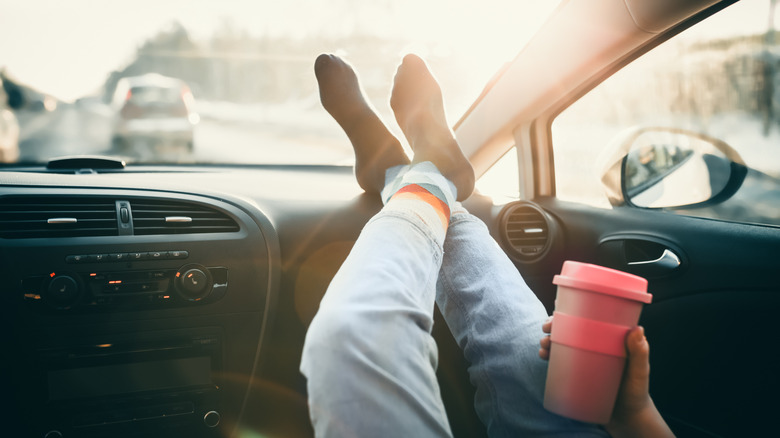
Probably one of the most common sightings on long road trips, aside from the incredible views on the road –- a passenger reclining their seat and kicking their feet onto the dashboard to relax. Movies have made us believe that it does feel liberating, but this seemingly innocuous decision is one of the dangerous things you can do inside a moving vehicle. It may make you feel comfortable — stretching your legs while the driver takes you for a ride — but the dashboard isn't a footrest.
Apart from the infotainment system, AC vents, and all of your favorite accessories, a dashboard also houses the passenger side airbags. These are designed to deploy with explosive force in a fraction of a second during a collision to protect the passengers. If your feet are resting on the dashboard when an accident occurs, the force from which the airbags get deployed will launch your knees directly into your face, a scenario that you don't want to imagine. This could result in severe fractures to the legs, pelvis, and facial bones.
To understand the real-world implications, the Michigan Auto Law firmly advises against this practice and states that injuries sustained by having your feet on the dash "can be far more extensive and complicated than injuries caused by a crash alone." In all, the safest place for a passenger's feet is always flat on the floorboard.
Side Mirrors: Don't skip checking for blind spot coverage
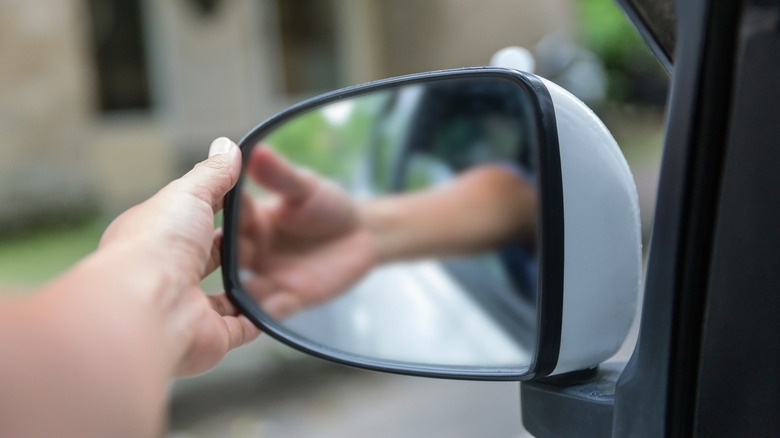
I love traveling and usually rent a car to explore a new place. When getting things in order before pulling out of the driveway, I used to adjust mirrors so I could see the back corners of my own vehicle. I believed this was the correct way to use the side-view mirrors, completely unaware that I was unintentionally creating blind spots. Many drivers do the same thing, using the side view mirror as a reference point. Unfortunately, this severely limits your field of vision. As a result, you have to crane your neck outside the window every time you want to change lanes on a highway.
The main purpose of the side mirrors is to cover the areas that cannot be seen by the rear-view mirror in the center. If you adjust the side mirrors to see the side of your own car, you are restricting your field of view. By pushing the mirrors further out, you create a seamless panoramic view of the road behind you. If a bike or car is behind you, you will have the perfect view that seamlessly transitions from the rear view mirror to the side mirror.
Correcting this habit is crucial for a safe drive, but requires a bit of skill. The NHTSA (National Highway Traffic Safety Administration) recommends the blind zone and glare elimination method, which can be achieved by "placing your head against the side window and then setting the mirror to just see the side of the car" for the driver's side mirror. For the passenger side, keep your head in the middle.
Handbrake: Don't press the button when you pull
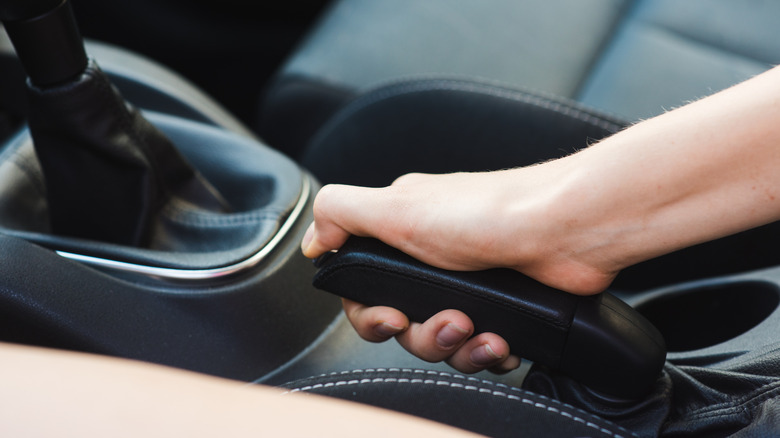
If you own a car that still uses a lever for the handbrake and not a button or rotating dial, then you might be familiar with the debate over that little lever button. While most cars are switching from manual to electronic brakes, the confusion remains as cars with a gear lever also exist aplenty. For the longest time, I believed that you had to press the button on the lever when pulling the handbrake to avoid damaging the internal ratchet mechanism. However, the clicking sound that came with pressing the button always sounded terrible.
Pressing the button when pulling the handbrake felt smooth, as there was no sound. It seems as if the mechanism isn't grinding against itself. This well-intentioned thought is actually not how the system was designed to function. The clicking noise is simply the pawl running over the ratchet teeth, in other words, correctly. Pressing the button puts you at risk of not engaging the brake securely, resulting in unexpected rollaway.
Automotive experts at Car Throttle have thoroughly debunked the myth of pressing the button while engaging the lever. They confirmed that pulling the handbrake without pressing the button will not damage the ratchet. So, to ensure that your car is parked securely, always simply pull the handbrake lever without pressing the button, straight up to the point where it feels right. Press the button only when you want to release the brake.
Fog Lights: Don't leave them on by default
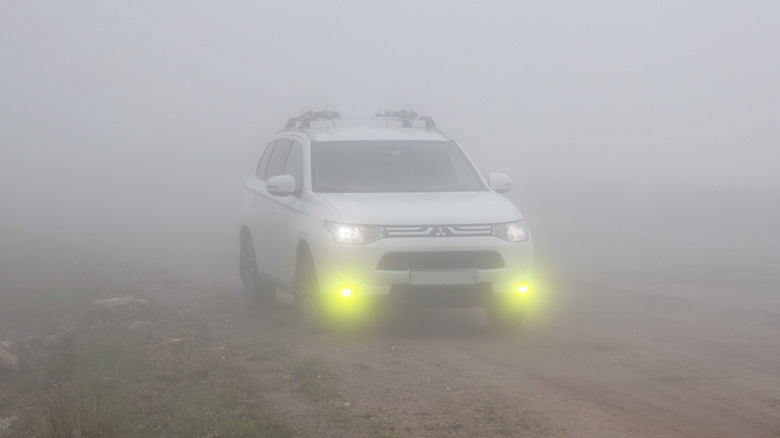
Fog lights look cool on modern cars and also add to their aggressiveness and sporty appearance. Many drivers leave their fog lights turned on even on clear summer nights, mistakenly thinking that they are needed. Unfortunately, fog lights aren't secondary headlights, and they should not be turned on unless the weather requires them. Leaving them on can affect others' vision on the road.
These lights are specifically designed with a unique beam pattern meant to cut through dense fog, heavy rain, or thick snow. Fog lights illuminate the road in front of you so that the immediate road is visible to you and you can see the road markings clearly in poor visibility. But in clear weather, low=angled beam can become intensely glaring to incoming traffic. And blinding other drivers on the road can result in fatal accidents.
In fact, there are various traffic regulations across the states that dictate when to use the auxiliary lights and when not to. For instance, Washington state law explicitly restricts its use, and similar rules apply for California vehicle codes, unless the weather has drastically reduced the visibility on the road.
Car Start: Don't leave it running (you needn't do so)
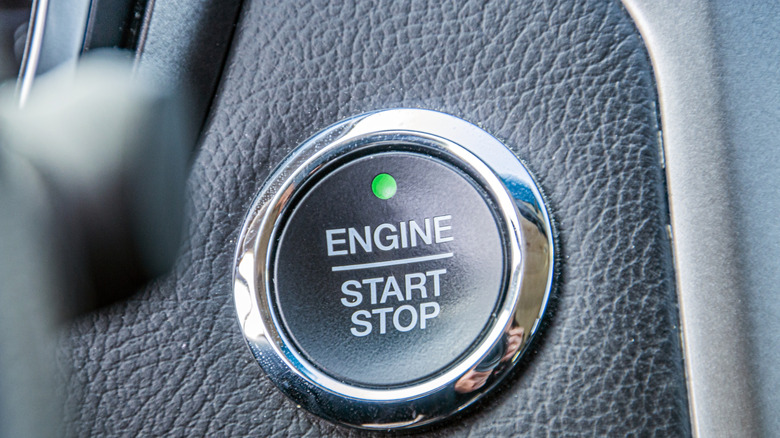
For years, we have been trained to leave our cars running, especially at the start of the day. It was widely accepted that allowing the car to run for a few minutes allows the engine to warm up so that the oil can circulate properly before taking on the stress of actual driving. For a long time, I used to believe this and made it a habit myself, thinking that a little runtime would allow the car to get heated up before driving in frosty weather.
This idea isn't entirely wrong. It is just that it doesn't adhere as much to modern cars. This warm-up routine may be a necessity for older vehicles with carburetors. However, modern cars make use of fuel injection systems and advanced engine control units that automatically adjust the air-to-fuel ratio. Contemporary cars are fully capable of being driven almost immediately after turning them on. In fact, idling a cold engine for prolonged periods is an inefficient way to generate heat and can cause unnecessary wear over time.
The fastest and most effective way to bring a modern vehicle up to its optimal operating temperature is to simply drive it. Just keep in mind that you shouldn't start drag racing with your car as soon as it starts. Avoid aggressive acceleration for the first few minutes, as AAA clearly points out in its vehicle maintenance guidelines, modern cars simply don't need extended idling to warm up.
Driver's Seat: Don't position too far back (or forward)
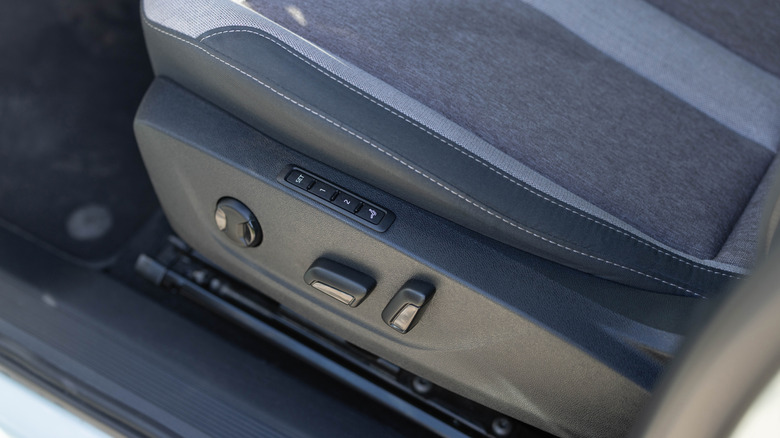
Modern cars come with electronic seat adjustment and features such as memory function, where the car remembers each driver's optimal chair position. Finding the perfect driving position is very important. It ensures that you have the proper visibility of the road and ease in operating the car. However, you must strike a perfect balance between comfort and control, as pushing the needle too far on either of these criteria can become dangerous. I also used to think that having the best driving position means being in the most comfortable spot in the driver's seat, but I was wrong.
You should not position the driver's seat too far back or forward is it compromises your ability to optimally use the safety features in case of emergencies. Sitting too far back lowers your ability to properly press the brake pedal. On the flip side, if you are positioned too close, your chest is dangerously close to the steering wheel, which houses the airbag.
According to research on non-conventional seating positions and driver safety by the National Library of Medicine, improper seat placement alters the safety of the driver during a violent crash. You should take your time adjusting the seat, ensuring that you have the optimal comfort while not compromising your physical safety.
Open Spaces: Don't leave loose clutter
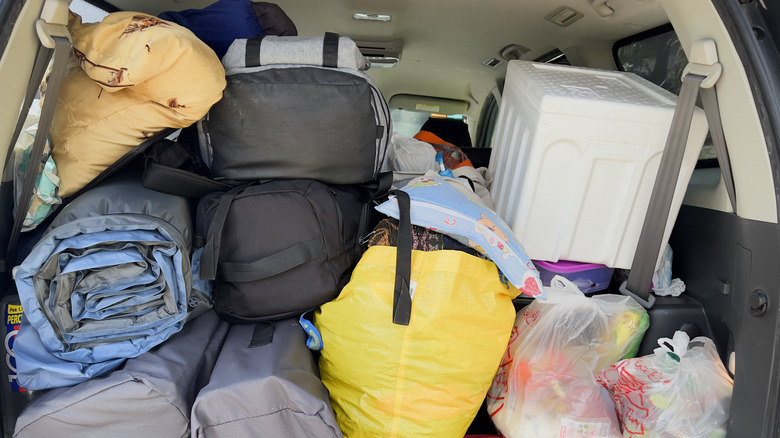
When a car is brand new, we all follow certain rules and regulations. No dirty shoes, no eating inside, etc., etc. However, at a certain point, the novelty and new car smell wear off, and the car becomes a comfort space. We eat, drink, and use it as a storage unit. My own car trunk was once neat and clean. After a couple of years owning it, I story some clothes, shoes, slippers, water bottles, bags, and whatnot on the back of the trunk.
While this may seen harmless, it could transform into a terrifying hazard the moment your vehicle is involved in a crash. When your car stops abruptly during a collision, every loose item inside moves at your original traveling speed. A full water bottle on the back of your seat can instantly become a dangerous item. Loose items can fly around the cabin and cause serious concussions or deadly injury.
The Canada Safety Council highlights the severity of messy cars and warns against keeping loose clutter to avoid catastrophic injuries. We want to remove any loose items or keep them strapped down so that they cannot fly around in case things go awry.
Headphones: Don't wear them while driving

Whether we are at home, traveling, or inside a car, we can't seem to disconnect from media. With the rise of advanced noise-canceling earbuds and premium headphones, there is a temptation to block the sounds of the outside world and immerse ourselves in a sonic exploration of our own. While it may sound logical to pop in earphones when behind the steering wheel to listen to your favourite music or podcast, it is simply not safe.
You are totally disconnected from the surrounding environment. Since driving requires the utmost attention, not only from your eyes but from your ears as well, using headphones while driving creates a barrier. You need to be able to hear sirens from an incoming emergency or police vehicle or hear horns from cars drifting into your lane. Ask yourself, will you be able to hear all these important sounds when wearing headphones? Nope.
According to a recent study on the legality of earbuds while driving featured in USA Today, it is completely illegal in California, Louisiana, Maryland, Minnesota, Virginia, and Washington to wear headphones while driving. These states completely restrict the use of these devices behind the wheel.
Tires and Oils: Don't ignore the manual's recommended figures
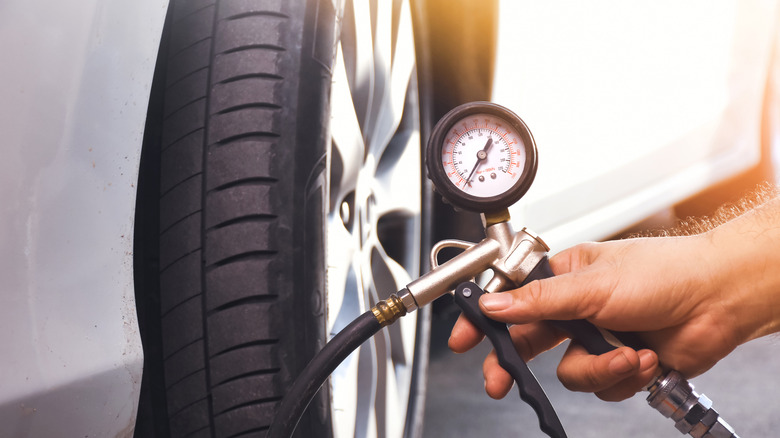
We often ignore precise levels when it comes to inflating tires or changing engine oil. Whenever the low-pressure tire warning would illuminate on my dashboard, I would visit a tire center and have it inflated to a random number, which I believed was correct without checking the manual. Or in other cases, I would go by the number listed right on the rubber sidewall. The same was the case with motor oil. I assumed getting any standard motor oil would do the job.
With years of driving and experience, I came to understand that treating car fluids and tire pressure with guesswork is one of the ways to shorten a vehicle's lifespan. The number stamped on the sidewall is the maximum pressure that the tire can handle, not the optimal tire pressure. Overinflated tires can lead to dangerous handling and rapid tread wear. Similarly, choosing the wrong engine oil starves your engine components of necessary lubrication, again leading to costly maintenance.
This is why you should look at your car's manual and understand the car's needs. Or you can also look at the driver's side door jamb for details.
Steering Wheel: Don't use the wrong grip position

For years, we have been instructed to grip the steering wheel at the classic 10 and two o'clock positions. I never felt comfortable with that grip, but because my instructor forced it on me, it became my default posture for years. However, as my experience grew and modern automotive technology evolved, the widely taught steering wheel hand placement became obsolete.
If your hands are resting at 10 or 2 o'clock positions during a collision, the explosive deployment of the airbag could launch your hands directly into your face. Not a great feeling. So, what was once considered the absolute default steering position is now a major liability in modern vehicles.
Traffic experts now suggest updating the steering wheel position to nine and three o'clock. A slightly lower — 8 and 4 o'clock position — also works. As per the updated driving guide on steering wheel grips, these modernized steering positions keep your arms safely out of harm's way in case of airbag deployment.
Recirculation Button: Don't leave it on all the time
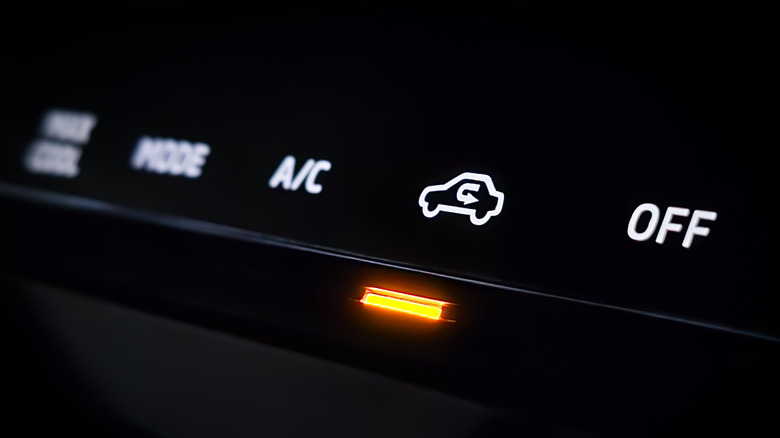
Most of my time is spent in India, where the climate is hot or warm. This means AC is on by default, and we rarely put that to rest. But apart from the AC on/off switch, there is also a button with an icon featuring a car with a U-shaped arrow inside it. That is the air recirculation button, and for a long time, I just thought that it should be permanently engaged.
I believed that the button recirculates the already cool air inside the cabin, and it was the smartest way to take off the stress off the engine. I was wrong. While the recirculation button is a great way to quickly cool down the cabin during hot weather or block exhaust smoke while stuck in traffic, leaving it permanently on can create certain issues. When you engage the recirculation button, you are basically trapping moisture and stagnant air inside.
During winter, this can create fog on your windows and windscreen, drastically reducing your visibility. Auto experts advise that once your car has reached a comfortable temperature, you should disengage the recirculation button to prevent windows from fogging up among other things.
Food: Don't eat and drive
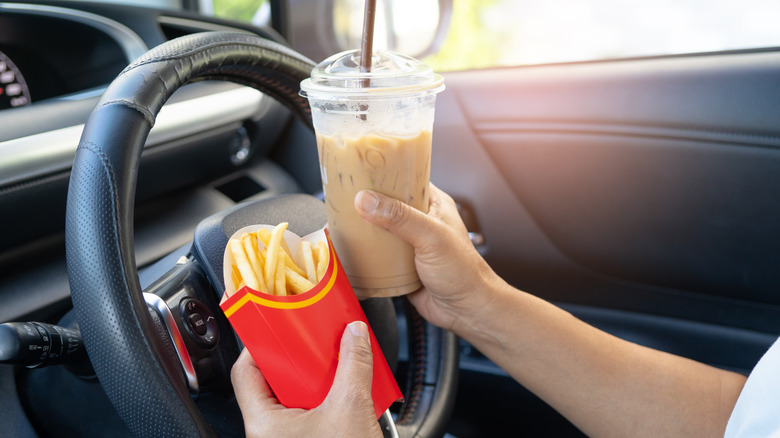
You might've already heard the famous slogan "don't drink and drive." And while alcohol is certainly dangerous behind the wheel, food isn't all that safe either. In this modern world, multitasking feels mandatory. It has also made the drive-thru window and fast food quite popular. I myself love having snacks or a coffee while driving, which I believed was totally normal.
However, consuming a full meal behind the wheel is a massive form of distracted driving. Eating requires your hands and eyes to be engaged, and that takes your attention away from the road. Removing even one hand from the steering wheel reduces 50% of your ability to control the vehicle and your reaction time.
Distracted driving is any form is dangerous. The Center of Disease Control and Prevention categorizes eating as a major visual, manual, and cognitive distraction that leads to thousands of accidents every year. Stay safe. If you are ravenously hungry, just stop the vehicle and eat.