

Jeep's 2026 Cherokee Looks Like An XJ But Drives Like Every Other Hybrid Crossover
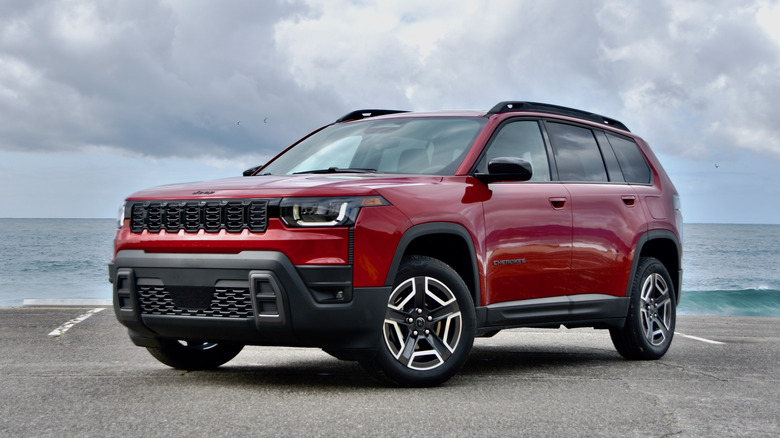
The Jeep Cherokee name has proven immune to changing trends and the concept of political correctness, because Jeep has been flexible about what kind of vehicle it gets applied to. The original SJ Cherokee from 1974 had very little to do with the iconic XJ Cherokee that first appeared in the 1980s and lasted until the turn of the century, which in turn had nothing in common with the most recent KL Cherokee aside from that enduring name.
After a gap of a few years, the Cherokee name is back on yet another very different take on the SUV genre. The 2026 Jeep Cherokee is once again a compact crossover like the last one, aimed at the heart of the new car market and well-known competitors like the Honda CR-V, Toyota RAV4, Subaru Forester, and the Korean duo of Hyundai Tucson and Kia Sportage. But it's essentially the reverse of the last Cherokee.
The outgoing model combined car-like styling that was untraditional for Jeep with a mechanical package that didn't conform to segment norms. Now the Cherokee definitely looks like a Jeep, but under the skin it's clearly taking cues from the competition.
Boxy is beautiful
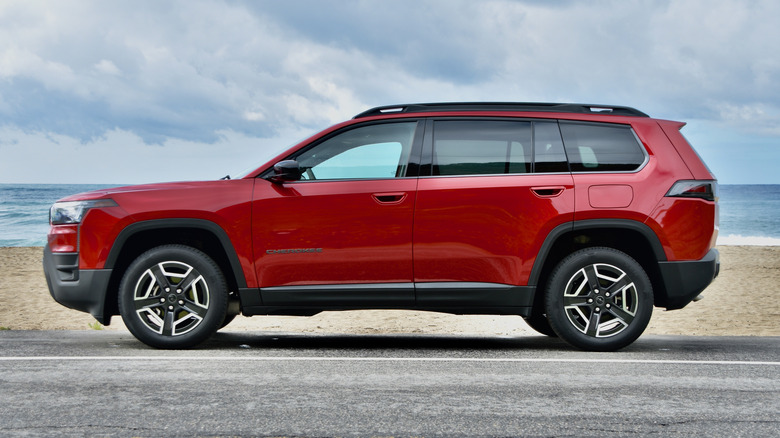
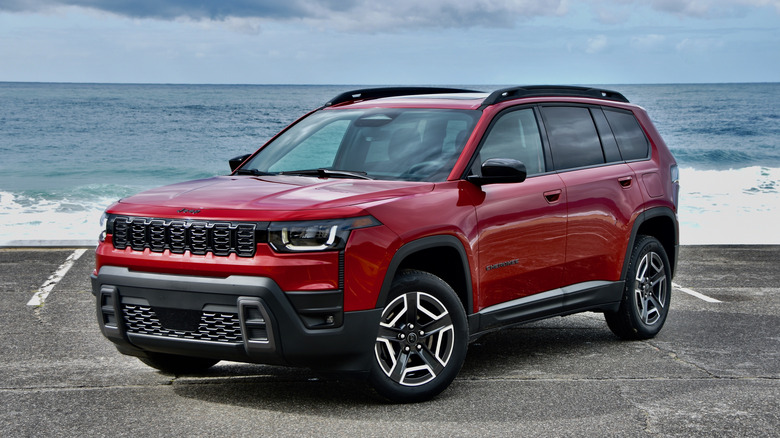
Jeep went in the right direction with the new Cherokee's styling. The shark-nosed previous-generation model was daring, but the boxier look of its replacement will draw more associations with the XJ Cherokee, which formed the basis for today's compact SUV segment during its long production run.
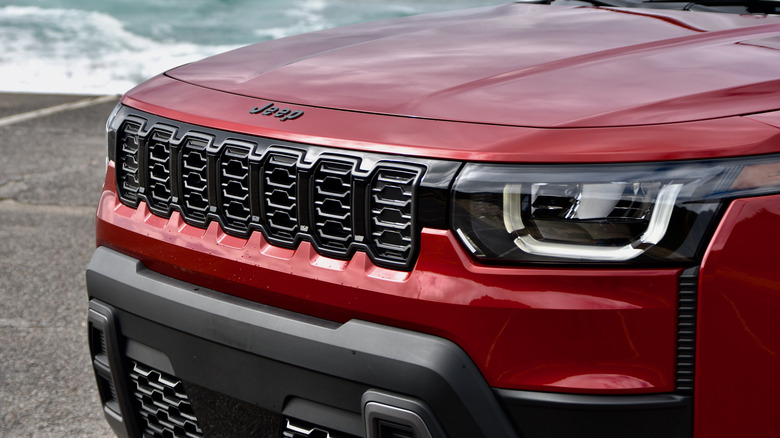
The new Cherokee channels the XJ with its upright roof, flat hood, and flat sides with bulging trapezoidal wheel arches. But some of the details aren't as well executed. The traditional seven-slot grille just looks like a rectangular piece of plastic from far away, the slots lost due to excess detailing. The front fascia and fenders also don't quite meet up, requiring distracting vertical trim pieces that look like eyeliner dripping down the face of a teary-eyed emo teenager.
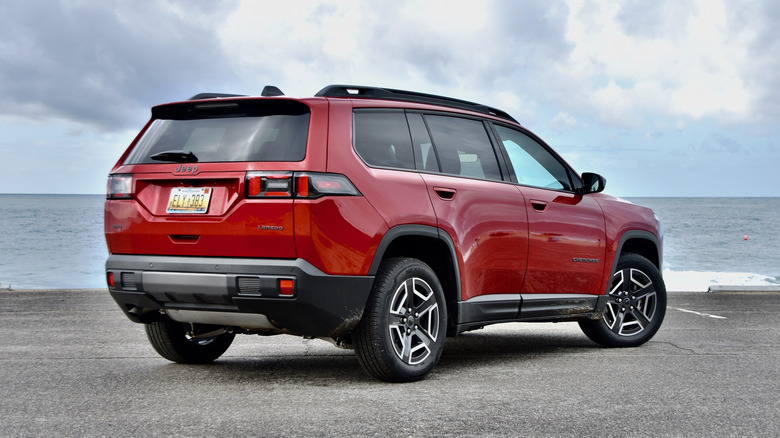
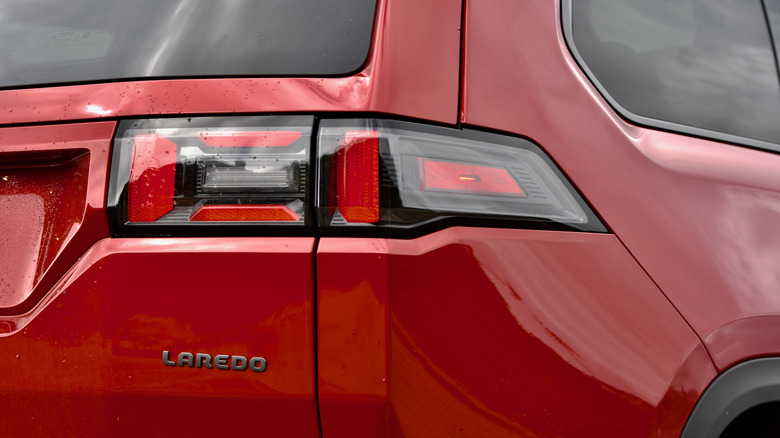
The rear-quarter view is more successful. The back window is angled just like on the XJ Cherokee, but also bows out for better aerodynamic performance. The taillights have a pattern meant to look like the "X" stamping in jerry cans that's distinctive without being kitschy. From this angle, the Cherokee really looks like a modern Jeep, rather than just a pastiche of stereotypical Jeep styling cues.
Underneath those styling cues is the same STLA Large platform used by the all-electric Jeep Wagoneer S and Recon (the latter is still slated to debut later this year, Jeep says), along with the Dodge Charger. That's quite a diverse family tree.
A powertrain for today's market
Jeep is backing away from plug-in hybrids, but it's also leading the charge (no pun intended) for conventional hybrids in Stellantis' North American lineup. The 2026 Cherokee debuts a new hybrid system based around a 1.6-liter turbocharged four-cylinder engine from European-market Stellantis vehicles and a pair of electric motors that drive the wheels through a planetary gearset. The latter is similar layout to the Toyota and Subaru hybrid systems.
A total system output of 210 horsepower and 230 pound-feet of torque gives the Cherokee more horsepower than a Subaru Forester Hybrid but less than a Toyota RAV4 Hybrid (Subaru and Toyota don't publish estimated torque figures). The Jeep trails the Hyundai Tucson and Kia Sportage Hybrids in both horsepower and torque, and has a few more horses than a Honda CR-V Hybrid.
More importantly, at an estimated 37 mpg combined (39 mpg city, 35 mpg highway) fuel economy is comparable to all-wheel drive versions of the segment's usual suspects. The Toyota RAV4 Hybrid Woodland—the most rugged version of Toyota's small crossover—comes in at 39 mpg combined (41 mpg city, 36 mpg highway), however. The Woodland also matches the Cherokee's 3,500-pound towing capacity, something that's out of reach for other rival hybrids.
Jeep is leaving some off-road capability on the table for now
Jeep is known for elaborate four-wheel drive systems, but at launch the Cherokee makes do with something simpler and more efficiency-focused. Instead of locking differentials, its noteworthy feature is rear-axle disconnect, which allows the Cherokee to revert to front-wheel drive when possible to reduce fuel consumption.
For now, the Cherokee's off-road prowess is primarily down to bodywork that won't get in the way on trails. Jeep claims the 19.6-degree approach and 29.4-degree departure angles are segment leading, but makes no such claims for the 18.8-degree breakover angle. The Cherokee's 8.0 inches of ground clearance is also 0.7 inch less than a Subaru Forester Hybrid's and 0.5 inch less than a Toyota RAV4 Hybrid Woodland's.
The standard Selec-Terrain system includes Auto, Sport, Snow, and Sand/Mud drive modes, but Jeep is saving things like all-terrain tires and upgraded suspension for a future Trailhawk model. In a media briefing ahead of this test drive, Michael Cockell, the Cherokee program director, said the Trailhawk is something "we'd like to talk about at a future date." With off-road models like the Woodland and Honda CR-V TrailSport Hybrid already crowding dealer lots, that date can't come soon enough.
It drives like most other small crossovers
The Cherokee's specs are more sensible than exciting, and that's also the case for the driving experience. Out of the box, the new hybrid powertrain provides smooth acceleration, the gasoline engine and electric motors working in harmony. The level of refinement is impressive considering that rivals have been developing their hybrid systems for longer, but otherwise the powertrain does its job in an anonymous fashion.
The only anomaly was a tendency to hold high engine revs for a bit too long after descending steep grades. The system tries to use engine braking when the battery is fully charged and regenerative braking is thus unavailable, but it seemed to get stuck in this mode after reaching level ground.
Ride quality and handling were also decent considering that the Cherokee was developed primarily with off-roading in mind, and the cabin was impressively quiet, but there's no fun to be had here. The steering also had a bit of play in its Comfort and Normal modes, allowing the driver to jiggle the wheel a bit without actually turning, like in an old movie. The Sport setting cured that, but switching requires diving into touchscreen menus.
As for the Cherokee's vaunted off-road capability, heavy rain made the planned trail unusable. All we can say is that Jeep's small SUV drives like most of the competition where these vehicles spend most of their time.
The interior gets a major glow-up, but the tech stays mostly the same
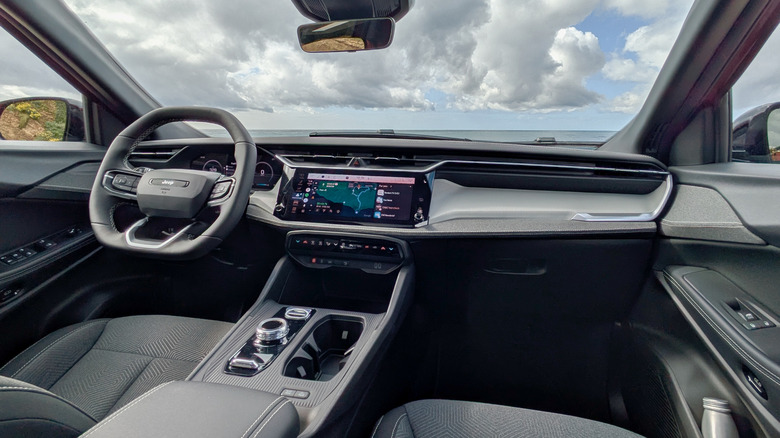
Where driving dynamics represent a holding pattern, the interior represents real progress. The last Cherokee debuted as a 2014 model, at a time when automakers were still struggling to package big touchscreens. The 2026 Cherokee's nicely-designed dashboard is a welcome contrast to the lumpy shape of its predecessor's.
The standard 10.2-inch digital instrument cluster and 10.2-inch touchscreen (a 12.3-inch touchscreen is also available) are enclosed in open, girder-like structures that also house the air vents. The look doesn't exactly say "rugged off-roader," but it's a lot more distinctive than the style-free interiors of many rivals. The same is true of the flowing surfaces of the doors that incorporate controls, armrests, and bottle holders like pieces of a collage. And Jeep deserves credit for largely avoiding piano-black trim, which you definitely don't want in a rugged vehicle. The octagonal steering wheel (designed to provide a clear view of the cluster) looks weird but isn't a problem to use.
The design may be new, but the new Cherokee uses the same Uconnect 5 its predecessor was using when it was discontinued after the 2023 model year. There was nothing wrong with the basic system, granted, and you still get wireless Apple CarPlay and Android Auto, but the default menus for both the cluster and touchscreen could use some cleaning up to make finding specific bits of information easier.
It's more spacious than before
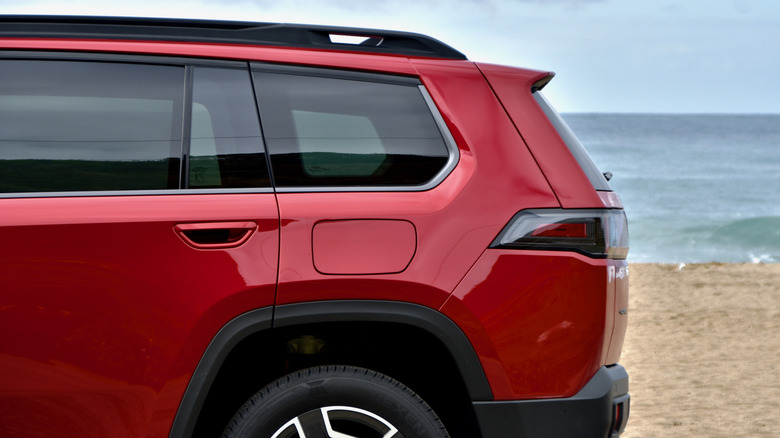
The switch to the STLA Large platform—which was designed to accommodate long underfloor EV battery packs—brings a nearly 6.5-inch wheelbase stretch and a 5.0-inch increase in overall length. The new Cherokee is also about 1.5 inches wider and 2.0 inches taller than the last one. This opens up more interior space, but not in all areas.
Up front, there's comparable headroom and legroom to most rivals, although shorter drivers might feel swallowed by the deep dashboard and the long hood protruding past it. Despite the wheelbase stretch, though, the Cherokee still doesn't have as much rear-seat legroom as a CR-V, Tucson, or Sportage. And while the 33.6 cubic feet of cargo space behind the second row, and 68.3 cubic feet with the rear seats folded, work out to 30% more than the last Cherokee, other similar-size crossovers have still more room.
Dimensions aside, the seats in the Laredo and Overland models we tested (one step up from the base model and the high-end model, respectively) were fairly comfortable by segment standards. Jeep opted out of real leather upholstery even in the Overland out of environmental consciousness, and claims to use some recycled material for interior plastics as well. The Overland's 10-speaker audio system also didn't sound like much of an upgrade over the six-speaker systems in other models, but its dual-pane sunroof provides plenty of sun and wind for those who can't commit to the Wrangler lifestyle.
2026 Jeep Cherokee verdict
Jeep is assembling 2026 models in Mexico—exposing them to Trump tariffs—but is still keeping pricing competitive. The base model starts at $36,995: within a few hundred dollars of a Subaru Forester Hybrid and $1,585 less than an all-wheel drive Honda CR-V Hybrid. You can get a Hyundai Tucson, Kia Sportage, or Toyota RAV4 Hybrid with all-wheel drive for less.
The Cherokee is the only option in the segment with both a standard hybrid powertrain and standard all-wheel drive, giving it a higher price floor than rivals that offer either front-wheel drive or non-hybrid base models. The climb from the base model to the Laredo ($39,995), Limited ($41,995), and Overland ($44,995) is also reasonable given the amount of added equipment as you move up the trim ladder. That being said, the Laredo and Limited probably represent the sweet spot of equipment and pricing.
The redesigned Cherokee doesn't really do anything better than its rivals. Even off-road, a Subaru Forester Hybrid will likely be able to keep up. But it also meets expectations—from road manners and interior space to fuel economy and infotainment tech—while still looking like a Jeep. It's a great opportunity for fans of the brand who need a practical car, but more importantly gives Stellantis the volume model it badly needs. Wranglers, Chargers, and twee Fiats are fun, but a normal SUV like this is what's needed to keep all of that going.