

5 TVs You Should Avoid Buying In 2026

We may receive a commission on purchases made from links.
Not everybody wants the same thing from their TV set. While some people are happy with a budget TV that just gets the job done, others think it's worth paying extra for OLED or other premium features. If you're a gamer, you might prioritize high refresh rates, or at least ensure that your television has enough ports to handle your devices. If aesthetics are important to you, you might be looking for a TV that doubles as a reproduction of van Gogh's Starry Night when you're not using it.
What you don't want, though, if you're shopping for a new TV set, is a lemon. Whether you're spending $200 or $20,000, it's infuriating to realize that your television has worse picture quality or fewer features than others of the same size in the same price bracket.
With that in mind, we've highlighted a few examples of TVs that may leave you disappointed. We've consulted reviews and compared specifications to see which TVs are best avoided. We'll go into more detail about our methodology in selecting these models at the end of this article. We've suggested some alternatives here, but of course, when it comes to spending your own money, you should absolutely buy whatever makes you happy.
Vizio V4K75M-0804
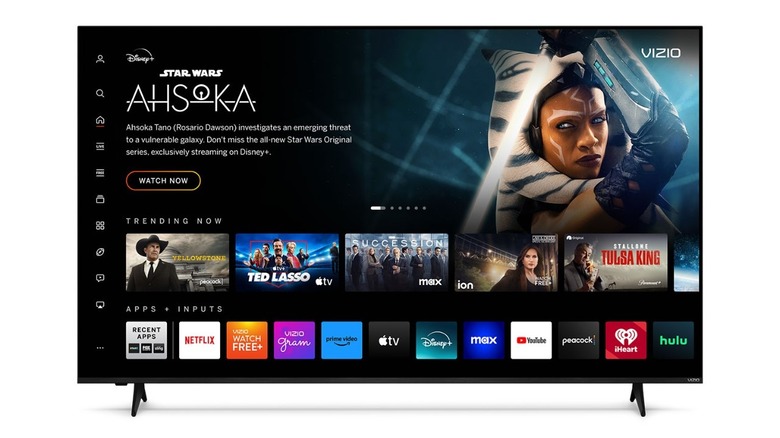
When compiling this list, we have tried not to penalize TVs for being inexpensive. If you look at scores on Consumer Reports and RTINGS, cheaper TVs naturally tend to score less well than more expensive ones. If you want the best color, quickest refresh rates, and widest viewing angles, then you need to pay for it. And plenty of us are happy to compromise on picture quality if it means we can save hundreds — or thousands — of dollars in the process. However, the whole Vizio brand deserves a shout-out for being consistently the lowest-scoring TVs while not necessarily being the cheapest option available.
We've singled out the V4K75M-0804 here, but there are several contenders, including the Vizio V435M-K04 and the Vizio VFD32M-08. The 75-inch V4K75M-0804 is the lowest-scoring TV in Consumer Reports' "70-inch and higher" category, with just 41 out of 100. In tests, its picture quality "fell short", and the sound was described as "sub-par" and "below average performance."
Although the specs promise High Dynamic Range (HDR), Consumer Reports found that the HDR performance was ineffective. The TV's peak brightness capability wasn't sufficient to do HDR content justice, and the images were no better than those on a TV with regular standard dynamic range (SDR). You can pick up a Vizio V4K75M-0804 in Walmart for only $428, so it's certainly cheap compared to many other TVs of the same size. However, there are TVs out there that got better scores from Consumer Reports and cost even less. For example, the 70-inch LG 70UQ7590PUB and the 70-inch Insignia NS-70F501NA26 both cost under $400, although admittedly, the HDR isn't great on those models either.
Samsung 8K 98-Inch QN990F
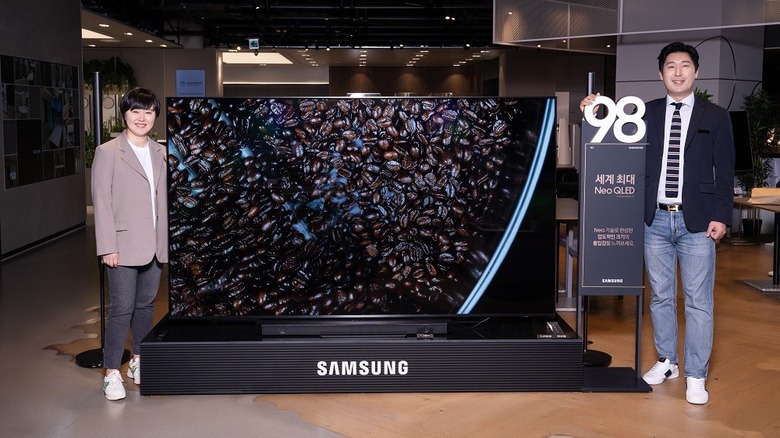
There are several noteworthy things about the Samsung 98 Inch Neo QLED QN990F, like the eye-watering price tag of $35,000 — a quite considerable step up from its 85-inch version, which sells for just over $8,000. If you're looking for a TV for your living room, 98 inches is almost certainly bigger than you need, as you'll need to sit at least 13 feet away from the screen.
Say you have set your sights on a television this big, is the Samsung QN990F worth the money? Not really. Part of the reason it's so pricey is that it boasts an 8K resolution, and 8K TVs really aren't worth buying in 2026. Compared to 4K, the benefits are not really noticeable to the naked eye, and even though it's been around for almost two decades, there's still hardly any 8K content available. Many manufacturers are removing 8K TVs altogether from their lineups. Another feature that isn't all it's cracked up to be, is the Vision AI picture setting mode. Samsung is adding more AI to its TVs, but the reviewer at Tom's Guide found that AI-tweaked picture settings on this TV resulted in "an appearance verging on artificial."
That's not to say that this TV doesn't have some impressive specs. It has excellent reflection handling, a wide viewing angle, and HDR, but you can get all that with Samsung's 4K 98-Inch QN90F, which at $15,000 is less than half the price. Or you could go for a TCL 98QM8K, which RTINGS considers the best 98-100 Inch TV and which only costs $4,000, and offers excellent image quality and high refresh rates.
Samsung U7900F
Although the previous Samsung entry may be altogether too much buck for its bang, Samsung does make some impressive top-of-the-range TVs. Its OLED televisions are highly regarded, and we included the Samsung S95F in our list of best TV models of 2025. However, if you're looking for a budget-friendly basic TV from Samsung, you might be disappointed with what you get.
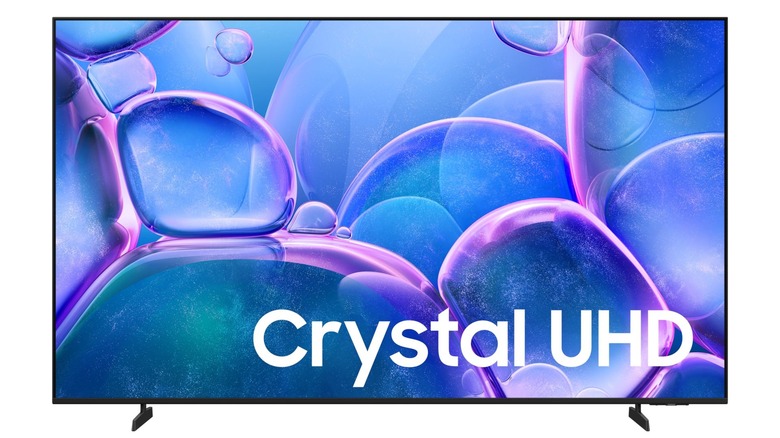
The Samsung U7900F costs just $230 for the 50-inch model, with prices going up to $700 for the 85-inch model. For this price, nobody is expecting first-class image quality, but even within this price range, the U7900F fails to deliver. RTINGS.com describes it as "a poor TV," saying that it doesn't work well in a bright room due to glare issues, while also struggling in dark rooms because of its "sub-par black levels," noting that "the screen looks washed out in most scenes." Consumer Reports also gave it a low score. Like the Vizio model, the Samsung U7900F doesn't deliver on its advertised HDR because it doesn't have the required brightness.
Another drawback of the U7900F is that it only has two HDMI ports, only one of which supports eARC, so once you've plugged your soundbar into the eARC port, you only have one HDMI port for everything else, which is pretty annoying if you want to use multiple game consoles or other devices, especially when there are other televisions available with more HDMI ports and better image quality. The Hisense QLED QD6QF has 3 HDMI ports, all with eARC, Dolby Vision, and a "decently vibrant viewing experience," according to RTINGS.com. It costs less than the Samsung, too. You can currently get the 85-inch version at Best Buy for $600.
LG UT75
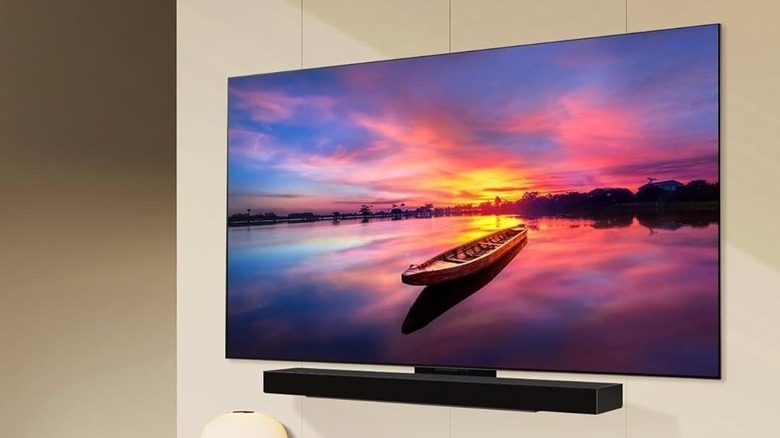
The LG 65 Inch Class UHD Series 4K UHD TV will set you back $530, while the 55-inch is, at the time of writing, reduced from $430 to $350, making the smaller 50-inch version currently comparatively more expensive at $370. It's not a pricey model, but you might want to think twice about purchasing it as your next television. RTINGS.com said it has "bad brightness," "awful black levels," and "disappointing colors." It does concede that the television has a wide viewing angle, but adds that will "only go so far on a TV like this one that has poor image quality to begin with."
As well as disappointing image quality, this television also falls short if you were planning to use it for gaming. Pixel transitions are slow, meaning that motion looks blurred. It has a refresh rate of 60Hz, which, while low, is pretty standard for TVs in this price bracket. However, where it really fails to deliver is by not having a Variable Refresh Rate (VRR) feature.
VRR synchronizes the screen's refresh rate with your game console's frame rate to reduce lag and stuttering while you're playing. It's a basic requirement in modern TVs. Even the cheap Vizio and Samsung TVs we mentioned earlier have it, so it's a good reason to swerve this model. One thing that works in this TV's favor, however, is that it uses webOS, which is one of the best smart TV operating systems available, and is easier to use than Vizio's OS or Samsung's Tizen OS.
TCL 75A300W

The TCL 75A300W scores a lacklustre 53 out of 100 on Consumer Reports' scoring system. Other same-sized 75-inch models with a similar score, like the Roku 75R4A5R or Hisense 75QD7N, are lower-budget TVs costing around $550 apiece. Not so with the TCL 75A300W, which costs $1,700, a hefty price tag for a disappointing device. This TV — also known as the NXTVISION – is an art TV, like the Samsung Frame or Hisense Canvas.
This explains the price markup. With these sorts of televisions, you're paying for the sorts of super-thin frames and super high-quality visuals that will enable your TV to convincingly pass as a framed piece of artwork. However, both Consumer Reports and RTINGS.com found that the TCL 75A300W failed to deliver on the basics. CR said that black levels were worse than on other TVs, looking hazy and overly bright. RTINGS' assessment revealed that colors were dull and inaccurate, regardless of whether you were watching in SDR or HDR.
It also doesn't come with a motion detector — a rather neat feature offered by Samsung and Hisense, so that the TVs only display art when there's someone there to appreciate it. Admittedly, it does cost less than the $2,400 75-inch Samsung Frame, but the Hisense Canvas is considerably cheaper than both — the 75-inch costs just $1,400.
In fact, the obvious shortcomings of the TCL NXTVISION led one TikToker to call it "the product that is outing influencers as people who are not telling me the truth on the products they are reviewing." In her video, nikkiandnico says that anyone who paid for this TV with their own money — rather than being given one for free — wouldn't claim that it was comparable with Samsung's Frame.
Methodology

To compile this list, we used professional reviews, particularly those on Consumer Reports and RTINGS.com, whose assessments are technically focused and extremely thorough. We also consulted user reviews, however, it was harder to make comparisons this way. User rankings are often left as soon as the buyers receive their sets, so won't reflect any ongoing issues.
Plus, unlike professional reviewers, most consumers don't have a selection of TVs in the same price bracket they can easily compare with one another. Across all makes and models, the biggest reason for one-star user reviews are because the TV had a damaged screen when it was delivered. This is more likely due to shipping issues than inherent problems with a particular model.
All the prices quoted were correct at the time of writing. When TVs were on sale, we used the sale price. Where manufacturers sell direct, and show prices on their websites, we used those. Otherwise, prices were found on Amazon.com or retailers like Best Buy. Prices change quickly and are often discounted, so you'll need to check current prices if you're planning to make a purchase. The list reflects televisions that are currently for sale in the U.S. There are regional variations between models, and if you're making a purchase in another country, the specs may be different from those we've mentioned.