

15 Of The Fastest Motorcycles From The 2010s, Ranked By HP
The 2000s were great years for fast motorcycles. Japanese heavyweights like Kawasaki and Suzuki clashed for national supremacy, while Italian brands like Ducati gave riders equally hair-raising machines that were as much at home on the race track as they were on the road. However, the 2010s weren't short on boundary-pushing performance machines either, with many of the decade's speediest motorcycles boasting claimed outputs of 200 hp or more. Even those that didn't quite hit that milestone were scarily rapid, matching or beating the performance of bikes from previous decades.
Many of the fastest motorcycles of the 2010s were eligible for license plates, although a few were restricted to the track. These 15 were among the decade's best performers, with some improved iterations of legendary nameplates and other entirely new models. We've ranked each of them by their claimed horsepower outputs, although every single one is more than capable of terrifying even experienced riders at full throttle.
Honda CBR1000RR — 189 hp
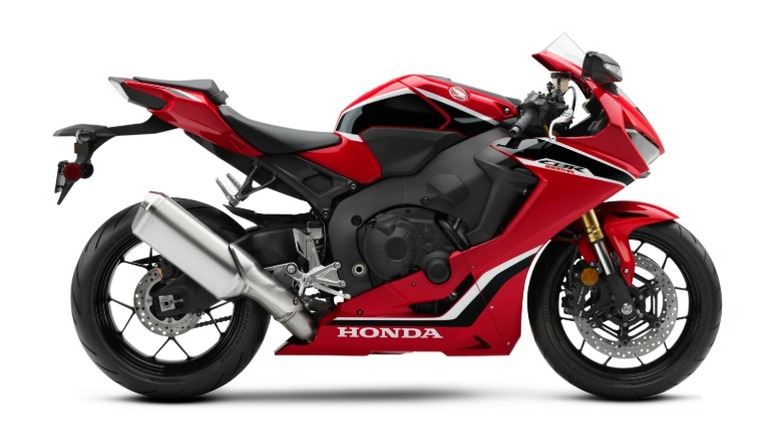
The 2025 Honda CBR1000RR continues to be impressively capable both at everyday speeds and at full throttle, continuing the standard set by earlier models. For the 2018 model year, buyers could pick from several variants of the bike, with each one featuring a 998cc inline-four engine making 189 hp. Entry-level versions offered fewer niceties, while top-spec variants had extras including a weight-saving battery and Öhlins semi-active suspension.
While it had plenty of power to satisfy seasoned riders, the CBR1000RR's generous equipment levels made it relatively accessible for newcomers too. It's far from the most sensible Honda motorcycle, but it is still a Honda, after all. Approachable as it might have been, the CBR1000RR was not quite up there with the leading players in horsepower terms, lagging a little behind rivals from the likes of Kawasaki and Suzuki. That said, unless you're looking for ultimate bragging rights, a few missing horses won't do much to dent the Honda's appeal.
Kawasaki ZX-14R — 192 hp
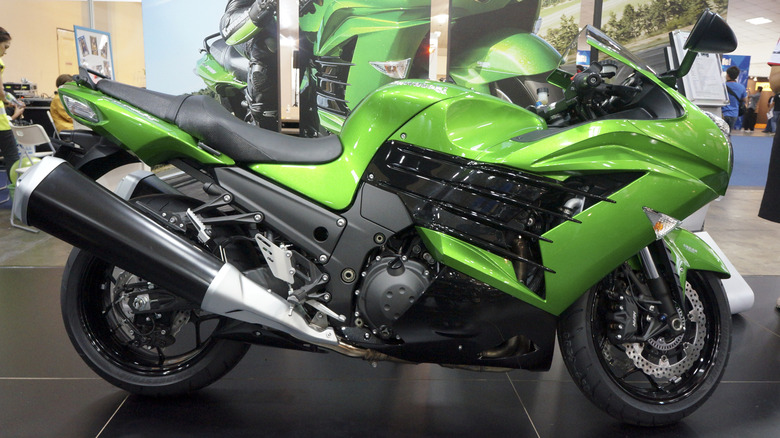
The original ZX-14R was one of the fastest Kawasakis ever built and could hit 200 mph with its speed restrictor removed. In 2012, the Japanese brand launched a new generation, which proved to be even more extreme. A 192 hp 1,441cc engine provided the poke, while Kawasaki's multi-mode traction control system helped ensure that riders didn't end up in the scenery the first time that they opened the throttle. Riders who wanted to feel the bike's full force could turn off traction control altogether, and then hope they hadn't overestimated their riding capabilities.
The bike also featured a Low Power Mode for those who wanted to get used to riding it before employing its maximum power. However, this mode mostly only affected the higher end of the rev range, meaning it still had fearsome performance off the line. The responsibility for keeping the bike glued to the ground fell to its 190-millimeter rear tires, although with the correct traction control mode engaged, it wouldn't have been difficult to get the 120-millimeter front tires raised into the air.
Suzuki GSX1300R Hayabusa — 194 hp
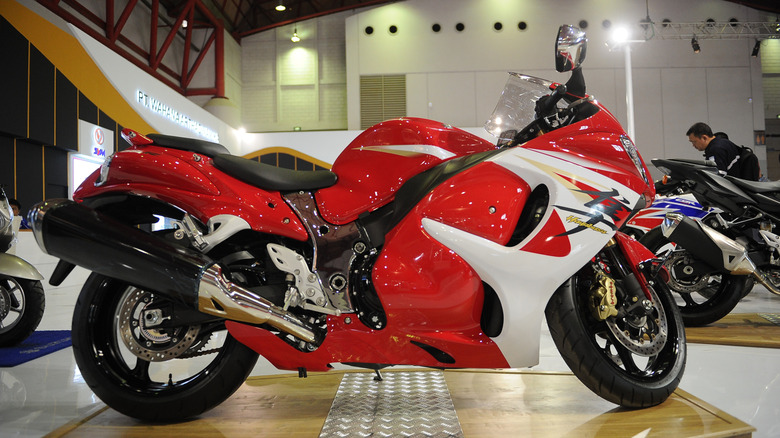
Although Suzuki first launched the Hayabusa back in 1999, it remained one of the fastest motorcycles on the market at the dawn of the 2010s. The Japanese manufacturer overhauled it in 2008, and it cruised into the next decade with no significant changes. At its heart sat a 1,340cc inline-four engine making 194 hp, which was enough to give it an official top speed of 186 mph. It could have gone even faster, but thanks to concerns raised by Japanese lawmakers, it was limited from its inception.
While 186 mph might seem like an arbitrary number, Japan uses the metric system for speed limits, and 186 mph is 300 kilometers per hour. That's a nice round number for manufacturers to display on advertisements at home, yet with the imposition of a clear limit, there was an end to the burgeoning horsepower war. Over the years, a variety of other vehicle manufacturers have borrowed the Hayabusa's engine to make non-motorcycle vehicles, including a one-off Smart Fortwo that was designed by Hans Schori.
Yamaha YZF-R1 — 197 hp
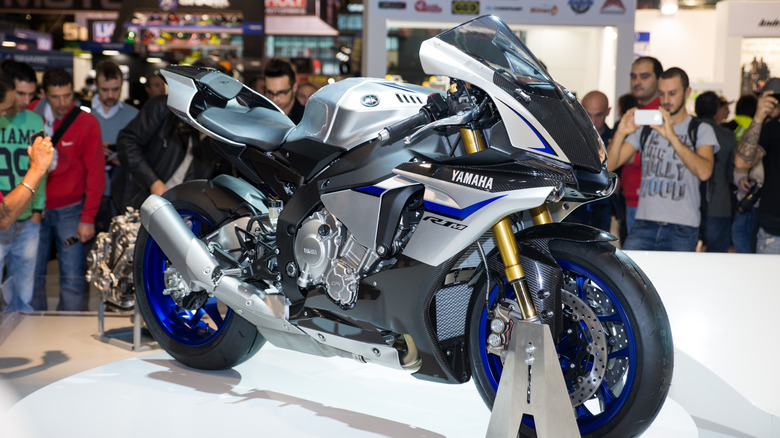
Ranking motorcycles based on horsepower isn't always an exact science, since manufacturer estimates and independent testing can produce some notably different figures. Horsepower outputs for one model can also vary between territories — take, for example, the Yamaha YZF-R1. The manufacturer claimed at its launch that the motorcycle was good for 197 hp, but when Motorcyclist estimated its wheel horsepower, it clocked 160 ponies. Still impressive, but not quite the best in class.
However, it's safe to assume most riders who actually got the chance to test out the YZF-R1 wouldn't care about its exact horsepower rating either way. They'd be far too busy tearing up the nearest track, with the bike's racing-derived tech and lightweight construction combining with its ample power to make a boundary-pushing superbike. Valentino Rossi reportedly helped develop the YZF-R1, but even less experienced riders would have been able to appreciate its champion-worthy speed and precision. In case the "regular" YZF-R1 wasn't extreme enough, Yamaha also offered an equally powerful R1M variant that came with even more race-ready components, as well as additional weight-saving carbon fiber body panels.
Kawasaki Ninja ZX-10R SE — 197 hp
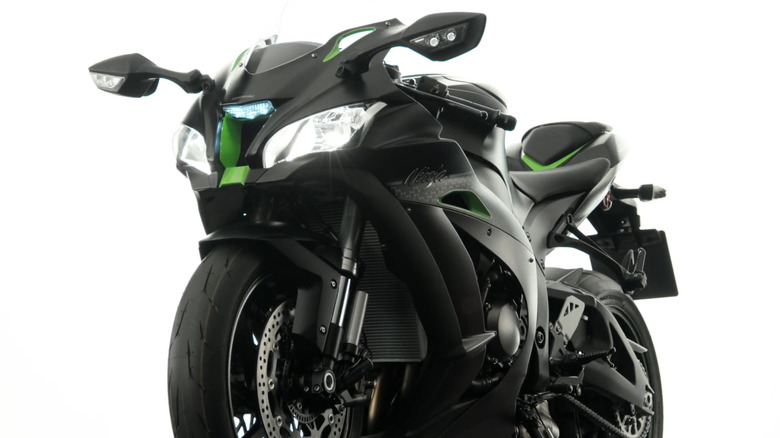
In the case of the Kawasaki Ninja ZX-10R SE, "SE" stood for Special Edition. The 197 hp literbike was indeed special, with a semi-active suspension system, Marchesini wheels, and Showa Balance Free Fork. If that wasn't enough, Brembo brakes improved the bike's stopping power, while Bridgestone Battlax RS10 tires helped it stick to the road or track.
All of these features didn't come cheap — the ZX-10R SE retailed for $21,899 at its launch in 2018 — but its price didn't dent its desirability. It might not have been the most powerful motorcycle in Kawasaki's range, but the ZX-10R SE was still a safe bet for any rider who wanted the power to outperform rivals on the circuit, but the comfort and electronic aids to make driving home again an easy task. That said, it faced stiff competition from both domestic and foreign rivals, including from the likes of fellow Japanese brand Suzuki.
Suzuki GSX-R1000R — 199 hp
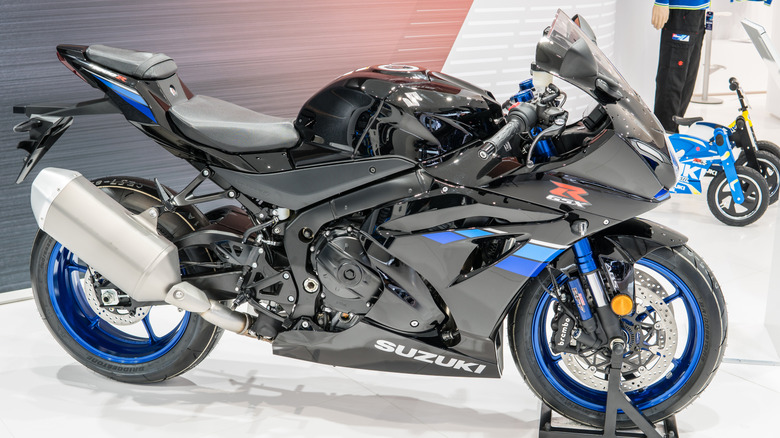
The Suzuki GSX-R1000R built on the already formidable performance of the GSX-R1000, making it even more of a weapon on track thanks to extras like a Showa Balance Free Fork. With a claimed 199 hp on tap, the Gixxer was also among the most powerful literbikes of its era when it debuted in 2017, although it was a few ponies short of being top of the pile. A 14,500 rpm redline ensured it sounded suitably rabid too.
While it offered enough power to enable riders to hit license-shredding speeds in seconds, the GSX-R1000R wasn't a menace to ride at lower speeds. A total of 10 different traction control levels were offered, with the most assistive levels meaning that even less experienced riders could find their confidence with the bike. Seasoned pros might want to turn it off altogether, although they'd have needed to be on a sufficiently smooth and flowing circuit to do so.
Ducati 1299 Panigale — 205 hp
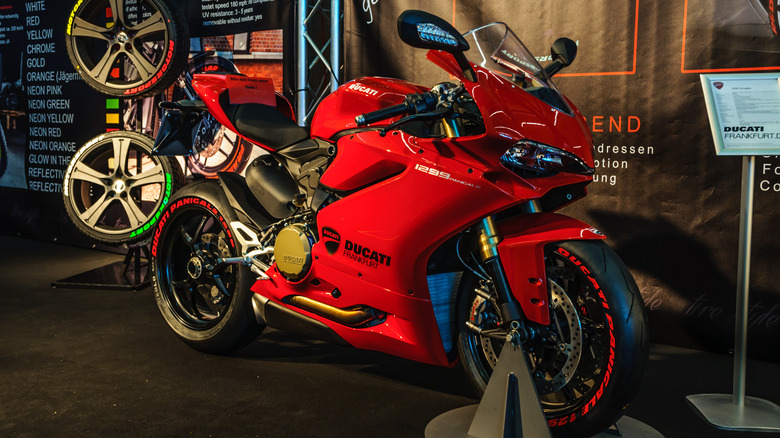
It's not like enthusiasts are short of choices when it comes to picking an ultra-fast Ducati motorcycle. With 205 horsepower on tap, the Ducati 1299 Panigale is one of the speediest of the bunch, and it also takes the honor of being the first production Ducati with over 200 ponies. That power figure was achieved by taking the 1199 Panigale engine and increasing the bore to 116 millimeters, up from 112 millimeters. A slew of other changes were made to the bike's handling setup to accommodate the increased power, including Öhlins semi-active suspension in top-spec S variants.
At the time of its unveiling in 2015, the 1299 Panigale was unlike anything else on the market. However, over the following years, a wider number of manufacturers would unveil bikes that offered more than 200 horsepower. Ducati didn't stop developing new, more powerful engines either, hence the 1299 Panigale now ranks in the middle of this list with two of the brand's other models boasting even higher outputs. Nonetheless, the 1299 Panigale deserves credit for helping to usher in a new chapter of the horsepower wars, even if it had already been bested several times over by the end of the decade.
BMW S1000RR — 205 hp
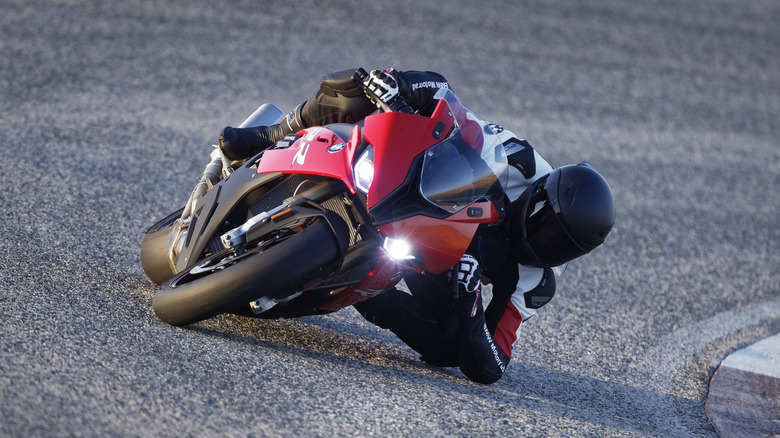
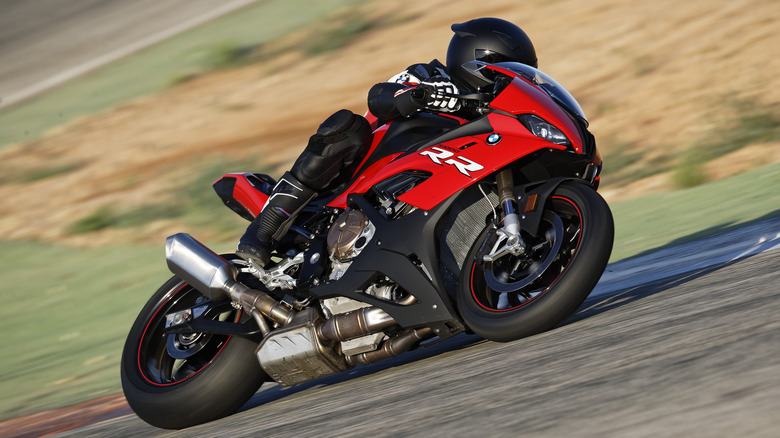
The first generation of the BMW S1000RR hit dealerships in 2009, while the third generation launched a decade later in 2019. This third generation motorcycle churned out as much as 207 hp in some markets, although in the U.S., that output dropped slightly to 205 hp. BMW wasn't just content with making it more powerful, and gave the bike a thorough overhaul to give it the chops to go head-to-head with the best in its class.
The S1000RR had a lighter exhaust, revised suspension, and plenty of new tech, including multiple new riding modes. Race mode configured the bike for maximum on-track performance, while Dynamic mode acted as a middle ground between its racing setup and Road mode. A Rain mode also helped give riders additional traction in slippery conditions, while certain variants of the bike also came equipped with three configurable Race Pro modes. Just from its mode selection, it's clear that the bike was built first and foremost for the track, although BMW claimed that it would be just as much at home on rural roads or doing the daily commute.
Kawasaki Ninja H2 — 210 hp
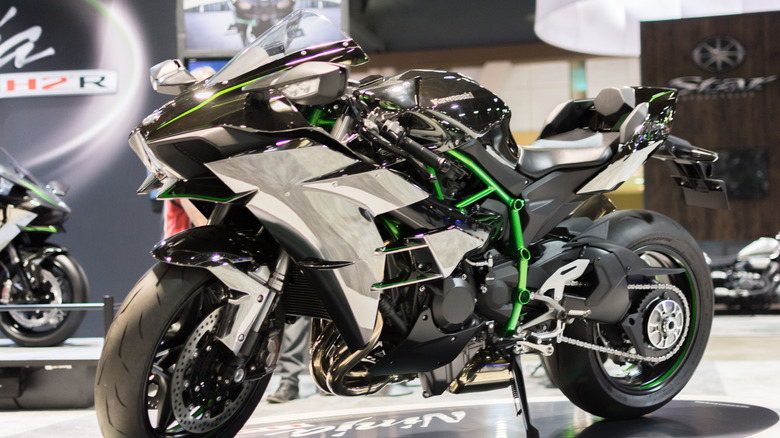
As well as being one of the fastest motorcycles of its time, the Kawasaki Ninja H2 is also among the most famous. At its launch, it instantly became a new benchmark thanks to its claimed 210 hp output, made possible by the supercharger attached to its 998cc engine. It featured a multi-mode traction control system for reassurance, and could in theory be ridden at everyday speeds without too much hassle.
However, the unprecedented amount of power available meant that it would still take an immeasurably disciplined rider to not succumb to the temptation of hitting triple-digit speeds on a regular basis. They'd look good doing it too, thanks to the Ninja H2's striking appearance and its signature Kawasaki color scheme. While the H2 was designed to be ridden on the road, Kawasaki also offered an even more powerful track-only variant, the H2R. It pushed the bike's performance to even greater extremes, although the standard H2 was already potent enough that most riders would run out of talent — and bravery — long before the bike ran out of power.
MV Agusta F4 RC — 212 hp
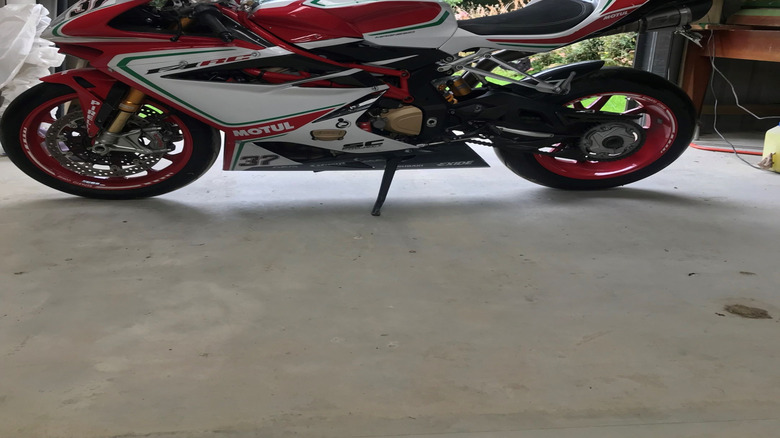
With a retail price of $46,000, the MV Agusta F4 RC cost far more than most superbikes. However, those who could justify the cost would be rewarded with a hand-built, race-derived machine which borrowed from the brand's World Superbike Championship program.
As standard, the bike made 205 hp, a scary proposition even without any extra tweaks. However, anyone who wanted even more horses at their beck and call could fit the bike with a complimentary race-style exhaust that MV Agusta handily threw in with every purchase. With the exhaust and a revised ECU fitted, the brand claimed the bike was capable of making 212 hp. The freebies didn't stop there either, since every bike came with an individualized construction certification and a cover.
Well-heeled riders would be getting plenty for their money then, but very few got the chance to own one. A total of 250 examples left the brand's factory, with each one finished in a unique livery that paid tribute to MV Agusta's race-spec superbike. Collectors hoping that the bike's rarity would mean it would hold its value might be slightly disappointed, as one example sold at a Bonhams auction in 2022 for just 16,675 British pounds (approximately $20,625 at 2022 exchange rates).
Ducati 1299 Superleggera — 215 hp
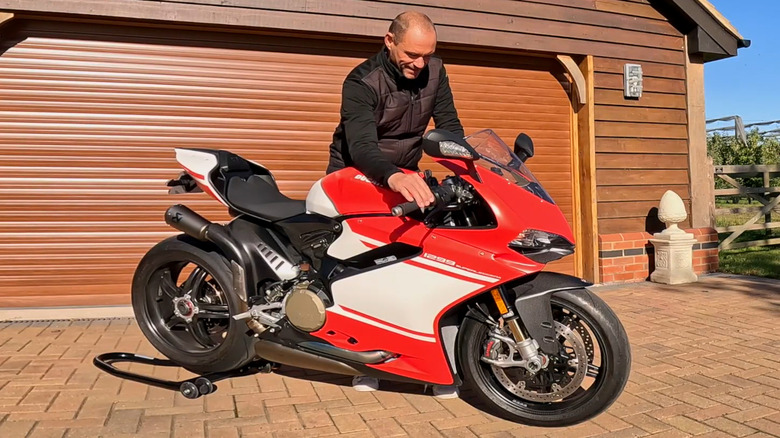
There are special bikes, and then there's the Ducati 1299 Superleggera. Launched in 2017 with a retail price of $89,225, the Superleggera's chassis and wheels were made from carbon fiber to keep weight to a minimum. It was the follow-up to the 1199 Superleggera that arrived in 2014, and it was even more powerful, with 215 hp available from its 1,285cc V-twin engine. Unsurprisingly, the best place to appreciate its full talents was the track, but it could also be fitted with a license plate and ridden home after a session.
Only 500 examples of the bike were built, and it seems like a few buyers didn't ride it home. In fact, some barely rode it at all, with one example appearing on Bring a Trailer in 2025 with just 39 miles on the odometer. Numbered as #81 out of the 500, it sold for a final price of $52,500. That's a drop in value of $36,725 over eight years, or just under $950 per mile ridden. Ouch.
BMW HP4 Race — 215 hp
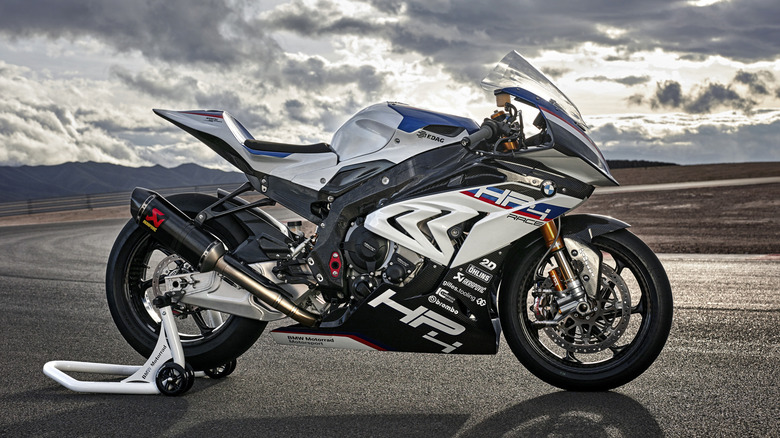
In case the name didn't already give it away, the BMW HP4 Race cannot be ridden on the road. Each of the 750 buyers of the bike were restricted to using it on the track, with the S1000RR being the nearest roadgoing equivalent. The HP4 Race featured a 999cc engine making 215 hp, as well as a carbon fiber frame, forks borrowed directly from MotoGP, and plenty of onboard gadgetry to keep riders in control of its power.
It looked like a racing bike too, being adorned in traditional BMW Motorsport colors. Accordingly, it was priced far higher than most road-going superbikes, with a retail price of $78,000. That price assumes riders won't cover more than 3,100 miles too — if they do, they'll have to fork out close to $20,000 more for a new engine. It appears that many buyers won't have needed to cover the extra cost, since the two examples for sale in the U.S. at the time of writing have both covered less than 1,500 miles since new.
Aprilia RSV4 1100 Factory — 217 hp
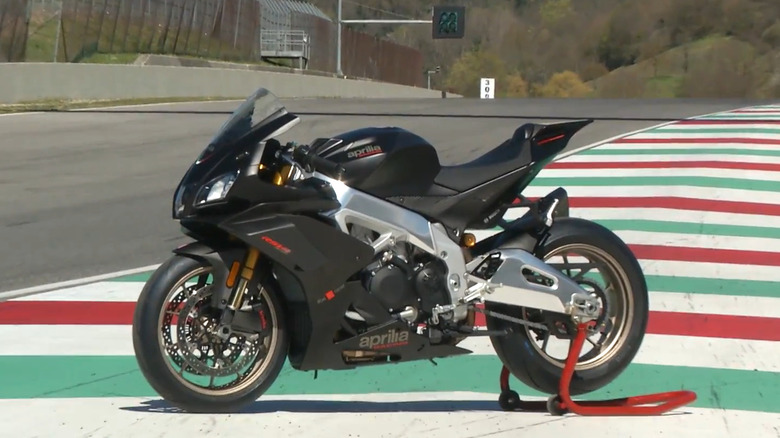
Aprilia reported a 217 hp output for the RSV4 1100 Factory, although like all of the motorcycles here, the numbers only tell a part of the story. Still, even that numerical part is thoroughly impressive, with the bike being one of the most powerful of the decade that could still wear a license plate. Aprilia deployed the usual list of superbike assistance tech to help riders keep the rubber firmly on the asphalt, including ABS, multi-level traction control, and a pit limiter for those mid-session stops.
Adjustable suspension and race-ready Brembo brakes helped complete the package. The bike retailed for $24,999, which seems very reasonable given the amount of horses on offer. It only just about qualifies as a 2010s bike, having arrived in dealerships in early 2019 and remained available through the start of the next decade. At the time of writing, the 2025 model is available from Aprilia USA for $26,499, with a slightly boosted power output of 220 hp.
Ducati Panigale V4 R — 221 hp
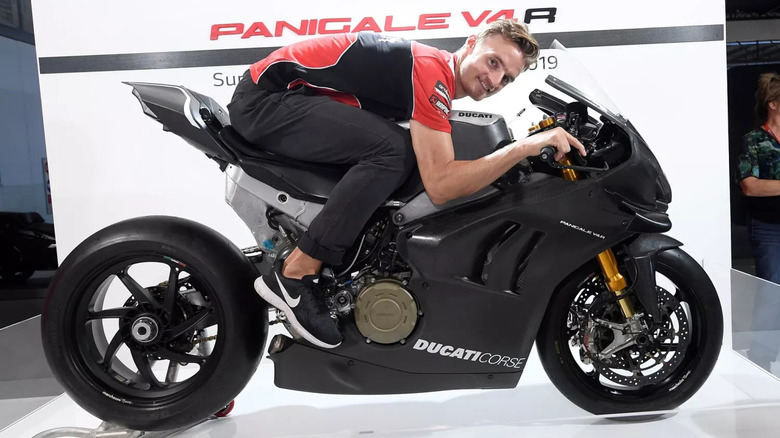
According to Ducati, the Panigale V4 R "is, in all respects, a road-legal WSBK racing motorcycle, and the technical baseline for Ducati factory Superbikes currently competing in the 2019 World Championship." It churns out 221 hp from the factory, which already made it the most powerful production Ducati unveiled at the time. However, that wasn't all: the manufacturer also said that by adding a specially-designed Akrapovič exhaust from Ducati Performance, the bike's output could jump even higher to 234 hp.
All this performance came with a hefty price tag, with the Panigale V4 R retailing for $40,000 at its launch. However, it doesn't seem all that outrageous considering that the bike is pretty much the closest that any non-professional rider will ever be able to get to riding a real race-spec superbike. It's also one of the most powerful bikes available even today, although one legendary Japanese track-only model from the 2010s eclipses it in terms of sheer horsepower output.
Kawasaki Ninja H2R — 326 hp
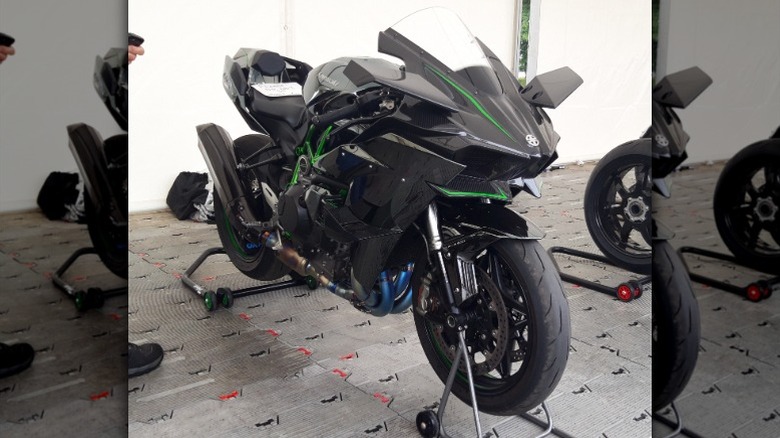
The Kawasaki Ninja H2R was in a league of its own when it came to horsepower, pushing 326 hp when it first launched in 2015. The most powerful motorcycle of the 2010s is still the fastest production motorcycle in the world today, having clocked a top speed of 248 mph during an official test run in Turkey.
The only catch for riders looking to purchase their own H2R is that they'll be restricted in where they can use it. Unless they've got regular access to a suitable track, they'll be out of luck, since the bike can't legally be ridden on the road. However, anyone that needs their bike to have a license plate isn't out of luck entirely, since the H2R's slightly less mad sibling, the H2, is road legal. The H2 is still immensely powerful, but it's over 100 hp down compared to the H2R. Plenty of high-powered bikes could be described as rocketships, but none of them will deliver the quite the same world-beating punch of acceleration as the H2R.