

5 Of Toyota's Most Underpowered Engines
Over the decades, Toyota has built some of the most impressive engines the industry has ever seen, and among the general public, Toyota's reputation for reliability is unmatched. That does not mean, however, that all of Toyota's engines are powerhouses or even that its cars haven't been outgunned by the competition at times. There's nothing inherently wrong with this, of course, and millions of buyers have spoken with their wallets, choosing the reliability or fuel efficiency of a Toyota even if it's down on power.
Over the last five to ten years, the company has taken big steps across the board to make the days of woefully underpowered Toyotas feel like a thing of the past. Likewise, cars like the latest iteration of the Prius and Camry have proven that you can have both incredible fuel efficiency and impressive power; however, there are still a few modern Toyotas that are quite slow by today's standards. It's also important to note that it's not even necessarily the engine itself that's underpowered, but more the combination of an engine and transmission in a car of a certain weight. With that in mind, we've picked five Toyotas from the last 20 years — including a couple of current ones that drivers and reviewers have found to be especially underpowered.
Toyota Tacoma 2.7-liter
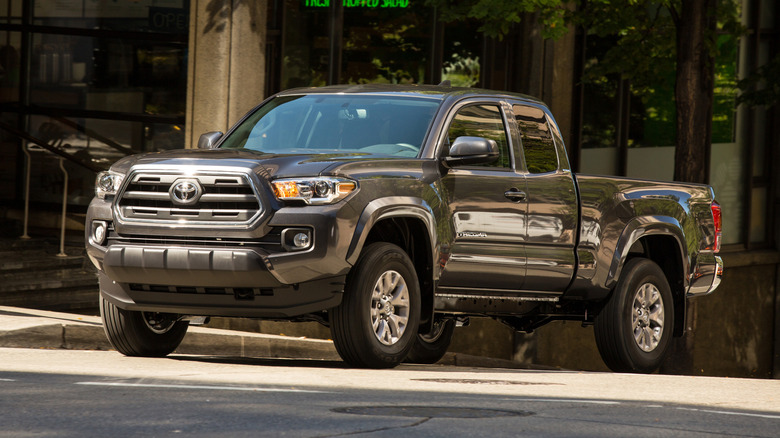
Until its latest generation, which introduced an all-turbocharged lineup, the Toyota Tacoma traditionally offered buyers the choice between a naturally aspirated four-cylinder engine or a naturally aspirated V6. Toyota's 2.7-liter 2TR-FE four-cylinder engine had no major issues as far as reliability goes. When it came to powering the previous-generation Tacoma, the four-cylinder very much had its work cut out for it.
Just look at the four-cylinder Tacoma's output – 159 horsepower and 180 pound-feet of torque. Those are both numbers that bring to mind the pickups of the 1990s, not ones that were sold into the early 2020s. Either figure is a massive downgrade from the more common 3.5-liter V6, which made 278 horsepower and 265 pound-feet of torque. And it's not like the V6-powered Tacomas were known as rocketships, with modest 0-60 times in the high seven-second range.
Given that it was the base engine, there isn't a whole lot of official testing data out there on the 2.7-liter Tacoma, but real-world 0-60 times have shown figures over 11 seconds, which makes the V6 Tacoma look like an absolute muscle truck by comparison. New Tacoma buyers won't have to deal with this anymore, though, as the latest version of the truck now makes a much more substantial 228 horsepower and 243 pound-feet of torque in its cheapest guise.
Toyota Corolla 1.8-liter (2020-2022)
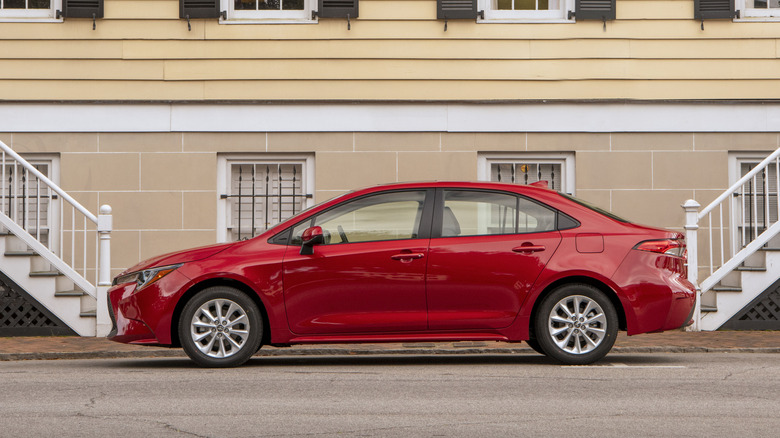
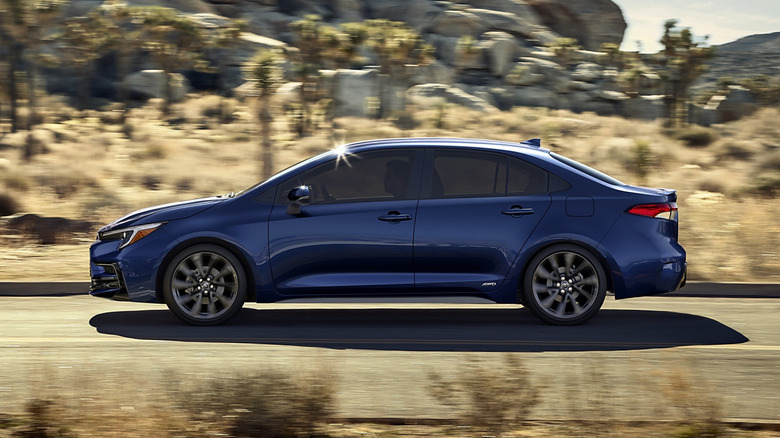
When Toyota debuted the current-generation Corolla sedan for the 2020 model year, it moved the car forward in a big way with its switch to the new TNGA-C platform. One thing that did not get updated with the new car, though, was its base engine — a 139-horsepower naturally aspirated 2ZR-FAE 1.8-liter four-cylinder that was mated to a CVT. As with the Tacoma we just mentioned, that sounds more like a 1990s horsepower figure rather than a 2020s figure.
When Motor Trend tested the new 2020 Corolla sedan upon its release, it found the base engine "loud and underpowered," with a 0-60 time over ten seconds and quarter-mile ET nearing 18 seconds. Obviously, the buyers of a base model Corolla aren't looking for big performance numbers, but the 1.8 cars were absolute slowpokes by the standards of the segment.
Fortunately, Toyota refreshed the Corolla's engine lineup for 2023, dropping the old base 1.8-liter from the option list completely. Today, even the base model Corolla LE comes with the more powerful 2.0-liter engine, and though it's still a far cry from the fire-breathing GR Corolla, the normal version of the 2025 Corolla remains a safe but competent choice in the compact sedan segment.
Toyota Prius c 1.5-liter
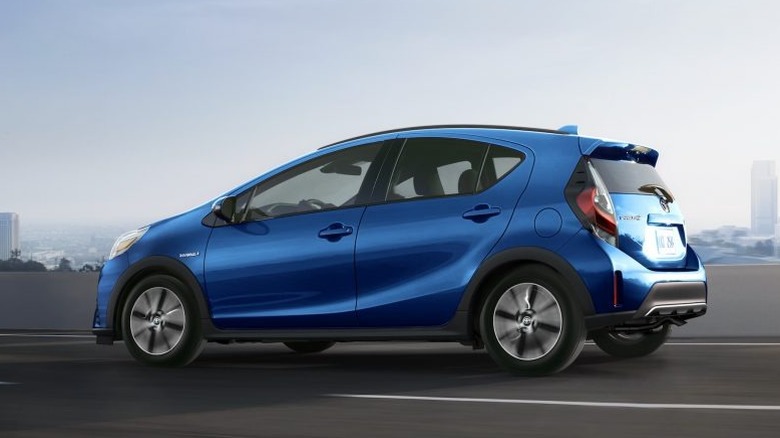
Back in the early 2010s, when the fuel-sipping Toyota Prius was at the height of its popularity, Toyota introduced a smaller version of the car called the Prius c. The idea was to carry over the Prius' excellent MPGs into a smaller, cheaper package — and that part of the goal was accomplished. But the Prius c was slow, almost painfully so.
Under the hood sat a 1.5-liter four-cylinder hybrid, which made just 99 total horsepower. That's right, double-digit horsepower. The Prius c was not a large or heavy vehicle, but with that sort of minuscule output, 0-60 times were over 11 seconds, and a quarter-mile run took over 18 seconds. The Prius c would be fine in the city, but on uphill highway climbs or passing traffic on the freeway could be a major adventure. When Car & Driver tested a Prius c in 2018, the car's highway acceleration was compared to that of a "three-toed sloth."
Ultimately, American buyers decided that the fuel economy just wasn't worth dealing with the small size and underpowered performance of the mini-Prius. The Prius c would last just a single generation in the American market, with Toyota discontinuing it in 2019 as Toyota shifted the new Corolla Hybrid to be its entry-level fuel-sipper.
Toyota Tundra V6 (2007-2015)
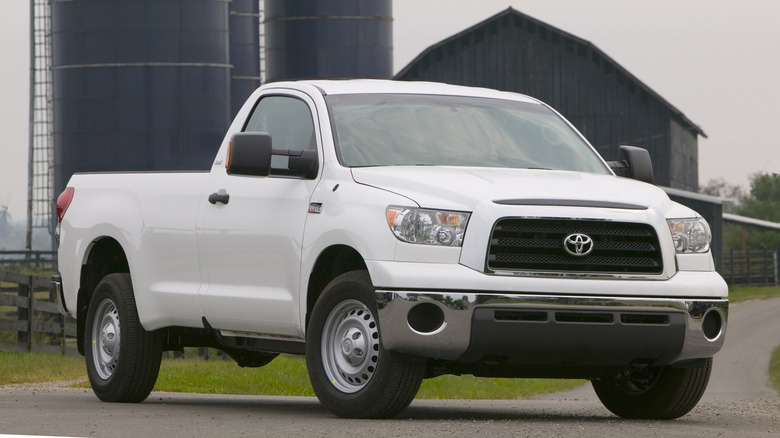
When Toyota introduced the second-generation Tundra pickup for the 2007 model year, it was a very big deal. The new Tundra was a full-sized, half-ton pickup aimed right at its Detroit competitors. And the engine people most commonly associate with the second-generation Tundra is Toyota's powerful 5.7-liter V8, which made over 380 horsepower and over 400 pound-feet of torque. This was the engine that defined the Tundra for many years, and is ranked among Toyota's most powerful V8s ever.
What's less talked about is the base model of the second-gen Tundra, which came with a 4.0-liter naturally aspirated 1GR-FE V6. The V6 made just 236 horsepower and 266 pound-feet of torque, which seemed unsuited to the Tundra's new full-size aspirations. The 1GR-FE was a solid engine in the Tacoma and 4Runner, but in a big half-ton pickup, most buyers expected a V8 — or at least V8-level performance.
V6 Tundras did get a power bump for 2011, but it wasn't enough to win over buyers, and the V6 option was dropped from the Tundra lineup for 2015. Today, with the third-generation Tundra, it's the V8 that's been replaced by a V6 — albeit a modern, twin-turbocharged version. Right now, even the cheapest version of the 2025 Tundra makes 358 horsepower and 406 pound-feet of torque from its 3.4-liter twin-turbo V6.
Toyota Corolla Hybrid
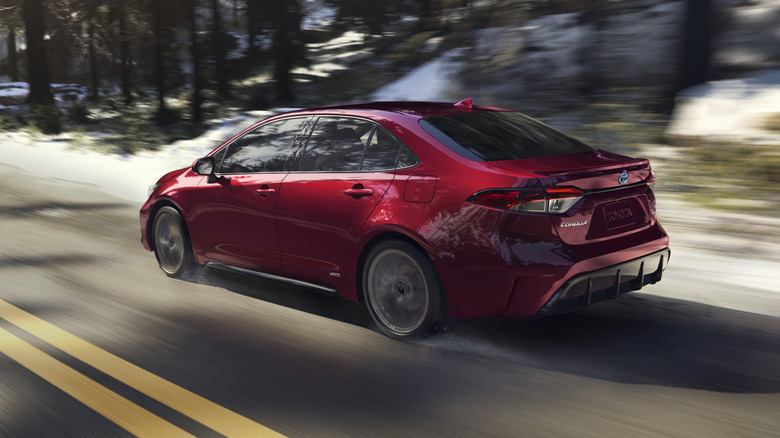
Last but not least, we get to the Corolla Hybrid, which is the slowest car that Toyota currently sells in America. In fact, the Corolla Hybrid is actually one of the slowest new cars currently available from any automaker. As far as its main mission of delivering excellent fuel economy and a low MSRP, the Corolla Hybrid succeeds, but the trade-off is having to deal with some pretty glacial acceleration figures.
The 2025 Corolla Hybrid is powered by a 1.8-liter hybrid setup that makes just 138 horsepower combined, and in testing, the car delivers 0-60 times anywhere from nine seconds to over 10 seconds, depending on its state of charge. Compare this to Honda's surprisingly powerful Civic Hybrid, which makes an impressive 200 horsepower and can hit 60 miles per hour in the low six-second range.
The good news is that after six model years, this generation of the Corolla is due to be replaced soon, and the hybrid version should be in line for a big power increase. Toyota has already proven with the new 2.0-liter hybrid setup in the latest Prius that its hybrids can make a lot more power with the same great fuel efficiency. It's only reasonable, then, to expect the next-generation Corolla Hybrid to have performance that's much more in line with the surprisingly quick and fun Prius.
How do you define underpowered?
Obviously, there are no hard rules for determining whether a car is underpowered or not, and the perception is based on each driver's own experiences. When putting this list together, we decided to focus primarily on modern Toyotas from the last 15 years. Selections were chosen based on personal experience, looking at road tests and notes from reviews, and comparisons to competitors. We also considered Toyota's own actions of replacing, discontinuing, or upgrading some of these engines on subsequent models.