

Mercedes' New CLA Makes Tesla Autopilot Look Dated, But That Wasn't My Biggest Surprise
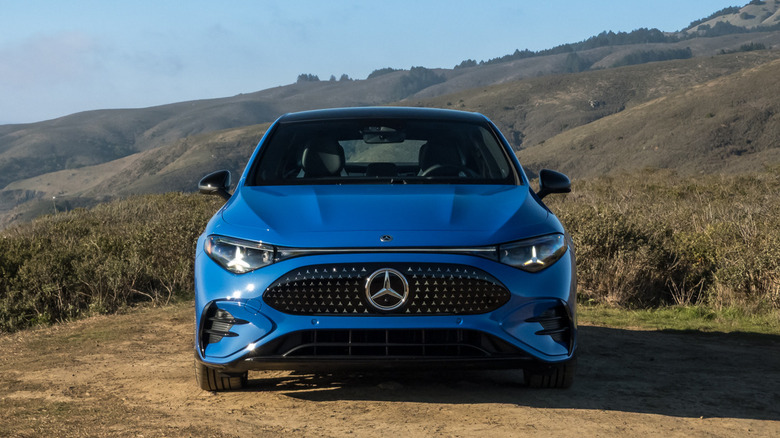
Last summer, Mercedes-Benz held a media drive program for the all-new 2026 CLA, which straddles the gap between fully electric and hybrid powertrain options on the same platform. SlashGear's own Emme Hall popped over across the pond to test the CLA EV in Copenhagen, Denmark, but without full confirmation or experience of the eventual American specifications.
Since then, the electric CLA secured an official EPA rating of 374 miles and–even more impressively–achieved a whopping 434 miles in real-world testing by Edmunds. The hybrid variant still appears to be a ways off, but in the meantime, Mercedes also held a separate drive program here in San Francisco to show off the CLA in United States spec, plus an impressive new "Level 2++" semi-autonomous drive program in one of the gnarliest traffic cities on the planet.
 Michael Teo Van Runkle/SlashGear
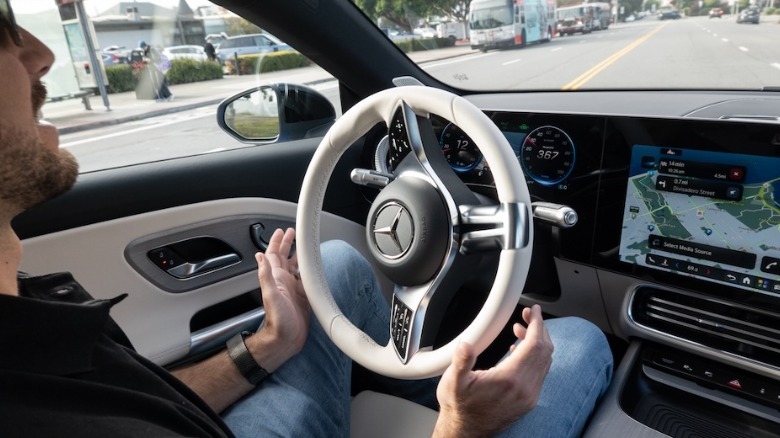
As part of the American wave, I got to drive the CLA all over the Bay Area and northward into Marin. But as well as the CLA drives—confirming Emme's impressions—I spent the most impressive part of the day sitting shotgun for about a 40-minute loop as the car essentially drove itself among traffic, pedestrians, cyclists, and plenty of other autonomous vehicles.
A quick CLA refresher course
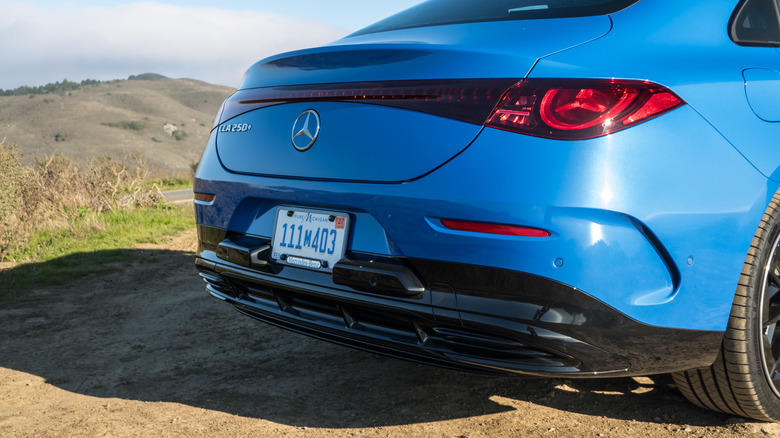
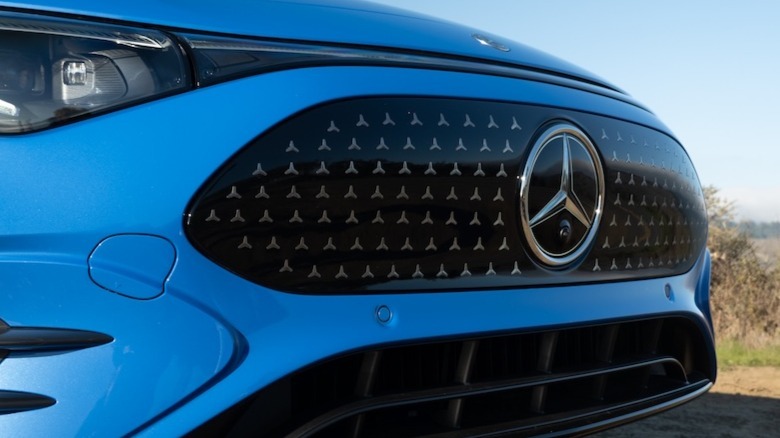
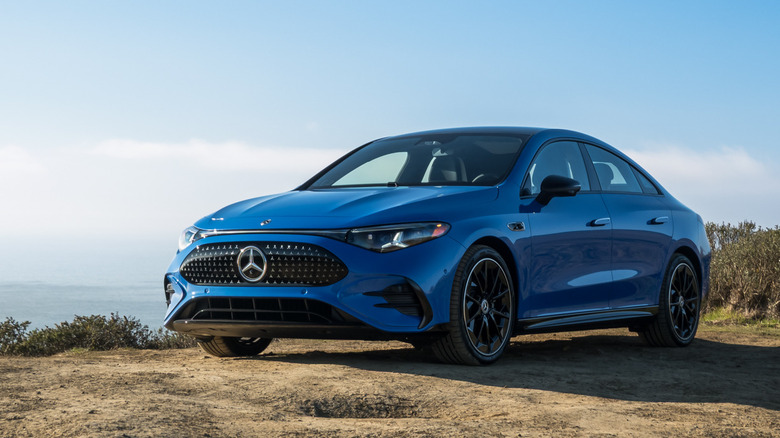
For those who feel less inclined to jump back into Emme's article, the CLA rides on Mercedes-Benz's uninamignatively named "MMA" platform. This chassis will eventually add internal-combustion power, and carries over to the GLB subcompact SUV as well, but for now the CLA comes in either the 250+ with EQ Technology with a single rear motor good for 268 horsepower, or the 350 4Matic that adds another motor up front for a total rating of 349 electric all-wheel-drive horsies.
 Michael Teo Van Runkle/SlashGear
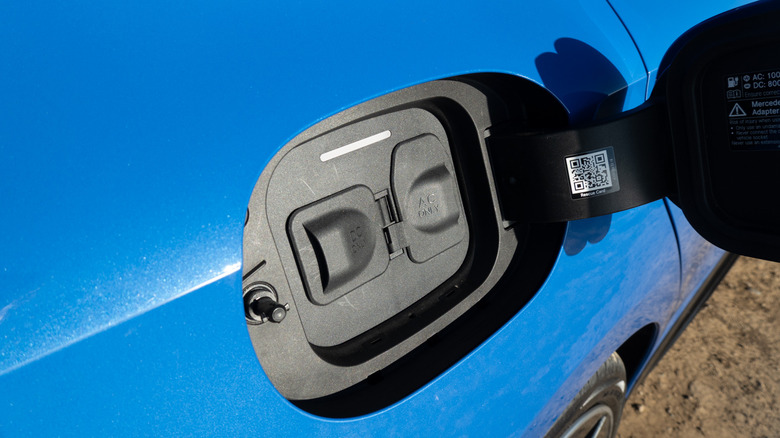
Both EV powertrains use a two-speed transmission—a la Porsche's Taycan—and the front motor on the 350 can disconnect to help improve efficiency. The first use of 800-volt architecture by Benz allows for up to a 320-kilowatt charging rate, good enough to add 200 miles in 10 minutes, and comes equipped with both a CCS and an NACS charge port to unlock access to Tesla's Supercharger network. All at a starting price of just $48,500 (not bad for a Benz, much less any EV in the modern era).
MB.Drive Assist Pro Subscription

The base CLA promises a substantial amount of tech at an entry level price, but the MB.Drive Assist Pro function that I flew to SF to evaluate technically counts as a subscription available per month, for a year, or for three years. In other words, the hardware to run Level 2+ comes equipped regardless, but owners can opt in and then out as desired. Read into that what you will, BMW fanboys.
Mercedes reps on hand preferred not to call MB.Drive Assist Pro either an autonomous or self-driving tech suite, instead referring to the new software as "Point-to-point assisted driving with cooperative steering" most of the time. And talk about a PowerPoint deck. The CLA uses a Google partnership for the 10.25-inch instrument cluster, the 14-inch center touchscreen, and the optional 14-inch passenger dash screen. Google's Gemini can therefore help with the "Hey Mercedes" voice activated assistant, but the main operating system still comes from Mercedes, though, and thankfully enables wireless Apple CarPlay. But then a whole new level of complexity enters for the Level 2+ driving, which Nvidia "AI" contributed after analyzing and simulating using Mercedes-Benz's data gleaned from 24 billion real-world miles driven since Distronic distance control adaptive cruise first debuted way back in 1998.
The software all needs to play nicely to enable what the "Pro" feature adds for $3,950. Namely, proactive lane changing, turning, point-to-point navigation, pedestrian yielding, intersection analysis, and "nudging." So yes, okay, but we all know how accurate so-called Artificial Intelligence search results turn up on Google—hence why I'm typing at a keyboard right now instead of searching for a new job—but how does a Level 2++ system actually work? Well, strap in, folks.
Long story short

Of course, I wish Mercedes let me slip into the driver's seat, rather than watching a professional road tester hovering his hands over the steering wheel at all times. As, I might add, I continuously quizzed him about features, feelings, sensations, and challenging moments that the CLA encountered. Talk about a fun morning in the city; sorry, pal. But long story short: MB.Drive Assist Pro works shockingly well. Whether that's a good thing, though...
My driver (my pilot, my captain) started driving, then pushed the usual button "Res" button on the left steering wheel touchpad, which now includes a little icon for a navigation destination. The gauge cluster lit up, showing a pre-programmed route that looped us up from the Financial District through Chinatown to Pacific Heights and then back home. Only a preset route will unlock Pro's takeover of the controls. So my first question? Of course, how to tell the software to drive faster than the speed limit.
As usual with adaptive cruise, pressing (or in the MB capacitive touchpad universe, swiping toward) the Plus button allows MB.Drive Assist Pro to technically break the law. But, still technically, the liability for doing so rests solely with the driver at any level of SAE International's widely accepted autonomous programming tier below Level 3. Hence why automakers keep adding the + to Level 2. But left to its own devices, the computer obeys.
Contemplating an adjustment period, or lack thereof
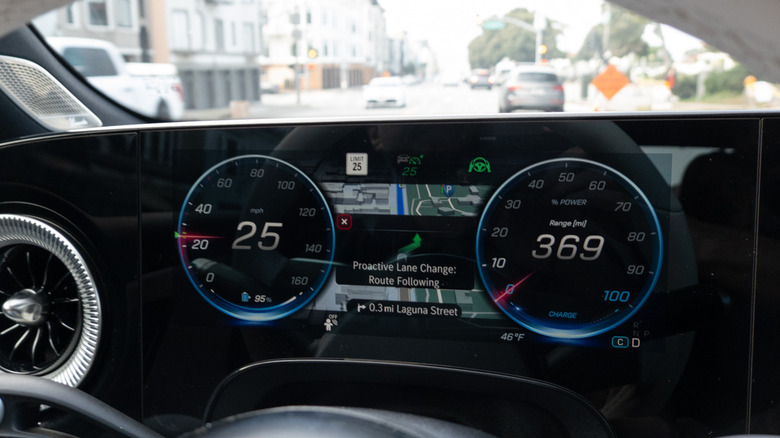
The physical and mental connection between human and machine reveals exactly how much thought from Mercedes went into creating a simple, confident robot chauffeur. Pushing the brake pedal while stopped, for example, does not deactivate MB.Drive Assist Pro. This inspires the feeling of safety for drivers who put a foot on the brake while stopped in the name of safety. But either tapping the brake pedal or the cancel button does cancel the autonomy while in motion.
From the passenger seat, I can't report how that dichotomy either clashes or works cognitively. Other functions also split the gap between fully autonomous and human-initiated, including lane changes via the turn signal stalk. But many happen without any input, from turning right on a red (state-dependent, naturally) to scooting leftward in a lane to stay slightly further away from a row of parked cars, or even fully leaving a lane into oncoming traffic if the maneuver is deemed safe and necessary.
I watched as the CLA negotiated a series of increasingly complex tasks that the pro to my left assured me Mercedes had no hand in organizing. First, a smooth left turn onto a diagonal street at a five-way intersection. Then, moving from the left lane to the right when a car ahead flipped on its left turn signal. Honoring a "No Right Turn on Red" sign, despite the car ahead of us ignoring it. Respecting right-of-way at a four-way stop with two lanes in each direction—at every stop sign, the CLA comes to a complete and legal stop, though. No California roll, despite scene and setting, and the pause does feel arbitrarily long for those accustomed to keeping an eye out for law enforcement rather than following the exact rules of the road.
One small step for man, one giant leap for Mercedes
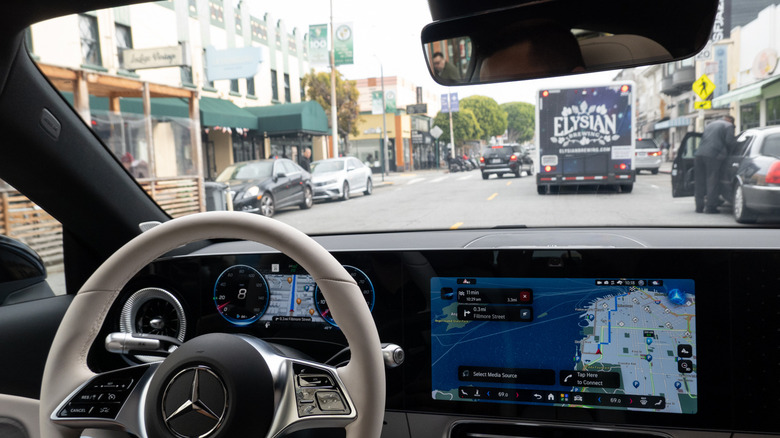
Mercedes calls the software process for a four-way stop "contender handling" as the CLA figures out which driver arrived first, or if one gets a right-of-way or needs to wait for a pedestrian all the way on the other side of the road. Don't expect the system to make any consideration for the little-known subconscious fact that humans give right-of-way to the driver in the most expensive car, as a tertiary calculation.
The best moment occurred when the CLA needed to nudge into the oncoming lane to get around a craft beer delivery truck, while a person got out of an open door in the lane, a pedestrian threatened to step out from across the street without a crosswalk, and directly in front of the truck awaited a three-way stop sign intersection with a minivan about to reenter traffic at the worst possible time after failing to parallel park.
Doubleplusgood

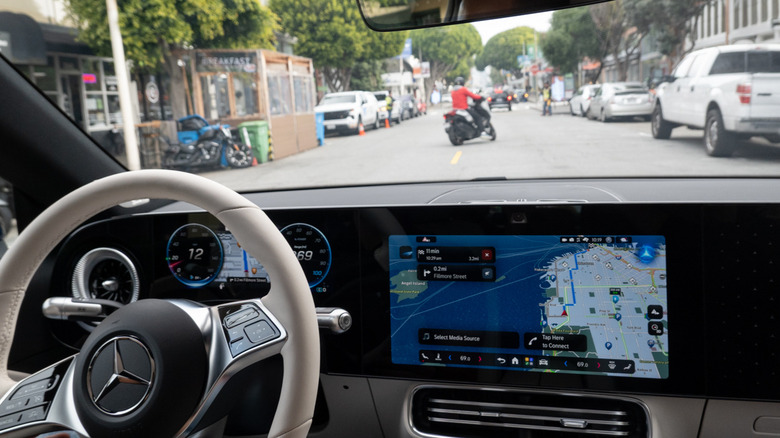
All that, much of which honestly might have given me pause: no problemo for the CLA. Same for the texting pedestrian who waited til the last second to step out into a crosswalk without looking (though I saw my professional follow the CLA's braking in this instance by a mere microsecond, in the name of safety). And a delivery scooter that made a U-turn in the middle of traffic with no warning. Most importantly: the computer recognized dogs in the crosswalk.
Neither negligent drivers, distracted pedestrians, nor construction zones stayed the CLA's progress slowly but surely through San Francisco. The old adage claims that 90% of drivers believe they're in the top 10% of drivers, but I can report without ego that MB.Drive Assist Pro definitely counts among the best. While fully concentrating, a solid human driver would definitely navigate these scenarios quicker, if not necessarily better. Both because of naturally exceeding posted speed limits but also the ability to process and pre-vision slightly quicker, then make a more instinctive reaction. And yet... I expect accident data will soon reveal just how much better Mercedes-Benz and Nvidia's software avoids accidents.
A neural net processor, it's a learning computer
As we pulled to the end of our drive, safe and sound, I wanted to know how much each CLA serves as a standalone learning computer, or how much Mercedes-Benz's entire fleet can share data. In the name of data privacy, my driver explained that the CLA only beams "hints" back to the mothership that enhance a standard-resolution navigation map. And yet, then stepping back to a "normal" CLA without the extra-cost software enabled then made for something of a strange experience over the rest of the day. Yes, MB.Drive Assist non-Pro still works as a solid Level 2+ system, similar to GM's Super Cruise but available on smaller roads. But I also noticed a few hiccups along the way, especially multiple times on the Bay Area freeways when the camera picked up a causeway-style exit lane's speed limit sign of 35 miles per hour, while cruising in the fast lane at 80, and then slammed on the brakes.
Now, humans might make that same mistake. But with somebody driving late to work right on my tail, I easily envisioned getting rear-ended (unless the car following also used some sort of autonomous software, either Tesla's FSD or Super Cruise or Blue Cruise or or or... Turns out I trust computers to leave more following distance than humans even at Level 2+.)
Mercedes also claimed that Gemini's improvements to the "Hey Mercedes" feature took a big step forward, but I noticed no change in annoying intrusions or helpful functionality. Oh well, hopefully the Pro software "learns" or permutates faster than the voice recognition.
Big Brother is driving
My confidence in both MB.Drive Assist and Pro grew noticeably by the minute over the course of a long day. But lingering–and I'd argue very natural–doubts about liability still cropped up before, during, and after. Those SAE classifications and, therefore, insurance adjuster future responses make the issue crystal clear: only when autonomy steps up to Level 3, as in Mercedes-Benz's Drive Pilot, does liability then fall to the car company.
Which very clearly also explains this new 2+ and 2++ nomenclature, despite whether the car can confidently negotiate stop-and-go traffic or freeway driving as well as a human driver. Regardless, the human behind the wheel still needs to keep an eye out, and needs to know they're still on the hook from a legal standpoint.
 Michael Teo Van Runkle/SlashGear
So what's the point, then? Why not just drive myself? Other than for beautiful road trips up to the headlands... This conundrum left me slightly more skeptical, even as the CLA demonstrated more baby steps in the development and capability of hardware and software on the way to full self-driving, as in the Waymos and Zooxes (Zooxii?) that the CLA gave as wide a berth to as I do. Mercedes and Nvidia appear to have maxed out how much a self-driving car can self-drive with this amount of affordable sensors onboard, without stepping up to more lidar and radar and cameras all over the car's body—which would add to price tags while taking away from aesthetic appeal.
MB.Drive Assist Pro verdict
And once we do get to that full-time Level 3, why even own a car? Presumably the monthly payments for a vehicle equipped with that software will cost less than just ride-sharing for all daily drives, or maybe will drop low enough by sending a privately owned car out to make some money and cover those steep monthly payments.
The quandary at this time involves just how well MB.Drive Assist Pro actually drives. I imagine easily forgetting to pay attention, distracted by texting or checking emails or watching Instagram reels, dozing off in the trap of something so effective and confidence-inspiring. That's the Catch-22 of this step in autonomous driving's evolution, before I can zip through traffic with computers programmed to avoid me, perhaps we put trust into the machine too quickly as regulations struggled to keep up with the technology.
The future is now, MB.Drive Assist Pro proudly proclaims, but as always, truly comprehending the potential ramifications of bleeding edge technology always takes more time than expected.