

12 Factory Cars With 10 Second Or Less Quarter Mile Times
What makes a good car a good car? It's subjective, but metrics dominate the car world. Someone might love one particular model because it's the one they had their first kiss in, someone else might love another model for its cameo in their favorite movie, and still someone else might love another model for how it makes them feel when behind the wheel. Gearheads could argue past lifespans about why one car is better than another, but luckily, the cold cut laws of math and science can intervene to provide objective touchstones for how one car compares to another.
One of these yardsticks is the quarter-mile time. This sprint of a drag race has become a benchmark metric in finding a car's position on the food chain, and while we can rate cars in numerous ways with this straight-line race, the true gateway time is the 10-second mark. Now, a Toyota Supra with a turbocharger larger than a watermelon might devour the quarter mile before 10, but that's a purpose-built car made to do just that. Where things get truly impressive is when you meet the cars that can beat the 10-second mark after rolling off the lot, racking up single-digit times all while coming with things like heated seats, infotainment systems, airbags, emissions regulations, and warranties. Here are 12 cars that can.
Lamborghini Revuelto
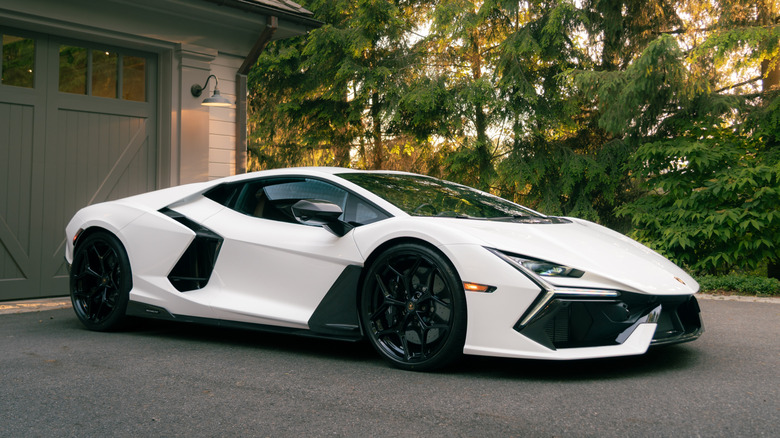
Sant'Agata Bolognese, Italy, is the birthplace of many a supercar bearing the name of a fighting bull. Lamborghini has a history of savage supercars that take Italian drama into its rawest form with screaming engines that boast double-digit cylinder counts. Their most recent flagship V12 supercar is called Revuelto, a name Lamborghini chose not just because it sounds cool, but for what it says about the car's character. Revuelto was a particularly rowdy and chaotic fighting bull from the 1880s, but it also translates to "mixed," which seems fitting for this rocketship of a car that mixes a 6.5-liter V12 with three electric motors for a combined output of 1001 fighting horses.
While the only real bull on the car is in its badge, the Revuelto's cutting angles and wide stance make it look as if it wants to charge you, and anyone else on the road, which it can, as that 1001 horsepower output means the Revuelto reaches 60 in just 2.2 seconds. Compared to its predecessor, the Aventador, the Revuelto seems light-years ahead without losing any of the angry gusto that makes Lambos so exciting. One such example is in the transmission, which now features a dual-clutch system, allowing for faster gear changes, and eliminating the head jerking pause in power that the Aventador's shifts produced. These improvements are noticeable everywhere, including the quarter mile, which the Revuelto completes in 9.9 seconds.
Porsche 918 Spyder
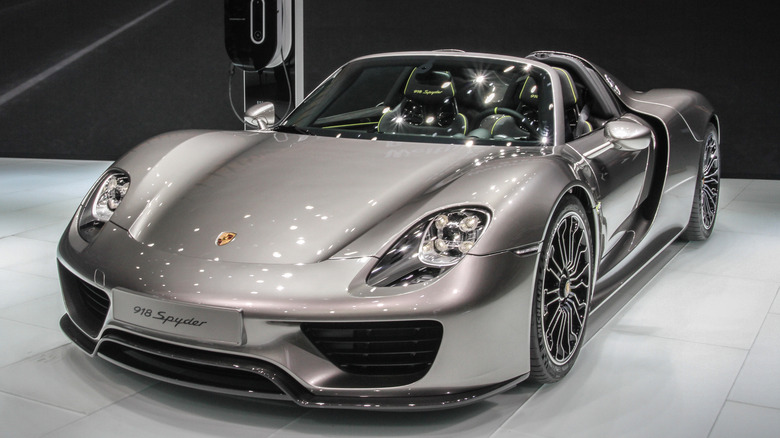
When it came out in 2013 as one third of the hybrid hypercar holy trinity, the Porsche 918 Spyder was the most advanced car Stuttgart had ever produced. Beyond being a supremely impressive performance car, the 918 Spyder served as a preview of the German giant. The star of the show, of course, was the 918's hybrid powertrain. Before its release, Porsche had never made a hybrid plug-in car for customers. As an introduction to hybrids, the 918 showed all the benefits at their best.
One such benefit is blisteringly fast acceleration. For an internal combustion engine (ICE), power delivery isn't as linear as with an electric motor. Part of this is because during gear changes, the ICE engine can't put the power down. With a hybrid system such as the 918's, the electric motor can fill in these power gaps. The 918's computer also watches over power delivery off the line, meaning wheelspin is minimized, and the 918 can reach 60 in just 2.2 seconds. During this lightspeed acceleration, gear changes are handled by Porsche's Doppelkupplungsgetriebe (an absurdly long German word that translates to dual clutch transmission, referred to as the PDK), which changes gears so fast you can barely appreciate the cleverness of filling in the gap with electric power. All this means the Porsche 918 Spyder crushes the quarter mile in 9.8 seconds.
McLaren 765LT
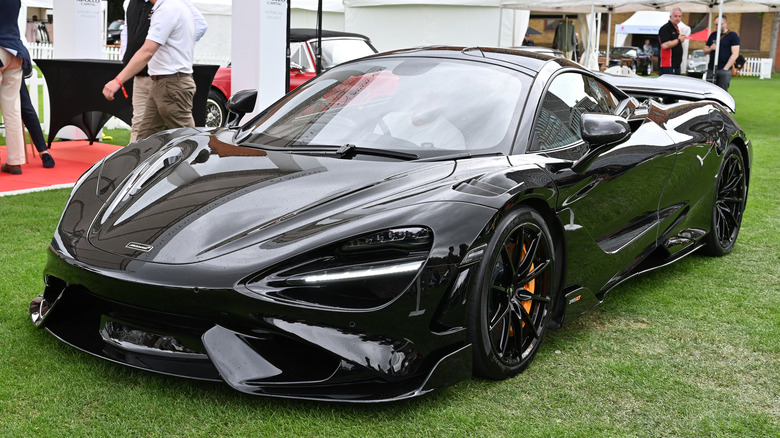
McLaren is not the best with names. The F1 is iconic, but since their return to road-going cars with the MP4-12c, which sounds more like the name of an HVAC unit than a supercar, their cars have all gone by some combination of numbers, commonly sixes, zeros, sevens, and fives. However, if you ever find yourself scanning through their numeric names looking for the cream of the McLaren crop, the LT moniker is one to look out for. Standing for Longtail, the LT badge is McLaren's codeword for extra fast and extra light. The 2016 675LT came out in 2016, and since then, every few years, the British brand bestows the LT treatment on one of their models.
The most recent car to be called LT, is the 720S-based McLaren 765LT. An already very good-looking car, the 720S body is transformed from its smooth cleanliness to a still smooth aggressiveness with tons of added aero elements, and a stripped down interior, even giving customers the option to remove the entire sound system with no extra charge to lighten up the car as much as possible. Powering the 765LT is a twin-turbo V8, producing 755 horsepower and 590 lb-ft of torque. While the 765LT's main purpose is to shred track days and wipe lap times, it isn't bad in a straight line either, with the 765LT passing the quarter mile in 9.8 seconds.
Ferrari 296 Speciale
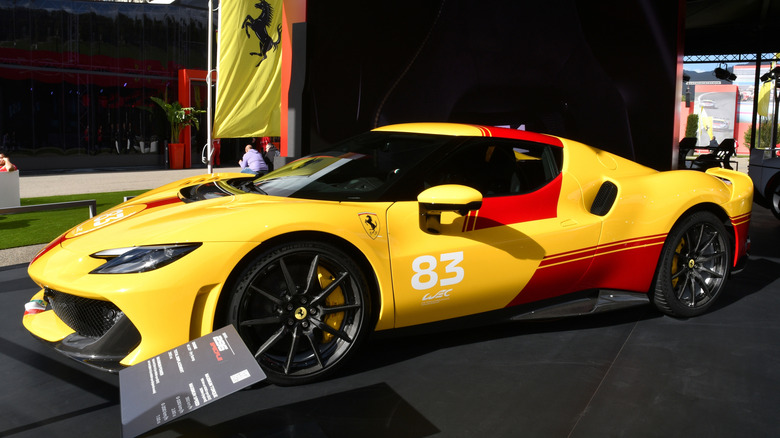
On the topic of special badging names, Speciale is one to look out for in any car coming out of Maranello. Ferrari has a few names that mean extra fast and extra expensive. Evoluzione, Competizione, Scuderia, Pista, and Stradale all hold some extra weight but if you don't speak Italian, these names might sound to be of no significance besides their dramatic sound. One that eliminates any confusion though, is Speciale. Ferrari's Speciale cars are exactly what they sound like: special. But what makes them special? Perhaps the new Ferrari 296 Speciale can help find us some answers.
Ferrari hasn't produced a new Speciale model since the original 458 Speciale, and seeing as that car has now become one of the most loved modern Ferraris, the 296 Speciale has a lot to live up to. Luckily, the Speciale brings out the big guns. One look at it and you'll know the car you're beholding is different from the base 296, thanks to its bold aerodynamic upgrades that help it produce 310 more pounds of downforce than the regular 296 at 155 miles per hour. The Speciale is also significantly lighter than the base model, which, when paired with its 869 horsepower twin-turbo V6 hybrid powertrain (which features 3 extra psi compared to the base), launches the car to 60 in just 2.3 seconds. Continue beyond 60, and the 296 Speciale will eat up the quarter mile in 9.5 seconds.
C8 Corvette ZR1
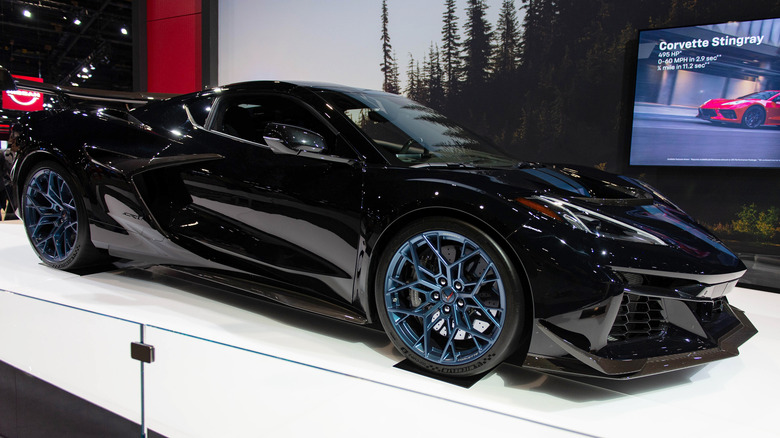
The Corvette has always set out to prove that speed doesn't have to be exclusive to the world's wealthiest. Corvettes have always competed on the cusp of supercar territory with varying levels of success, but since the C8 generation came out, Chevrolet's sports car has never come closer to that proof. The base C8 is already a lot of bang for your buck, and gives owners a mid-engined, two-door coupe with a flat plane crank V8. Climbing up the food chain of Vettes past the hybrid E-Ray and the sporty Z06, and we come to the ZR1.
The ZR1 is the most extreme Corvette you can get, before the bonkers ZR1X. Although the interior looks basically the same as any other C8, one look at the exterior, and you'll deduce that the ZR1 means business, thanks to its exterior upgrades like a rear wing so big you could host a banquet on it. At the heart of the ZR1's performance, though, is the engine. Here, the V8 is equipped with a pair of turbochargers, and power output comes up to a staggering 1,064 horsepower, which means the ZR1 can go very, very fast. Outside, that enormous wing works with other aero elements to keep this rocket on the asphalt with 1,200 pounds of downforce. That downforce is needed, as the ZR1 eats up the quarter mile in 9.5 seconds.
Bugatti Chiron
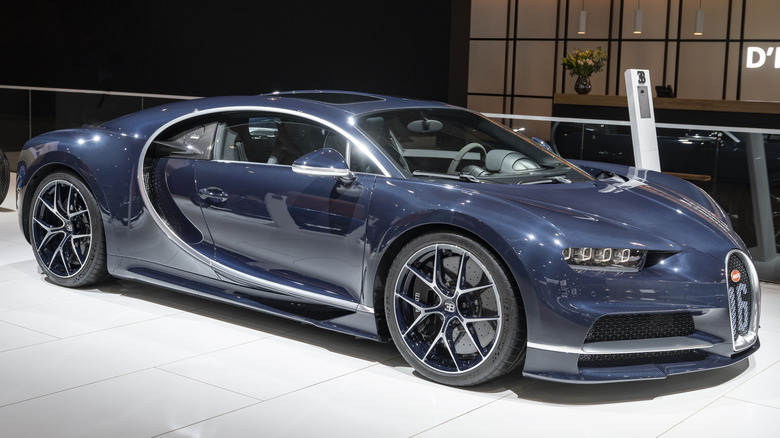
Compared to the ZR1, the Bugatti Chiron is quite a bit more expensive. You might be surprised to see a car of this magnitude in terms of price and top speeds so low on the list. As each Chiron is highly bespoke, each car varies significantly in price, but you can expect to be dropping at least two million on a Chiron. The Chiron can also sprint all the way to 261 miles per hour, so how is it only in our number six spot? Although the Chiron is one of the most impressive performance cars in the world, it's important to note that the car's mission is not just speed.
The Chiron manages to bring levels of luxury that best even those of a Maybach or Rolls-Royce, all while giving owners the option of driving faster than a small jet. Interiors swathed in leather, physical buttons heavy with metals, and masterful design inside and out become even more impressive when you remember the Chiron's quad-turbo W16 that produces just under 1,500 horsepower. That horsepower is meant to reach high top speeds, as are the gear ratios that prioritize squeezing power rather than face-melting acceleration. That doesn't mean the Chiron is slow to get going, though, as it can reach 60 in just 2.4 seconds, and completes the quarter mile in a clean 9.4 seconds.
Porsche Taycan Turbo GT
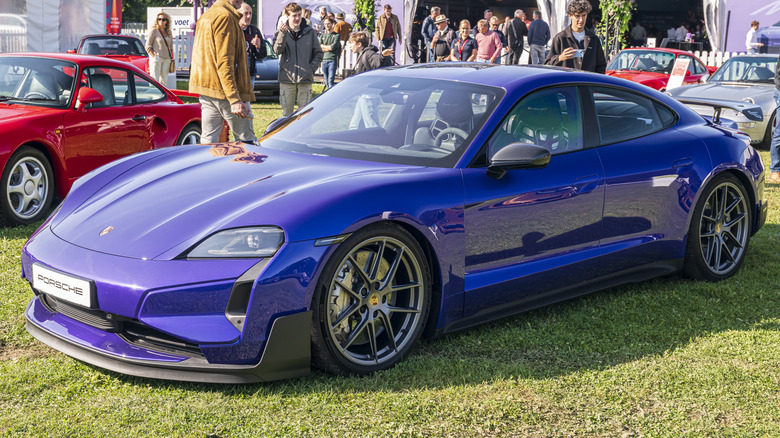
For anyone who knows cars, you could've guessed it was only a matter of time before an electric car found a place on this list. While our EVs have not had the time to refine themselves in all the suites of performance as their gas-powered counterparts, there is one thing they inherently excel at, and that is acceleration. The instant power delivery that electric motors provide is perfect for the quarter mile, and cars like the new Porsche Taycan Turbo GT demonstrate this with ease.
Although it has four doors, equipping the Taycan Turbo GT with the optional Weissach Package removes the rear seat in favor of a carbon fiber storage bucket. This saves 49 pounds, which is useful for any performance car, but particularly so for an electric car with a heavy lithium-ion battery. Even without the rear seat, and with the aero elements included with the Weissach package, the Taycan Turbo GT is still a four-door sedan, which makes its 1.9-second 0-60 run seem like it came from another car. Peak power comes out to 1,019 horsepower, which is delivered to all four wheels via electric motors on each axle. Stamp on the accelerator, and the Taycan Turbo GT will zoom past the quarter-mile mark in just 9.2 seconds.
Lucid Air Sapphire
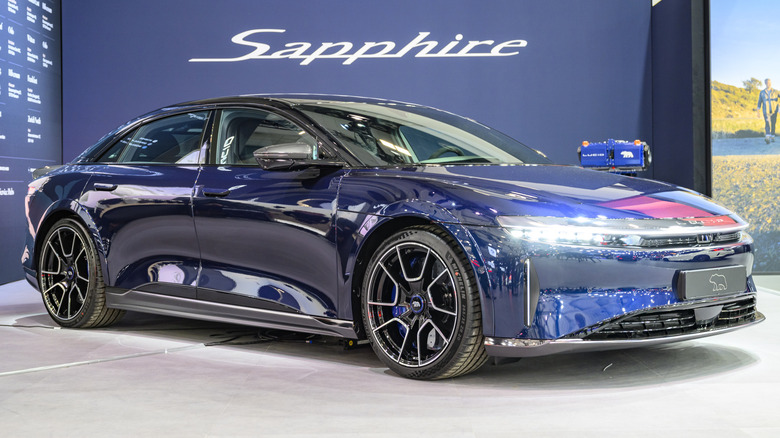
Continuing on trend with electric sedans, we arrive at the Lucid Air Sapphire. While the Golden State-based brand is a new player, they've shown new levels to the game of EVs. The luxury and performance niche is their area of expertise, and even though the four-door Air sedan that premiered in 2020 was their first attempt, it set a new standard for what EVs could be. Fast forward to 2025, and the Air has only gotten better. While all trim levels are impressive, the highest rung on the ladder is currently the Lucid Air Sapphire.
With a fully equipped Air Sapphire ringing up at just under a quarter of a million dollars, it's not exactly cheap, but take a look at the spec sheet, and maybe take a seat inside, and you'll quickly see that money is well spent. The Air is stuffed to the gills with leathers and metals, and with the absence of a traditional drivetrain, the rear seats aren't split by a gear tunnel, giving passengers tons of room to stretch out in. What's more impressive though, is that in the Air Sapphire comes packing 1,234 horsepower. In the 2025 model, with the optional Pirelli P Zero Trofeo RS Elect tires, the Sapphire can launch to 60 1.9 seconds, and zoom past the quarter mile in 9.1 seconds.
Dodge Challenger SRT Demon 170
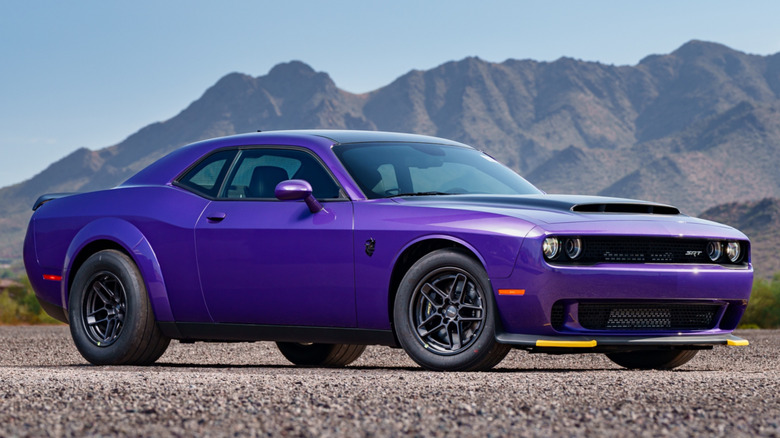
The first car to bring us into the 8-second range takes us back to fossil fuels in the form of the Dodge Challenger SRT Demon 170. When the Hellcat engine premiered in the 2015 Challenger, few fans of straight-line speed may not have guessed that this now legendary supercharged V8 would go on to dominate the streets and drag strips for eight years, and even fewer could have guessed what its final iteration would look like. Anything with a Hellcat motor under the hood is expected to be brutish and angry, but the Challenger SRT Demon 170 asserts itself as the most brutish and the most angry for a few reasons.
Firstly, when fed E85 gasoline, this ravenous Hellcat engine can pump out 1,025 horsepower. To use this power without tearing itself apart, the Demon 170 uses a fortified driveshaft that's 30% stronger than it is on the standard Demon. As the Challenger has always been meant for the drag strip, the Demon 170 takes this a step further, coming with drag radials for the front tires, should owners wish to use all that power to pop a wheelie. That wheelie comes at launch, and shortly after that comes the quarter-mile mark, which the Demon 170 roars past in just 8.9 seconds.
Koenigsegg Jesko Absolut
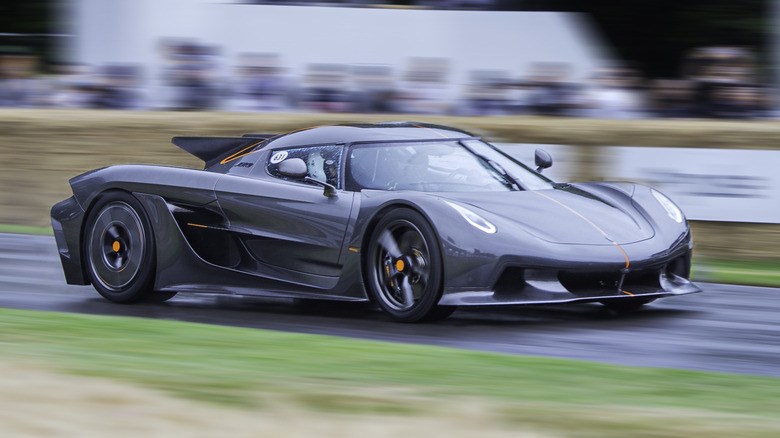
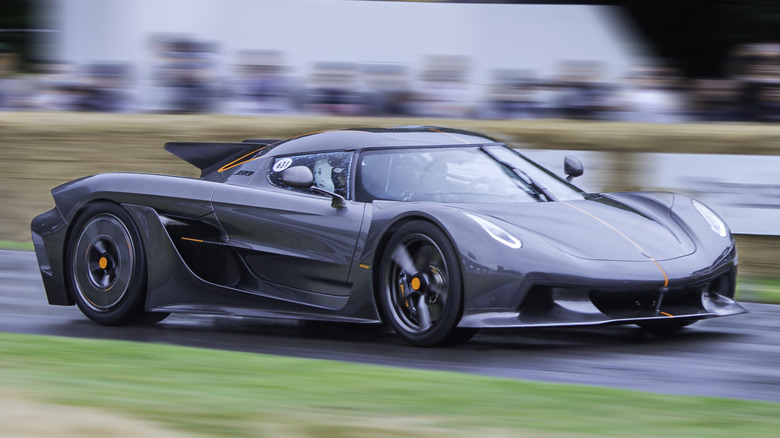
Speed-obsessed Swede Christian von Koenigsegg is one of the most prominent names in modern hypercar making. Koenigsegg is a relatively new brand, with their first production car debuting at the Paris Motor Show in 2000, but in the 25 years to follow, they've quickly made a name for themselves as one of the best hypercar manufacturers in the world. Their most recent creation is the Jesko. Named after Christian Von Koenigsegg's father, the Jesko comes in two forms. One is the Jesko Attack, which focuses on hardcore cornering and track performance, and the other is the Jesko Absolut, a more slippery version focused on top speeds.
The Absolut certainly looks the part, with its longtail shape and the two fighter jet-esque shark fins coming off the top, which are meant to stabilize the car at high speeds. At the heart of the Jesko is its 5-liter twin-turbo V8, which produces 1280 horsepower on normal gas and 1600 horsepower on E85. This power is dolled out to the rear wheels by Koenigsegg's incredible Light Speed Transmission, which can shift gears at lightning speed and jump over gears thanks to its multi-clutch design. When this power is put down, though, this Swedish rocketship flies past 60 in just 2.4 seconds, and continues past the quarter mile in 8.8 seconds, making it the fastest gas-powered car in the world down the quarter mile.
Pininfarina Battista
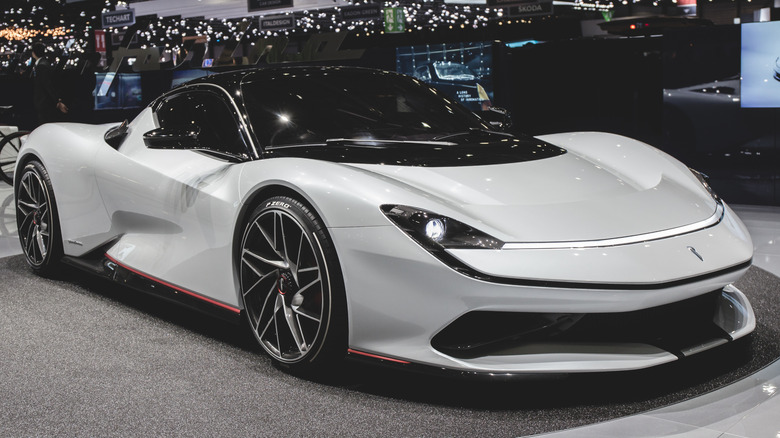
For a brand that historically never made their own cars, Pininfarina is perhaps one of the most well-known automotive brands in enthusiast circles. Pininfarina is best known for making mouth watering, gorgeous cars. After their long term partnership with Ferrari ended, the future of the Italian design house was unclear, but when the Battista was unveiled in 2019, any wonders were cleared up. The Battista is a supremely beautiful car inside and out, but what's under that pretty face is what makes it truly impressive.
As mentioned before, Pininfarina had, up until this point, never built a car on their own. Their styling abilities were more than good enough, but to develop a power unit from scratch was too risky for a first foray into car creation. The solution they came up with was to partner with someone who already knew what they were doing and that someone was Rimac, a name which will come up again soon. Rimac supplied the Battista with its 6960 cell battery, that produces a whopping 1877 horsepower. Once tapped into, this huge bank of power can launch the Battista to 60 in just 1.8 seconds, and it'll zip past the quarter mile mark 8.5 seconds clean.
Rimac Nevera R
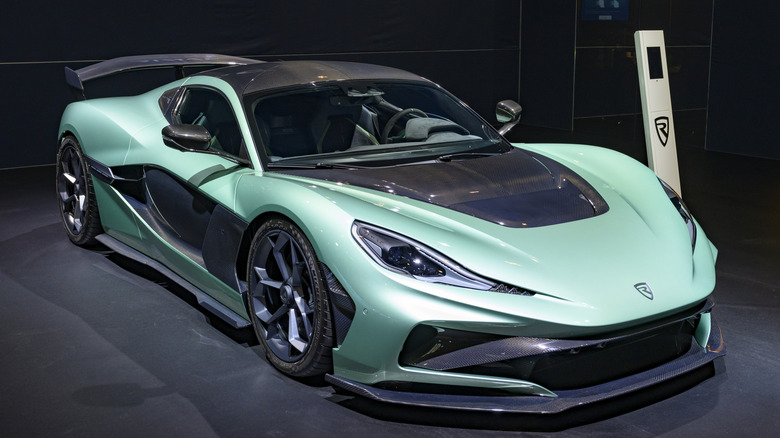
Nevera is a Croatian term that refers to a fast and furious storm found in the Adriatic Sea. Nevera is also the name of Mate Rimac's fully electric hypercar that has taken the motoring world by storm. The base Nevera is already one of the most impressive performance EVs in the world, but the R version takes it to the next level. Off the bat, the R looks completely different, with only about 30% of its parts being shared with the base Nevera. One of those new parts is the enormous rear wing, which adds 15 percent more downforce, all in a ploy to make the Nevera R the most track-dominant EV the world has ever seen.
Mate Rimac also claims that the Nevera R has the stiffest carbon fiber structure of any car ever made. This rigid frame is complemented by the Nevera R's new torque vectoring system, which allows each motor to supply the wheels with different power levels to improve cornering dynamics. At the foundation of all these upgrades and performance abilities, though, is the Nevera R's horsepower count, which amounts to a staggering 2107 horses. This colossal horsepower number can launch the Nevera R to a quarter mile in just 8.23 seconds.