

The Volkswagen SUV Models You Can Buy In 2026, Ranked By Price
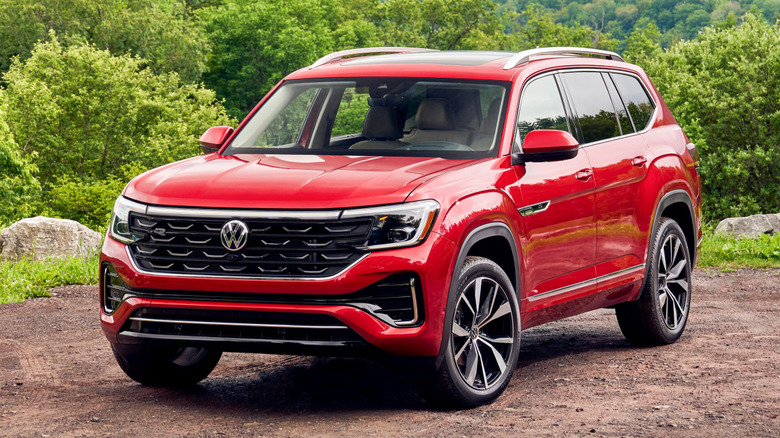
Although SUVs have only been a part of Volkswagen's lineup for a little over two decades, they're already one of the manufacturer's most important segments. In fact, some of the most successful Volkswagen models in history are SUVs, with the Tiguan standing out in particular as a global sales hit in recent years. American buyers looking for a Volkswagen SUV have a range of options to pick from, from compact urban runabouts to family haulers. The brand also offers both traditional internal combustion engine (ICE) vehicles as well as an all-electric SUV.
For 2026, Volkswagen's best SUV models remain as affordable and appealing as ever, although some do a better job of matching up to their rivals than others. We've driven the latest generation of all of the brand's current SUV offerings, evaluating each one on factors from their efficiency to their spaciousness and included tech features. This is what we thought of each model — and how much you can expect to pay for one in 2026.
Volkswagen Taos — $26,920
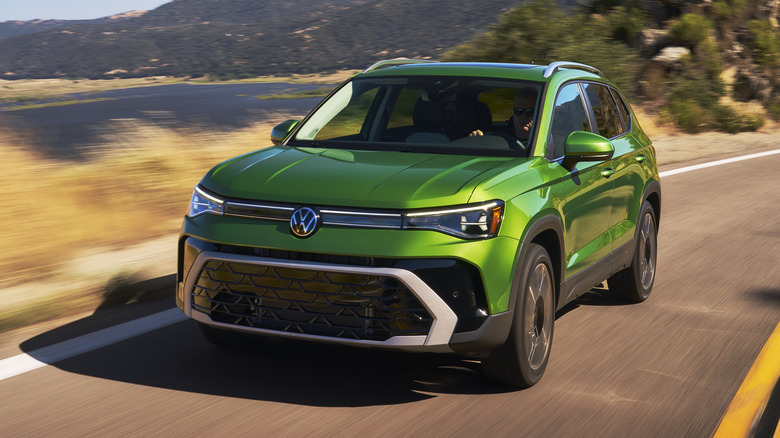
With a starting price of $26,920 (including a $1,425 destination fee), the Taos is the cheapest SUV in Volkswagen's lineup. It's available in a choice of four trims — S, SE, SE Black, and SEL — with each trim offering all-wheel drive. All trims apart from SEL also offer a cheaper front-wheel drive option. Every Taos comes with a turbocharged 1.5-liter engine making 174 horsepower, regardless of trim.
We put the SUV through its paces in our 2025 Volkswagen Taos review and came away with mixed thoughts. On the one hand, it's spacious, efficient, and competitively priced. Then again, it isn't fun to drive, even by the standards of its segment. We also found its highway capabilities to be behind the best in class, with the transmission sometimes needing to downshift just to stay with the flow of traffic traveling at 70 mph. Buyers looking for engaging handling or a long-distance mile muncher will want to look elsewhere, but as an urban runabout, the Taos remains a competitive option.
Volkswagen Tiguan — $32,280
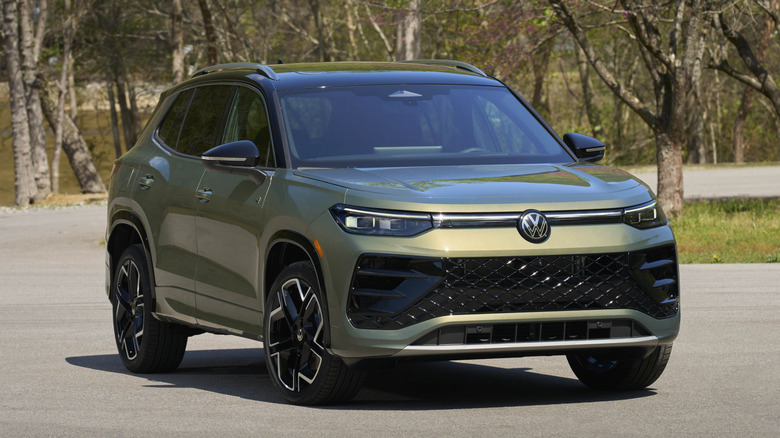
The Tiguan is a sales heavyweight, with more than 7 million examples of the car sold globally since the car debuted in 2007. That popularity was hard-earned, and in our review of the 2025 VW Tiguan we found that the latest generation doesn't deviate much from the formula that made it a winner. The U.S.-market Tiguan is a little different to the car that's sold in other markets, and it misses out on the third row that the rest of the world benefits from. Anyone looking for three rows of seats will need to look further up the brand's range to the Atlas.
On the road, we thought the Tiguan was a competent, comfortable SUV, and unlike some others in its segment, it didn't pretend to be sportier than it was. The standard 201 horsepower 2.0-liter four-cylinder engine isn't particularly eager, but it'll shuttle drivers and passengers around with minimal fuss. For 2026, the Tiguan starts from $32,280 (including a $1,475 destination fee), although buyers looking for all-wheel drive will be paying extra. Much like the Taos, the Tiguan is available in four different trims, culminating in the SEL R-Line Turbo, which pushes the car's starting price well north of $40,000. However, this level of trim does offer a boosted power output of 268 horsepower alongside standard all-wheel drive.
Volkswagen Atlas Cross Sport — $39,775
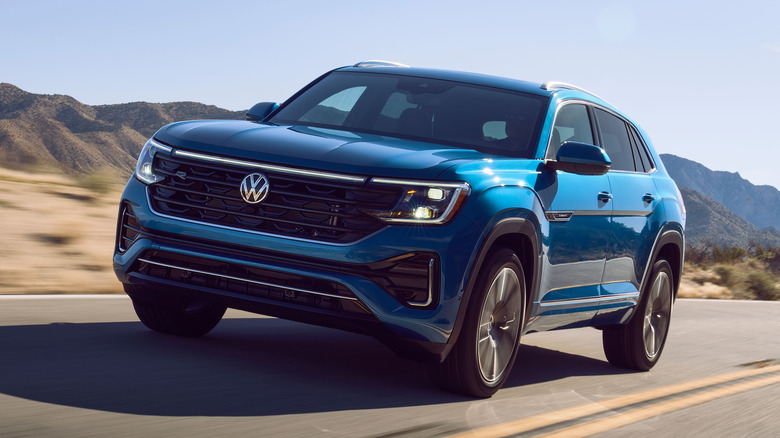
Volkswagen offers two very similar SUV models, the Atlas Cross Sport and Atlas, with the former being the cheaper of the two. It starts from $39,775 (including a $1,475 destination fee), with five trims available. Front-wheel drive is standard on lower trims with optional all-wheel drive available, while higher trims get AWD as standard. As far as how the 2026 Atlas Cross Sport differs from the previous year's model, the automaker has made very few changes; there are only some minor variations in standard equipment across its trim range. Otherwise, the car remains unchanged from the previous model year.
We reviewed the 2024 Volkswagen Atlas Cross Sport, finding it to be a decent — although not standout — entry into a packed segment. Despite its name, we thought that the Atlas Cross Sport didn't feel particularly sporty to drive. Its standard turbocharged 2.0-liter four-cylinder engine makes 269 horsepower, a figure that's best described as "just fine" for its class.
As a value play, the lower trims might still be appealing, but the Atlas Cross Sport has a lot of rivals, including its stablemate, the Atlas. It's only slightly more expensive, but the Atlas offers an extra row of seats and all the same interior trimmings as its slightly less practical sibling.
Volkswagen Atlas — $40,785
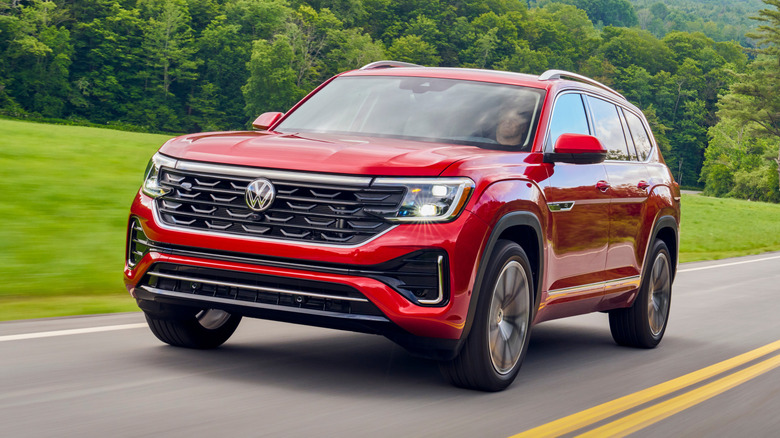
Buyers looking for three rows of space without breaking the bank shouldn't overlook the Volkswagen Atlas, which starts at $40,785 (including a $1,475 destination fee) for 2026. It shares its 269 horsepower 2.0-liter four-cylinder engine with the Atlas Cross Sport, which is enough to make it adequately fast and nothing more. It won't be left standing by other traffic at the stop lights, but it certainly isn't a car that encourages spirited driving as we discovered in our review of the 2025 VW Atlas.
Atlas buyers get a choice of five trims, and like Volkswagen's other SUVs, all-wheel drive is available across all of them. Lower trims make do with front-wheel drive as standard. We were impressed by the level of included equipment available on lower trims, with even base spec cars benefitting from niceties like heated and ventilated front seats. As a straightforward people mover, there's plenty to like about the Atlas, even if it isn't the most efficient — or the most exciting — car in its class.
Volkswagen ID.4 — $46,570
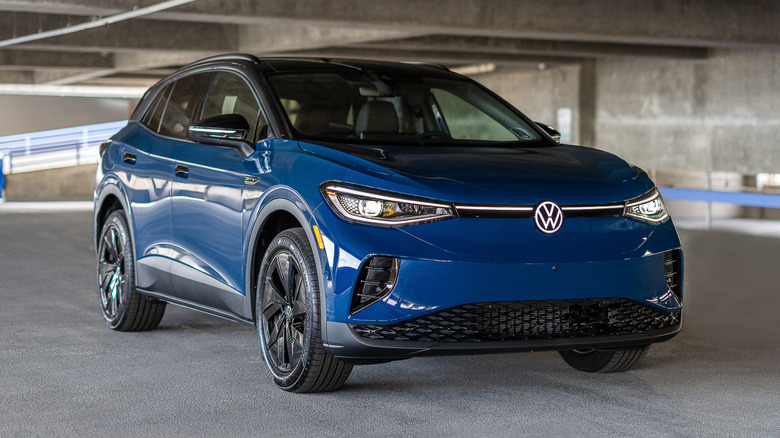
The priciest Volkswagen SUV in the current range is the all-electric ID.4, which starts from $46,570 (including a $1,475 destination fee). The base trim offers 282 horsepower and 291 miles of range, while the top-spec all-wheel drive trim delivers 335 horsepower but only manages 263 miles on a full charge. Neither of those range figures are particularly impressive by today's standards: For reference, a similarly priced Tesla Model Y Premium offers 357 miles of range.
After driving the 2023 Volkswagen ID.4 shortly after its launch, we found its cabin, styling, and handling to be on par with its rivals, although even back then its range was only adequate rather than good. However, its familiarity to other models in the Volkswagen range makes it an approachable entry point for first-time EV buyers, even if it's far from the best choice in its class for longer highway journeys.