

15 Of The Most Complicated Cars Ever Made

A complete list of most complicated cars ever made is vast and littered with famously over-engineered vehicles. Consider the Aston Martin Lagonda and its 16-week build saga or the McLaren P1's full complement of F1-derived active aerodynamics. To be clear, we're talking about cars that make overall complexity a calling card, not just those with bewildering engine designs — though there is some overlap. These are automobiles that seem to have been designed by engineers determined to cram every available technology into a single car, simply to make it all work.
To define complicated in this case, we've tried to cover the gamut. From bespoke barely street-legal exotica like the Mustang GTD with its "treasure chest" suspension display to automotive goofballs like the GMC Envoy XUV with its moonshot retracting roof. Also, did you know Mazda once made a 626 with four-wheel steering (4WS)? Me neither. There's a trace of Rube Goldberg in each one of these rides, but as any enthusiast will tell you, that's part of what makes them so worth your time.
GMC Envoy XUV
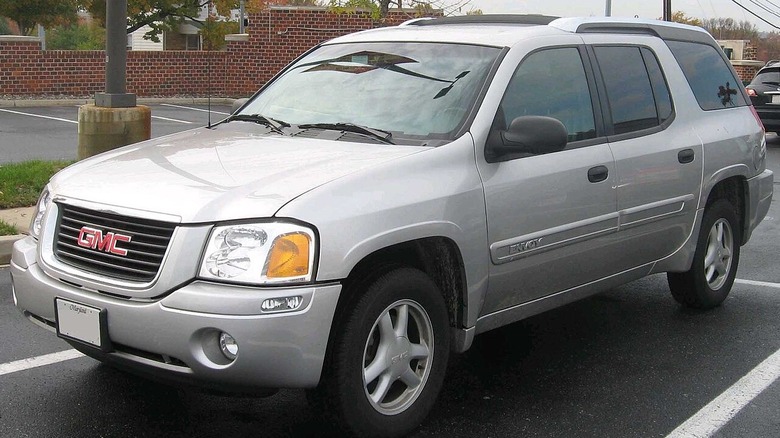
If you don't remember the GMC Envoy XUV, that's okay; there probably aren't many left on the road because it was famously problematic. Inclusion on a list of worst-selling American cars ever made doesn't help. These SUVs from the early aughts made waves for offering a roof that retracts — not like a Porsche targa top and not like a convertible softtop, but like a reverse panoramic moonroof. The entire rear section was designed to slide forward and leave a 32 x 32-inch square opening over the cargo bay.
Picture a Geländewagen Landaulet, but with a hunchbacked hardtop. Not only that, owners could enjoy a two-way tailgate opening to a cargo area with built-in drainage, plus GM's unique Midgate contraption that offers both a limo-like glass window partition and the ability to fold down. Jan Sanfillippo, EVP of Automotive Marketing Consultants, told Autoweek that this was "a very, very nifty idea". It mat have been on paper, but in practice, owners found exciting flaws like the roof simply stopping in its tracks, a variety of water leaks, and a rear tailgate window refusing to close.
Mazda 626 4WS
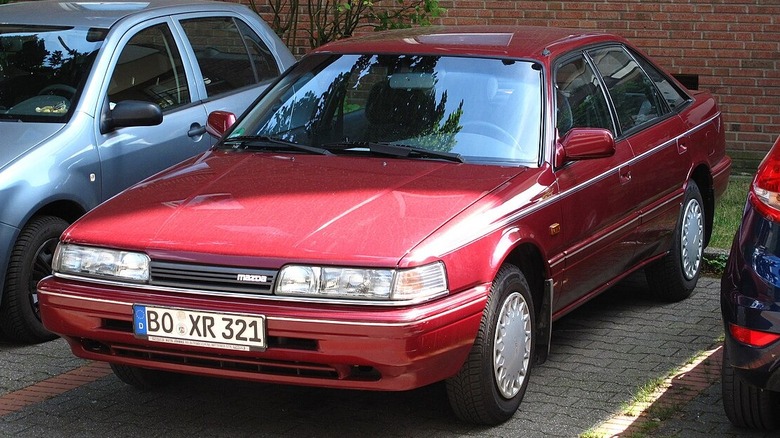
Four-wheel steering, on a car, is inherently complicated as it enables the rear wheels to turn. An extreme example is the Hummer EV and its gawky Crabwalk capability that can add 10 degrees of rotation out back. More typically, 4WS is employed to aid maneuverability at low speed and stability at high speed. Like on the Genesis G80, that only adds two degrees of steering angle above 37 mph. In theory, modern vehicles would have the technology required to make this wacky bit of engineering simpler. No matter how you slice it, 4WS requires many extra bits and pieces to do its dance, which was doubly true circa 1988.
ICYMI, this automotive era saw a brief spike in the use of steering all four wheels. Like the Honda Prelude and Mazda 626, to name just two. It's the Mazda, however, that takes the complicated car cake on this front as the 4WS system featured mechanical, hydraulic, and electronic components. A dedicated control unit and speed sensors performed calculations based on vehicle speed rather than steering-wheel angle. Up to five degrees of movement were on hand, which is neat, but one shudders to think how this wildly complex system has held up over the past 37 years.
Volvo V60 T8 Polestar Engineered

To the wagon mafia, please understand, the inclusion of this mighty, and sadly discontinued, Volvo V60 is by no means a slap in the face. This Swedish longroof is the coolest of the cool, but just get a load of the fully spelled-out name of this car. It's a lot, and hints at the complexity hiding under the skin. Like an internal combustion four-cylinder engine strapped with a turbocharger, supercharger, and intercooler.
Volvo calls it Twin Engine, which is both very literal and exactly correct — but that's not all. These cars also feature an electric motor with a water-cooled stator on the rear axle, enabling all-wheel drive. Another motor, that's integrated with the crankshaft, gets sandwiched between the ICE and transmission to start the four-pot, provide some electric juice, and charge the battery.
Did we mention this V60 is a plug-in hybrid? Yet another electric motor gets paired with an 11.6-kWh battery pack to offer 22 miles of electric-powered driving range and a whole lot more complexity. 415 horsepower and a 4.4-second blitz to 60 is nice, but say your prayers if this ode to complicated cars ever soils itself.
Volkswagen Phaeton
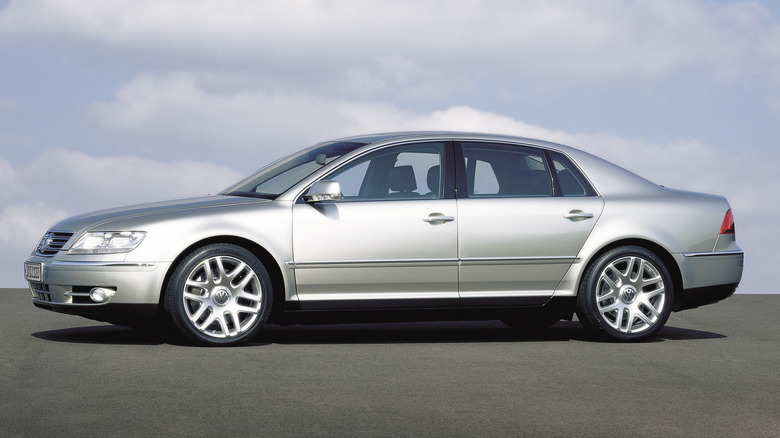
The Phaeton was a short-lived (in North America), six-figure large sedan that bore a striking resemblance to the period Audi A8, but wore a Volkswagen badge. It resulted in 100 new patents for VW, which virtually guarantees automotive intricacy. For example, the Phaeton was designed to run a steady 155 mph for 24 hours straight in 120-degree heat, with the cabin set to a crisp 70 degrees, managed via a hidden, silent HVAC system.
There is not enough room on this page to dive into the layers of engineering wizardry required for such a feat in such a car. All-wheel drive was standard, and along with a V8, Volkswagen sold its halo ride with an available W-12 powertrain. With the unnecessarily complex 12-cylinder mill, the Phaeton was said to be capable of 186 mph.
This is all very cool, but comically overkill in a four-door VW. A whopping $1.4 billion development budget was required, in the early 2000s, to create this most complicated of cars, and it was effectively built by hand at the all-glass "Transparent Factory" in Germany. All that said, we'd argue the Phaeton is one discontinued VW worth putting in your garage today.
Toyota Celica All-Trac Turbo

Toyota's GR Corolla captures the modern limelight, thanks to its rally-derived design and engineering. However, the Japanese automaker has been at this game of converting rally racers into street-legal temples of convolution since at least the 1980s.
Take the Celica All-Trac Turbo, for example. Unlike the regular Celica of the era, with a 116- or 135-horse naturally aspirated inline-four, the All-Trac made 190 horsepower from its special Yamaha-designed turbocharged and intercooled setup. Featuring an aluminum twin-cam head with pent-roof combustion chambers, sophisticated knock detection, and an oil-spray system for keeping the pistons cool, the engine alone was worthy of all-time elaborate status.
As the name implies, these Celicas also had full-time 4WD, which at the time meant a center differential with viscous coupling, a 3-piece prop shaft with quadruple U-joints to quell noise, unique engine mounts, and a stiffened floorpan. Lest you think the All-Trac's complexity was exclusive to its powertrain, know that the center stack contained an interface with 29 buttons, two dials, and an HVAC control slider.
Lamborghini LM002

The first time you lay eyes on the Lamborghini LM002, it's immediately evident where the Rambo Lambo name originates. Muscular, outrageous, and one of the loudest pickup trucks ever made, the LM002 was an early entrant into the now-commonplace super SUV movement, and an epic exercise in overdoing it. Powering this 6,780-pound brute was a naturally aspirated 5.0-liter V12, from the Countach, with six Weber carbs, all of which needed special protection for off-road use. The selectable 4WD system featured triple locking diffs, enabling low-range rough road, but the LM002 was also designed to hit 125 mph on the street.
The chassis for this extra-complex SUV was a special tubular steel setup finished with composite body panels. Even the brakes on the original Lambo SUV were elaborate, featuring twin calipers for the front discs. Old-school drum brakes were used out back, but if you've ever taken apart a set of drums, you know they're not exactly a simple system. It was all part and parcel of the Lamborghini LM002, a vehicle that looks as complicated as it really is.
Dodge Stealth R/T Turbo

Like its mechanical twin, the Mitsubishi 3000GT VR4, Dodge's Stealth sports car in R/T Turbo spec was a gloriously overcomplicated car. In a Hagerty review, it was described as, "a fiendishly complex exercise in excess." The reasons are many, but it started with the 3.0-liter twin-turbo V6.
Any time you add forced induction to an engine, there are complications from the increased plumbing and added stress to the internals. Dodge doubled down with a pair of snails and dual intercoolers. These range-topping Stealths came with full-time four-wheel drive that used a planetary-gear center differential and viscous coupling. Then there was the four-wheel steering, variable exhaust noises, and electronically adjustable dual-mode suspension.
A suspension system that analyzed data from steering, brake, throttle, and g-force sensors was employed simply to set the damping rate. Undoubtedly cool-looking, the Stealth was also fast (5.2 seconds to 60 mph) and sticky (0.87 g lateral grip) for the time, but getting there necessitated a whole lot of advanced engineering.
Buick Reatta
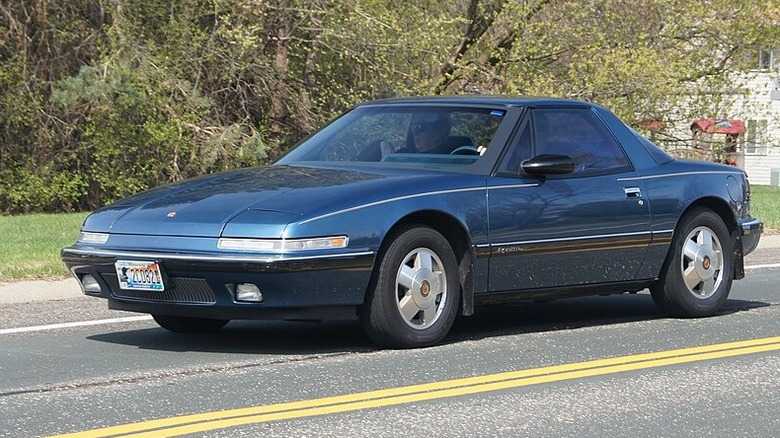
Positioning a car as the halo of any automaker's lineup is a surefire way to guarantee over-the-top engineering, such was the case of the Buick Reatta. An easily forgotten oddball of the late 80s, the Reatta started its parade of complexity by dint of its status within the wide-ranging GM portfolio. Neither a Corvette nor a Fiero, this Buick stood alone, which left consumers befuddled as to what exactly it was.
This effort at over-complicating things continued with features like pop-up headlights, special bubble-shaped rear glass, an electronically-controlled transmission (keep in mind, this was the 80s), and a trick anti-shake system for convertible variants. Variants with a design that saw the top narrowing in width on its way down.
It gets better: the Reatta was one of the first GM cars to feature the new port fuel injection. Plus, Buick was effectively hand-building these little coupes at the so-called Reatta Craft Center. But the pièce de résistance is perhaps the cutting-edge, for the era, cathode-ray tube touchscreen cockpit interface that Motor Trend called "shockingly complex".
Porsche 911 Targa (993)
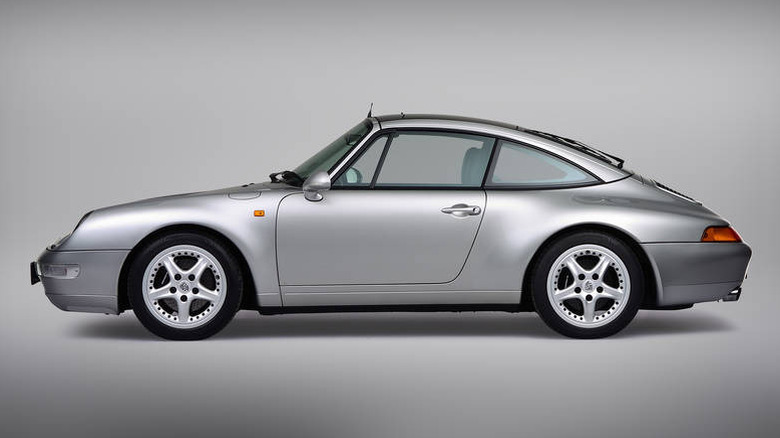
In gearhead circles, German automakers are renowned (ridiculed?) for staggering displays of well-developed (over-engineered?) designs. As an illustration of this, one unknown Porsche owner crafted a 16-page PDF titled "993 – Targa Roof Operation Outline". It is excruciatingly detailed, loaded with custom graphics, arrows pointing at things, and all manner of notes, just as Porsche would have no doubt intended.
The author of this tome said, "The 993 Targa top is one of the most unnecessarily complicated systems I have ever seen". It was Porsche's first 911 Targa with a glass roof, and wow, did they go overboard. To open it up, a sheet of seven-millimeter thick roof glass first splits in two, with the front six inches levitating skyward. Then, the rear 26-inch section slides backwards, pulled by cables that are, in fact, long springs acting as flexible rack gears.
Three electric motors are employed, and the whole section tucks beneath the rear windshield, at which point you can activate a power-operated flexible plastic sunshade should it be just too bright. Please note: If the roof drive mechanism fails, it is designed to be replaced — with the top removed from the car.
Mercedes-Benz S600 (W220)

Another German carmaker with a legacy of complicated cars, Mercedes-Benz makes this particular list with its W220-series S600. An early aughts flagship, this S-Class was packing a 5.8-liter V12, which automatically brings it under the lens of overkill engineering. However, Mercedes went much deeper with the S600, stuffing it with a hydraulic active anti-body roll system dubbed Active Body Control, plus Airmatic air springs and electronically-controlled adaptive dampers — which was new at the time.
This was the first S-Class with AWD, the first car in the world with keyless start and adaptive cruise control, plus it introduced the COMAND infotainment interface with GPS navigation, Linguatronic voice control, and TeleAid. Little wonder its glovebox came jammed with three separate owner's manuals. Mercedes secured 340 patents during the development of the W220 S-Class, several of which were no doubt dedicated to the 40 ECUs running across a trio of fiber-optic conduits.
Nissan GT-R
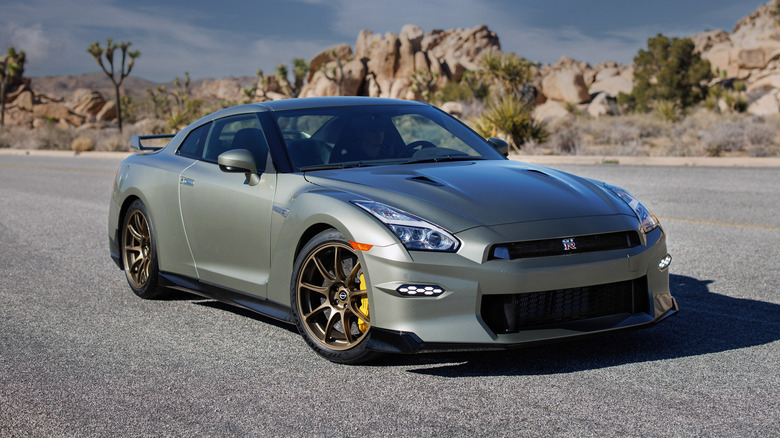
The Nissan GT-R was in production for 18 years, which is incredibly long for any vehicle, but especially so for the wickedly potent sports car sub-class that the GT-R belonged to. Its performance creds were astonishing when new in 2007, and even in 2025. Going from zero to 60 mph in less than three seconds is seriously fast.
To make this happen, Nissan basically wrote The Most Complicated Cars Ever Made book. It started with a new chassis and an independent transaxle-based AWD system that was believed to be an automotive first, mainly because the dual driveshaft configuration is highly complex. A carbon fiber driveshaft, to be specific. The ATTESSA-ETS AWD system is both convoluted as an acronym and in practice.
It blends electronic sensors with hydraulically-actuated clutches to manage the front-rear torque split. And how about the tilt angle of the crankshaft that shifts precisely between zero and one degree under acceleration to avoid wasted output. Or the fact that the body and suspension are put together on a jig, much like a race car.
Lexus LFA
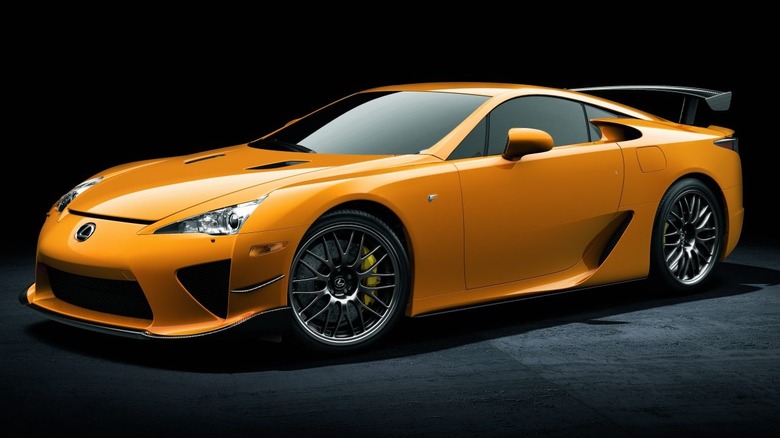
Lexus knows how to make elaborate, high-precision cars. Just take the Kiriko glass trim option on its current LS. A blend of ancient Japanese craftsmanship and modern artisanal production, it remains a hand-finished piece. That's nice, but it pales in comparison to the LFA, which is perhaps the most ambitious and complex Lexus ever created.
To start, the automaker built its own in-house carbon fiber loom as nothing existed at the time to meet its exacting needs. The finished carbon fiber monocoque was fitted with aluminum subframes at both ends, which were bolted and glued in place. Yamaha was pulled in to hand-build the naturally aspirated LFA V10 with titanium valves and connecting rods, carbon and silicon-coated rocker arms with integrated oil jets, and magnesium alloy cam covers.
Not to mention the remote-reservoir suspension dampers, the carbon-ceramic brake rotors, the speed-activated rear spoiler with a Gurney flap and inner door edges shaped just so to ensure perfect aerodynamics. All of which is both awesome and crazy complicated.
Infiniti QX50

Nissan, and its luxury arm Infiniti, did something in 2017 that will no doubt go down in automotive history as one of the most ambitious endeavors ever. That being the release of the variable compression turbocharged four-cylinder ICE, or VC-Turbo for short, which is an obvious contender for one of the most complicated engines ever made. It's too early to know if this wacky design will be an epic success or fail, but it absolutely qualifies the QX-50 SUV in which it is installed for complicated car status.
Not only does this Rube Goldberg-worthy design feature a multi-link system that can adjust the compression ratio, but it also comes with triple the number of bearings found in a traditional ICE. Then there's the electronically controlled wastegate actuator and high-capacity intercooler, along with the two-stage variable-displacement oil pump that has to account for changes in engine speed and compression. Plus, the multi-way flow control valve needed to manage coolant distribution, again based on more than the typical factors.
Let us not forget the Active Torque Rod, an apparent world-first active engine mount with a built-in G-sensor. Nissan also rolled out a new CVT for this project. Known as XTRONIC. It is a shift-by-wire design and was created specifically to work with the VC-Turbo engine.
DeLorean DMC-12
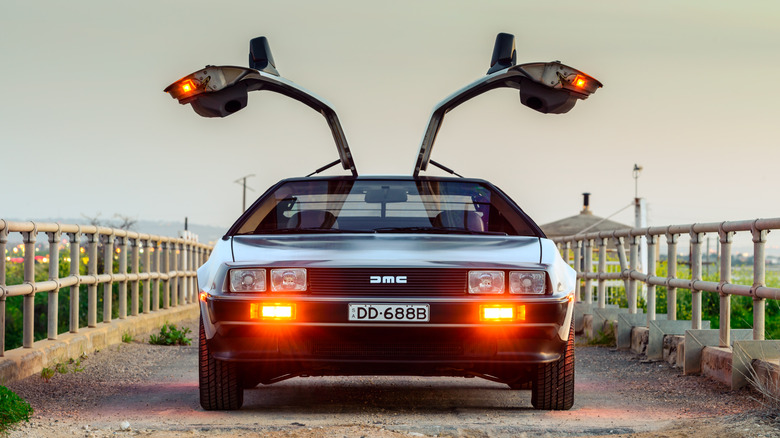
If we could cite the flux capacitor, DeLorean's DMC-12 would simply be (no hyperbole) the most complicated car ever. Even outside its "Back to the Future" fame, this storied coupe stands tall in the department of elaborate engineering. Gullwing doors are rarely used on a vehicle for good reason — they are a super complex way to provide ingress and egress. On the DeLorean, this setup operated via a torsion bar and gas strut system.
Though it is not spelled out anywhere, one can guess that the need for a dual assist design was dictated by the weight of those stainless steel body panels. Speaking of, the use of stainless steel over a fiberglass body required a special foam adhesive to bond the whole structure together. A fiberglass-reinforced resin structure that is bolted to a double-Y frame. Interesting. Contrary to what the name implies, the DeLorean did not come with a V-12.
An engine with six cylinders, that was sourced from Volvo and paired with a Renault transaxle, buyers could opt for a five-speed manual or three-speed automatic. Going with the automatic added yet more complexity, as it meant having two different oils on hand for it to run properly.
Mustang GTD
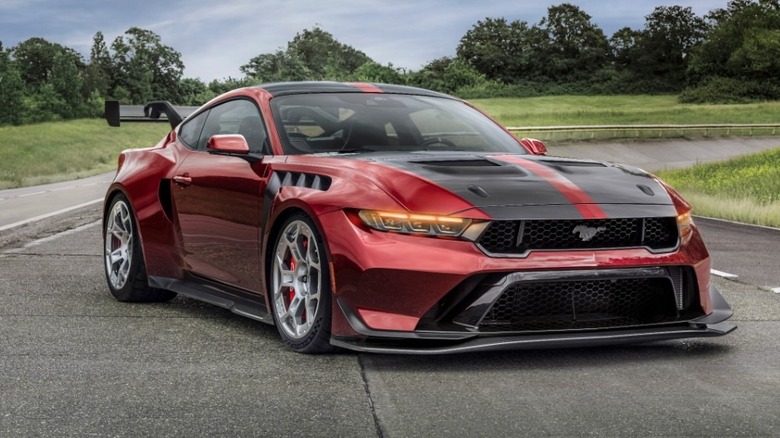
One look at a Mustang GTD will tell you this is a seriously complicated car. The vented fenders and aerodynamic addenda, which are hydraulically adjustable front and rear, are a visual giveaway. The GTD is a multi-layered car of complexity. Aside from the door skins, the entire body is made from carbon fiber. As is the driveshaft.
The active exhaust system is made from titanium, presumably because it looks cool when hot. The GTD's supercharged 5.2-liter V8 remains up front, but the eight-speed DCT is mounted out back, as are a pair of heat exchangers. There are many valid engineering reasons for all this, but it is, objectively, a case study in cumbersome car design.
Then you've got the height-adjustable Multimatic spool-valve dampers, mounted in a pushrod configuration, prettily arranged for visual pleasure behind a transparent panel within the cabin of this most epically complex of Mustangs. An amazing car to be sure, but also one for the ages when it comes to convolution.