

Antigravity A1 Review: An Entirely New Type Of Drone That Truly Makes It Feel Like You're Flying
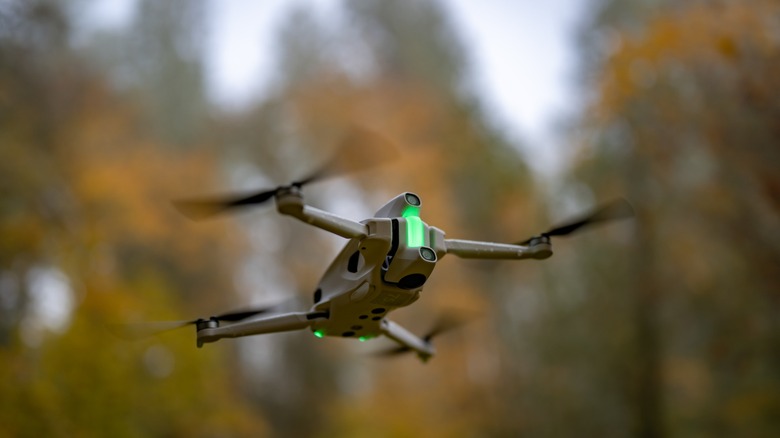
The Antigravity A1 is something I haven't seen in a very long time – an entirely new type of drone. It features a 360 degree camera, and streams that panoramic image back to a headset for what is basically a real-time VR flight experience. Antigravity itself is a new drone manufacturer (incubated by Insta360 and other independent parties), which is also an exciting development, as this space can certainly benefit from such competition.
There are numerous exciting aspects to the Antigravity A1, from its ability to capture 8K resolution video, to the immersive flight experience that it is designed to support, coupled with motion control and a whole raft of purported modern features which pilots have come to expect in drones. I had the opportunity to test the A1 a few times earlier this year, so I was extremely excited when Antigravity sent me a review unit and I had a chance to really dig into the A1 to see the full extent of what it's capable of.
8K 360 video capture in a drone is an incredible creative tool
To get a really crisp, clear panoramic 360 image, you need at least 8K resolution, and happily the Antigravity A1 delivers just that. It looks great, and the performance of the imaging of this camera is, to my eye, very similar to that of the Insta360 X5, or one of Insta360's other recent handheld 360 cameras. It delivers a high degree of detail, even in challenging lighting conditions and relatively low light. The best experience from an image quality and transmission reliability perspective will of course be on open, brightly lit environments, but I also produced what I feel to be great results in challenging high contrast and low light conditions.
 Andy Zahn/SlashGear
 Andy Zahn/SlashGear
 Andy Zahn/SlashGear
Take for example the following video, where I flew the A1 rather daringly through the fog above and below the canopy of a legacy forest in the early morning, all through thick fog lit by the rising sun. The A1 had to contend with the significant moisture in the air, the very strong light of the sun, and the dimly lit forest below. Once in the forest it was plunged into a complex environment with generally low light levels and a very bright sky overhead. These are some of the most difficult conditions possible for a 360 camera, and the A1 performed to a rather spectacular degree, only losing detail in the most extreme highlights of captured in the video.
The A1 is no slouch when it comes to still photography either, capturing highly detailed images up to 55 megapixels in size. It's by far the best way to capture enormously wide aerial angle images in a single shot.
The joy and practicality of immersive flight
When it comes to pure, unadulterated fun, there isn't any drone quite like the Antigravity A1, particularly given how easy it is to fly. The capability to look around while wearing the goggles, regardless of where the drone is pointing, imparts a sense of realism that just isn't there with a traditional FPV drone with a fixed field of view. Antigravity has also built in some things just for fun, such as an animated dragon positioned so that the drone pilot feels as though they themselves are riding it. It's the first example of what is essentially an augmented reality experience in a drone. I would love to see Antigravity expand this to include actual video games, such as flying the dragon through virtual floating rings.
 Andy Zahn/SlashGear
From a purely practical point of view, the panoramic field of view allows the user to navigate more safely. I spend a lot of time flying drones in confined spaces, and I have never felt so confident piloting a drone through complex environments. I always felt hyper-aware of my surroundings, with a wonderful sense of depth and motion. This means that when I'm flying the A1, I am always confident of how much room I have to avoid obstacles. As a result, I find navigation at speed easier than I did even with a drone such as the DJI Avata 2.
 Andy Zahn/SlashGear
The bottom line is that the Antigravity A1 is the first drone in which I have ever felt truly present in the skies. It's no hyperbole to say it feels like you're really flying.
Automation and sharing the experience
The Sky Path feature of the A1 enables it to fly a pre-planned route autonomously, allowing you to simply enjoy the flight without even having to think about controlling it enroute. This is also an ideal method for sharing the drone with those who don't wish or are unable to fly themselves. Between this and the ability to show what you are seeing on the external monitor of the goggles, the A1 is by far the easiest drone experience to share with those around you.
 Andy Zahn/SlashGear
The experience of viewing the final footage is also something special. My mother does not like VR headsets, nor has she much interest in piloting a drone, but by watching on her phone the panoramic footage I captured, she was excited to get a taste of what I experienced flying in a medium with which she is more comfortable. The finished videos, to which I've added music and appropriate ambient sounds, are far and away the best panoramic 360 content that I've yet uploaded to YouTube.

It's important to note, too, that the drone itself is entirely invisible in your final footage, and the aerial perspective helps to conceal the awkward stitching line of the two halves of the 360 camera in most scenarios. This means no more visibility of the distorted object supporting the 360 camera, as is nearly unavoidable with hand-held 360 cameras. Obstacle detection and avoidance systems in the A1 are competent, which is a nice safety feature to have in any drone, especially for beginner pilots. The excellent diopter controls are also noteworthy, as it's really easy to dial in the correct focus and eye-alignment, even for individuals with strong prescriptions.
Battery life and range
The only issue I encountered during flight was a relatively limited range. Under ideal conditions, it's rated for up to 6.2 miles of transmission range, but in actual real-world scenarios it is somewhat prone to interference. I didn't feel comfortable taking it very far from me, but honestly that's just as well, given that it is safer not to fly far away from your take-off point. So long as you are flying it in a wide-open space without obstructions, you shouldn't have a problem. I suspect the reason for its somewhat limited range is a result of the complex task of transmitting a high resolution 360 degree video feed from the drone to the goggles.
 Andy Zahn/SlashGear
That video transmission is impressive in its level of quality and its consistency, so long as you are reasonably close to your point of operation or have a clear line of sight. In such conditions, I enjoyed the nearly complete lack of noticeable latency, and the sharp, high fidelity of the transmitted picture. The Antigravity A1 isn't particularly fast, but I had no trouble getting most of the shots I needed with it, including of high speed gokarts, as the post-processing capabilities of an 8K 360 image help to compensate for the relatively moderate speed of the A1.
 Andy Zahn/SlashGear
In terms of battery life, you have the option of either the standard flight battery which delivers around 24 minutes of battery life, or 39 minutes with the extended flight battery. The standard battery keeps the weight of the drone at that magical regulation-friendly 249 grams, so keep that in mind when considering the extra weight of the extended battery. However, I never felt limited by the run time of the standard battery.
Hardware is polished and cleverly designed
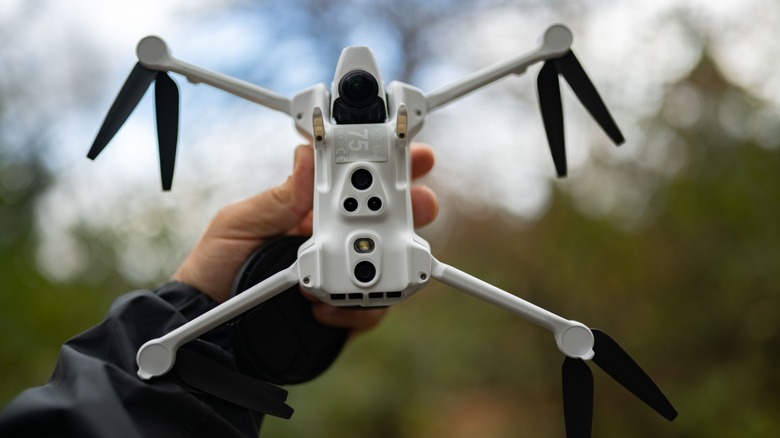
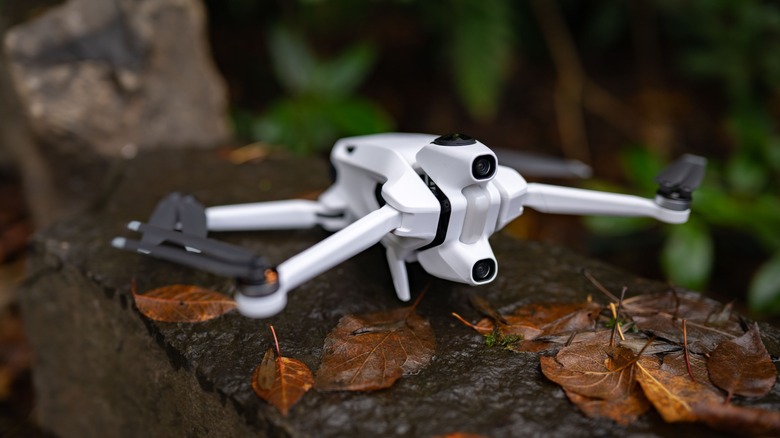
This is one of those rare products where almost everything about its design is novel and fascinating. It's clearly a device which was built from the ground-up rather than iterated on from a long established design philosophy. One of the more ingenious elements is the automatically retracting landing gear; two little nubs which extend when the drone is powered-up, and retract when it takes off. This prevents the 360 camera lens from touching the ground, while keeping the field of view free of landing gear while in the air. Also, they add an extra helping of cool-factor to an already eye-catching drone.
 Andy Zahn/SlashGear
I also appreciate the ingenuity of the vibration reduction system in which the camera unit of the drone is suspended within the chassis by what are essentially shock absorbers, so that none of the turbulence or the motion of the motors is felt by the user or is visible in the final footage exported from the drone. In flight, this is also one of the quietest drones I've ever tested.
 Andy Zahn/SlashGear
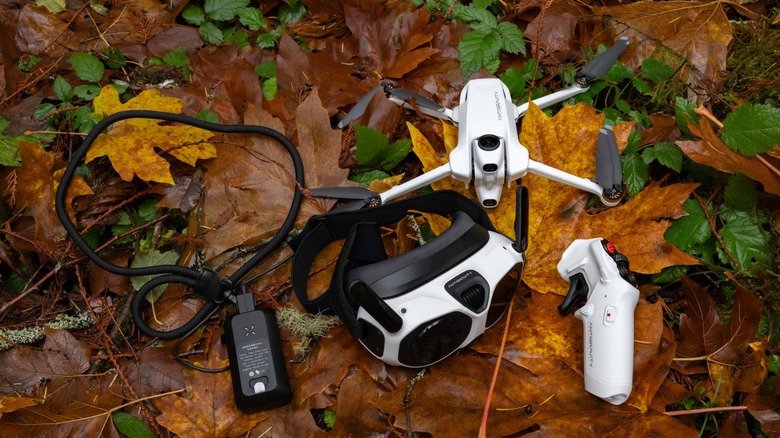
The headset offers a clear picture and a wide field of view, with numerous methods of menu control on the headset or through the motion control (which is itself an awesome and fascinating device). It also features a circular screen, which can display the view you're seeing inside the goggles to those around you. This is great for sharing the experience of flying with others. My one minor quibble is that the battery is designed to be worn via a lanyard around your neck, which can be somewhat awkward. However, this reduces the amount of weight on your head, making the goggles more comfortable to wear, so it is arguably a worthy tradeoff.
Software suite reveals strong Insta360 heritage
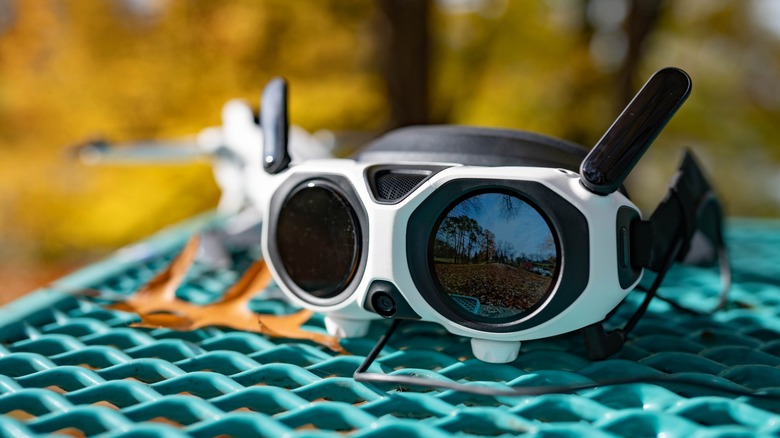
I've long been a fan of Insta360's user interface in their cameras, mobile applications, and desktop software, so I was pleased to discover that has been carried on by Antigravity and its companion software. The menu systems in the goggles are easily navigable using the motion controller, with all the settings being highly accessible so as to be altered on the fly. The controller itself is really responsive, and though the button layout takes some getting used to, it makes sense once you've acclimatized to it.
 Andy Zahn/SlashGear
The Antigravity mobile app has all the tools you need to update the drone, pull footage from the drone, edit and publish that footage, and help locate the drone should it become lost, among other functions. The desktop app is powerful, with plenty of tools with which to fine tune and produce professional quality results. I made particularly extensive use of the time manipulation and motion ND features here, which when combined with the FOV and camera movement controls, yielded results which look for all the world like what a highly skilled manual FPV pilot might achieve, yet was captured by flying slowly in straight lines and gentle curves.
In the process of editing the footage captured with the A1, I gained the distinct impression that this device really shows the true potential of 360 cameras. Panoramic imaging is truly elevated when it is integrated into a drone. As trite as it may sound to say, the sky's the limit when it comes to your creative options with the A1. Unlike when you don't get a shot quite right with a standard drone, with the Antigravity A1 all you need to do is go back and tweak your edit to get a better result.
Replaceable lenses and useful accessories
Much like the Insta360 X5 and the Insta360 X4 Air cameras, the Antigravity A1 features user replaceable camera lenses. As in those hand-held cameras, lens replaceability is essential in any modern 360 camera, even (and perhaps especially), in one that can fly. There's a lot of exposed surface area on the lens of a 360 camera, which protrudes bulbously from the exterior of the camera (or in this case, drone) body. It has to be built like this to maintain a clear field of view. It also means that the most sensitive part of the drone/camera is also the most exposed.
 Andy Zahn/SlashGear
However, with available replaceable lenses, this concern is essentially eliminated, and it's worth noting that as someone who has flown drones and filmed with 360 cameras for much of my professional career, I have only once seriously damaged a drone's camera, and only ever inflicted two small scratches on 360 camera lenses. Also, modern 360 camera lenses such as those in the Antigravity A1 are extremely durable, so damage is less likely than you might think.
 Andy Zahn/SlashGear
Other accessories I tested include propeller guards, which are a good idea to use when flying in tricky spaces where collision may be more likely, and a landing pad. The landing pad is particularly cool, as the drone will automatically identify and lock onto it. This is paired with the auto return to home functionality, which is capable of navigating around obstacles back to the landing pad/take-off point.
A steep price to pay
The biggest hurdle most people will face with the Antigravity A1 is the cost of it. Starting at $1599, this drone comes at what is definitely a premium price tag. It's not what you expect from a drone of this size, and it puts it up against some fairly serious competition in the same price bracket. However, something like the DJI Air 3S may be more wallet friendly and offer advantages when it comes to traditional filming methods, but the A1 is an entirely different breed of drone. The A1 is experiential and offers a wealth of post-production creative potential, rather than being a straightforward tool like a standard camera drone.
 Andy Zahn/SlashGear
It is also important to remember how much cutting edge tech is crammed into a drone so incredibly small and light as the A1. It is entirely unique, and is thoroughly innovative. Beyond the cost of manufacture, you've got to figure in the herculean R&D effort that went into its creation. Not only did the team at Antigravity have to build a fully featured high-performance drone from scratch, but they stuck a 360 camera in it, and miniaturized it. That sort of product development doesn't come cheap. The A1 was also clearly designed with as few compromises as possible in terms of the features and capabilities it possesses. They clearly wanted to come out the gates swinging with an impressive flagship product, but flagship products with cutting edge hardware entail an inherently higher cost.
 Andy Zahn/SlashGear
Would I prefer that the A1 cost less to be more affordable for the average person to experience? Absolutely, but I can also see why it costs what it does, and I wouldn't have wanted to see corners cut to hit a lower price point.
Conclusion
The Antigravity A1 feels very much like the realization of the nascent potential that existed tantalizingly in the combination of 360 cameras and drones. The result is every bit as compelling as I imagined, and more so, as the Antigravity A1 has surpassed my expectations for such a device. It has been an amazing journey to see it go from hands-on demonstrations of prototypes still in development this past spring, to what is now a remarkably polished final product.
 Andy Zahn/SlashGear
There is nothing like the A1. It gives you an immersive virtual-reality style experience in the real world. It genuinely feels like flying, and it's something you honestly need to try for yourself to understand just how much fun it can be. It also delivers creative possibilities for post-processing that can easily deliver spectacular results; effects that are simply impossible with any other camera or drone, but here are pulled off easily even by amateur pilots. The one real caveat is the price, which is perhaps the one major detracting factor for an otherwise stellar product. While it is enough to likely cause some hesitation among potential buyers of the A1, the fact is that when it comes to a the actual experience of flying, this drone can't be beat.
 Andy Zahn/SlashGear
This is beyond a doubt one of the coolest products of 2025, and a truly innovative drone. The Antigravity A1 is available now starting at $1599 from Antigravity's online store.