

Kia Put A Target On The EV9's Back, And Now That's Catching Up With It

If the Tesla Model S gave EVs a beachhead of credibility, the Kia EV9 led the push inland. Its arrival for the 2024 model year was a big moment for EV adoption, as it combined the well-designed Hyundai Motor Group E-GMP architecture with true SUV packaging and the ascendant Kia brand name. The EV9 duly won plaudits from critics and arrived at dealerships in heavily-marked-up form, demonstrating pent-up demand for a family-hauling EV.
In the short time the EV9 has been on sale, though, things have changed substantially. The Trump Administration's cancellation of federal EV tax credits and implementation of tariffs have driven up costs and shifted focus from size to affordability. The EV9 now also faces friendly fire in the form of the Hyundai Ioniq 9, another three-row SUV based on the E-GMP platform. So is the EV9's advance about to be halted, or can it hold its ground?
Box to the future
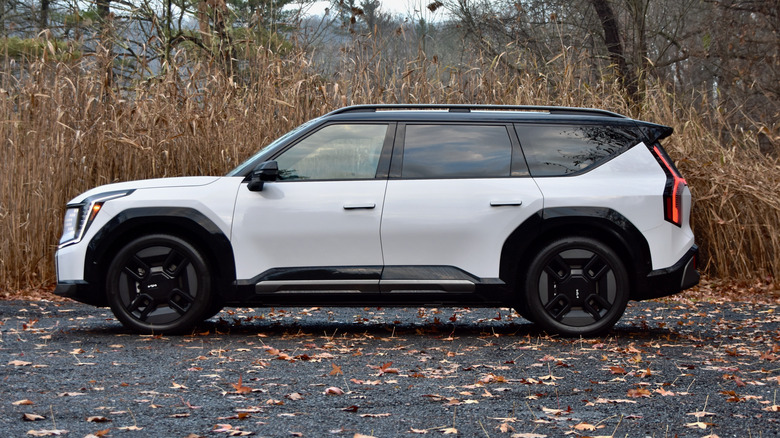
The EV9 has the relentlessly angular shape that attracts new-car shoppers like the smell of freshly baked pie, but the details are a lot more creative. In classic Land Rover fashion, the profile is essentially one rectangle sitting on top of another. A long hood and broad front end give this SUV presence, even if they are just styling affectations (there's only a small storage compartment under the hood). Flush door handles emphasize the flat door sides, and while Kia couldn't make the wheels square, it did the next best thing with the 21-inch ones on our GT-Line test car with four square spokes and square hubs.
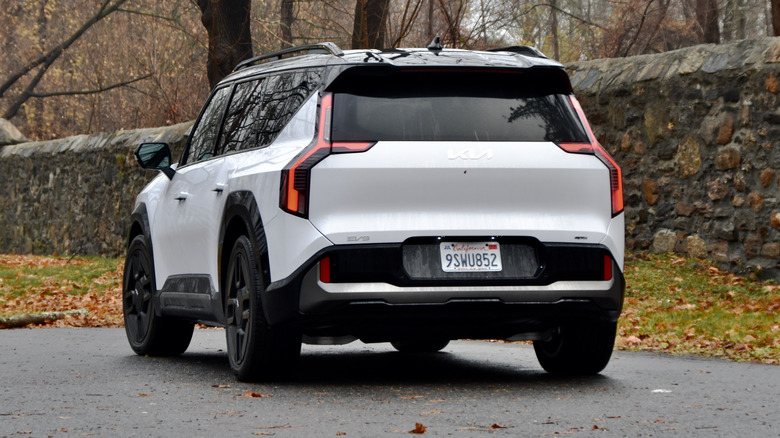
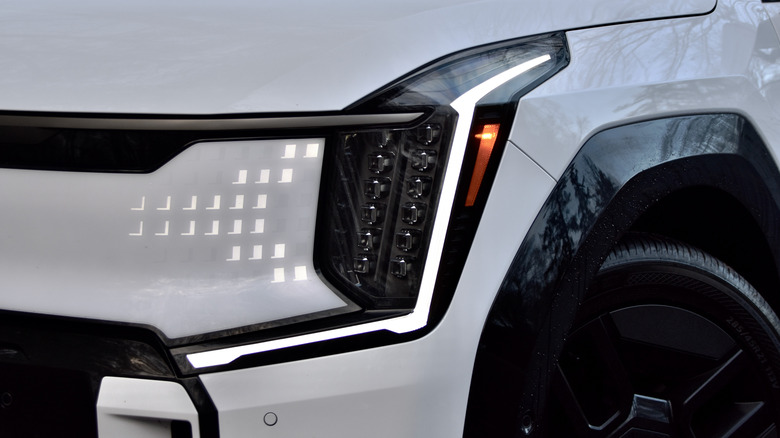
The wheels aren't the only funky design details. Backlit pieces extend out from the vertical headlights like arrows pointing inward, while daytime running lights bleed down into the lower front fascia to help break up this tall surface. The rear end is an intersection of angles that looks as if it was designed without room for taillights. Those lights are thus shaped by the rear fenders and tailgate, so you won't mistake an EV9 for anything else on the road from this angle. As an overall design, the EV9 manages to look like a real SUV without being a copycat.
More than just a big screen

The interior also demonstrates creativity while adhering to current design trends—at least if you go for the top GT-Line model. Dual 12.3-inch displays—one serving as the instrument cluster, the other as the central touchscreen—are standard and placed side-by-side. Such installations are common, but Kia actually displays information throughout, rather than having two discrete displays that just happen to share a housing. A climate-control panel (with a cool digital-clock-style typeface) sits between the instrument cluster and main touchscreen, which can then be used for the standard wireless Apple CarPlay or Android Auto.
Our GT-Line test car had white-and-gray two-tone leather upholstery, which contrasted nicely with the default red ambient lighting. Many cars have ambient lighting, but in the EV9 you actually notice it. Designers literally carved out space for it in the form of coves in the dashboard and center console, and the lighting elements are bright enough to be seen in regular daylight. Shiny plastic trim is another common feature in new cars, but our EV9 test car's gray retro-tech vibe wasn't as smudge-prone as the typical piano black.
There's also plenty of storage space up front. An elevated center console keeps cupholders and a wireless charging pad within easy reach. In front is an open area perfect for handbags that also has charging ports, although their elevated height means cables will be left dangling to devices sitting at near-floor level.
Comparable space to combustion SUVs
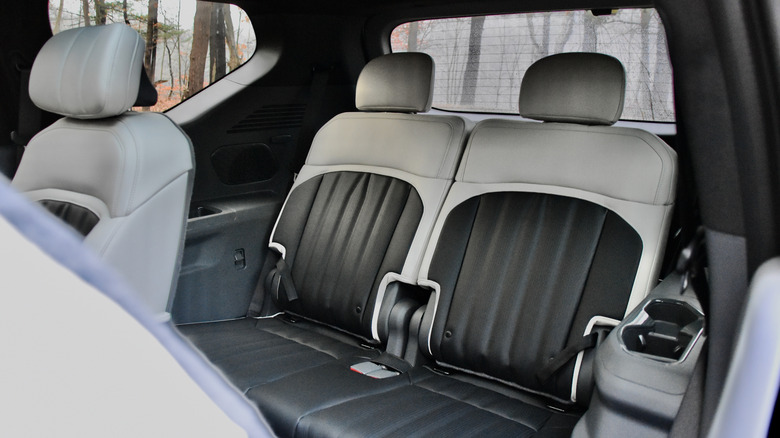
Without engines and traditional drivetrains, EVs theoretically have a packaging advantage over internal-combustion vehicles—one that's especially relevant in a three-row SUV. Kia provides an opportunity to test that theory because its lineup also includes the three-row Sorento and Telluride.
The Telluride is the closer of the two to the EV9. It's nearly the same length and height, but the EV9 is narrower and has a 7.8-inch longer wheelbase. Headroom and legroom vary by mere fractions of an inch across all three rows, although the EV9 has a more substantial 1.4 inches of additional third-row headroom. One could say the EV9 is still the more efficient packaging job because it contains more of this passenger space within its wheelbase, but its overall size makes that irrelevant in the real world.
Even the Sorento, which is 7.6 inches shorter than the EV9, has similar legroom in all three rows. Here the EV9's advantage is in cargo space. But whether you leave all three rows of seats in place or fold one or two, the Telluride has even more. The EV9 does have a small front storage compartment, but at 3.2 cubic feet in single-motor models and 1.8 cubic feet in dual-motor models, it's barely worth calling it a "frunk."
That being said, the third row still has enough space for adults, even with the optional reclining second-row captain's chairs, which erode third-row legroom slightly. The EV9 comfortably accommodated six adults and enough Thanksgiving leftovers to feed them.
Quick acceleration—if you're willing to pay

The EV9 lineup includes two single-motor rear-wheel drive and three dual-motor all-wheel drive trim levels. The base Light has 215 horsepower and 258 pound-feet of torque, and a 76.1-kilowatt-hour battery pack. The Light Long Range loses 14 hp but gains the 99.8-kWh pack used by the all-wheel drive Land, Wind, and GT-Line models. All three of those are rated at 379 hp and up to 516 lb-ft of torque.
The maximum torque rating only applies to GT-Line and the new-for-2026 Nightfall Edition, which is based on the Land trim level. Wind and non-Nightfall Land models are limited to 443 lb-ft unless you pay to unlock more. With full torque enabled, an all-wheel drive EV9 will do zero to 60 mph in 5.0 seconds, according to Kia. That drops to 5.7 seconds without the software unlock, 7.7 seconds for the Light, and 8.8 seconds for the Light Long Range, which weighs around 200 pounds more than the Light.
A 5.0-second zero to 60 mph time was once considered performance-car territory, and still feels pretty incongruous in a big SUV, even in today's world of absurdly quick EVs. Plus, Kia has an even quicker version in development. Announced at the 2025 Los Angeles Auto Show, the EV9 GT has 501 hp and can reach 60 mph in a claimed 4.3 seconds. At press time it had been certified by the EPA but hadn't gone on sale yet, with no word from Kia about timing.
A dancer with lead shoes
The EV9 GT-Line is a more pleasant vehicle for passengers than drivers. Ride quality generated no complaints, although the related Hyundai Ioniq 9 felt a bit more refined. Despite some wind noise owing to the boxy shape and prominent exterior mirrors, occupants of each row could easily hear and be heard by others. But quick acceleration was the only way in which the GT-Line defied its large footprint and heavy curb weight of approximately 5,800 pounds—about 700 pounds more than the 76.1-kWh rear-wheel drive Light base model.
On the highway, the GT-Line felt very stable, with standard self-leveling rear suspension compensating nicely for a full load of passengers and cargo. But even in its Normal drive mode, the steering was too heavy to easily make small inputs, and so devoid of feel that it was hard to tell when corrections were needed. Switching to Sport mode dialed up the steering's heft even more, enough that inputs felt like hand-strength exercises.
The suspension did its best to counteract the motions of the tall body perched atop it, but that didn't leave much room for fun. The EV9 changed directions only with great effort, feeling like a much bigger vehicle in the corners. Again, the Ioniq 9 does a bit better here, taking corners a bit more smoothly, in our experience. It's still not sporty, but it is more pleasant.
NACS onboard
With the 99.8-kWh pack and single-motor powertrain, the Light Long Range model is EPA-rated at 305 miles of range—not exactly impressive considering the pack's size. Range drops to 230 miles for the 76.1-kWh Light. All-wheel drive Wind and Land models are rated at 283 miles, while GT-Line and GT models are rated at 280 miles and 260 miles, respectively. All three versions of the EV9's Hyundai Ioniq 9 cousin surpass 300 miles, but with a larger battery pack.
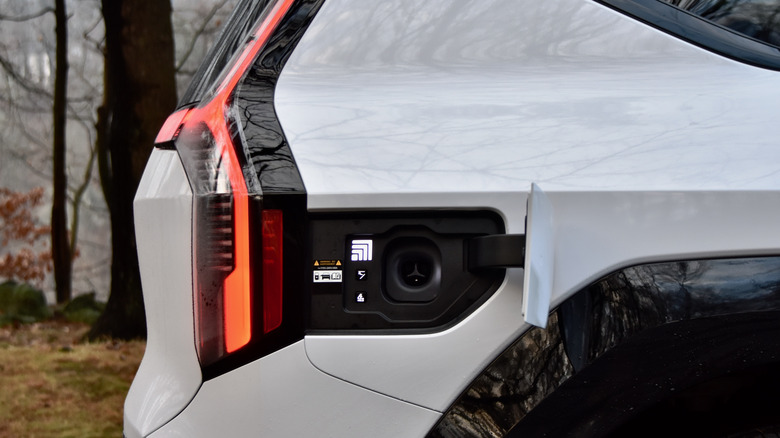
For 2026, the EV9 switches from CCS to NACS for DC fast-charging, granting access to Tesla Supercharger stations. Peak charging power remains unchanged at 235 kilowatts with the smaller battery and 210 kW otherwise, but expect slightly longer charging times with the native NACS than with CCS (via an adapter). Kia estimates a 10%-80% charge will take 20 minutes with the smaller battery and 24 minutes with the bigger one using a 350-kW CCS fast charger. NACS takes seven minutes and 10 minutes longer with the smaller and bigger packs, respectively.
A 10.9-kW onboard charger can recharge the bigger pack in an estimated eight hours and 45 minutes with a suitably powerful Level 2 AC charger (subtract two hours for the smaller pack). But the EV9 can also discharge power through a standard vehicle-to-load (V2L) system. Kia began rolling out a complete home backup power system earlier this year, including a Wallbox Quasar 2 charger, power recovery unit, and grid disconnect switch, retailing for $6,440.
2026 Kia EV9 verdict
Pricing for the 2026 Kia EV9 starts at $56,495 for the Light base model. Add $3,000 for the bigger-battery Light Long Range model. All-wheel drive Wind and Land models start at $65,495 and $70,495, respectively. Our GT-Line test car had a $73,495 base price, but options like reclining second-row seats and Glacial White paint with a black roof gave it an as-tested price of $76,670.
For nearly the same price, you could have a Rivian R1S Dual Standard with 270 miles of range that can do zero to 60 mph in 4.5 seconds, while still hauling up to seven passengers and lots of cargo thanks to a cavernous frunk. You could also get a Hyundai Ioniq 9 Calligraphy, which is rated at 311 miles of range thanks to a larger battery pack. It has the Kia's excellent charging hardware and similar tech features as well. The 305-mile Light Long Range is a better value, if you can live without all-wheel drive and some creature comforts.
The EV9 still has a lot to recommend it, including a standout design, true SUV utility, and quick road-trip charging. V2L capability and Kia's generous warranty coverage are nice bonuses as well. But the high cost of a well-equipped version, a truck-like driving experience, and middling efficiency show that there's still room for improvement. And with other electric three-row SUVs now on sale, Kia needs to get on it.