

4 Car Brands That Wont Give Up On Leaf Spring Suspension
A car's suspension is intended to connect the wheels to the vehicle while stabilizing it, controlling pitch, roll, and sway, and making sure everyone is comfortable. Manufacturers do so in many different ways. High-end performance cars often use independent double wishbone suspension setups that allow each side to move independently, while a typical off-roader might use solid axle setups that connect the two sides of the vehicle.
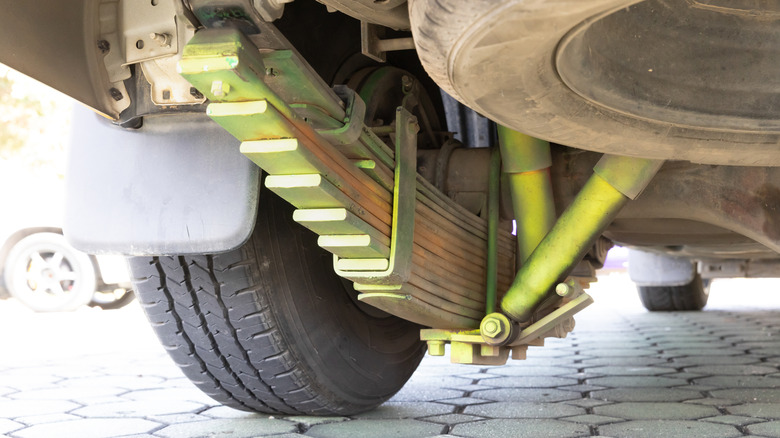
A leaf spring suspension setup is designed to support the vehicle's weight using one or more curved steel plates mounted between the chassis and axle. In many solid-axle applications, that axle-to-spring connection is held by U-bolts, which clamp the stacked steel strips in place. Mounting orientation varies by application, and these are typically either transverse or longitudinal.
The appeal comes down to a handful of practical advantages. Leaf springs are typically simple, relatively inexpensive, and space-efficient compared with many other suspension types. A leaf spring's stiffness scales with how many individual leaves are stacked into it. On the other hand, they are prone to sagging over time and can often feel a bit too stiff due to a limited range of motion. Either way, they still seem to be winning over many modern engineering teams, and because of that, some manufacturers are bringing leaf springs back.
Kia
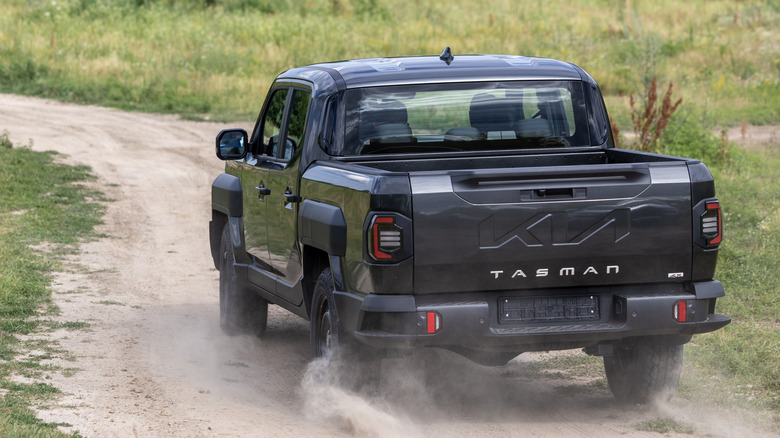
The Tasman is Kia's first-ever pickup truck, putting the brand into a segment it has never competed in before. The Korean brand describes the rear end as using a rigid axle with leaf springs, paired with a high-mount double-wishbone front setup, according to Kia's Global Media Center. Maximum ground clearance on the X-Pro trim reaches 252mm. Kia states the rear setup delivers "SUV-like comfort when unladen and excellent load-bearing support when hauling."
Built at Kia's Hwaseong facility in South Korea, unlike most of the brand's current lineup, which leans heavily on crossovers and unibody construction, the Tasman rides on a body-on-frame platform – a structural choice more common among traditional pickups than passenger vehicles.
With a rigid rear axle and a leaf spring setup, Kia aims to maximize robustness and load-carrying capabilities which are expected out of utility-oriented trucks. Two years ago, when we listed a few features we wanted to see on the new Kia Tasman, we specifically noted adaptive suspension because it can give you the best of both worlds, regardless of whether you spend most of your time on-road or off-road.
As it seems, our wishes were not granted, but Kia does offer the Tasman with adaptive dampers, also known as Frequency Selective Dampers, which can become softer over gentle bumps and firm up on sharper impacts to keep the leaf-sprung rear from feeling too stiff. All in all, the leaf-spring setup communicates Kia's intention, and when CarExpert tested the Tasman off-road, they specifically noted it's "probably one of the best cars we've tested off-road."
Volkswagen
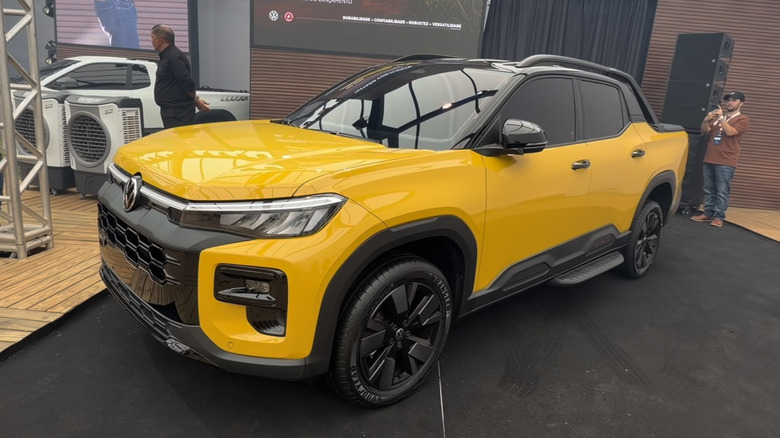
Volkswagen is retiring the Saveiro, a small pickup that's been a best-seller in Brazil, having sold more than 1.6 million units since its release in the 1980s. It does so in favor of an all-new model called the Tukan. The T-Cross crossover is a platform sibling here – Carscoops confirms the Tukan runs on the same MQB-derived architecture, but the differences between the Tukan and the T-Cross are in the suspension department.
The Volkswagen T-Cross typically carries a torsion-beam rear axle, which is also what the Saveiro used. The Tukan skips that in favor of a rigid rear axle and semi-elliptical leaf springs – an unusual rear-suspension choice for a truck built on car-platform bones rather than a body-on-frame chassis.
VW's stated aim for the switch centers on load capacity and durability for work-focused buyers. Production of the Tukan is scheduled to start in 2027 at Volkswagen São José dos Pinhais plant in Brazil. Positioned in size between the smaller Strada and larger Toro, the double-cab version is expected to lean toward comfort-focused buyers rather than commercial use.
The Volkswagen Tukan is not going to be available for sale in the U.S., a market where every other compact truck besides the Ford Maverick failed. The only other competitor, the Hyundai Santa Cruz, is getting discontinued in 2026. Either way, VW opted for a leaf spring suspension setup in order to make the Tukan more suited to an environment where bumpy roads, challenging terrain, and durability is important.
Stellantis
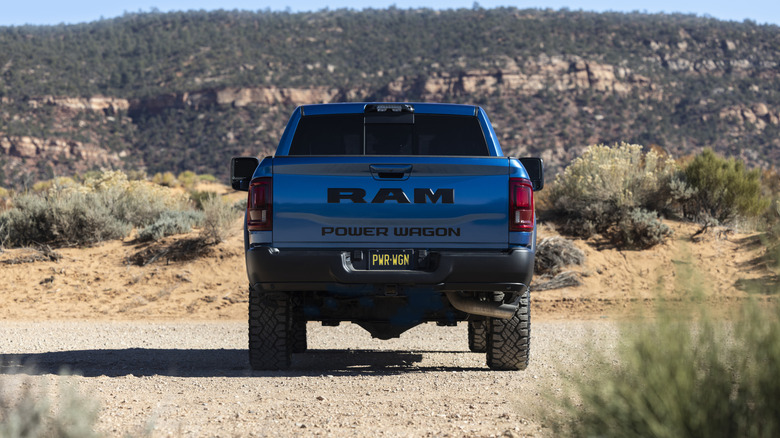
While some brands are bringing back the tried and tested leaf spring setup, others seem to be evolving. Back in March 2026, Stellantis filed a new patent – FR3165420 – for a two-shackle new leaf spring suspension design that is intended to underpin some of its upcoming passenger cars and EVs.
In the intro, we talked about how leaf spring suspension can be beneficial in terms of space-saving, something that has become a bit of a problem for electric vehicles since they have to carry large batteries around that can take up a lot of space in the car's floor. The Stellantis design incorporates leaf springs in order to save space.
We also talked about leaf springs sometimes being too rigid, and Stellantis relies on a two-shackle, or two stage system that effectively allows for variable travel, this making the system more comfortable than what you'd expect from a leaf-spring setup. Not long ago we talked about what Stellantis needs to do right to survive, and two of the points we made is that they need to focus on parts that work and that they should lean toward hybrids and EVs.
With a relatively simple leaf-spring setup intended to cut costs and weight, that works best with passenger cars such as EVs and hybrids, this could be a step in the right direction. Only time will tell which cars will actually receive this system.
Porsche
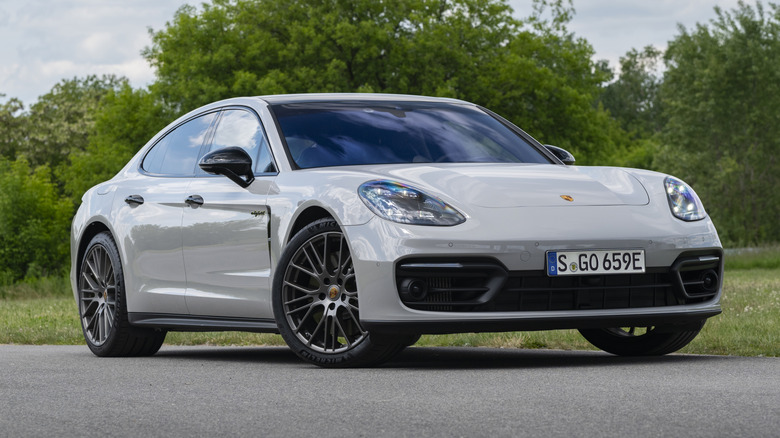
Porsche is not the type of brand you typically associated with beefy off-roaders with leaf springs, but recently, Porsche's engineering arm filed a pair of related patents covering a new take on independent suspension – DE102024117820 and DE102024117821. The idea is to have an independent suspension where the lower control arm doubles as the leaf spring, but not for the purpose of off-roading.
The DE102024117820 filing describes the arm as shaped like a leaf spring and built from unidirectional carbon fiber composite. Removing the usual coil spring lets the whole suspension sit at a lower height, which the patent says opens up more design freedom and can improve pedestrian safety by lowering the vehicle's structure.
Separate support bushings manage the small amounts of lateral movement and length change the leaf spring goes through as the wheel moves, aiming to smooth out the ride despite the simpler design. The companion filing, DE102024117821, narrows in on one specific application of that same suspension design: Housing electric drive directly inside the rim, tying the leaf-spring redesign to Porsche's broader interest in in-wheel EV systems.
As always with patents, filing one doesn't mean it's headed to production — but these coordinated fillings could see Porsche rocking a leaf spring suspension setup. When looking at it more broadly, Porsche suspension innovation has been strong in recent years, especially since the Porsche Panamera's Active Ride adaptive air suspension makes it one of the best luxury cars for people with a bad back.
How we made the list
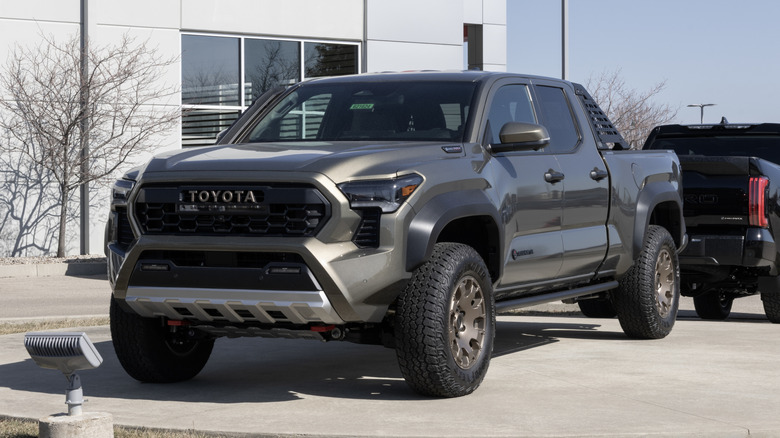
Although these brands make it seem that way, leaf spring suspension isn't universally on the rise. There are plenty of automakers moving away from it. The Toyota Tacoma is a good example — prior generations relied on leaf springs across the board, but the current fourth-generation Tacoma now uses coil springs on the higher end trims, with leaf springs reserved for the SR, SR5 XtraCab, and TRD PreRunner.
That split shows the format isn't making a universal comeback. Instead, automakers are selectively retaining or reintroducing it where they see a specific advantage, whether that's payload capacity, packaging efficiency, durability, or cost. To build this list, we focused specifically on brands genuinely introducing or reintroducing leaf springs, rather than trucks that never moved away from the format.
That meant digging through official manufacturer materials, technical specification sheets, and, where available, primary patent filings instead of relying on secondhand summaries. Sources used throughout this list include Kia's Global Media Center, Car Expert, Auto Evolution, Volkswagen, Car and Driver, Car Sauce, Hyundai, Carscoops, Car Parts, Ford's own technical specifications, and patent filings retrieved from WIPO's Patentscope database for Stellantis and Porsche. Every factual claim in this piece is linked to its original source.