

Time's Up For The Hyundai Santa Cruz, And One Final Fling Shows Why
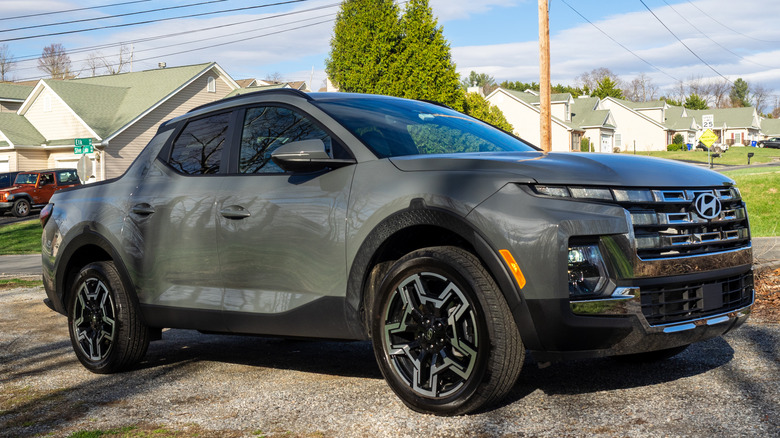
After a decade without any new, truly small pickups in the market, Ford and Hyundai both arrived with their own ideas on what the compact truck segment should resemble in the 2020s, using a crossover-based formula with nods to coupe and sedan utilities like the Chevrolet El Camino, Dodge Rampage, and Subaru Baja. Ford turned to its C2 platform (which underpinned the Bronco Sport, Lincoln Aviator, and the now-discontinued Escape) to create the Maverick. Hyundai, meanwhile, lopped off a bit from the backside of the Tuscon, gave it a bed and tailgate, and dubbed the result the Santa Cruz.
How did this turn out for the duo? For Ford, the Maverick was a game-winning grand slam out of the gate, its popularity so great that the Blue Oval couldn't keep up with orders for the first couple of model years. As for Hyundai, the Santa Cruz just couldn't bring the heat to the pitcher's mound, even as its sole competitor increased its price year over year.
Now, 2026 will be the last model year for Hyundai's "Sport Adventure Vehicle." But before it heads off into the sunset, the automaker sent over a 2026 Santa Cruz in its top-of-the-line Limited trim, dressed in its finest Hampton Gray paint. What did five model years on the road ultimately offer to Hyundai fans? Only one way to find out.
Shorter roofline, bigger bottom line
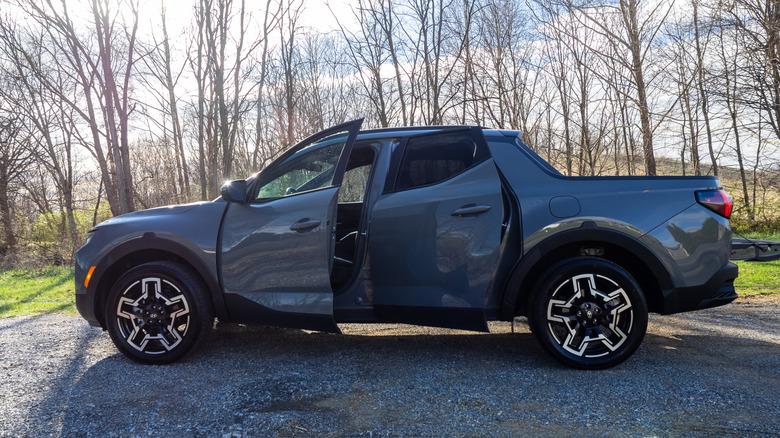
There aren't many options out there in the compact truck segment. In fact, no other manufacturer joined the fray the entire time the Hyundai Santa Cruz and Ford Maverick were fighting their (ultimately one-sided) battle. There were rumors and speculation about Toyota and Ram jumping in with their own compact trucks, but rumors were all there's been.
With that in mind, here's what you can expect to pay for your 2026 Santa Cruz before the $1,495 destination charge:
- SE: $29,750
- SEL: $31,400
- SEL Activity: $34,450
- XRT: $41,350
- Limited: $43,700, $45,185 total sticker as-tested
The Ford Maverick, meanwhile, can be had in 2026 for anywhere from $28,145 to $41,425 before options and other fees, depending on trim.
Then there's the Hyundai Tucson, largely the same as the Santa Cruz from the bed forward. Turns out lopping off that bit of backside comes at a premium, though: the Tucson starts between $29,200 and $40,675, based on trim level and whether you go for front- or all-wheel drive. Not to mention that, unlike the Santa Cruz, the Tucson can also be had as a hybrid or plug-in hybrid. The Maverick, too, can be had as a hybrid, either in front- or (as of the 2025 model year) all-wheel drive, for what it's worth.
Would a hybrid have helped here?
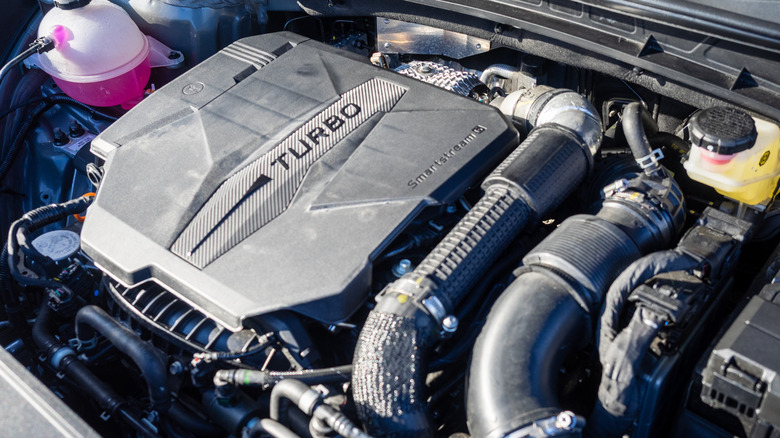
Those shopping for a 2026 Santa Cruz can expect to find one of two engine configurations ready to move the front wheels, if not all four. The SE, SEL, and SEL Activity trims get a 2.5-liter naturally aspirated four-cylinder good for 191 horsepower and 181 lb-ft of torque. A new-for-2026 eight-speed automatic transmission (replacing the previous eight-speed dual-clutch transmission) sends that power to the front, though if you shell out $1,500, you can get Hyundai's HTRAC all-wheel drive system.
On the other hand, if you choose either the rough 'n' ready XRT or the fancy Limited trims, that same engine gains a turbocharger the 15 to 17 pounds of force of which pushes the four-cylinder's output to 281 horses and 311 lb-ft of torque. The same eight-speed automatic is in play here, too, but the HTRAC all-wheel drive is standard.
 Cameron Aubernon/SlashGear
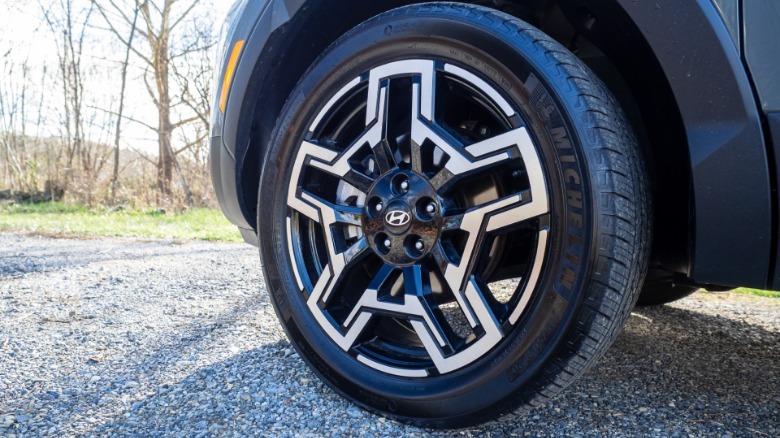
SE through XRT trims wear 18-inch alloys, though the XRT's are more rugged-appearing to go with the off-road spirit that trim embodies. The Limited, meanwhile, hits the road with a unique set of 20-inch alloys (as seen above).
Per the EPA, the 2026 Santa Cruz nets anywhere from a combined 25 mpg (22 city/30 highway) for the non-turbo, front-wheel drive configurations, to a combined 20 mpg (18 city/25 highway) for the turbocharged, all-wheel drive setups. The Limited I tested didn't hit the combined rating, a bias toward short in-town trips during my testing leading to an average of almost 18 mpg. Though both powertrains are happy with regular, filling the 17.7-gallon tank on the regular might hurt more often than not, especially in areas experiencing higher fuel prices as of this writing. Meanwhile, the hybrid version of the Maverick rates a combined 37 mpg on the same fuel grade; perhaps the hybrid powertrain from the Tucson Hybrid (38 combined mpg) could have helped this ute's cause more.
The old ways live on behind the wheel
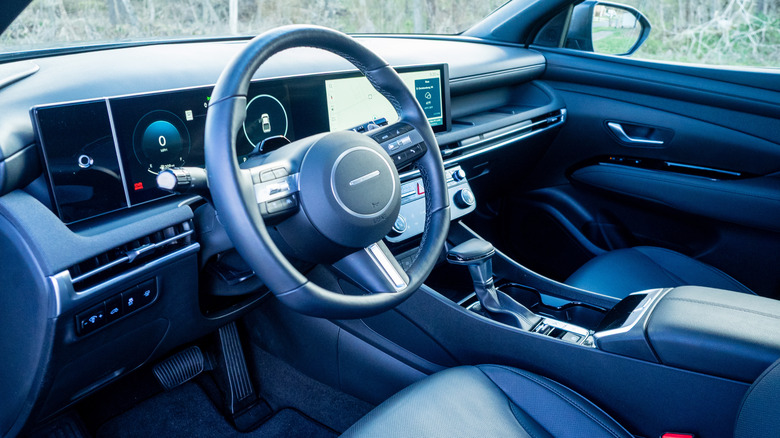
Behind the IONIQ-esque steering wheel, the Santa Cruz is one of the few Hyundais left to not undergo the IONIQ-ification of its driving experience, along with the Venue and the Elantra. In front of the wheel is a near-continuous wall of framed screen. All trims feature a 12.3-inch touchscreen, while the SE and SEL trims offer a 4.2-inch driver information display, and the rest gain a matching 12.3-inch digital gauge cluster.
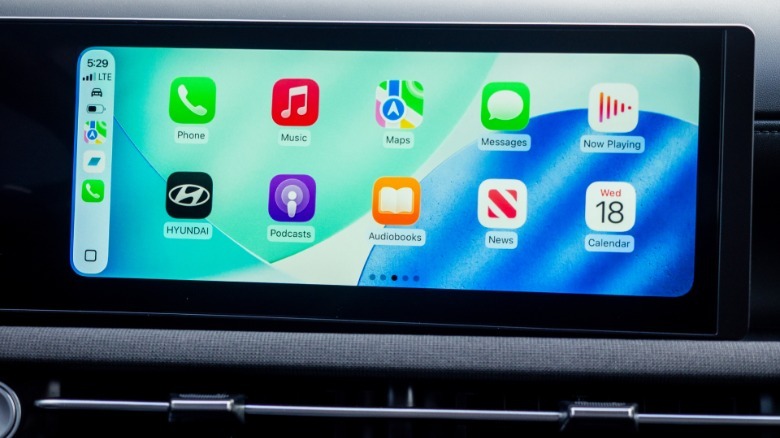
Standard features include wireless Apple CarPlay and Android Auto, four USB ports, Bluetooth, Hyundai Bluelink connective services, HD radio, and satellite radio. Most trims deliver sound through a six-speaker system, while the Limited has an eight-speaker Bose system. Wireless device charging is available on the SEL Activity through Limited trims.
 Cameron Aubernon/SlashGear
As far as safety goes, the 2026 Santa Cruz includes automatic high beams, blind-spot monitoring, lane-keeping and lane-centering assists, vehicle-exit warning, and rear-seat alert (so you don't forget your pets and children as the days get warmer and vehicle interiors get hotter). Available features include adaptive cruise control with stop-and-go and navigation, a surround-view camera system for maneuvering into and out of those tight parking spots, blind-spot cameras, and Hyundai's (somewhat aggressive) Highway Driving Assist. Oh, and the radio and HVAC controls are a few knobs and buttons, just to keep things just a bit safer as far adjusting things go.
Plenty of ways to haul all of life's adventures
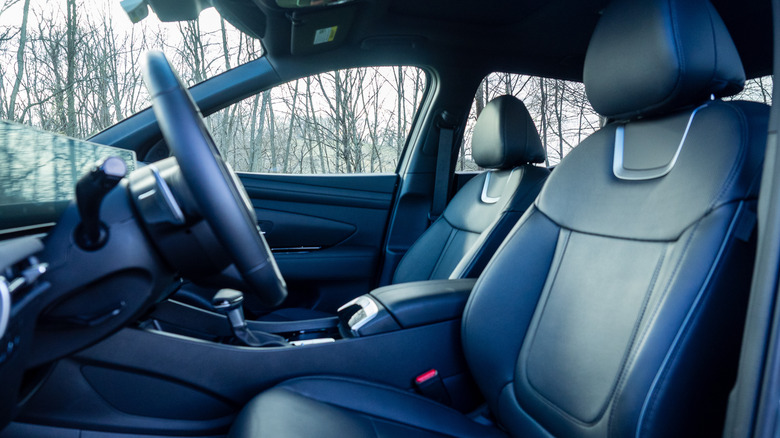
The Santa Cruz comes with cloth upholstery on the SE trim, synthetic leather for the middle trims, and — as in the case of my example — genuine leather for the Limited. The front seats gain heating on the SEL trim (as well as heated side mirrors), plus ventilation on the Limited for year-round comfort. The Limited also brings six powered ways of adjustment for the front passenger to go with the eight-way power-adjustable driver's seat found on the SEL on up.
Front legroom is generous at 41.1 inches. Unlike the Tucson's 41.3 inches of rear legroom, though, the Santa Cruz only has 36.5 inches for the three rear occupants. If you don't need that space, though, the rear seat bottoms fold up to reveal storage bins.
 Cameron Aubernon/SlashGear
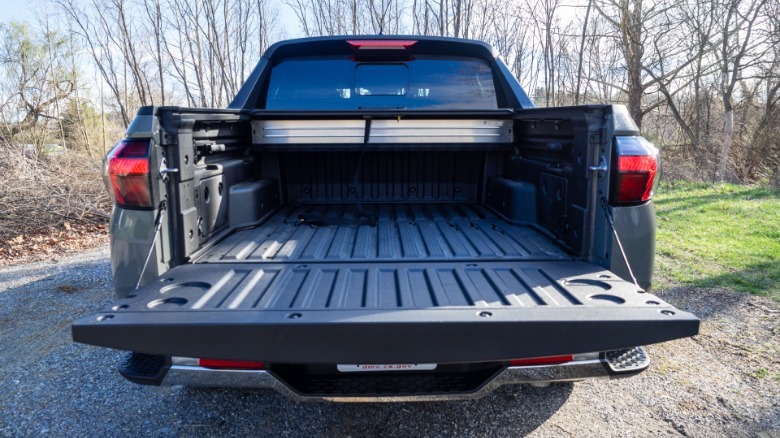
The real star of the show is, of course, the bed. Much like the Honda Ridgeline, the Santa Cruz's bed features 9 cu-ft of lockable space underneath for storing everything from muddy boots off the trail to lots of beverages chilling in an ice bath for the tailgate party (the tailgate has shallow cupholders built-in, too), plus a drain plug to, well, drain out the post-party mess.
The bed itself offers 27 cu-ft of space for holding up to 1,411 pounds of mulch or gravel, though you'll need to drop the tailgate to slide in a 4x8 sheet of plywood or two over the top of the wheel wells. SEL Activity through Limited trims include an integrated sliding tonneau cover for protecting that cargo from thieves, as well as a 115V power outlet for powering portable coolers, air pumps for inflatable mattresses, and small power tools. Finally, the Santa Cruz can tow up to 5,000 pounds and hold up to 220 pounds on its roof when properly equipped.
And then, there was only one
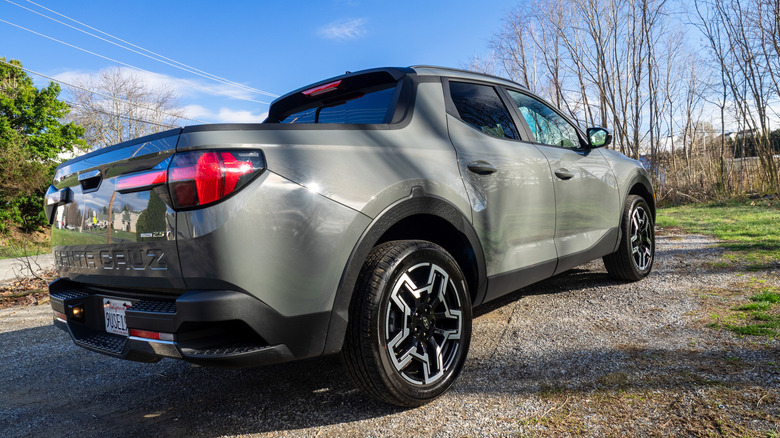
So, why then is Hyundai moving on from the Santa Cruz, leaving the very compact compact truck market to Ford and the Maverick?
Because the Maverick killed it from the start.
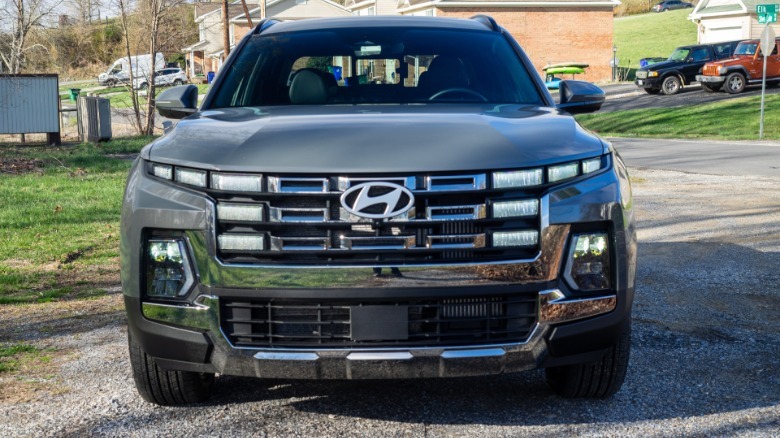
When it arrived in 2021 for the 2022 model year, the Maverick was marketed as the little Ford that could do it all, similar to (just smaller than) the Ranger and the F-Series. Looking more like a truck than the Hyundai certainly helped its case, not to mention all those QR codes for DIY projects scattered throughout to encourage owners to truly make the Maverick their own. Meanwhile, the Santa Cruz was positioned as more of a weekend ride, spending time cruising the farmer's markets, cute antique shops, and heading out to the beach for some fun in the sun. Nothing wrong there, but few saw any potential beyond the lifestyle aspirations this Hyundai presented.
 Cameron Aubernon/SlashGear
Then, there was the pricing. Coming out of the dark days of the pandemic, money was tight. Hyundai offered the Santa Cruz for a starting MSRP of $24,440 to $40,170. However, Ford delivered its Maverick for anywhere from $20,995 for the XL to $26,860 for the Lariat. To add more value, the automaker also offered its compact ute with a hybrid powertrain, something Hyundai, again, never got around to.
Finally, Ford was able to bring in new fans to the Blue Oval with the Maverick, with some 60% of that ute's buyers in Q2 2025 being fresh to the brand overall. The Santa Cruz, on the other hand, didn't have the same pull. Instead, more Hyundai fans opted to buy the Tucson.
In the end, the numbers don't lie. The Ford Maverick closed 2021 with 13,259 units sold in the United States alone. By the end of 2025, over 155,000 units left the lot, with no peak in sight thus far. The Hyundai Santa Cruz, by comparison, sold just over 10,000 units in 2021, peaked at 36,675 units in 2023, then cruised down to 25,499 in 2025.
Jack of few trades, mastered none of them
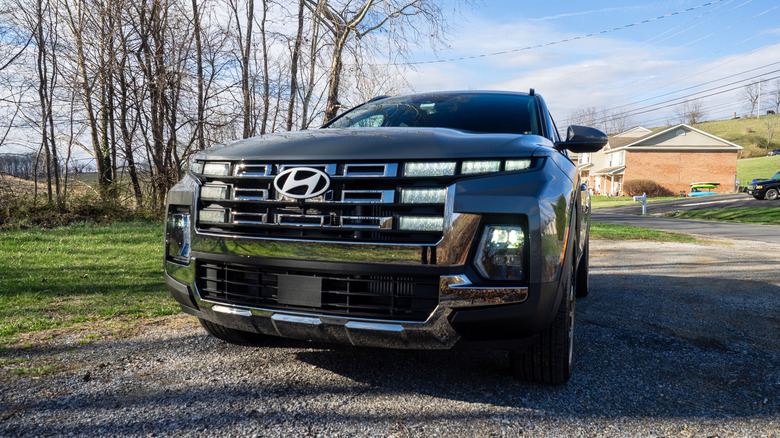
Spending a week with the Santa Cruz helped explain those numbers for this "sport adventure vehicle," and it wasn't all negative. Its crossover-sourced suspension — this is, after all, a Tucson with a bed — left the resulting ride very comfortable over interstates, winding mountain roads, and small-town streets alike. Speaking of those interstates, the turbocharged four-cylinder loved being able to let it all hang out at higher speeds than what it was confined to doing most of the week I drove it. I even considered bringing it to my local quarry to load up the small bed with enough gravel to "fix" the driveway at home.
Then again, though, how many Santa Cruz owners would actually do such a thing? This Hyundai is for cozy and fun activities, not hard work. That is the realm of its competitor, the Ford Maverick (and every midsize on up, body-on-frame truck, for that matter). I've seen so many Mavericks dressed in their blue-collar vinyl wrap finery on their way to service HVAC units, install cable TV, and repair other vehicles in the time that guy's been on the road. I can't recall seeing a single Santa Cruz undertaking the same duties.
The biggest and most glaring issue, in my opinion, remains the lack of a hybrid for this ute. At any time over these five model years, Hyundai could have – and should have – dropped a hybrid powerplant into the Santa Cruz. Yet, it never did. Would it have moved the needle on the sales floor? Maybe not enough to save it from its coming fate, but considering how much money Hyundai wanted for its "Tuscon with a bed," a hybrid might have given the Santa Cruz more of a fighting chance.
That is, if anyone wanted such a thing to start. After all, if they wanted a Hyundai crossover for fun family adventures, they bought the Tuscon. If they wanted a truck for a hard day on the job site, they bought a Ford Ranger with four-wheel drive and a combined 21 mpg EPA rating (or anything else that was actually a truck).
2026 Hyundai Santa Cruz verdict
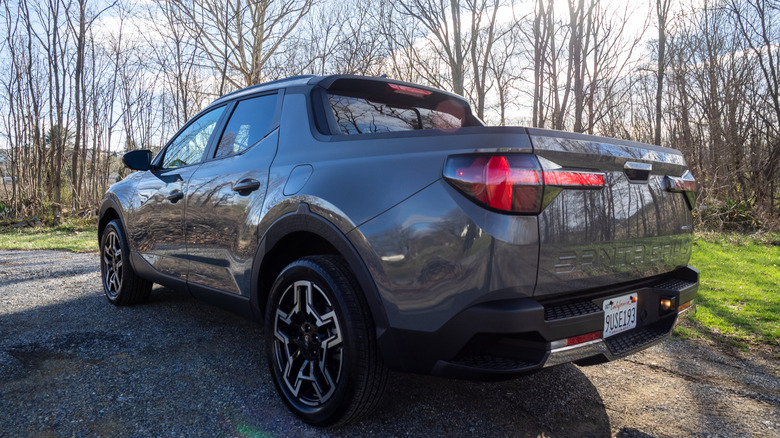
The 2026 Santa Cruz is the swan song for the Korean automaker's dreams in the compact truck segment. After a long reading of the room, Hyundai will instead head into the midsize truck space by 2030 with a proper body-on-frame machine, a preview of which was recently unveiled at the 2026 New York International Auto Show in the form of the Ford Bronco-esque Boulder SUV concept. Along with the truly wild Crater SUV concept revealed last year in Los Angeles, the Boulder represents the future of Hyundai's off-roading/blue-collar aspirations, culminating in the launch of the XRT sub=brand.
As for the Santa Cruz, though it simply could not bring the heat to the juggernaut that is the Ford Maverick, it's a good compact truck in its own right. It can tow, it can hit the trail and beach as hard as it does the cozy small-town markets, and it can move you and yours through all of life's adventures. The lack of a hybrid powertrain hurts, but for compact and stylish practicality with a crossover-like ride this ute is worthy of consideration. Just make sure you're ready for the turbo's thirst for fuel.