

5 Sports Cars That Are Lighter Than The Toyota GR86
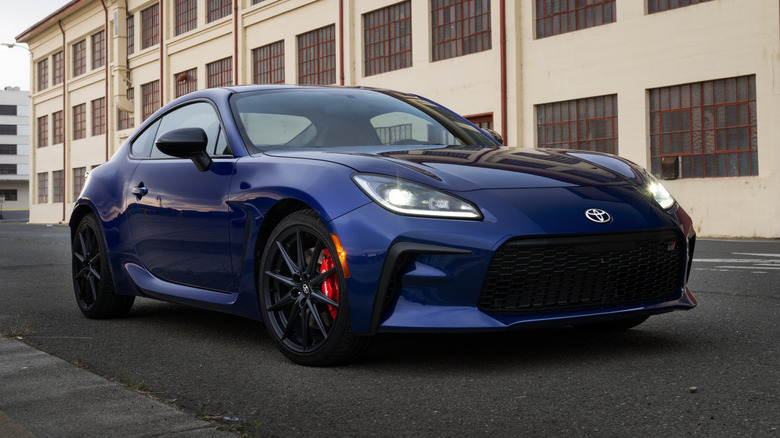
Vehicles have, on average, been growing heavier for decades. According to the EPA, the average new vehicle in 2024 weighed 4,354 lbs, with the increased weight of EVs helping to nudge the market-wide average up compared to previous years. Even many performance cars are now heavier than before, but there are still a few exceptions to the rule. The Toyota GR86 is one of them: in its lightest form, the latest model year of the car weighs just 2,811 lbs.
That light weight helps the GR86 feel faster than its 228 horsepower output would suggest, with its six-speed manual transmission allowing you to use as many of those horses as possible when road conditions allow. There's an auto 'box available too, in case stick shifts aren't your thing. Regardless of your transmission choice, the GR86 remains one of the lightest mass-market sports cars, an outlier in a world where increasing numbers of performance cars are so powerful that no one could ever fully exploit that power outside of a closed circuit.
While there's no denying that the GR86 is very light, very responsive, and very fun, it's not the only car on the market with those traits. Some brand-new sports cars are even lighter, although most of them are very rarely seen on American roads.
Mazda MX-5 Miata — 2,366 lbs
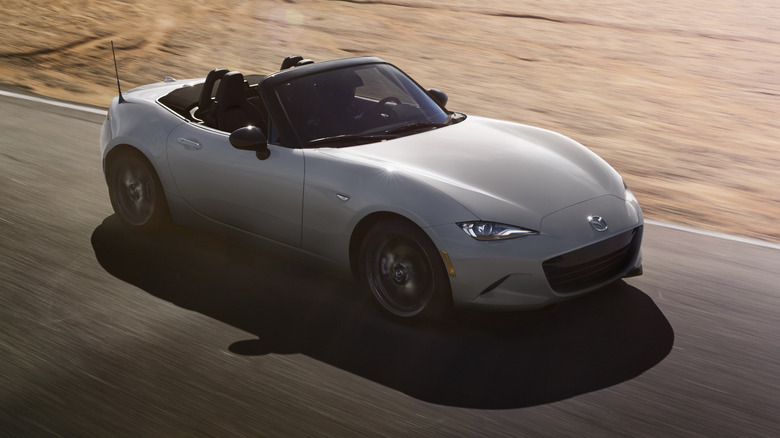
The Toyota GR86 and the closely related Subaru BRZ are among the lightest mass-market sports cars currently available in the U.S., but they're beaten by one long-standing rival. The latest Mazda MX-5 Miata is even lighter, weighing in at 2,366 lbs, according to its maker's spec sheet. The basic formula of the Miata is much the same as the Toyota-Subaru twins, offering sharp handling, a driver-focused cabin, and a six-speed stick shift. There's less power available in the Mazda, but again, straight-line speed isn't the point — this is a car that's meant to be fun to drive without needing to hit triple digits on the speedometer.
The soft top of the roadster isn't as practical during the winter months as the GR86/BRZ, but Mazda does offer a compromise in the form of the hard-top convertible Miata RF. Much like the GR86, the Miata roadster starts below $35,000, yet it still features enough modern creature comforts to be a feasible daily driver. The RF is a little pricier, with entry-level versions costing around $40,000, but that's still arguably a very good deal considering the fun that's on offer. There's no lighter sports car on the market for the money, either. Finding any car with a lower curb weight will mean not only sacrificing practicality but also coughing up a whole lot more cash.
Morgan Plus Four — 2,233 lbs
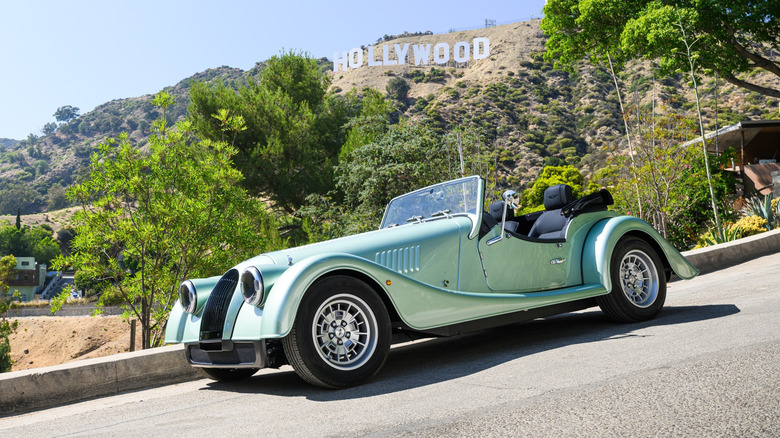
Morgan occupies a unique space in the sports car market, having made various iterations of the Plus Four since 1950 with remarkably few styling changes since then. The latest version still looks more like a restomod than a modern sports car, but the engine under the hood certainly isn't retro. It's powered by a 2.0-liter turbo-four BMW engine, which is shared with the BMW 330 and the now-discontinued Z4, and it makes 255 horsepower. That's plenty given that the Plus Four only weighs 2,233 lbs, and allows for a top speed of 149 mph and a 0-62 mph time of around 5 seconds.
Morgan has just over a dozen dealers in its U.S. network, stretching from Florida to California. So, unlike some of the other ultra-lightweight sports cars here, you can simply walk into a dealership and purchase a Plus Four. That is, assuming you have around $100,000 burning a hole in your pocket. Prices for the Plus Four start from $92,995 excluding taxes and destination charges, and that's without factoring in the cost of options either. Morgan helpfully includes a 3-year or 36,000-mile warranty with the car, although it's safe to assume that most buyers won't be using their Plus Four as their daily driver.
Zenos E10 — 1,742 lbs
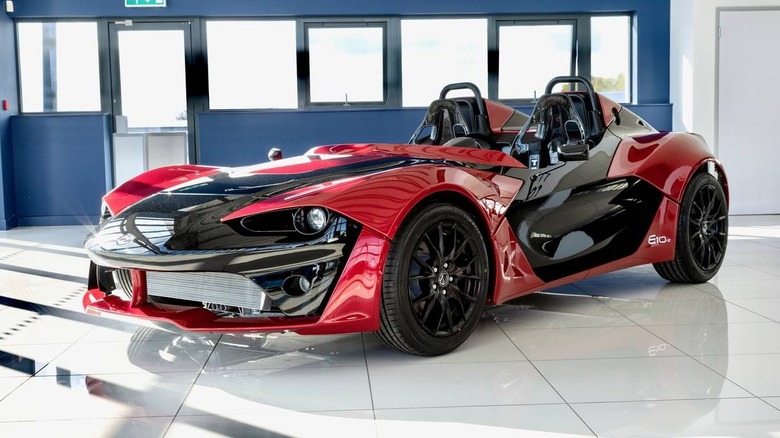
Drivers of the GR86, Miata, and Plus Four are all likely to cover the majority of their mileage on the road, but drivers looking for a track day toy can pick from a handful of even lighter sports cars. Among them is the Zenos E10, which is relaunching for the 2027 model year. Zenos is a small British carmaker that was founded in 2012 but went bankrupt in 2017, and its only production car was the E10. The company has now been relaunched under new ownership and has brought back its signature model, albeit with several key changes from before.
Originally, the E10 was a relatively affordable sports car, but now buying one will cost a six-figure sum. According to Zenos, prices start at £115,900, which is equivalent to around $152,500 at the time of writing. Then, buyers will have to factor in the cost of shipping and any taxes and fees on top. In the U.K., the carmaker says that the E10 can either be bought as a track-only car or a road-legal car, but in overseas markets like the U.S., only the former option is available.
It's a significant investment, then, but there isn't much else like it on the market. The E10 features a carbon-fiber tub and doesn't have any doors, windows, or a roof, which keeps its weight down to just 1,742 lbs. Buyers can pick from either a 2.0-liter or 2.3-liter turbo-four engine, with the smaller option offering 380 horsepower and a claimed 0-62 mph time of just 3.2 seconds.
Ariel Atom 4 — 1,350 lbs
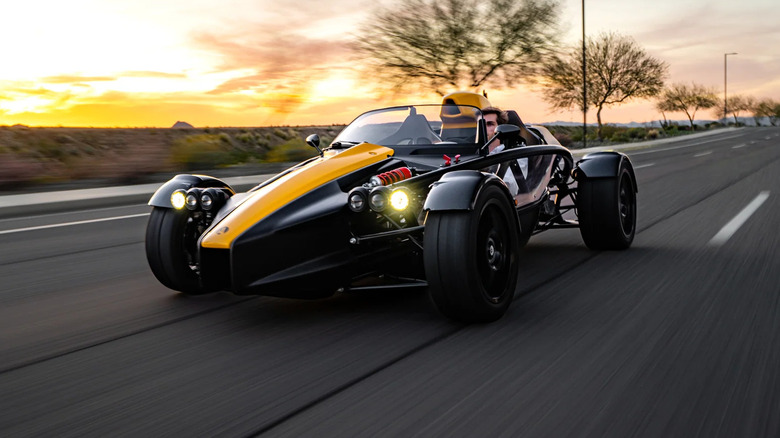
American enthusiasts looking for bare-bones driving thrills have been able to purchase an Ariel Atom for years, but they've never previously had access to the full model range or been able to customize their cars in the same way as buyers in other markets. In 2027, that'll no longer be the case, with Ariel announcing that it's partnering with Arizona-based Forman Motorworks to offer its full U.K.-built model range in America.
That means the latest version of the Ariel Atom, the Atom 4, is available to factory order. Its spec sheet is just as outlandish as you'd expect, promising up to 350 horsepower and 310 lb-ft of torque from a car that weighs just 1,350 lbs. That means the Atom's 0-60 mph time is closer to that of a hypercar than most sports cars, clocking in at 2.8 seconds according to its maker's estimates. Power comes from a modified version of Honda's K20C 2.0-liter four-cylinder engine, which has powered a wide variety of Honda models from the Civic Type R to the humble Accord.
Whether or not owners can register their new Atom 4 as a road car varies by state, since it doesn't meet U.S. crash test standards or emissions standards. Ariel says that some states allow it to be road-registered as a kit car or specially constructed vehicle, while in other states, it'll be limited to track-only use. Prices for the latest Atom start from around $117,000.
Caterham Seven — 970 lbs
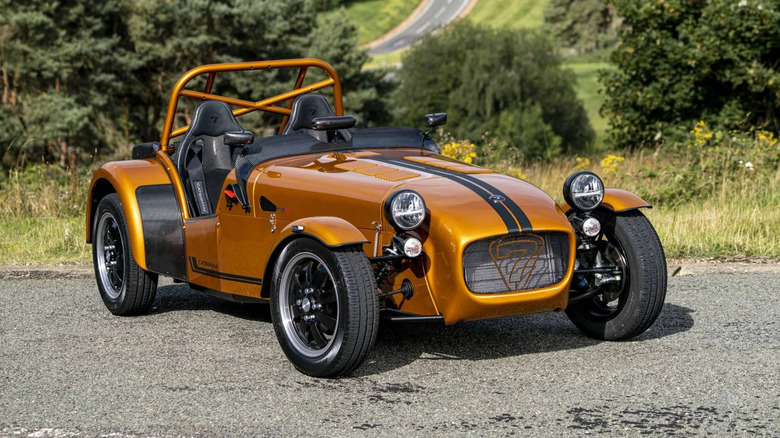
There are light sports cars, there are ultra-light sports cars, and then there's the Caterham Seven. In its most lightweight form, the Seven 170 weighs as little as 970 lbs, about a third of the weight of a GR86. That seemingly implausible weight is made possible thanks to the car's tiny 660cc Suzuki engine, which makes just 84 horsepower. That power is sent to the rear wheels via a five-speed manual transmission, and it's enough to propel the car from 0-60 mph in 6.9 seconds.
No other variant of the car is as light as the Seven 170, although the others more than make up for it by being far more powerful. At the other end of the global range is the Seven 620, which features a supercharged 2.0-liter Ford Duratec engine making 310 horsepower. It's only slightly heavier, at 1,344 lbs, with the 620R achieving a 0-60 mph time of 2.79 seconds. Top speed is capped at 149 mph.
Caterham has a very small network of U.S. dealers, and not every variant of the Seven is offered. The Seven 170 is not officially sold in America, but the range-topping 620 specification is available. Prices start from just over $50,000 for the Seven kit, which does not include a drivetrain. Buyers can either choose to assemble the kit themselves, or have a Caterham dealer assemble it for them for around $3,500 extra. Add up the total cost of assembly, drivetrain, and shipping, and the final price can reach north of $100,000 in some cases. Much like the Ariel Atom, street legality can vary by state, but in some places, the Seven can be driven on the road as well as the track.