

2 Advantages & 3 Disadvantages Of 4-Cycle (Or 4-Stroke) Chainsaws

If you live in a rural or even suburban area, or do any construction work, you either already own or need a chainsaw. You can use it for woodworking and construction projects, clearing yards, and, of course, cutting firewood. However, as with most things in life, you need the right chainsaw for the job, and we don't just mean the best major chainsaw brand.
When shopping for chainsaws, you should consider two primary types: two-cycle and four-cycle chainsaws, better known as two-stroke and four-stroke chainsaws. Unless you are thinking about buying an electric chainsaw, you will purchase a power tool that runs on gas and thus uses an engine. Like with cars, the strokes in engines you find in chainsaws determine how (and how quickly) a piston cycle completes. Two-stroke engines require two strokes (one crankshaft revolution) to complete an ignition event — when air and fuel are mixed together and combust to push the piston down and create torque — whereas four-stroke engines need four strokes (two crankshaft revolutions). These differences affect the engine's efficiency, which snowballs into the overall device construction, each with its own advantages and disadvantages.
While four-stroke engines are standard for car engines, they are actually somewhat rare in devices such as chainsaws. In this article, we will discuss the capabilities and shortcomings of four-stroke chainsaws and explain why.
4-stroke chainsaws are more fuel-efficient
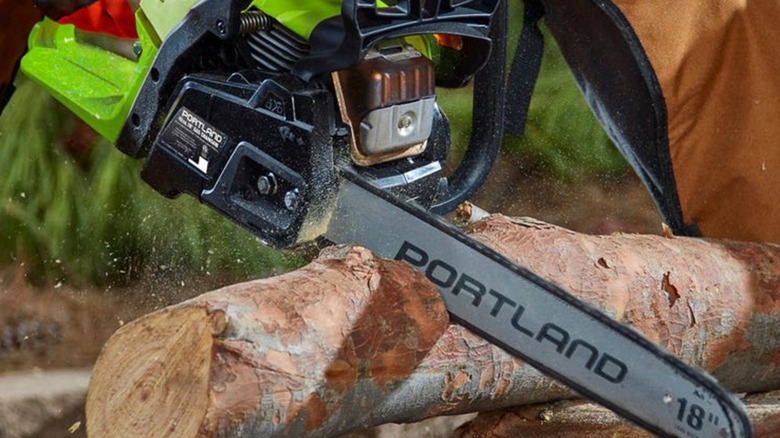
For the most part, two-stroke engines became a thing of the past because four-stroke engines are way more efficient. Four-stroke chainsaws run on the same principle. However, this design necessitated several other changes, some of which came back to bite four-stroke chainsaws in the handle.
Obviously, the biggest argument in favor of four-cycle chainsaws is their fuel efficiency. While all chainsaws (and combustion engines) function by mixing and igniting fuel and oxygen, because of how their engines are designed, two-stroke chainsaws often don't burn all of the mixture every cycle, so some escapes through the exhaust pipe. Meanwhile, four-cycle chainsaws burn more of the mixture each cycle, which improves efficiency and reduces waste. And as an added bonus, while two-cycle chainsaws only work if you mix oil into the fuel, four-cycle chainsaws have a separate receptacle for oil, which provides a controlled stream of lubrication that makes these tools last longer.
Unfortunately, many of these efficiency advantages are theoretical at best. In order to actually provide a more efficient engine and a separate oil dispersion system, four-stroke chainsaws need more moving parts. Plus, in order to actually move the chain, four-stroke chainsaws need heavier flywheels. And let's not forget that since four-strokes double the number of revolutions needed for an ignition event, they require twice as much displacement (the volume for air and fuel inside the pistons). All this additional mass weighs four-stroke chainsaws down and requires more fuel to move. So yes, four-strokes are more fuel efficient, but not by much. Depending on the chainsaw, a four-stroke might only increase sawing time by a scant 10%.
4-cycle chainsaws are quieter
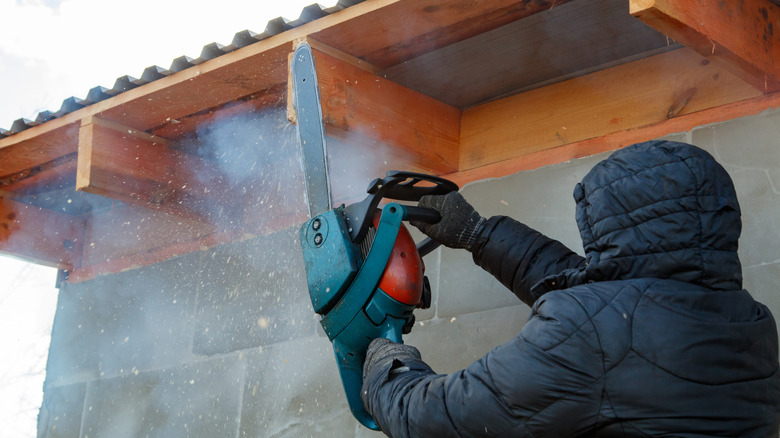
Depending on who you ask, the noise chainsaws produce is a common problem with the devices. It's kind of unavoidable, since they can only cut because motors spin toothed chains at thousands of revolutions per minute (RPM). There are only so many ways to reduce that noise, and they all come with their own problems.
Even though four-stroke chainsaws have more moving parts, they are ironically quieter than the two-stroke variety primarily due to the pistons. The biggest contributor to engine noise is the ignition event (it is combusting fuel and oxygen, after all). Since four-stroke chainsaws don't fire as often as two-stroke chainsaws — half as often, to be precise — they are quieter as a result. Plus, fewer ignitions means fewer jolts from the engine, which means fewer, or at least more manageable, vibrations. Four-stroke chainsaws are ideal for projects that require precise control and a steady hand, such as crafting wooden sculptures with a chainsaw. Oh, and if you're working in areas with strict noise ordinances.
Unfortunately, the four-stroke design comes with several price tags — aside from the higher initial cost, that is. These chainsaws are slower to pick up speed, and even when they reach their max RPM, they are still several thousand rotations behind two-stroke engines. Sure, that means less noise, but cutting speed depends on fast-moving chains. If you want a quick, smooth cut, you can't get that with a four-stroke. Plus, this is another point against four-cycle efficiency: the fuel you save each second gets spent in the subsequent seconds it takes to saw through wood that a two-stroke chainsaw already finished.
4-stroke chainsaws are harder to maintain
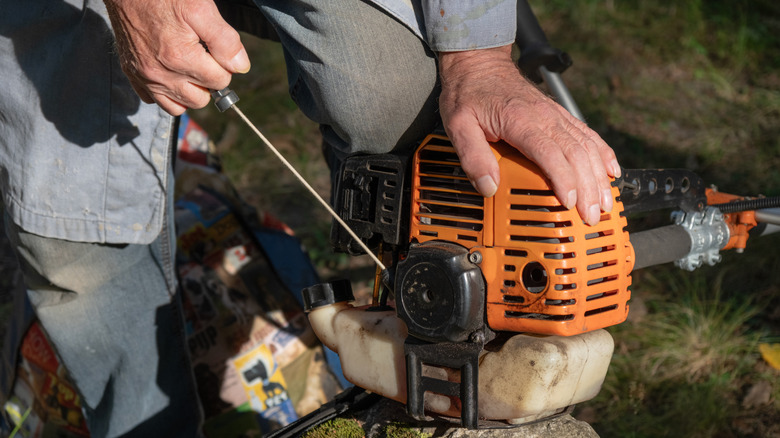
While the four-stroke engine design is more efficient than the two-stroke variety, it only achieves this feat because it is a comparatively complicated system. Again, this design contributes to a higher initial cost at purchase, but it can also come back to haunt people who want to keep their chainsaws running smoothly — which should be everybody.
As we have stated multiple times, four-stroke chainsaws have more moving parts when compared to two-stroke chainsaws, and owners need to ensure all of these work not only to maintain that higher efficiency quotient but also general functionality. This is especially true for parts you don't find in two-stroke tools. Valves and the valve train are the poster children of this reality, as they maintain the precise flow of air and fuel into the engine and exhaust out of it. Any misalignment can impact efficiency at best and cause catastrophic damage at worst. Two-stroke engines don't use valve trains, so owners don't need to check or replace them in these chainsaws.
Ironically, the four-stroke's oil system adds a lot to maintenance complexity and costs since oil and oil filters need to be occasionally replaced. Sure, you don't need to mix oil into the gas before refueling — heck, you can fill it up at any gas station with the gas you put in your car — but without this lubrication, a chainsaw won't run as efficiently, if at all. Two-stroke chainsaws require more frequent maintenance checks, but four-stroke maintenance is often way more complicated and pricey as a trade-off.
4-cycle chainsaws aren't ideal for every project
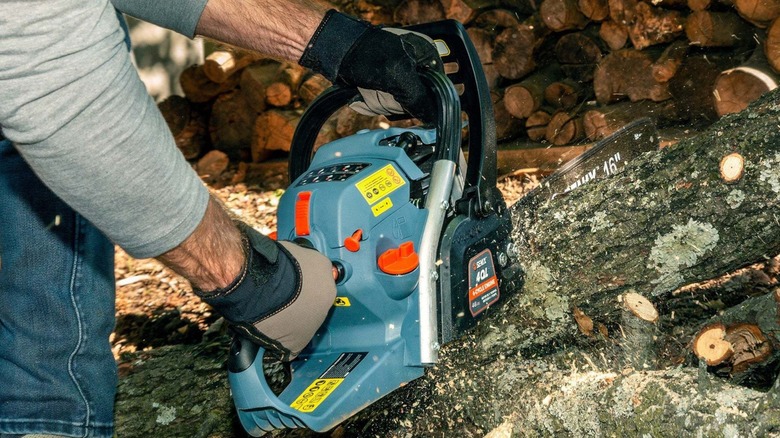
To the layperson, a chainsaw is nothing more than a chainsaw. If you need to cut a lot of wood in a short amount of time, don't use an axe; use a chainsaw. Any chainsaw will do. Except not really. Your chainsaw needs to be properly sized for the job, but its systems and the side effects of each are also considerations.
Two-stroke and four-stroke chainsaws, and all their individual advantages and disadvantages, have intended uses. Let's say you need to cut down elevated branches or cut down a tree. Because two-stroke chainsaws are lighter than four-stroke models without sacrificing power, they shine in these scenarios. Conversely, if you need to hold a chainsaw for extended lengths of time, such as when chopping firewood, four-stroke chainsaws are preferable due to their weaker vibrations and (slightly) improved fuel efficiency.
You might wonder what happens if you need to cut down a particularly large tree. Why not go for the four-stroke chainsaw? Because unless the power tool is in the right orientation, its oil system will work against it. Gravity does much of the heavy lifting for four-stroke chainsaw lubrication, so if you turn the device horizontally or even upside down, the oil won't reach the components it needs to maintain. The only way around this shortcoming is to purchase either a four-stroke chainsaw with a special oil system that defies gravity or a simple two-stroke chainsaw. You might have to mix oil into the fuel, but at least this process keeps the internal parts of two-strokes running smoothly.
4-stroke chainsaws are harder to obtain

At the end of the day, the power tool industry that produces chainsaws is just that: an industry. In order to succeed in any industry, you need to turn a profit. And you can't turn a profit without pursuing the most profitable avenues, especially at the expense of less popular models.
Arguably the biggest disadvantage for any would-be four-stroke chainsaw owner is the sparse market. Not only do you need to put up with fewer offerings, but fewer stores will keep four-cycle chainsaws in stock or repair them. The same goes for parts availability, which is especially troublesome since we already established that maintenance is more complicated when compared to two-stroke saws.
Why are four-cycle chainsaws rarer than the two-stroke variety? We don't know for certain, but we can make educated guesses. Customers might prefer two-stroke chainsaws due to their higher power-to-weight ratio and lower prices — and possibly because their lubrication systems don't starve if held horizontally. Perhaps manufacturers just prefer producing two-strokes because they require fewer parts. Whatever the reason, it's just easier to buy a two-cycle chainsaw.