

5 Disadvantages Of OHC Engines
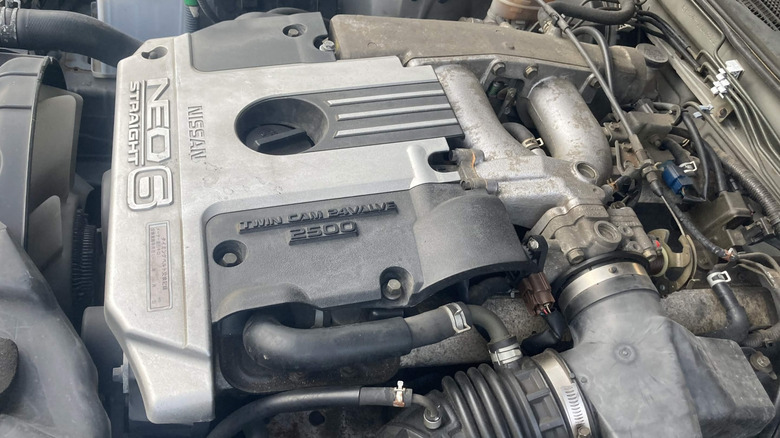
These days, most cars you see driving around have an OHC engine of some sort, either a single overhead-cam or double overhead-cam design. Not every car has this engine, of course — many still have the older overhead-valve (also known as pushrod) configuration, leading to a never-ending debate as to which is best. Spoiler: There is no single "best" configuration, only that some types are better suited to certain tasks than others. Every type of engine is a compromise, with its own corresponding pros and cons, OHC engines included.
Generally, though, the pros outweigh the cons with these engines a lot of the time anyway. There are many reasons why you hardly ever see pushrod engines in regular passenger cars anymore, after all. Pushrod engines simply have a lot of downsides that make them generally less suited to that type of driving, though it doesn't mean they're unable to do it, of course. An OHV-equipped Challenger is just as capable of daily commuting as a Nissan Versa, though the latter will have certain inherent benefits owing to its OHC design.
That said, there are still compromises here; though they're generally outweighed by the benefits inherent to OHC design, they do still exist. Specific engine configurations exaggerate these deficiencies more than others as well, such as boxer engines with complicated timing belts, inline engines with tall physical dimensions, and so on. To be clear, this only relates to the OHC layout, not inherent defects with the engine itself like recalls or poor reliability. Let's look under the hood and discuss all these imperfections.
OHC engines are physically taller than OHV engines
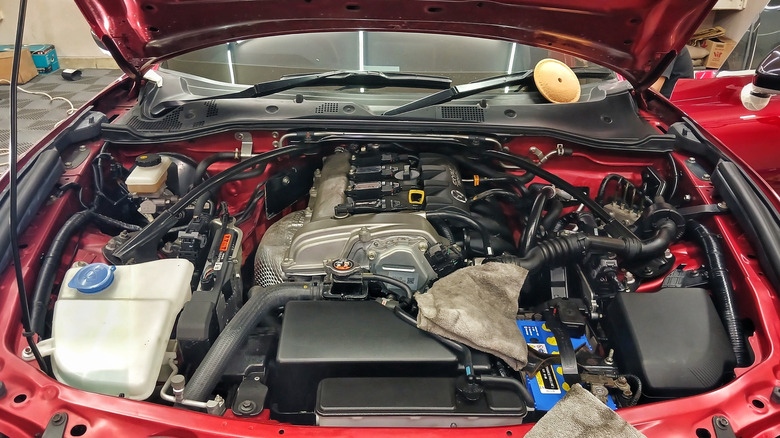
First of all, why are OHC engines taller than OHV engines? It's all to do with the camshaft placement. In an OHV design, you're burying the camshaft inside the block itself, then using pushrods to actuate the valvetrain on top. What does this look like in terms of physical dimensions?
You're starting off with a camshaft that runs to these pushrods, then the pushrods run up to a set of rocker arms. They're basically a bunch of seesaws in the cylinder head. You push up on one side, and the other side pushes down onto the valve, opening it up and allowing the engine to do its thing. So the main components you'll see protruding from the top of the engine head are these arms, with everything else housed within the block itself.
Contrast this with an OHC design, which places the camshaft (or camshafts if it's DOHC) on top of the engine block. You're not just putting the camshaft up there, either. You need a way to hold the camshaft in place, and you need a method to turn it. All this takes up physical space.
Who cares about that, though? Well, let's take a look at a few straight sixes in modern cars. BMW, for example, famously has its straight six sitting at an angle because the engine would simply be too tall to keep the front end aerodynamic and slender otherwise. It's also why cars like the Mercedes-Benz 300SL Gullwing tilted the engine at a steep 50-degree angle, so the hood line can be low and keep the car's frontal cross-section to a minimum.
They have timing belts or chains
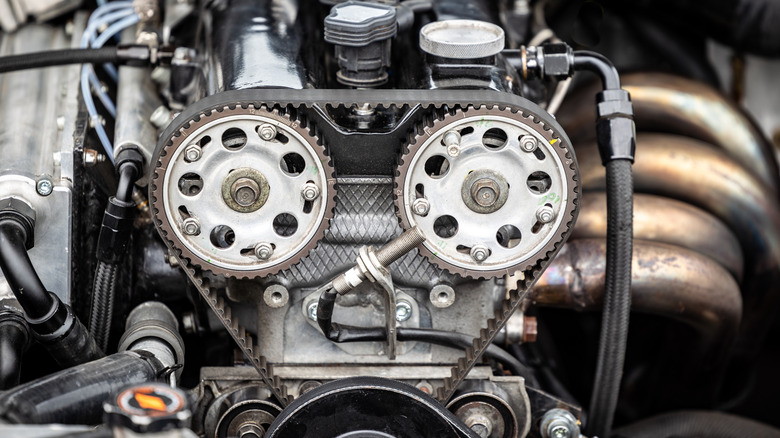
As its name implies, an OHC engine has the camshaft over the head, which seems fine until you realize something still needs to move the camshaft. The main power source of the engine is the crankshaft — that's what you're spinning when the engine is running, and the crankshaft is at the bottom of the engine. So you need a way to get the force from the bottom to the top; that's where a timing belt comes in.
Timing belts are tricky things. They're perishable items, for one, typically needing servicing around 60,000 to 100,000 miles depending on your particular make and model. Plus, like any rubber component, it'll harden and degrade over time if you don't run the car often enough. Timing chains are obviously more robust, so their service intervals are far longer. Regardless of type, though, changing a timing belt isn't trivial. In some cars, you have to practically dismantle most of the front end to even reach the thing. It's not uncommon for such jobs to require specialized tools and take multiple hours.
All this for a belt, though? Yes, and it's absolutely crucial it gets done, because a snapped timing belt can instantly brick an engine if yours is an interference-style configuration. Why is that so important? Because in interference engines, the piston and valves share a workspace — when one leaves, the other moves in. So if you mess up the timing, both will try to occupy the same space at once, and then you have a valve smashing into the piston, which is not compatible with your engine's health.
They don't like low-RPM grunt work

This is a physics problem related to how everything moves within the engine. The main inherent difference between OHC and OHV is just the camshaft placement, but if you have the cam placed low, then you don't have this big, long timing belt going through the engine to reach it. Instead, you have pushrods actuated by lifters, which in turn push against the rocker arms.
At low speeds, the back-and-forth momentum of this mass doesn't matter so much as the power required to overcome everything. Think of it like this — it takes less leverage to move an object that's closer to the main driving force. If you're spinning a wheel, it's generally easier to spin that wheel when it's closer to you than if it's farther away and you're spinning it with a belt. In other words, you have to overcome the force of the other components to actually move the valves, which is why OHV wins out in low-RPM work. Less stuff moved with more leverage makes it easier to produce higher torque.
Like everything, though, this too is a trade-off. While OHC and DOHC engines don't typically like low-RPM stuff, they excel at making good peak horsepower. The precision afforded by having the camshaft be right on top of the valvetrain helps with top-end power and efficiency. But that's not as important in applications like commercial trucks and muscle cars, which enjoy the robustness and torque potential of the traditional OHV design.
The heads are more complex
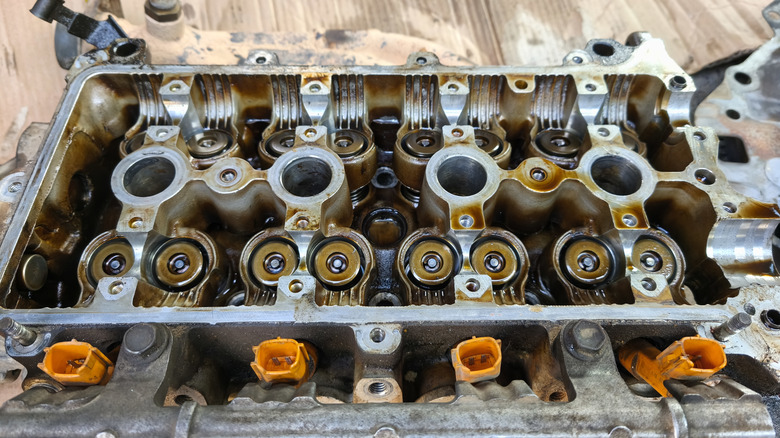
Again, one simply needs to look at the internal geometry to realize how this is a necessary evil of the OHC design. In addition to the camshaft or camshafts themselves, you need all the parts to properly seat them; they all need to be well lubricated; you need timing equipment like belt pulleys and sprockets; and you need the holes in the metalwork to accommodate all of this. And that's before we get into more advanced systems like variable valve timing and multi-valve setups, both of which add further complexity.
Take multi-valve setups, for example. Some engines may have four or more valves per cylinder, and each of those valves needs to be correctly actuated at the same time. So you have forking components to move both at once, plus the valves themselves, and the increasingly complex cam setups along with it. Having those extra valves can make a big impact on performance and fuel efficiency, which is why it's generally worth the trade-off. But it is still a trade-off; more parts means more failure points.
The same thing applies to advanced variable valve timing systems. DOHC engines have the distinct advantage of independent camshafts for intake and exhaust, which means you can vary the timing of each valve set independently as well. However, this also requires its own components, such as a cam position sensor, specialized adjusters with their own little parts, ECU mapping, and so on. And again, all of these components need adequate lubrication. By contrast, pushrod engines, while unable to offer these benefits, are far simpler in construction and, thus, inherently more robust designs from a baseline standpoint.
It's costlier to service and upgrade
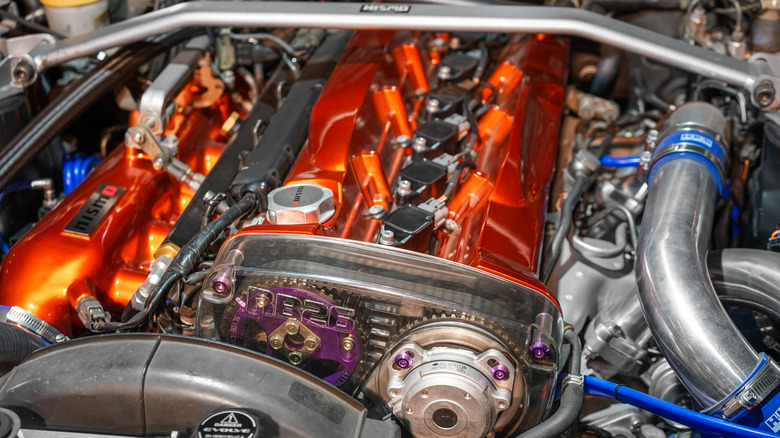
Let's suppose you want to upgrade to a more aggressive cam profile, or you have some sort of problem with the camshaft and need to replace it. Both are intricate and involved processes regardless of where the cam is in the engine, of course. But an OHV holds several advantages despite that.
Yes, it depends on the engine — sometimes you're lucky and can pull the camshaft after removing the intake manifold, and other times it requires removing most of the front end of the car to slide the cam out of the front of the block. But the same can be said for SOHC and DOHC designs as well. Depending on the engine configuration, you might have any number of intricate timing fun and games, such as belt pulleys, specialized valve components like VVT, and the need to freeze the valves in time when you pull the camshaft.
That doesn't say anything about a DOHC engine's tuning potential, however, just that there are more parts to replace if you want to change it up. Belts have specific thicknesses, and pulleys are only able to cope with so much power, so you need to change those. Then you have the cam itself, plus any ECU work to get it dialed in. You have sensors and brackets that need changing as well. By comparison, OHV engines, while also requiring a lot of invasive work to remove the camshaft, don't have nearly as much to replace if you're camming the engine.