

5 Drawbacks Of Cold Air Intakes You Should Know About
We may receive a commission on purchases made from links.
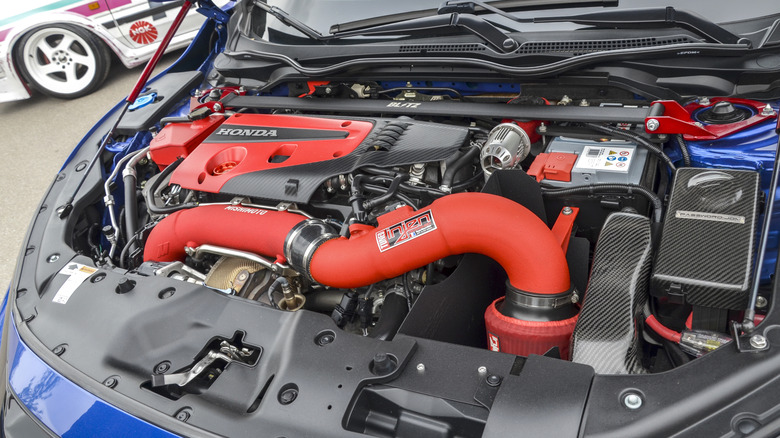
A cold air intake swaps the stock airbox and tubing for a freer-flowing setup that draws in cooler air, usually low in the front bumper or on top of the hood. The idea is this: colder air is denser, and denser air lets the engine burn fuel more efficiently because it is richer in oxygen. That mix of promise and price explains why the mod is so widely recommended.
It costs less than most performance mods, and plenty of kits bolt on in an afternoon with basic tools. For many first-time modders, it's a clear place to start. However, common doesn't necessarily make it a smart buy for every car. Product descriptions and enthusiast forums tend to spotlight the wins while glossing over the trade-offs.
Engineers spend a lot of time balancing airflow, noise, filtration, emissions, and packaging in the factory iteration, so replacing it can shift that balance in ways the box never fully mentions. On some cars, the payoff is easy to feel; on others, it's close to invisible, and a few owners end up with headaches they never had before.
Before you commit your cash and your weekend, look at what could go wrong. Real-world gains, upkeep, engine safety, and the way dealers or inspectors might treat a modified intake all deserve a second look. Here are five drawbacks of cold air intakes worth knowing before you pull the trigger.
The horsepower gain is limited
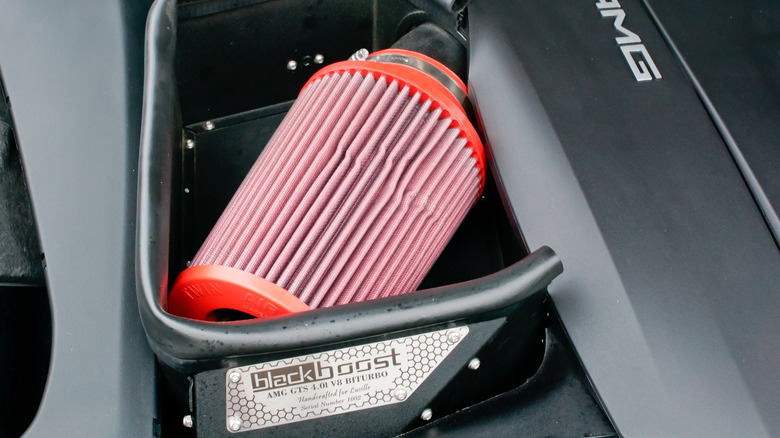
Aftermarket intake ads love promising big numbers, but independent estimates are often a lot more modest. Most V8s land in a 5 to 15 horsepower window, and even the high end is about 25. A widely used rule of thumb holds that ambient heat can also eat into that: on a V8, 10 degrees of added intake temperature can cost about 1 horsepower. This means that a hot summer afternoon can quietly take back part of what the kit gives.
Smaller engines often see less. Andy Jensen at Advance Auto Parts bolted an AEM intake onto a stock 2016 Scion FR-S and put it to the test, and the boxer went from 158.91 wheel horsepower to 163.31. That's a gain of 4.4, well short of the 10 AEM had reported, though AEM's own test car started from an unusually low 135. Jensen's morning baseline ran at 53 degrees and the afternoon pulls at 74, so his estimate for a consistent 53 was 7 to 8 horsepower.
Some engines have nothing to gain, which is why cold air intakes for Hemi engines are so controversial. Fifth-generation Hemi Rams from 2019 onward leave the factory with a cold air intake, so an aftermarket kit just swaps one for another. One expert quoted at Cars.com said a stand-alone intake is "probably not going to show much, if any, of a performance improvement."
Then there's the dollar per horsepower ratio. With kits running from roughly $70 to $500, a $500 kit that adds 5 horsepower works out to $100 per horsepower. None of this makes the mod useless, but power isn't always what you expect. To make the most of your cold air intake, investigate your engine's specifics and which kit will make the biggest difference.
It can hydrolock your engine

In the intro, we noted that many people place their cold air intakes in areas where it isn't too hot, which allows the engine to breathe freely. This often means putting the intake closer to the ground. Our rundown of what causes a hydrolocked engine singles out cars running aftermarket cold air intakes, because the cone filter often ends up low enough to sit level with the bumper.
From there the physics does the rest: a cylinder can compress air but not water (or any other liquid), so a piston that meets a slug of it on the compression stroke has nowhere to go. All that force has to go somewhere, and the connecting rod takes it. Bend one rod, and it starts making contact with the cylinder wall and the crankshaft counterweights. At that stage, you could be looking at a rebuild or a new engine.
How much water it takes depends on the kit. One retailer that installs these systems puts the submersion depth at 8 to 10 inches or more for a filter mounted near the ground, and says rain alone won't drown an engine. Their own advice is blunter than that reassurance suggests: anyone who can't avoid water deeper than 6 to 8 inches should probably skip a cold air intake.
They also flag a wet filter as its own way to end a drive, with no hydrolock involved because a wet filter makes it harder for air to enter. Sealed airboxes and hydro-shield covers exist for exactly this reason, and a kit with one is worth the extra money if you live somewhere wet. Just know that a flooded underpass you'd have driven through without a thought is now a judgment call.
It could cost you a warranty claim

An aftermarket cold air intake kit often ships with a cotton gauze filter. This cotton gauze requires oil to catch dirt and keep it out of the intake, and keeping that filter working means washing, drying, and re-oiling it, since a clean reusable air filter performs better than one caked in dirt. If you apply too much oil, excess can travel onto the mass airflow sensor, which can mess with your ECU by telling it an incorrect amount of air is entering the engine.
GM has had a bulletin on this for years (04-07-30-013E), applying to its 2024 and older cars and light-duty trucks. Oil on the sensor throws off its readings, and the driver may notice: a warning light on the dash, a rough idle, hesitation when pulling away from a stop, revs that won't climb past a certain point, and an automatic gearbox changing gear at the wrong moments.
The part that hits your wallet is what GM tells its dealers. Before a claim gets approved, the inspection covers the sensor element and the induction hose, and where an excessively over-oiled filter caused the fault, the repair comes out of your pocket rather than GM's. K&N argues the opposite and has published its lab work to back the claim.
The company deliberately over-oiled one of its filters, pushed 1,000 CFM through it, and weighed a capture filter on the far side to catch whatever came off. K&N reports that nothing did. No dash light appeared when the company smeared its oil directly onto hot wire and film sensors either. K&N's position is that the sensors sent to it as failures usually weren't.
The wrong kit can even be illegal
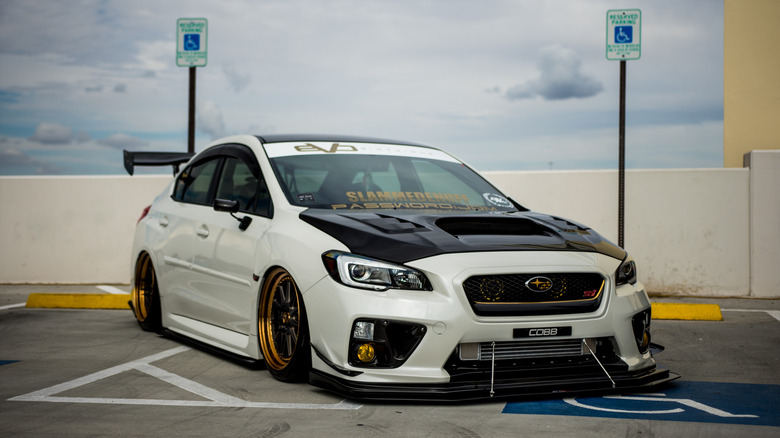
In the modern age, it is no longer just about which mod you want to buy, but also which mod is actually even allowed on your car. For example, K&N publishes a notice for the intakes it can't sell for street use everywhere, and the list runs to fourteen states plus the District of Columbia: Arizona, California, Connecticut, Maine, Maryland, Massachusetts, New Jersey, New Mexico, New York, Oregon, Pennsylvania, Rhode Island, Vermont and Washington.
A cold air intake is just one piece of car tech that can be illegal. K&N ties the restriction to Sections 177 and 209 of the Clean Air Act, which lets California set tighter vehicle emissions standards than the federal ones and lets other states follow California instead. Legality in those places comes down to a part number. A part only escapes California's anti-tampering rules once CARB has put it through an engineering evaluation and concluded emissions don't go up.
What the manufacturer gets back is an "Executive Order" with a number attached, and that number is checkable — by CARB, by a BAR referee station, or by whoever runs your smogs. It doesn't clear the part in general, though. Approval names the vehicles it applies to, down to model year, which is how a kit ends up street legal on one car and illegal on the one beside it.
The approval also comes with a sticker, which needs to be placed in the engine bay, visible to inspectors. The catch is that a single brand sells both kinds, and the part number tells you which you're holding. K&N's 57 series cleared CARB, so those kits are street legal in all 50 states. Some kits numbered 63, 69, 77, or RK did not, which makes them restricted in California and other states that follow California's lead.
It can let more dirt into the engine
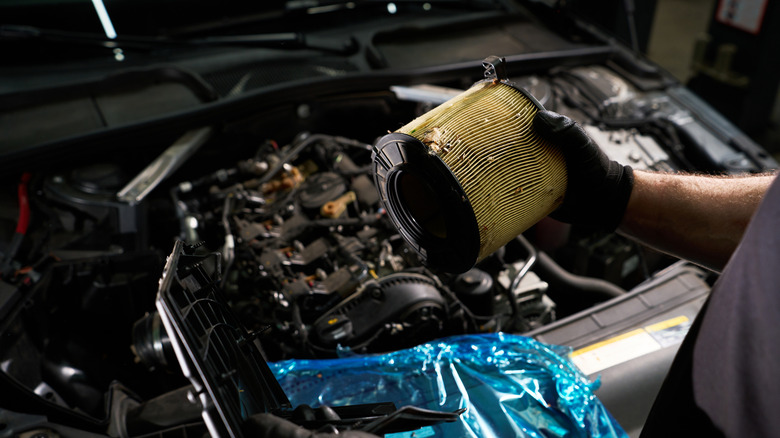
The whole point of a cold air intake is to let more air into your engine so you can make more power. However, filtration is a trade-off; it comes with drawbacks. In other words, by letting in more air, you may also let in more dirt. That dirt doesn't stop at the cylinder walls either: particles that get past a filter end up in the oil, and contaminated oil is one of the bad habits shortening your car's oil lifespan.
On the ISO 5011 test, K&N puts most of its own filters at 97% to 99%. The cellulose media in a factory airbox is characterized in the engineering literature at over 99.9%, with grains larger than about 2 to 5 microns held back. A couple of percentage points sounds like nothing. Well, it isn't. A 2022 study in Energies collected wear figures across filter grades: against an unfiltered engine, a 97.8% filter cut wear on the liner and rings to 1.89%, while a 99.45% filter cut it to 0.41%.
Better filtration left roughly a fifth of the damage. What does the cutting is road dust — silica and alumina, both harder than the steel your engine is made of. K&N's counter is that efficiency alone is a bad yardstick. Its FAQ points to capacity, restriction, and service life too, noting that a brick wall would filter all the dirt but barely let any air in.
Also, these figures come from separate sources, not a head-to-head test of matching factory and aftermarket filters. Ultimately, the bottom line is this — the risk comes when an intake gains airflow at the expense of filtration efficiency, allowing more abrasive dust to reach the engine.