

14 Extreme Cases Of Hollywood Completely Misunderstanding Cars
The silver screen has never allowed the laws of physics to get in the way of a good, old-fashioned car chase scene. There is a marked difference between bending reality for the screen and simply failing to understand, or even consider, basic things about how a car works. Unfortunately, Hollywood in particular is littered with examples of the latter. Some of these absolute howlers are so bad that even non-car people wince when they see them.
Worse, some of these mistakes were pointed out during shooting, only for script-obsessed directors to overrule the technical team and carry on anyway. Now, we love these movies, and we're not here to ruin them or dunk on them, but these errors are too egregious not to point out. From nitrous oxide acting like rocket boosters and floors falling out of Mitsubishis to cars reversing at highway speeds through gunfire, Hollywood clearly doesn't care how cars actually work — here are 14 examples.
John Wick's Mustang Boss 429 wasn't actually a 429
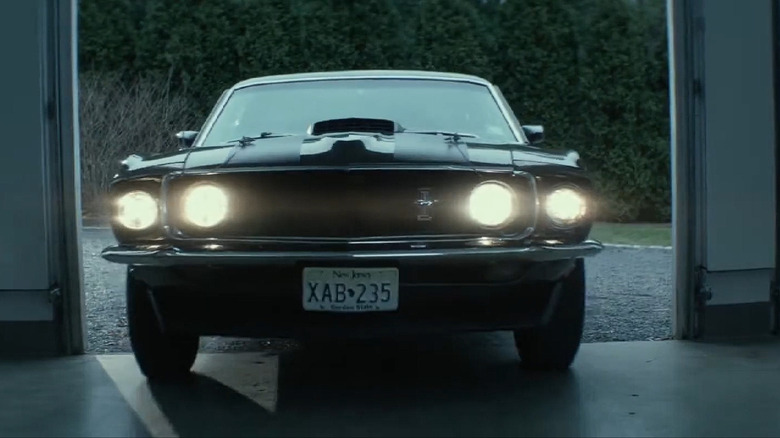
There are many things to love about the 2014 film "John Wick", chief among them the protagonist's car. A famous scene shows John Wick (Keanu Reeves) filling up gas at a station. There, the antagonist gangster Iosef Tarasof (played by Alfie Allen) accosts him and asks about the car. John reveals it to be a Mustang Boss 429, and when asked, "She a 70?", mentions that it's a "'69".
This would mean the car is a 1969 Mustang Boss 429, an extremely rare variant made that year. Less than a thousand units of this model were made—859, to be exact—and it was sold in only certain colorways. The '69 Boss 429 came in one shade each of white, black, and green, and two shades of red; John Wick's version (in the movie) was silver.
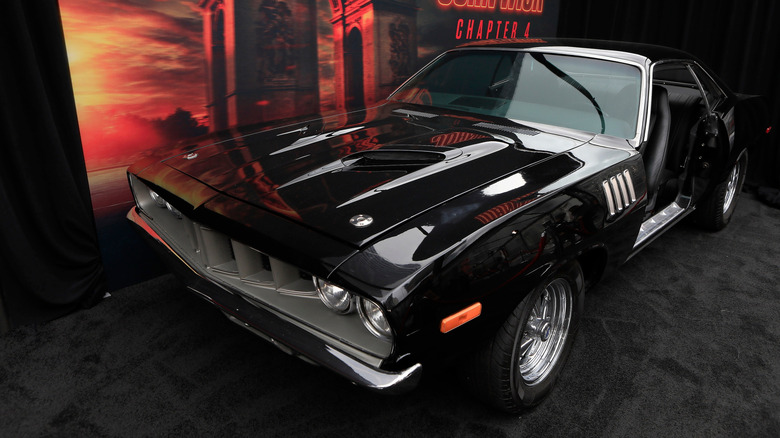
Another detail was the hood scoop. John Wick's alleged Boss 429 (pictured above) had a narrower hood scoop than a real 1969 Boss 429 (pictured below).
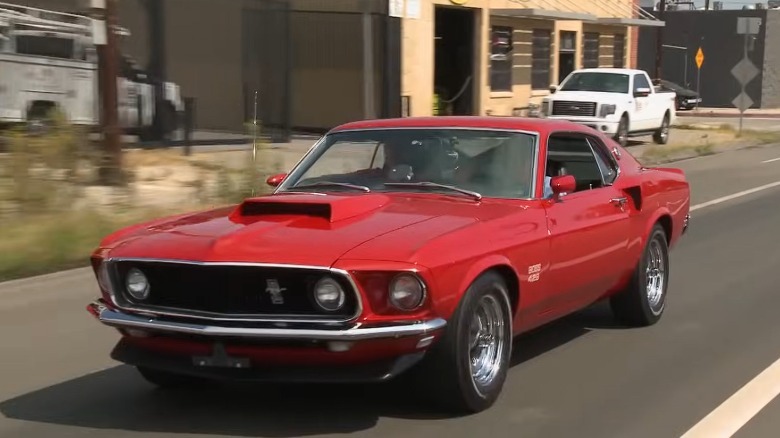
Furthermore, the Boss 429 only ever came mated to a four-speed manual box, while John's was depicted to be an automatic unit. None of this is particularly egregious, but it shows a lack of attention to detail that car people would notice immediately, especially on such a famous model. For those interested, the movie used a 1969 Mustang Mach 1.
The Fast and the Furious got the Eclipse all wrong
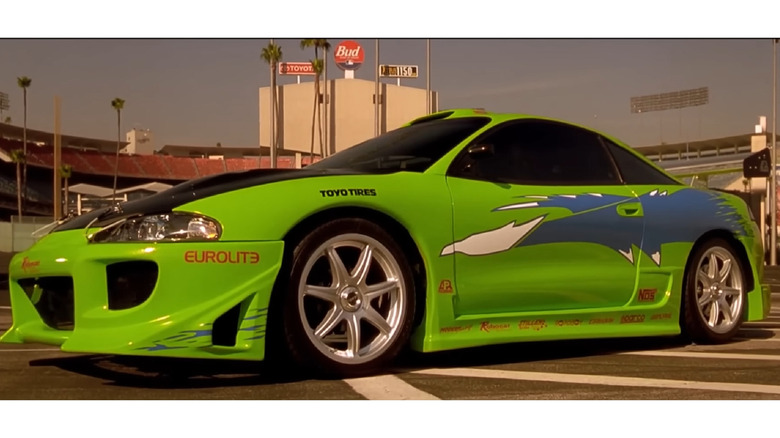
For enthusiasts, Brian O'Connor (Paul Walker's) Mitsubishi Eclipse is definitely one of the flashiest cars in the Fast and Furious franchise. However, the franchise's 2001 pilot movie got several details wrong, both about cars in general and the Eclipse in particular. The biggest one people pointed out was the "danger to manifold" error that showed up when Brian O'Connor was in a drag race driving the car. The movie's technical advisor, Craig Liebermann, published a YouTube video explaining several ideas explored in the film.
At 8:00 into the video, Craig talks about the "danger to manifold" error, so you can watch to learn more. Basically, Brian O'Connor saw the error and continued the race, which seemingly caused the (passenger-side, mind you) floorboard to drop out from under the car. While Craig pushed back on the error, the director pushed back, so the scene went unchanged.
In real life, an engine manifold error couldn't possibly cause a floorboard to eject itself, since the two aren't connected. In another scene, Dom Toretto (Vin Diesel) pokes at Brian for "granny shifting" and not double-clutching. While double-clutching is real, it's pointless on synchronized gearboxes, which the Eclipse had even then, so it would have slowed the car in a race.
The Fast And The Furious got the concept of NOS wrong
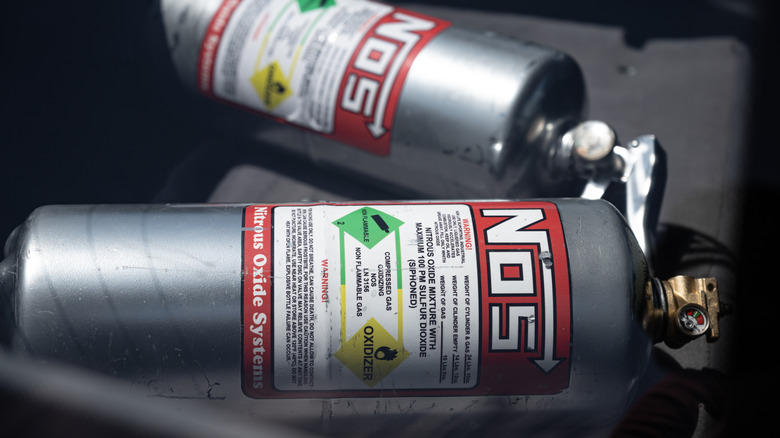
This next one is less about the 2001 movie and more about the franchise as a whole. In many examples, a character is losing a high-speed, high-stakes race, then presses a button or flips a switch in the cabin, supposedly activating a cold-air nitrous oxide (NOS) system attached to the engine. The engine gets a massive boost in power seemingly from nowhere, and the car shoots like a rocket. The problem here is that the franchise hasn't understood how a nitrous system works and what it does to your engine.
While it is a very real thing, a NOS system will not magically push your car forward. It does, however, add more oxygen to the air-fuel mixture for your engine to burn, giving the car some extra oomph. Generally, it's not the push-a-button-and-win-the-race thing the franchise depicts. Another thing to consider before adding nitrous systems to cars is the engine. A NOS system might add horsepower, but if the engine parts (the block, seals, gaskets, and other internals) cannot handle it, you'll end up with a wrecked motor.
Tokyo Drift's Mitsubishi Evo was shown as an RWD car
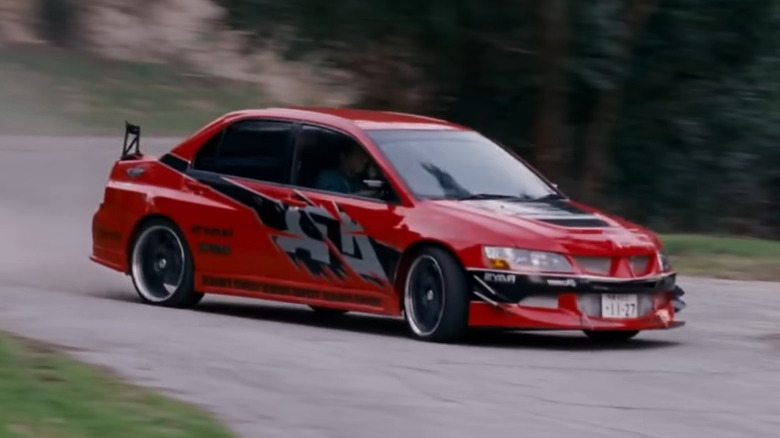
By 2006, the "Fast and Furious" franchise had really taken off, and the third installment, called "The Fast and the Furious: Tokyo Drift," had just hit cinemas. It featured many amazing cars that enthusiasts still revere today, but one of the franchise's most iconic cars was the Mitsubishi Evo. Specifically, it was a Mitsubishi Lancer Evolution IX, commonly called the Evo.
Famously, the movie car came with the front bumper from the previous Evo VIII, or eighth-generation model. That, however, is a minor niggle compared to the actual reason we're featuring the car on this list. The Evo IX is a rally-bred, all-wheel-drive (AWD) grip machine, but Tokyo Drift showcased it as if it were rear-wheel-drive.
The stunts and handling the production team wanted would simply not have worked, so Rhys Millen Racing converted eight Evos to RWD. Even Edmunds said that "moviemaking sometimes demands that a car be robbed of its talents" when talking about the RWD Evo IXs used in the movie — and that's all that needs to be said, really.
Fast & Furious used Nos to trigger an explosion in 2009
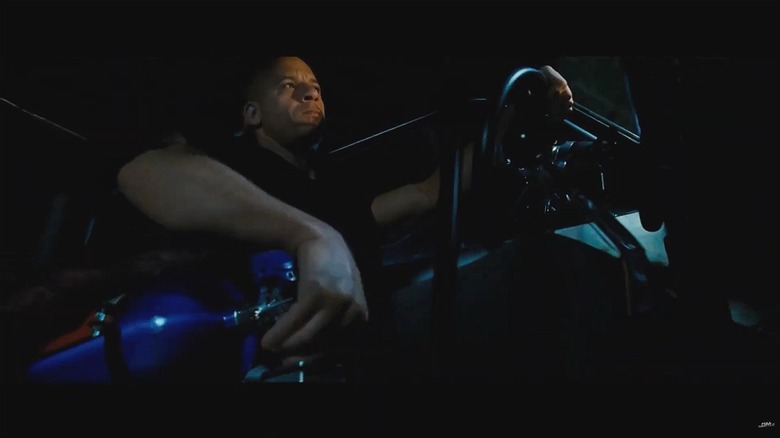
The 2009 movie "Fast & Furious" was the fourth installment in the franchise, following the 2006 title Tokyo Drift. The movie featured a lot more non-car action scenes, but that's a topic for another day. Turns out the production team thought they could use NOS systems for more than making cars go faster in street races, so they decided to use a tank of NOS to blow up a car. In the scene, Dominic Toretto (Vin Diesel) unscrews the cap on his nitrous tank, located near the shifter, just before meeting up with the henchmen of drug lord Arturo Braga, played by John Ortiz.
Before getting out of the car, Dom also pushes a button, maybe the ignition or a cigarette lighter. Shortly after, once the two parties are out of the cars and some distance away, the nitrous oxide gas that presumably filled the cars ignites via the button Dom pressed, blowing up all the cars in the scene. The problem is that nitrous oxide is classified as a non-flammable gas; even NOAA says so. While the gas can worsen an existing fire (since it is an oxidizer), a cloud of nitrous alone doesn't behave like an explosive fuel-air mixture.
Days Of Thunder apparently never looked at a real NASCAR race
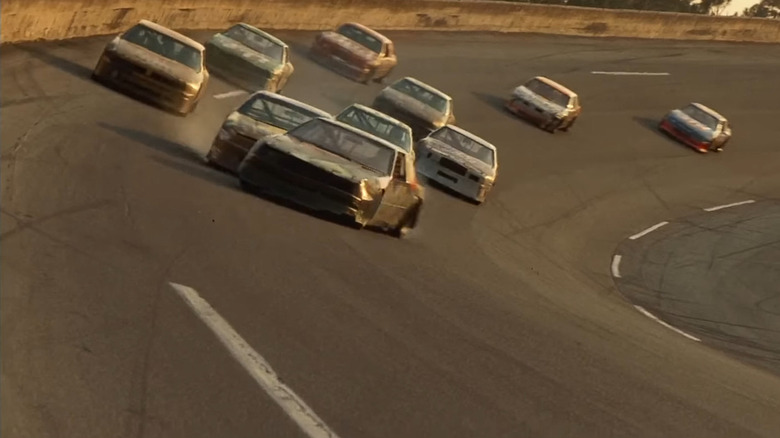
"Days of Thunder" follows NASCAR driver Cole Trickle (played by Tom Cruise), who makes a great career comeback. One (among many) examples is the final race scene where Cole Trickle's car takes quite a beating, and many other drivers trade blows at extremely high speed. Afterward, the race and struck drivers continue as if nothing had happened — which is extremely unrealistic.
Alan Kulwicki, one of the car drivers who helped the movie production, said, "I don't think they did us justice. They portrayed us like we're running bumper cars" — which just goes to show the sentiment the film had developed. That said, "Days of Thunder" did race actual race cars in actual races, including the 1990 Daytona 500, but the film had several flaws, most notably a frustrating lack of realism despite contrary efforts, such as Tom Cruise's lengthy consultations with NASCAR legend Dale Earnhardt.
2 Fast 2 Furious had a car going at highway speeds in reverse
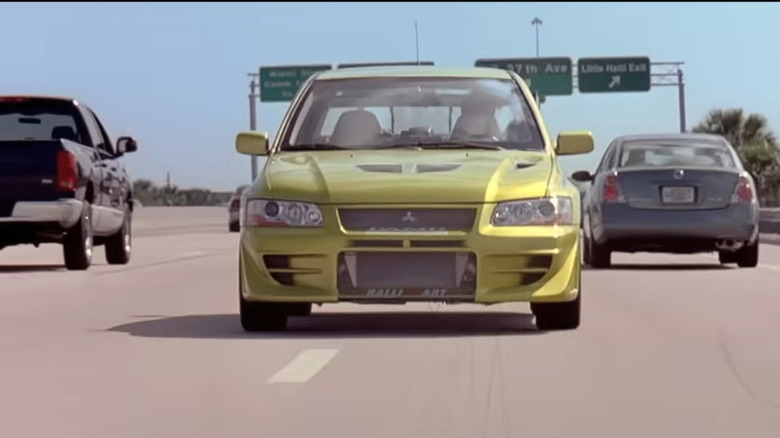
Yet another entrant on our list from the Fast and Furious franchise is from the second installment in the series, "2 Fast 2 Furious", which was released in 2003. In this example, Brian O'Connor (Paul Walker) races his on-screen friend Roman Pearce (Tyrese Gibson) down a motorway. Brian drives a green 2002 Mitsubishi Evo VII, while Roman whips a 2003 Mitsubishi Eclipse Spyder GTS. The scene we're referencing shows both characters and cars cutting through highway traffic in the afternoon when Brian O'Connor suddenly decides a little pizzazz is needed.
He then proceeds to do a J-turn at highway speeds — in traffic — and so far, we're still in the realm of plausibility. However, Brian then throws his 2002 Evo VII into reverse and overtakes cars going at regular highway speed while still in reverse. Normal, stock cars, including the Evo VII in question, usually have gearing ratios that would make this impossible, which is just something the production decided to go with anyway. And for those wondering, yes, Brian O'Connor did win this race, and the Evo VII didn't even appear to lose any speed in the J-turn, which is also unrealistic.
The Italian Job forgot about GVWRs
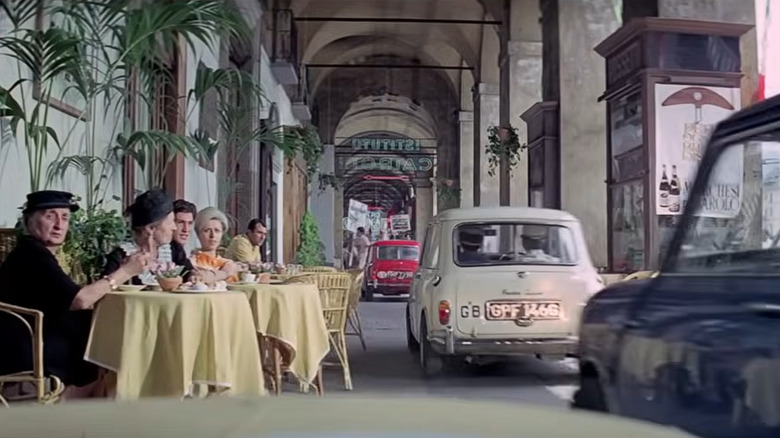
GVWR stands for gross vehicle weight rating, and it is an important number for vehicles because it affects things like maximum payload. And yes, payload is very different from towing capacity, but that's not what we're talking about. The 1969 movie "The Italian Job" follows a motley crew of would-be robbers who eventually make off with several tons of gold bullion bars after a high-stakes safe-cracking operation.
The crew transported the gold in three Mini Cooper vehicles. Aside from the impossible timeframe for loading the gold into the vehicles, we find the premise unrealistic. According to the movie, the gold was worth four million GBP, or about $10 million, which, at the 1969 rate of $41.10 per troy ounce, translated to about 7.5 tons of the shiny stuff. The film used Mk1 Austin Mini Cooper S cars. For reference, the GVWR of a 1965 Austin Mini Cooper was 2,006 pounds, and its curb weight was 1,400 pounds. This means the payload (including the humans inside!) would be around 606 pounds — a far cry from the one-ton-and-change the cars were carrying.
Drive disregarded gearing ratios
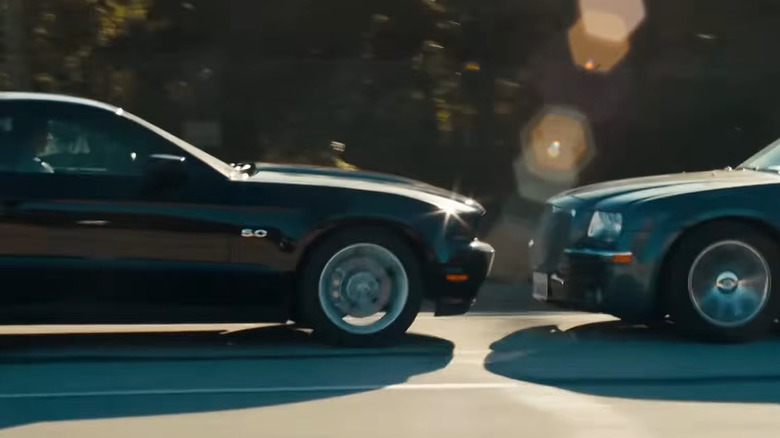
Another case of production crews ignoring something as basic as a car's available gearing is the 2011 flick "Drive". In the offending scene, the driver (Ryan Gosling) uses a Ford Mustang 5.0 as his getaway car, with Blanche (Christina Hendricks) in the back seat. The 5.0 pony car is being hawked down by a Chrysler 300C, which, in the scene, appears to be faster than the 'Stang.
That alone is a bit odd, since even the 5.7 Hemi in the 300C of the time had a zero to 60 mph of 5.8 seconds, while the 5.0 Coyote-powered S197-gen Mustang boasted a standing-to-sixty time of 4.6 seconds. The incredulous bit comes next, though. After a slight PIT maneuver, the Mustang whips around and begins driving in reverse, with driver Ryan Gosling cool as a cucumber. Then you hear the car downshift while still in reverse. We don't know about you, but as of our last check, the Mustang only had one reverse gear. Clearly, the sound engineering team has some explaining to do.
Transporter 3 forgot about laminated glass
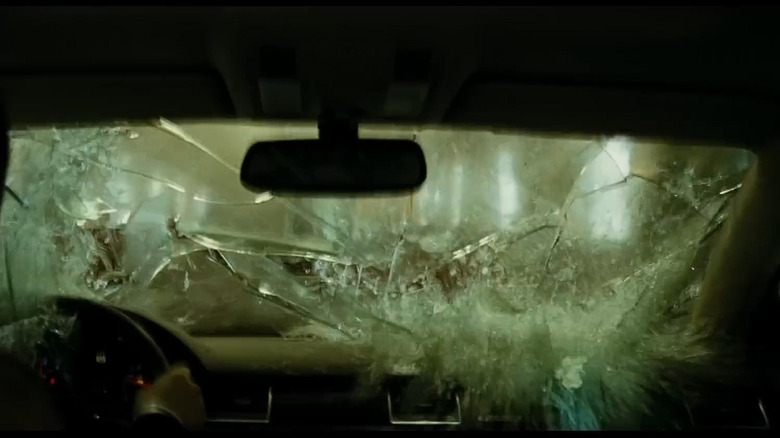
In "Transporter 3," Frank Martin (Jason Statham) tries to deliver a package while staying within a set radius of his car, or it will explode. In one scene, Frank drives his Audi A8 L on the roof of a train and crashes into another carriage to rescue his partner in crime, Valentina (Natalya Rudakova).
The crew got one detail wrong: the car windscreen shattered completely in the process. The issue is that most modern cars use laminated glass designed to keep the windshield from shattering in a crash. The Audi A8 L, an executive luxury limousine, also featured laminated glass, even in early models, so aside from everything else in the scene, this would also be unrealistic. But hey, at least the action sequences were entertaining. Also, while the A8L is already a long-wheelbase car, Audi also built an A8L extended, easily one of Audi's strangest cars ever.
The Matrix Reloaded uses cars to block gunfire
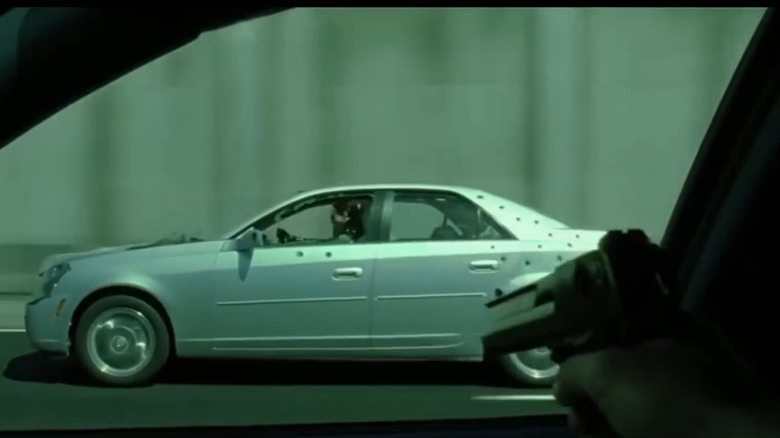
We don't know if it's fair to talk about realism in a movie about simulated reality and digital manipulation of the physical world. However, in the 2003 film, "The Matrix Reloaded," there is one glaring error about vehicles that we must address. In the scene in question, a Cadillac CTS and a Cadillac Escalade, along with a plethora of collateral-damage commuter cars, are part of a high-speed chase down an interstate.
Trinity, played by Carrie-Anne Moss, and several other actors trade gunshots, and everyone seems to use car panels and ducking to avoid them. This gives the impression that car doors and other panels can effectively stop gunfire, which they can't. And this isn't just one film; it is a recurring trope you'll see in Hollywood, where car doors and assorted panels shield protagonists and antagonists alike from small-arms fire. The trope was so common, in fact, that MythBusters dedicated an entire episode to it.
The Mechanic overestimates what gasoline can do
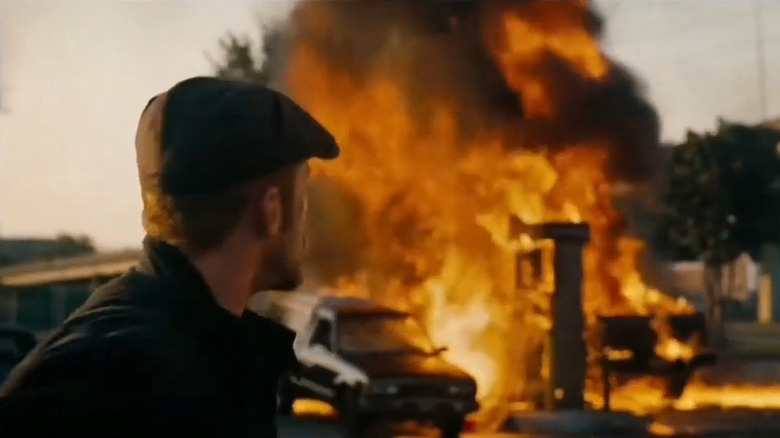
In the 2011 movie "The Mechanic," Steve (Ben Foster) pours gas around and under a car, then ignites it, causing a fireball and setting the car ablaze within seconds. In reality, while you can catch flames, fuel spilled beneath a vehicle isn't a reliable way to detonate the entire vehicle — and especially not as quickly as the movies show.
A Highways England guide explains that fuel spills can "degrade the road surface", but it makes no mention of fire hazards. For one, gasoline needs a specific fuel-air concentration to ignite, between 1.4% and 7.6%, according to OSHA. Even with ruptured fuel tanks, detonation — or rather, deflagration, the correct term — is not guaranteed.
Groundhog Day
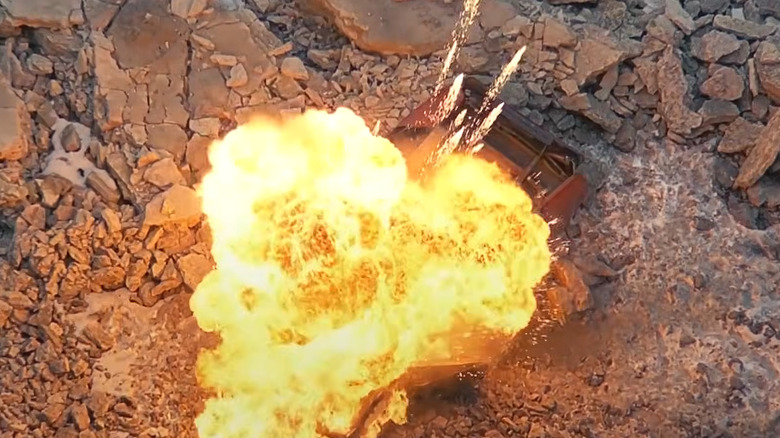
Finally, we have yet another overused Hollywood trope — that driving a car off a cliff, or otherwise dropping it from a height, will cause an explosion. In the 1993 movie "Groundhog Day", this is exactly what happened when Phil Connor, played by Bill Murray, stole and drove a red Chevrolet C-10 pickup truck off a quarry cliff. The truck flipped, crashed, and promptly exploded, killing the occupants inside.
The MythBusters put this claim to the test too, and posted the results to YouTube. Unsurprisingly, they found that launching a vehicle off a cliff, while severely damaging to the car, isn't a reliable way to get the big boom Hollywood seems to love so much. Of course, getting your car road legal again after such a stunt would be borderline impossible — so you'd be left sans explosion and sans a car if you tried.