

Video Games Nearly Died In '83 - Here's What Nearly Killed And Saved Them
These days, most gamers take the video game industry for granted, as it's been one of the strongest entertainment industries for decades. In 2025, the gaming industry was valued at $322.6 billion, and estimates for 2033 indicate that number will rise to around $498 billion. To put that in perspective, the film and video market reached $361.36 billion in 2025, so gaming is hot on its heels. While we might take the video game industry for granted today, it wasn't always like that.
It took decades for the industry to go from simple devices that played games like "Pong" to the latest and greatest PlayStation 5 Pro. What started out small grew over time, encompassing arcade games, computer games, handheld games, and console games. What some newer-generation gamers might not know is that it all came crashing down in North America back in 1983, and if things hadn't worked out as they did, video games might not be the juggernaut they collectively are today.
The video game crash of 1983 saw a massive drop in market value that resulted in multiple companies going under. It looked like the whole industry was on the verge of ending just as it was getting going, and a lot of people felt that way. Fortunately, a company out of Japan righted the ship with a brand-new product in 1985, turning everything around and building on the success of the past to grow the video game industry into the one we know today.
How video games were made in the early days
If you want to produce a AAA game for today's market, you're going to need a lot of people and resources to get the job done. Often, hundreds, if not thousands, of people work for several years on games that cost hundreds of millions of dollars, but in the early days, games were typically coded by small teams or just one person. Initially, many were coded on university mainframes, while "Tennis for Two," often cited as the first video game ever made, was created using an analog computer and an oscilloscope at Brookhaven National Laboratory in 1958.
"Space Invaders," which was one of the most popular games of the late 1970s, was coded by Tomohiro Nishikado while he was working for Taito. He not only coded the game himself, but he also created the bespoke hardware to run it. It took him a year and a half to produce the game and its hardware. For home consoles like the Atari Video Computer System, later renamed to the Atari 2600, development time was typically around six to nine months, whether one or more people worked on it.
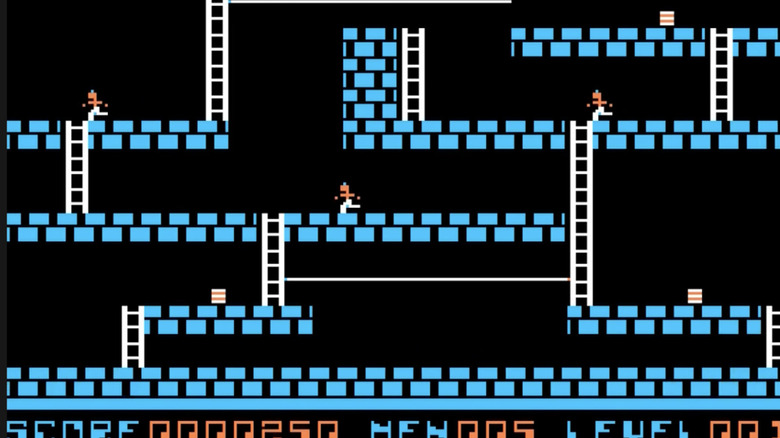
Some games were designed on early personal computers by a handful of people handling music, art, and coding. A classic example of this is the 1983 classic "Lode Runner" (pictured), created by Douglas E. Smith on the Apple II, which is one of the best-selling computers of all time. As the industry expanded from the '70s and into the '80s, more programmers jumped on the bandwagon, creating a plethora of games, though most were unsuccessful and only a small percentage managed to gain a foothold in the industry.
The lead-up to the crash
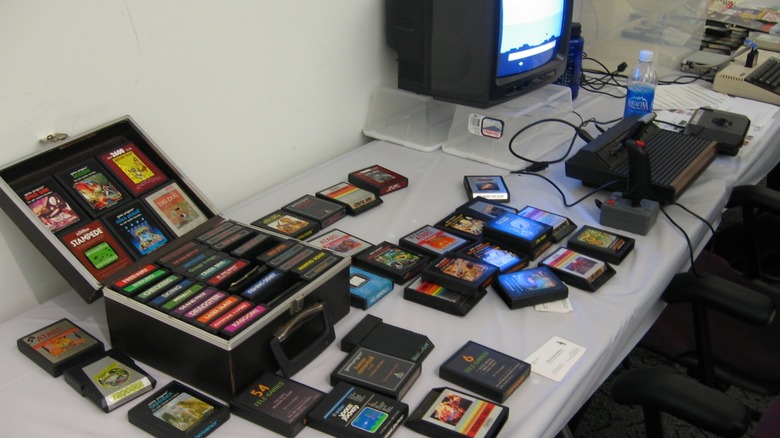
In the '70s, the video game industry grew significantly, and with the release of the Atari VCS in 1977, gameplay at home became more commonplace. This not only cemented Atari as one of the biggest names in the industry, but it helped establish what a home video game console could be. In its heyday, the system featured many excellent titles, including "Pitfall!," "Combat," "River Raid," "Yars' Revenge," and a decent port of "Space Invaders." Atari released the system with an open architecture, which was a mistake that hardware developers would remember.
The problem with an open architecture is that Atari ultimately didn't have a final say in which games could be sold for its system. Because of this, a myriad of companies hoping to capitalize on the growing trend that was home video game entertainment unloaded a massive pile of crummy games onto the system. These were shameless cash grabs, using detailed box artwork and low prices to sell games that looked terrible, featured buggy programming, and were generally not fun to play.
Essentially, the Atari 2600 became the victim of third-party shovelware, and the software manufacturers didn't suffer as much as Atari did. Over 70 software companies vied for a share of the market, which was estimated in 1983 to be worth around $2.4 billion, or around $8.1 billion in 2026. That amount of money was too much to pass up, but quantity over quality became a burdensome problem for hardware developers like Atari, and it ultimately led to the crash that nearly ended the company.
The video game crash of 1983
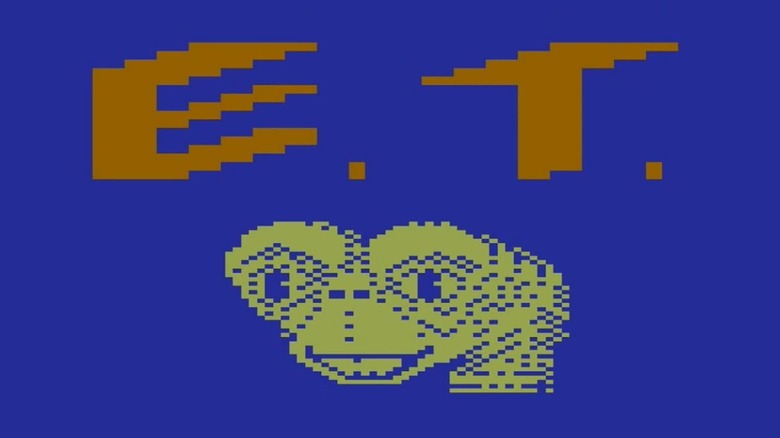
If there was ever a game that bore the brunt of the fallout from the video game crash of 1983, it was "E.T.: The Extra-Terrestrial," released on the Atari 2600 in December 1982. The game is notorious for how poorly it played, but when you look into it, it wasn't the fault of programmer Howard Scott Warshaw. He was given only about six weeks to create the game from scratch and did what he could in the unbelievably short period of time. Unsurprisingly, the game was terrible, but Atari produced an estimated 4 to 5 million copies.
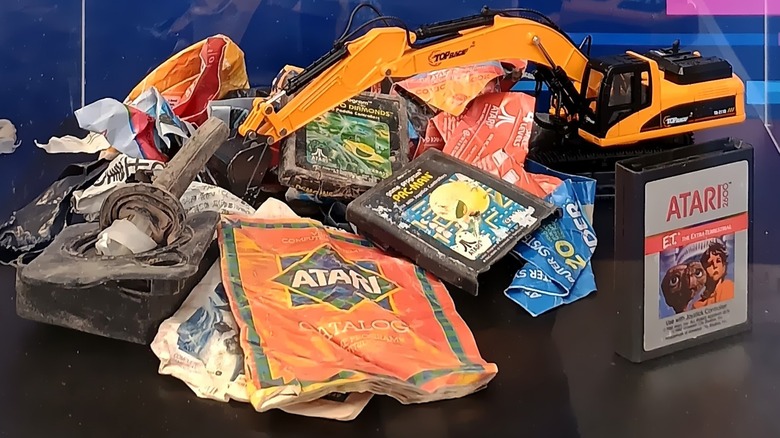
The game wasn't the sole culprit but rather the straw that broke the camel's back, and the camel was the video game industry. Atari was left with so much unsold inventory that it ended up burying copies of "E.T." and other unsold cartridges in a landfill just to get rid of them. The game did highlight a growing problem: the immense pile of terrible titles being produced en masse, leaving consumers frustrated and angry about being fooled into purchasing games that weren't any good.
The resulting outcry caused widespread dissatisfaction among video game buyers around the country, and the industry utterly crashed, going from a value of $3.2 billion to around $100 million by 1985 ($311 million in 2026). Poor-quality games and market oversaturation took a growing industry and utterly ruined it. The rise of personal computers played its part as well, and home video game consoles became the butt of jokes. Interestingly, decades after the burial, the Atari landfill was unearthed, and a recovered "E.T." cartridge sold for $1,537 at auction, showing that even a crummy game can sell if it comes with a great story.
Video games are a passing fad

In December 1977, Michael Moone of Milton Bradley said of the video game industry, "Americans love gadgets, and this is just another gadget." He compared it to stereo components, CB radios, and 35mm photography, implying that video games were like any other passing fad. The Atari VCS proved him incorrect, but after the video game crash of 1983, many came around to Moone's point of view. The crash didn't entirely destroy the industry, as arcade and computer games were less affected.
It was console gaming that truly suffered, and while Atari took the brunt, other console manufacturers were driven out of business. Reducing a market value from $3.2 billion to $100 million is a reduction of about 97%, so the crash hit incredibly hard. Atari, which helped launch the industry, suffered greatly from the crash. The company went through mass layoffs due to massive loses; it buried its shame in the New Mexico desert, and future attempts to turn things around with the Atari 7800 ProSystem and Atari Jaguar all fell short.
As the so-called "passing fad" faded into relative obscurity, parents who bought crummy games for their kids turned their attention elsewhere, and it truly looked like the industry wouldn't recover. For two years, from 1983 well into 1985, video games disappeared from store shelves, console sales were slashed, and an industry that was just getting going in the West seemed at an end. Fortunately, one company managed to turn it around.
Nintendo turned things around
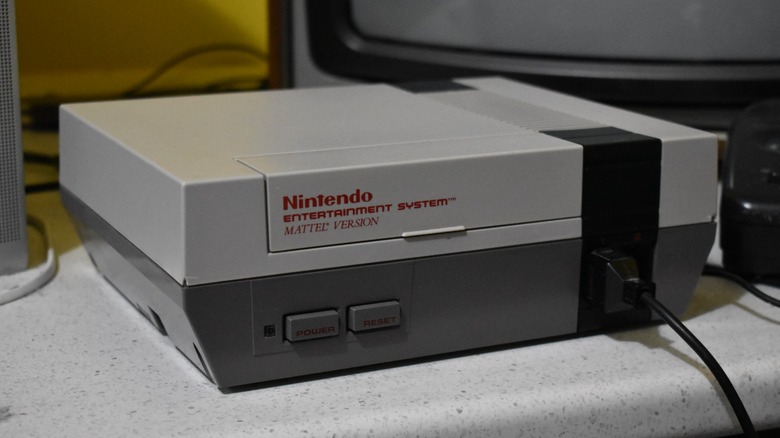
With the market utterly devastated, it didn't look like any companies would be able to revive the industry. Fortunately, Nintendo, which had made significant gains in arcades with titles like "Donkey Kong," "Popeye," and "Mario Bros.," had the answer. The company developed the Nintendo Entertainment System for the North American market, releasing it on October 18, 1985, in select cities before a widespread release came on September 27, 1986. It was a massive success, giving Nintendo a major foothold in the U.S. console and gaming market.
From the jump, Nintendo's then-president, Hiroshi Yamauchi, corrected Atari's mistake by restricting what could be programmed and sold for the system. In a 1986 article in The Vindicator, Yamauchi said, "Atari collapsed because they gave too much freedom to third-party developers and the market was swamped with rubbish games." The solution was the 10NES, a lockout chip, which made releasing games for the NES a near impossibility without Nintendo's support.
Because of this decision, Nintendo only produced or licensed games it approved, and while not all of them were hits, many were. They sold well, establishing long-enduring franchises like "The Legend of Zelda" that continue today on the Nintendo Switch 2, and the NES opened the door for wider competition from companies like NEC, Sega, and others. By the 1990s, the console wars kept the momentum going, building up the industry as it continued to grow, utilizing new technologies to produce incredible, story-rich, and competitive games. The result is the industry we have today, which might look very different had Nintendo not released the NES in 1985.