

7 Fighter Jets Capable Of Speeds Over Mach 2
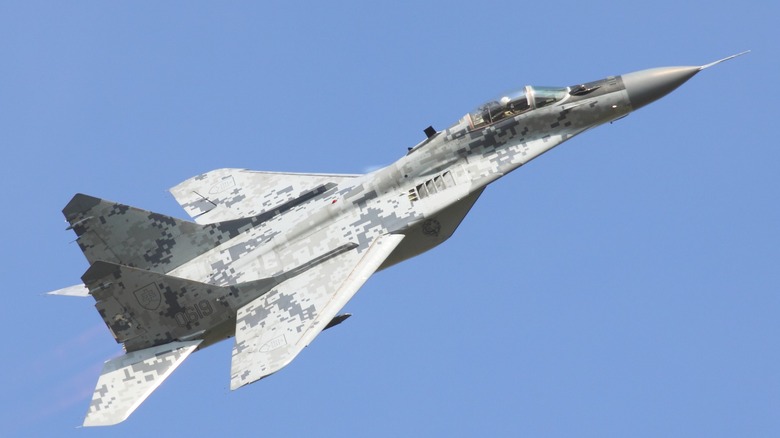
Ever since the first fighter jet took to the unfriendly skies at the tail end of World War II, they've been known for one thing over any other factor: speed. For many fighter jets, the faster they fly, the more survivable they are in combat, and there have been some truly fast jets introduced and operated by the world's militaries over the years. It took time for technology to progress until Chuck Yeager broke the sound barrier in 1947, and after that, fighter jet speed was measured in Mach, not miles per hour.
Fighter jet speed became a common factor in aircraft development throughout the Cold War, when the United States and the Soviet Union continuously one-upped the other. When the U.S. introduced a fighter jet like the F-15 Eagle, the Soviets designed a new plane to counter it, resulting in the development of the Sukhoi Su-27. The game of technological military leapfrog endured until the USSR broke up in 1991, though the U.S., the Russian Federation, and the People's Republic of China continue the trend.
A speed benchmark that sets many planes apart is Mach 2 (1,535 mph), and there are far fewer currently operational fighter jets that exceed that speed than you might think. Every fighter below has surpassed Mach 2, though it should be noted that airspeed at altitude is different from at sea level, due to a decrease in drag and other factors. Because of this, while each of these seven fighter jets can pass Mach 2, that's not their typical cruising speed and is instead a top speed the aircraft can and has reached.
Dassault Mirage 2000
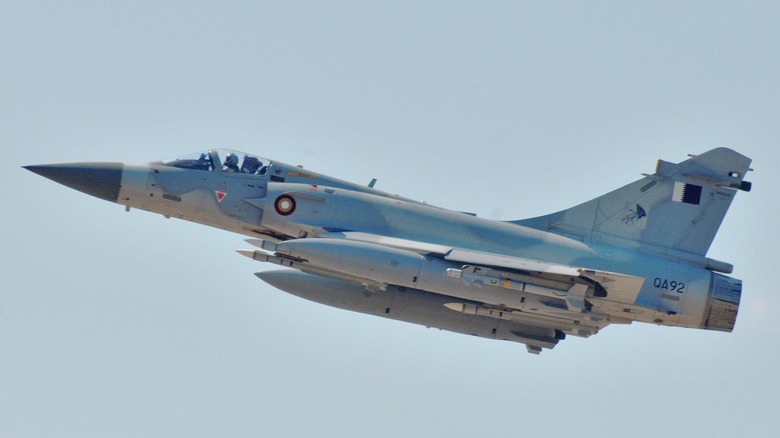
The French Air Force began flying the Dassault Mirage 2000 in 1984, and the multirole aircraft remains in operation as of this writing. In total, 600 were produced, of which half remained with the French, and the remaining aircraft were exported to Taiwan, Brazil, Greece, Ukraine, the UAE, Qatar, Peru, India, and Egypt. The multirole fighter is armed with two 30mm guns, and it has nine hardpoints for additional weapons of various types. It's powered by a single Snecma M53 afterburning turbofan engine that enables the Mirage 2000's incredible speed.
There are several variants of the aircraft that use various engine designs, though the M53-P2 has the greatest thrust rating at 21,400 lbs. That's the most recent variant, though Snecma continues to advance its engines for the Mirage 2000. The aircraft's engine provides the power necessary to achieve a top speed of Mach 2.2+ (1,688 mph). It has an operational ceiling of 60,000 feet, can loiter for 2 hours and 40 minutes, and has a combat radius of 955 miles.
The Mirage 2000 has been utilized in numerous military operations since its introduction, including the Kargil War in India and the Russo-Ukrainian War. The Mirage 2000 is a multirole aircraft, and while not a traditional fighter, it has achieved a single air-to-air kill while not losing any aircraft in similar combat, giving it a kill ratio of 1:0. Its only air-to-air victory came when a Greek Mirage 2000 shot down a Turkish F-16 during the Aegean confrontation in 1996.
Lockheed Martin F-22 Raptor
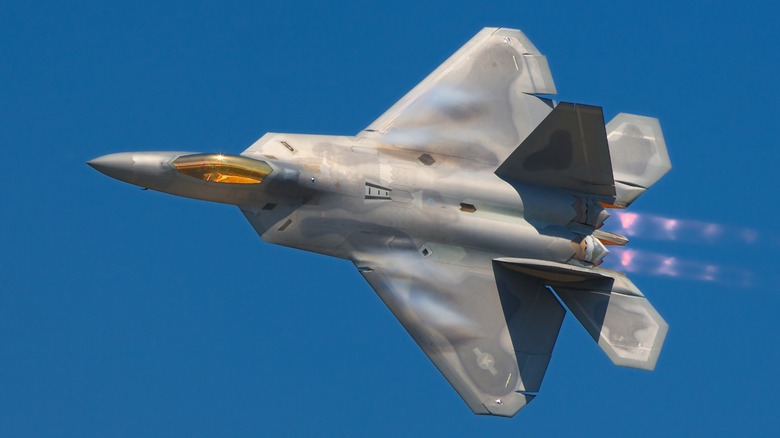
The Lockheed Martin F-22 Raptor is the world's first 5th-generation aircraft. It was first introduced in 2005 and has flown exclusively for the U.S. Air Force ever since. The program to develop the aircraft went into incredible cost overruns, such that a single F-22 costs U.S. taxpayers $369.5 million. Because of this, there are fewer than 200 in the USAF inventory, as further production became untenable due to costs. Despite this, the F-22 remains one of the USAF's greatest and most advanced aircraft, and it's expected to remain in operation until sometime in the 2040s.
The F-22 is a twin-engine, all-weather stealth fighter that's been used in several combat operations since its introduction. It's powered by two Pratt & Whitney F119-PW-100 turbofan engines that were developed specifically for the F-22. The engines offer excellent maneuverability via thrust-vectoring, and they're powerful, producing a combined 70,000 lbs. of thrust. This gives the F-22 the power it needs to reach a top speed of Mach 2.25 (1,726 mph).
One of the F-22's most remarkable features is its supercruise ability, as it doesn't need to engage afterburners to reach and sustain supersonic flight. This is accomplished via a number of factors, including engine power and the aircraft's weight, which is 43,340 lbs. While that may sound like a lot, it's considerably lighter than something like the F-35 Lightning II, which weighs in at 70,000 lbs. The reduced weight and powerful engines enable transonic flight without afterburners, which saves fuel and makes the F-22 particularly powerful.
Mikoyan MiG-29 Fulcrum
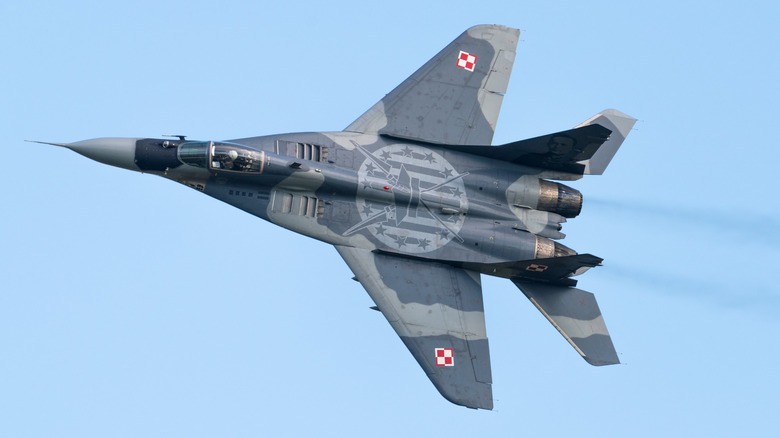
American-made aircraft aren't the only ones that exceed Mach 2, as there are more foreign-made fighters with that capability. The Mikoyan MiG-29 Fulcrum is one such example, and it was introduced by the Soviet Union in 1983. Like many aircraft developed during the Cold War, the MiG-29 was developed to counter the American-made F-15 and F-16, so it boasted similar capabilities. The USSR and Russian Federation don't name their fighter jets like the West, so "Fulcrum" is the NATO designation given to the fighter soon after it arrived on the scene during development in 1977.
The MiG-29 is outfitted with a 30mm cannon, and it can carry a variety of air-to-air missiles, bombs, and rockets, depending on which loadout is needed for a particular mission. It is powered by two Isotov RD-33 turbofan engines capable of producing a combined maximum of 36,600 lbs. of thrust with afterburners engaged.
This gives the MiG-29 a top speed of Mach 2.3 (1,765 mph). That makes it faster than the F-16 Fighting Falcon, but slower than the F-15 Eagle. Despite its introduction over 40 years ago, the MiG-29 continues to fly for several countries around the world. It remains a reliable frontline fighter for countries like India, Russia, and Ukraine. Because it's been in service for so long, modern MiG-29s feature upgrades over the original aircraft first delivered in '83, but even the OG Fulcrum remains one of the fastest fighter jets on record, which is one of the reasons for its longevity.
Sukhoi Su-27 Flanker
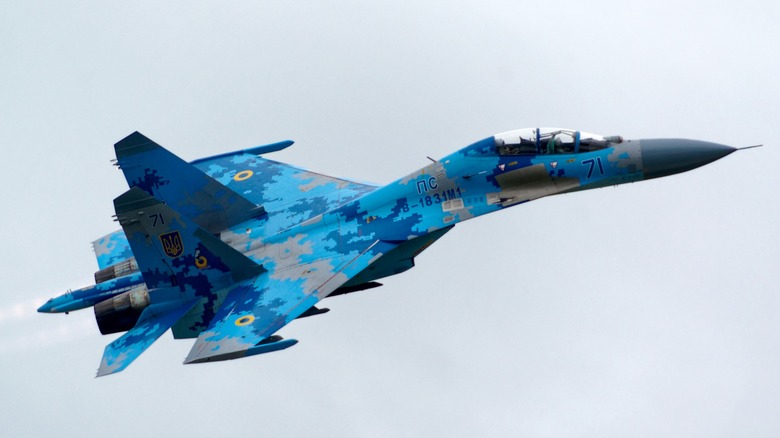
The Sukhoi Su-27 Flanker is another Soviet-designed fighter jet that continues to operate for several militaries around the world. It first appeared in 1985 as a potential counter to the F-15 and the Grumman F-14 Tomcat, and while only around 680 were produced, it remains relevant to this day, thanks to some modernization upgrades. The long-range air superiority fighter features up to 10 hardpoints for a variety of missiles, rockets, and bombs, and the aircraft is flown by the Russian Knights, which is an aerobatic demonstrator team similar to the U.S. Air Force Thunderbirds.
The Su-27 is powered by two Saturn/Lyulka AL-31F turbofan engines capable of producing a combined 55,123 lbs. of thrust. This affords the aircraft incredible speed, as it can reach a top speed of Mach 2.35 (1,803 mph). The aircraft is also well-known for its agility and super maneuverability, as it's one of a handful capable of pulling off the Cobra Maneuver. In fact, the maneuver was named after Soviet test pilot Viktor Georgiyevich Pugachev, who first achieved it while flying an Su-27 in 1989.
The Su-27 remains in operation for various militaries around the world, including China, and has been used in numerous conflicts, including those involving Vietnam and China, Russia and Ukraine, and Ethiopia and Eritrea. It can carry up to eight air-to-air missiles of different types and is an exceptional fighter in the right hands. While it has air superiority fighter capabilities, the Su-27 is most often used as a ground-attack aircraft and fighter-bomber, making it versatile and deadly.
Boeing F-15EX Eagle II
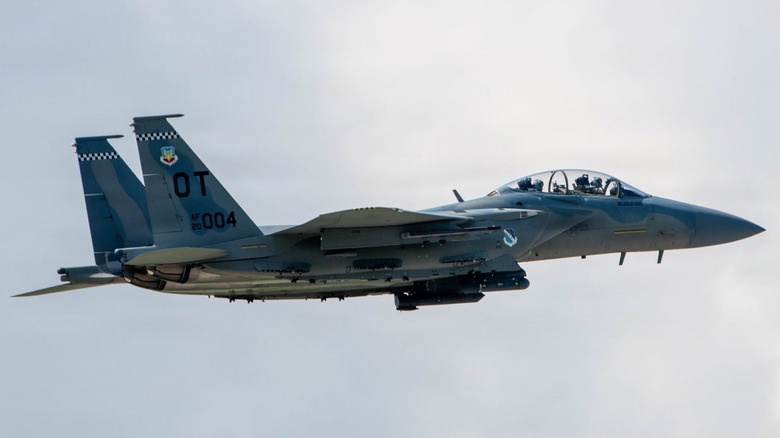
The McDonnell Douglas F-15 Eagle first entered active service in 1976, and over the subsequent decades, the aircraft has gone through numerous modernization efforts. The current version, the Boeing F-15EX Eagle II, is one of the most impressive 4.5th-generation aircraft in operation, and it boasts many excellent features in speed, maneuverability, and versatility. When the U.S. first introduced the F-15, the Soviets took notice, as it featured several advancements that set it apart from everything else flying the unfriendly skies at the time.
Initially, the F-15 Eagle was powered by two Pratt & Whitney F100-PW-100, 220 or 229 turbofan engines capable of producing 46,900 lbs. of thrust. This gave the aircraft a top speed of Mach 2.4 (1,875 mph) with afterburners at altitude, making it incredibly fast. That already made the F-15 a Mach 2+-capable fighter jet, but the newest model is even faster. The F-15EX Eagle II is not only the USAF's missile truck, but also the service's fastest multirole fighter.
It's outfitted with two General Electric F110-GE-129 engines capable of producing a combined 59,000 lbs. of thrust. The top speed afforded by those engines has been noted as Mach 2.497 (1,916 mph). At that speed, the F-15EX Eagle II is the fastest modern jet in operation, exceeding the F-35 Lightning II, the F-22, and everything else previously mentioned. According to some pilots, the aircraft can exceed Mach 2.5, but it's unsafe to fly it at such speed, as one noted, "Things started to melt around Mach 2 in the aircraft I flew," referring to an F-15EX Eagle II.
Mikoyan MiG-25 Foxbat
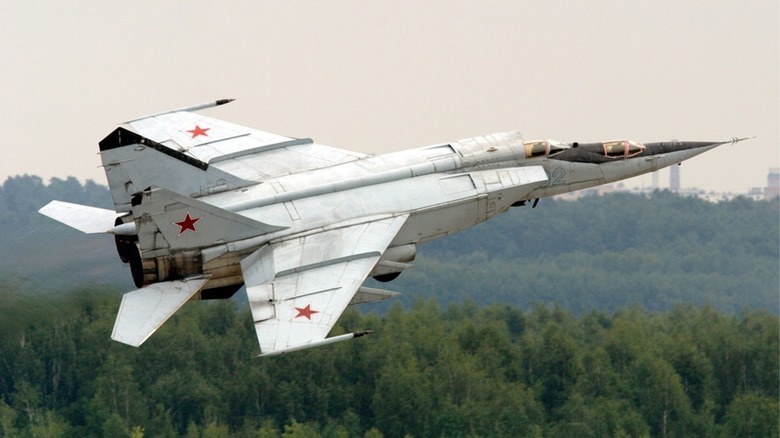
The Soviet Union developed the Mikoyan MiG-25 Foxbat in the 1960s as an interceptor, and speed was clearly on the minds of the engineers who worked on it. Initially, while it was being developed, the MiG-25 managed to reach a top speed of Mach 3.2 (2,455 mph), but it wasn't sustainable. As a result, while the aircraft was pushed through further development, it received a speed cap of Mach 2.8 (2,148 mph), but at that speed, it also caused the engines to overheat while the affixed air-to-air missiles would shake violently, which isn't something you want in a fighter jet.
Regardless, the final production MiG-25 could reach a top speed of Mach 2.83 (2,171 mph), so it remained an incredibly fast aircraft. It was the legendary speed that made the MiG-25 so terrifying to the West, as it demonstrated the exceptional Soviet engineering capabilities at a time when contemporary Western fighters like the McDonnell Douglas F-4 Phantom II were limited to around Mach 2.23 (1,711 mph).
The MiG-25 achieved its impressive speed thanks to its two Tumansky R-15B-300 turbojet engines that provided a combined 45,000 lbs. of thrust with afterburners engaged. The MiG-25 was primarily used as an interceptor, so it typically carried two AA-6 Acrid and two R-40T air-to-air missiles. It also holds an impressive altitude record, earning the distinction of achieving the absolute altitude for a jet aircraft taking off under its own power, reaching 123,542 feet, which is exceptionally high and more than twice the ceiling of most fighter jets.
Mikoyan MiG-31 Foxhound
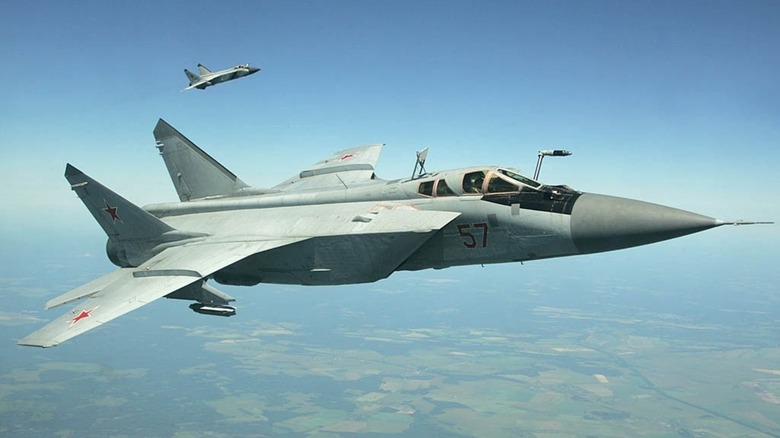
Soviet engineers demonstrated their impressive capabilities by pushing speed envelopes as much as possible, and the absolute pinnacle of these achievements came with the introduction of the Mikoyan MiG-31 Foxhound in 1981. It is the fastest fighter jet ever put into service, though it most often functioned in an interceptor role. Like other aircraft that were introduced long ago, it remains in service for the Russian Aerospace Forces and has received several upgrades and modernization efforts over the years, but its speed is what it's best known for.
The MiG-31 was fitted with two Soloviev D-30F6 afterburning turbofan engines capable of producing a combined 68,000 lbs. of thrust. This gave the aircraft a top speed of Mach 3 (2,301 mph). Technically, the MiG-31 could hit Mach 3.2 (2,455 mph), but doing so would cause the engines to break, so it was limited to a slightly slower speed. In most situations, pilots wouldn't push the MiG-31 beyond Mach 2.83 (1,711 mph), but that didn't mean that the aircraft couldn't reach faster speeds, and it's the fastest production fighter ever produced.
Russia has used its fleet of MiG-31s during the Russo-Ukrainian War, where they reportedly downed Ukrainian aircraft using long-range air-to-air missiles. Because of their speed and ceiling, which is 67,585 feet, Ukraine doesn't have an aircraft to match the MiG-31, making it particularly deadly in any engagement. Technically, the Lockheed YF-12, which was an interceptor prototype of the SR-71 Blackbird, was faster, but it never went into production, making the MiG-31 the fighter to beat in terms of speed.