

5 Of The Most Powerful Rockets Ever Launched
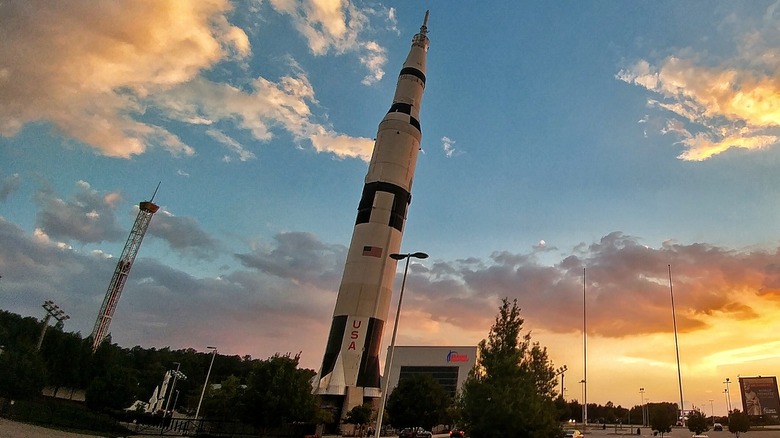
Rockets have been around since the 11th century, but modern rockets weren't properly invented, tested, and flown until the 20th century. The first modern rocket launched successfully on March 16, 1926, and the technology continued to advance throughout the century into World War II. That's when the first modern rockets were used in warfare with the German V-2, the world's first large-scale rocket fueled by a liquid propellant. From that, German scientists like Wernher von Braun wound up in the United States working for NASA, where they developed the space program.
Their efforts bore fruit in various stages, beginning with Project Mercury, the nation's first manned spaceflight program. From there, rockets grew significantly larger, which was necessary to carry larger payloads into orbit. So-called "heavy-lift launch vehicles" arose with the capability to put large payloads into Low Earth Orbit (LEO), which was a significant achievement. Of course, the way rocket engines work requires a great deal of fuel and incredibly large vehicles to put so much mass into orbit, and many of the biggest are the most powerful rockets ever launched.
Sending astronauts to the Moon required one of the biggest rockets of all time, but even that massive machine has since been surpassed by 21st-century space launch vehicle rockets. Rocket production and operation are no longer limited to the world's governments either, as several private companies have developed massive rockets capable of lifting large payloads into orbit. These five rockets are the most powerful ever launched as of writing, and they all represent impressive scientific achievements.
Falcon Heavy
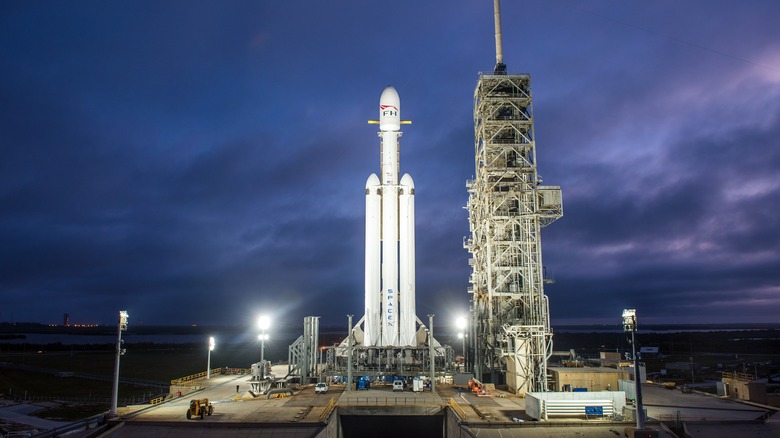
SpaceX is the most successful private space launch company in the United States, and it's been contracted by the government for various activities, including sending cargo to the International Space Station. To send large payloads into orbit, SpaceX developed several rockets, including the Falcon Heavy. The vehicle stands 229.6 feet tall with a width of 39.9 feet. The Falcon Heavy has a total mass of 3.1 million lbs., and it can carry up to 140,660 lbs. of payload into LEO.
It can send 58,860 lbs. into Geostationary Transfer Orbit (GTO), and while it's yet to test the spec, the Falcon Heavy is designed to carry a 37,040 lbs. payload to Mars. To achieve this, the Falcon Heavy uses SpaceX's Merlin engine, which uses a rocket-grade kerosene called RP-1 and liquid oxygen in a gas-generator power cycle. Each Merlin engine produces 190,000 lbs. of thrust at sea level. Once the rocket reaches the vacuum of space, its power increases to 220,550 lbs. of thrust.
Throughout its two stages, the Falcon Heavy uses a total of 28 Merlin engines. It uses 27 engines in its first stage to launch the rocket, which is used to measure its power at launch. The 27 Merlin Engines are arranged with nine on each side booster and nine on the main vehicle. Combined, these produce 5.13 million lbs. of thrust. While all of its engines produce an amazing amount of power, the system monitors them and can shut individual engines down if required, so they're there for redundancy.
Energia
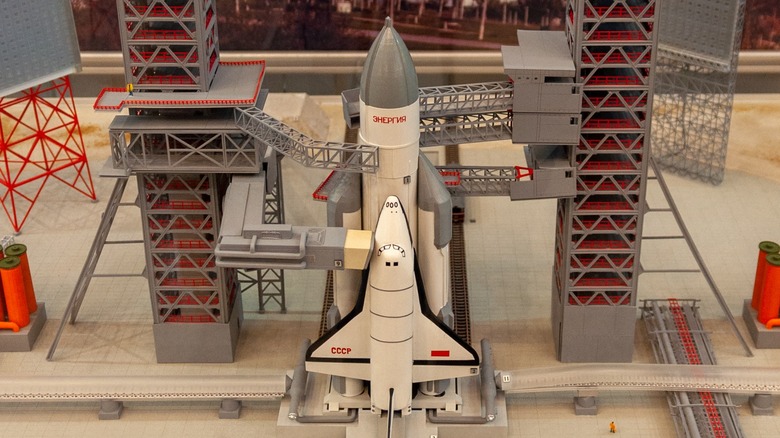
During the Cold War, the USSR and the United States continuously tried to outperform each other's space programs. While the Soviets launched the first artificial satellite into orbit and achieved the first manned spaceflight, the U.S. made it to the Moon and developed the Space Shuttle, a reusable space plane. The Soviets paid close attention and developed their own version called the Energiya-Buran, which looked exactly like the U.S.' shuttles, thanks to some espionage that brought the shuttle's design plans to the USSR.
While the U.S. had its own launch vehicle for its reusable spacecraft, the USSR went in another direction and developed the Energia super-heavy launch vehicle, which was the Soviet space program's biggest and most powerful rocket that successfully reached orbit. Energia used four boosters, each with four engines, while the main vehicle had four larger engines. The strap-on boosters used RD-170 engines, while the primary vehicle used RD-0120 engines, all of which were exceptionally powerful, giving the Energia the capability to lift 100 tons into LEO.
Combined, the Energia rocket produced 7.89 million lbs. of thrust, which was enough to carry the spacecraft into LEO. The Energia rocket only flew twice, with its first flight occurring in 1987 and the second the following year. When the USSR dissolved in 1991, the Energia and its various parts lost their supply chain and production capacity, ending the Energia rocket's time having carried the Energiya-Buran only once. Most of the remaining components were destroyed in 2002 when a roof collapsed during an earthquake at Site 112 in Baikonur, Kazakhstan, where it was stored.
Saturn V
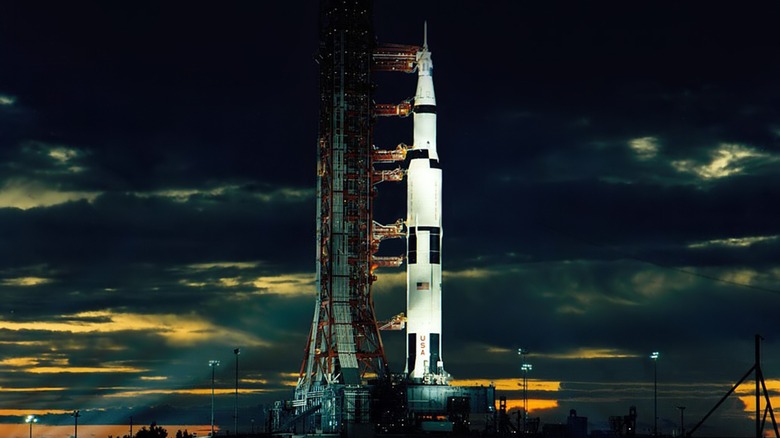
When it came time to send people to the Moon, the rocket designed for the Apollo Program was the Saturn V. The three-stage rocket was a record-setting vehicle, as it was the first rocket to take people beyond LEO. It also boasts the largest payload capacity of an incredible 310,000 lbs., which is why it takes the lead over Energia despite its lower thrust at launch, which was 7.5 million lbs. It achieved this via its five incredibly powerful F-1 engines, each of which produced 1.5 million lbs. of thrust at launch.
The Saturn V used RP-1 for fuel, which was pumped at a rate of 42,500 gallons per minute to the engines. The rocket stood 363 feet tall, which is about as tall as a 36-story building. When it was fueled for flight, the rocket weighed 6.5 million lbs., which is why it required a great deal of thrust to get it off the ground. Despite the Saturn V's incredible mass, it could take 140 metric tons into LEO and around 48 metric tons to the Moon, which outperforms all other heavy-lift vehicles that preceded it, not to mention for several decades after.
Between 1967 and 1973, Saturn V rockets successfully took 24 astronauts to the Moon during the Apollo program. Its last and 13th flight occurred in 1973 when a Saturn V carried Skylab into orbit. As the first rocket to take people outside of LEO, the Saturn V was capable of reaching impressive speeds. Relative to Earth, its speed reached 24,200 mph, though it slowed down as it approached the Moon.
SLS
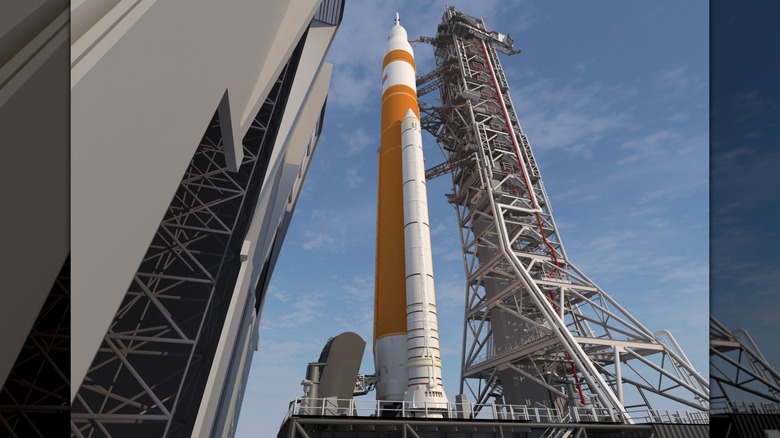
The last time anyone set foot on the Moon was in December 1972 during the Apollo 17 mission. Since then, robots and satellites have returned, but humanity has yet to make the trip; NASA is working on just that via its Artemis Program. The plan is to first return to the Moon and build upon the foundation of previous experience to one day send people to Mars. The Saturn V is retired, and while it was an impressive rocket, NASA developed an entirely new launch vehicle for Artemis called the SLS, or Space Launch System.
The two-stage super heavy-lift vehicle has already taken people into Lunar orbit during the Artemis II mission. As of this writing, the plan for a Lunar landing is set for the Artemis IV mission, scheduled for sometime in early 2028. The SLS stands 322 feet, 4 inches tall and weighs 5.74 million lbs. when fueled. When it begins its trans-lunar injection (TLI), it will be traveling 22,670 mph relative to Earth, so it's a bit slower than the Saturn V.
Despite this, the SLS' engines provide more thrust, thanks to its four RS-25 engines and two five-segment solid rocket boosters (SRBs) that produce a combined thrust of 8.27 million lbs. at launch. The SLS' SRBs each produce 3.3 million lbs. of thrust at launch, offering a similar configuration to the SRBs used to launch the Space Shuttle, though those were more powerful. In terms of payload capacity, the SLS falls a bit short of the Saturn V, though it's still quite capable. It can carry 209,439 lbs. into LEO, and for its TLI, it can bring a payload of 59,525+ lbs.
Starship
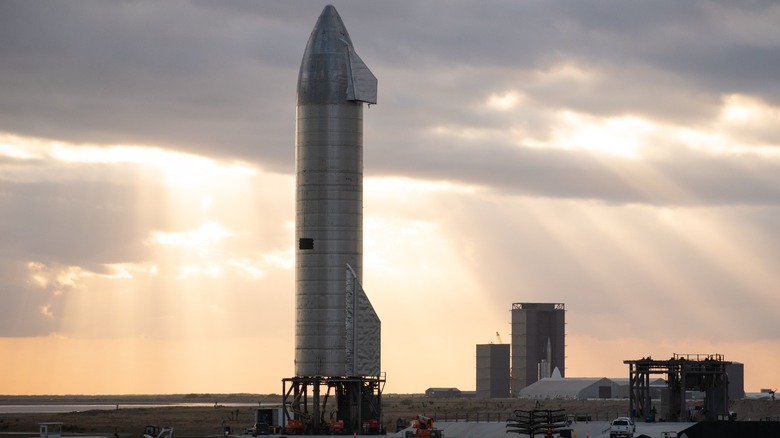
While SpaceX's Falcon Heavy is an impressive and highly capable rocket, the company's Starship is something else entirely. Starship is SpaceX's super-heavy lift rocket, which is entirely reusable and capable of carrying both cargo and people into space. Starship isn't limited to LEO, as it can carry its payload, whatever it might be, to the Moon and to Mars, though the latter two have yet to happen as of this writing. Starship is the most powerful rocket ever launched, and it can carry over 100 metric tons into orbit.
Starship stands 407 feet tall with a 29-foot diameter, so it's not only the most powerful, but it's also the tallest rocket ever launched. SpaceX engineers designed Starship to carry up to 100 people on long-duration interplanetary flights, but it can also deliver satellites, help to develop a base on the Moon, and carry people and cargo from Earth to the Moon. Starship's power stems from its 33 SpaceX Raptor 3 engines installed on the primary vehicle's first stage used at launch.
Each Raptor 3 engine produces 551,000 lbs. of thrust at sea level, and they've proven themselves in several test launches as SpaceX updated its engines for the Starship program. This gives Starship 18.1 million lbs. of thrust at launch, far exceeding the power of every rocket that preceded it. Starship achieved its first successful orbital insertion on September 28, 2026, when it deployed 26 Starlink satellites. As it currently stands, SpaceX's Starship is the tallest, most powerful rocket humanity has ever launched.