

2027 Chrysler Pacifica Redesign Barely Qualifies, But I Think There's An Upside
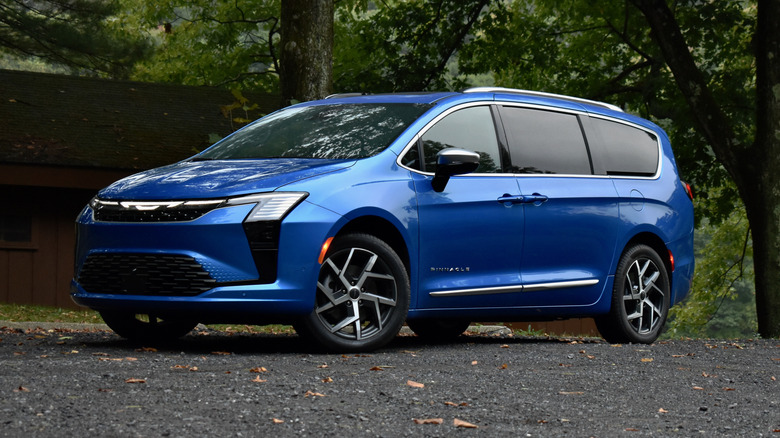
Given the way events have unfolded, I often feel like time stopped in the year 2016. But for the Chrysler Pacifica, that is actually the case. Since its arrival a decade ago as a 2017 model replacing the Town & Country, the Pacifica has carried on with minimal updates as the rest of Chrysler eroded around it. When Chrysler celebrated its 100th anniversary last year, the Pacifica was the last model left wearing the brand's winged badge (unless you count the Voyager, which was the same van sold under a different name, with older styling).
A minivan seems like a particularly weak foundation for a car brand in the year 2026. Image-conscious families fled for SUVs long ago, leaving only the Honda Odyssey, Kia Carnival, and Toyota Sienna as competition for the lone Chrysler. And Kia refuses to call the Carnival a minivan, preferring the (equally boring) term "multipurpose vehicle."
And while the Pacifica gets a refresh for 2027, the changes are minimal. There's new styling up front, but not anywhere else. The lineup is compressed, dropping the Pacifica Hybrid and Voyager, and some options are reshuffled. That shouldn't be adequate for the last model from a dying brand, in a dying segment. But remarkably, it is.
It's the kind of lazy refresh we've come to expect from Stellantis...
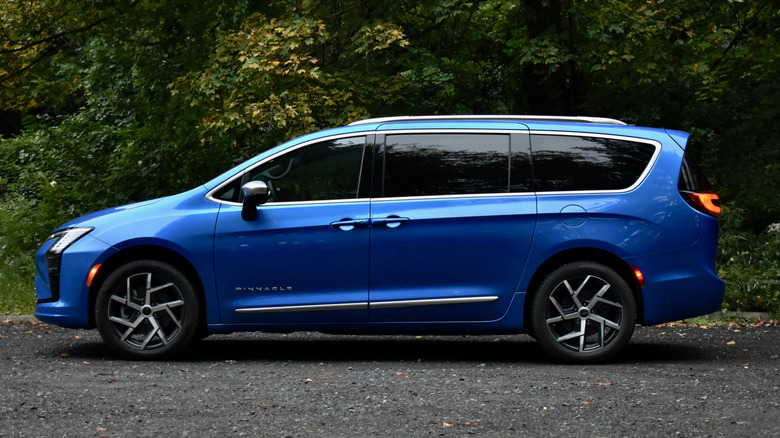
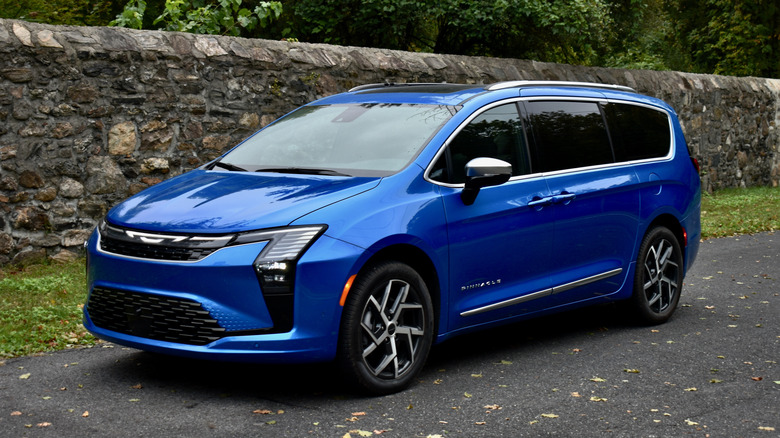
After so much teasing from Chrysler, the updates for 2027 are the definition of anticlimactic. Styling changes are limited to new headlights and a reshaped grille, and those only appear on the Select, Limited, and Pinnacle trim levels. The Pacifica LX base model (formerly the Voyager) keeps the decade-old look, skipping even the front fascia from the Pacifica's last refresh for the 2021 model year.
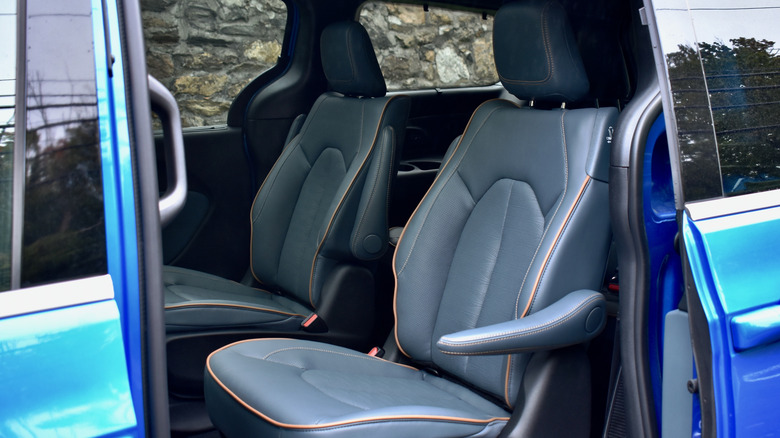
There's a more minimalist Chrysler logo as well, which is the only way you can tell from the back that you're looking at a 2027 model. It also appears on the steering wheel as the only change to the interior that all customers will get. A new Blue Agave color for the optional leather upholstery is also available, and while it was a refreshing change from the usual black or tan, it also clashed with the test car's Hydro Blue paint.
It's embarrassing that Chrysler parent Stellantis waited this long to roll out such a weak refresh. Even having it ready one year earlier, for Chrysler's centennial, would have made things seem less dire. But it's not surprising. Stellantis and predecessor Fiat Chrysler Automobiles played this game before with the Alfa Romeo Giulia and Dodge Charger and Challenger. The Pacifica's predecessor, the final-gen Town & Country, lasted eight years, albeit in part because of its maker's bankruptcy. And once again, Stellantis might just get away with it.
...but it works
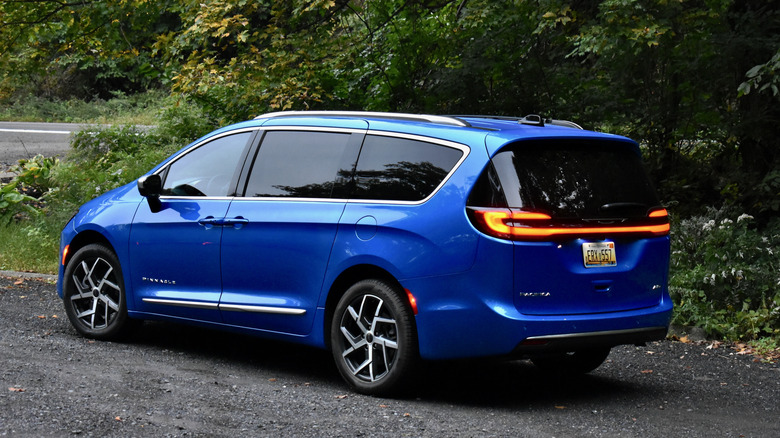
It may not be new, but the Pacifica is still good. That's partly because it's competing in the stagnant minivan segment, and partly because Chrysler did a good job designing it in the first place.
The Pacifica doesn't look dated on the outside. It's a good-looking vehicle that wears its minivan-ness proudly without resorting to styling gimmicks like the Odyssey and Sienna, or SUV kitsch like the Carnival. It's also competitive with those vans when it comes to interior space, whether we're talking about passengers or cargo. Available fold-flat third-row seats and the signature Stow 'n Go second row that disappears into the floor make using that space a lot easier. And you can still get a built-in vacuum cleaner.
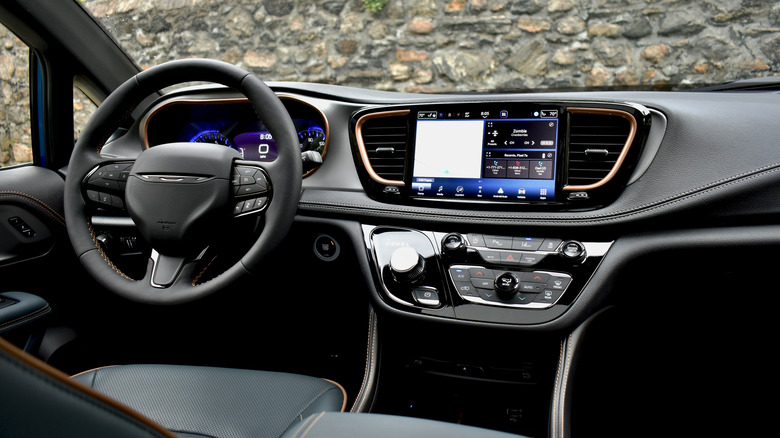
The interior is definitely starting to look dated design-wise, but even that isn't a bad thing. The reasonably-sized touchscreen and plethora of buttons and knobs might be holdovers from an earlier stage of technological evolution, but they're still as easy to use as they were a decade ago. Nicely framed by wing-shaped vents that echo the Chrysler logo, the touchscreen integration also looks a lot cleaner than those in many newer cars. Why designers and product planners decided to do anything different remains a mystery.
Don't let the shape fool you. It drives great
There was also nothing that needed changing about the way this minivan drives. With its well-damped, comfortable ride to complement its spacious interior, the Pacifica carries on the legacy of the New Yorkers, LeBarons, and Newports that once filled Chrysler showrooms. If the B-52s wrote their hit "Love Shack" today, the lyrics would still make sense. This Chrysler "seats about 20" in much greater comfort than ones on the road in 1989.
Instead of the ocean-swell flop of a traditional American land yacht, the Pacifica takes corners without drama. Body control usually comes second to soft damping when tuning for comfort, and is just plain hard to achieve in a vehicle with a tall center of gravity that also needs to carry lots of people or stuff. But that's exactly what you get here, teamed with steering that's not the sharpest, but helps maintain smoothness. I love a solo drive on a deserted stretch of twisty road, but sometimes it's nice to bring people along for the ride—and not make them car-sick.
With the Pacifica Hybrid gone, the sole powertrain is the familiar 3.6-liter Pentastar V6, connected to a nine-speed automatic transmission. Front-wheel drive is standard, with all-wheel drive available on all but the base LX model. With 287 horsepower and 262 pound-feet of torque, the V6 pulls enthusiastically and musically, with a nice exhaust note unmuffled by turbos. Standard active noise cancellation filters out unwanted noises and makes conversations with third-row passengers easy.
A minivan is still a better solution than many people want to admit
It may not look as athletic as some crossover SUVs, but the Pacifica is better to drive than many of them. And if you're serious about utility, it's a lot easier to live with.
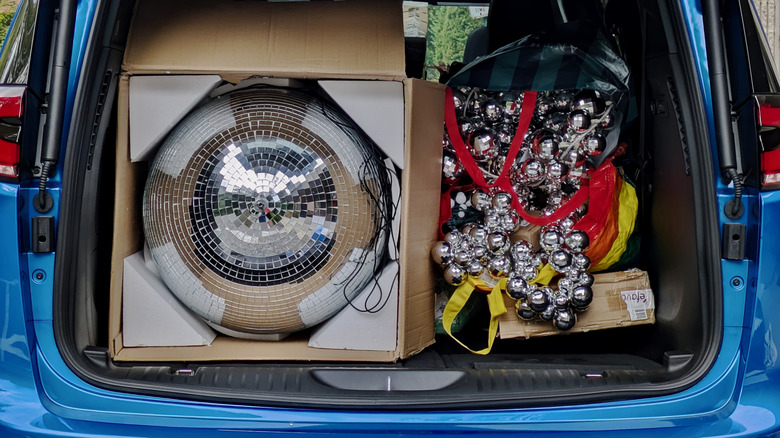
Most people don't live the active lifestyles depicted in SUV ads. I didn't use the Pacifica to carry mountain bikes to the trailhead, nor did I fill it with camping gear. But I did use it to move a two-foot disco ball, and to shuttle guests from airport to hotel to venue for a family wedding. The Pacifica did it all with poise of a well-drilled catering staff. Sliding doors and the combination of a tall roof and car-like ride height meant passengers didn't have strain themselves to get in, or duck to reach the third row. This Pinnacle model didn't have Stow 'n Go due to its fancier seats, but those second-row captain's chairs still didn't interfere with third-row access when slid forward.
Even with the third row in place, there was enough room for two weeks' worth of luggage for three people, thanks to the deep well the seats fold into when stowed. That can be done with one button touch in higher trim levels, and a power liftgate is now standard for 2027. With that liftgate open, not having to shot-put items over a tall rear bumper was also helpful.
Dated tech is the only real giveaway of the Pacifica's age
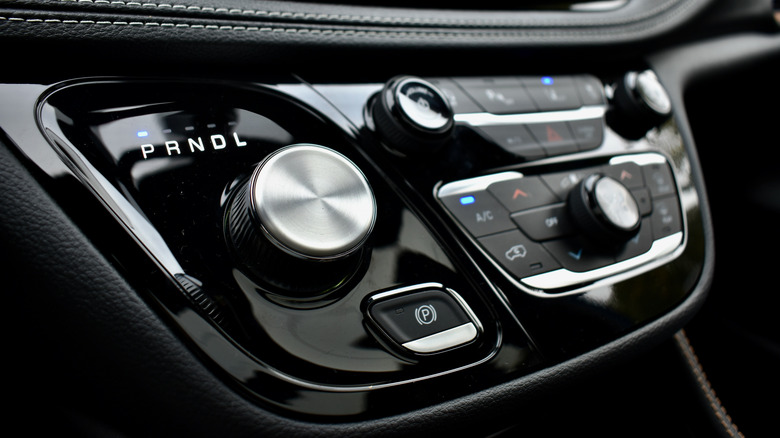
In-car tech is better than one might expect in a decade-old vehicle, but are there some areas that could use updates. The 10.1-inch touchscreen isn't one of them. As noted above, it's a reasonable size, and the Uconnect 5 infotainment system still includes wireless Apple CarPlay and Android Auto. Uconnect's graphics are decidedly dated, but they don't impact usability.
Another anachronism was the Pacifica's rear-seat entertainment system, part of the optional Theater Group package. It's unclear why automakers still sell built-in monitors when every person has a phone or tablet, but for 2027 Chrysler at least made the sensible decision to decouple the Theater Group from the Family Tech Group, which includes more practical features like additional USB ports and power outlets and an upgraded audio system, as well as a rear-facing camera for keeping an eye on kids in the back seats.
Turn-signal-activated blind-spot cameras are new for 2027, but the camera view shows only the touchscreen, not in the instrument cluster, because the Pacifica still has analog gauges on all trim levels. A physical button for the surround-view camera system would have also been appreciated, as it didn't automatically activate with the parking sensors. And those sensors were a bit too, well, sensitive. A hands-free driving system—like the ones Detroit rivals Ford and General Motors have—would also be a big plus for road trips.
The Pacifica Hybrid will be missed
It's not necessarily new technology that's missing from the 2027 Pacifica though. Chrysler already had a plug-in hybrid model, and while the number of recalls associated with it indicate that no one ever figured out how to build it properly, the absence of this more fuel-efficient model still leaves a hole in the lineup.
Badged as the Pacifica Hybrid, it teamed the Pentastar V6 with a two-motor hybrid system and 16 kilowatt-hour battery pack. It wasn't available with Stow 'n Go or all-wheel drive, and was down 27 hp from the non-hybrid model. But it had an EPA-rated 32 miles of electric range, and was rated at 30 mpg combined in hybrid mode. The non-hybrid 2027 model is rated at 22 mpg combined (19 mpg city, 28 mpg highway) with front-wheel drive and 20 mpg combined (17 mpg city, 25 mpg highway) with all-wheel drive.
The difference between the city and highway numbers is key here. I averaged 17.1 mpg in mostly suburban driving, likely because the transmission couldn't stay in its highest gears. Extra-tall gears for highway cruising help improve fuel economy, but only if you spend a lot of time at highway speeds. The Pacifica does have an engine start/stop system, but it mainly prevented the climate control for working well on muggy days and nights. This wouldn't be a problem for the Pacifica Hybrid, which can draw power from its battery pack to run accessories when the engine's off.
2027 Chrysler Pacifica verdict
The Pacifica may be very old by auto-industry standards, but it still has everything one could want in a family car, and at reasonable prices. The base LX model starts at $43,490, which is more than a Kia Carnival but slightly less than a Honda Odyssey (Toyota didn't have 2027 Sienna pricing available at the time of writing). The LX still has the old styling, but with the same powertrain and infotainment system as the other models, as well as Stow 'n Go seats.
The carryover trim levels actually get price decreases. The Select starts at $45,540, which is $1,000 less than the 2026 model. The Limited is $1,710 less than before, at $49,990. All-wheel drive costs $2,995 ($350 less than before) on the Select, Limited and Pinnacle. The latter is now available with front-wheel drive as well, effectively lowering its base price. The car you see here is an all-wheel drive Pinnacle with $495 Hydro Blue paint, retailing for $60,395.
It's easy to criticize an automaker for putting off redesigns, especially one that barely has a pulse. But there's a lot of that going around now. Mercedes just gave its current-generation GLE and GLS their second refresh. Most of Volvo's lineup is nearly as aged as the Pacifica, as is the Mazda MX-5 Miata. And that's okay. Newness just for the sake of newness doesn't help anybody.