

These 5 Modern Cars Are Popular With DIY Mechanics (And Here's Why)

While new cars continue to get more and more complex, there are still some that can be enjoyable to work on. Doing routine maintenance on your own car by yourself is not only a great way to save money on the expense of a mechanic, but it also puts you in touch with the machine that takes you from place to place, whether it's to run errands around town, go to work, or take an exciting, fun-filled road trip with your loved ones. In this spirit, we have listed some easy car repairs even beginner home mechanics can tackle.
For the purposes of this article, we will focus on five new cars available today that tend to be popular with DIY mechanics, as selected by several different sources. We will not be including any trucks or SUVs, however. There are many more than we have room for, so that leaves plenty of time for future articles on the others that we didn't have the space to mention.
Some of these cars also lend themselves well to modifications, with a plentiful aftermarket industry to supply upgrades to various systems. With others, you may be concerned primarily with saving money by doing your own servicing. Whichever path you choose, take comfort in knowing that the DIY path not only puts money back into your pocket, but you also have the satisfaction that the job will be done right by the person who has the most riding on the outcome.
Mazda Miata
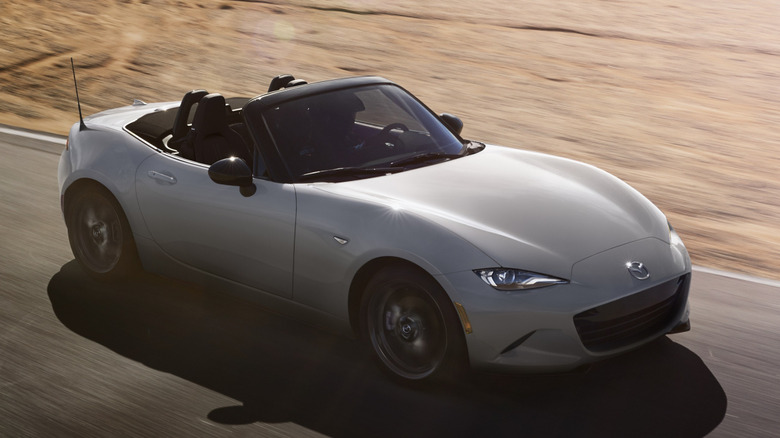
The Mazda MX-5 Miata has been on the scene since it first debuted in 1990. SInce then, it has evolved through four generations, all using the same front-engine, rear-drive formula that makes it easy to both do routine maintenance and make upgrades to its engine, suspension, wheels, tires, and more. There are a variety of aftermarket parts awaiting your installation, ready to make your own Miata into a track-ready giant-killer or an autocross winner. You can add a turbocharger for max power, stiffen up the suspension, install a roll cage — it's all out there.
What's even better about the Miata is that the parts you need to maintain it are relatively inexpensive, with lots of room around the engine. That's a great combination that makes this car an excellent place to start your DIY journey. Our review of the Mazda MX-5 Miata appreciated its power, its manual transmission, its suspension, and its affordable price.
The MX-5 Miata is a great performer in stock form. You get a 2.0-liter inline four-cylinder engine producing 181 horsepower flowing through a six-speed manual or six-speed automatic on its way to the rear wheels. Performance testing of the latest MX-5 Miata by Car and Driver showed the zero to 60 mph run took 5.5 seconds, with the quarter-mile going by in 14.3 seconds at 96 mph. Roadholding on the skidpad measured 0.90g. This level of performance is largely due to the Miata's small size and low weight, which helps explain why there's only four cu. ft. of trunk space to be had. Bring soft luggage.
Subaru BRZ/Toyota GR86
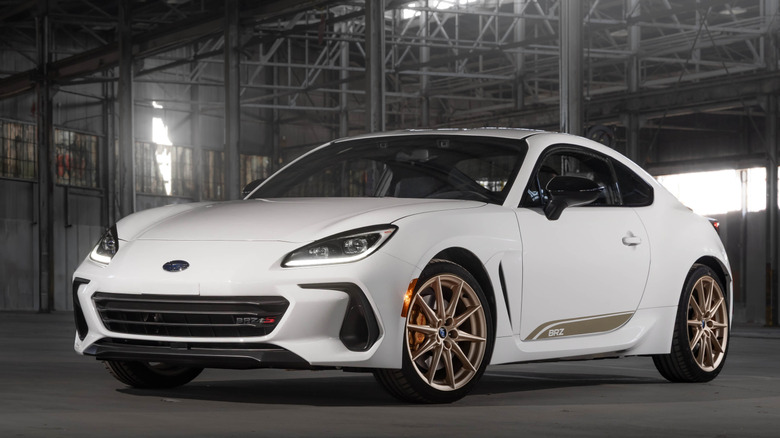
The Subaru BRZ and Toyota GR86 siblings represent Subaru's and Toyota's joint attempt at a fun-inducing sports coupe that remains affordable. The result has been satisfying for those who enjoy its charms. In addition to having all the right stuff under its hood, it is an excellent vehicle for the DIY mechanic who wants to get his or her hands dirty handling the greasy bits of this very interesting car. Our review of the Toyota GR86 version revealed it to be lightweight and fun in the corners, with classic coupe looks.
The "Toyobaru" twins are virtually identical, except for some minor trim and suspension tuning differences. What they have in common is the 228-horsepower, flat-four Subaru engine in the front for a low center of gravity, with plenty of room around it for DIYers to work in the engine bay. Like the Miata, the BRZ and GR86 are rear drive, with a choice of six-speed manual or six-speed automatic transmissions available. Tuning these vehicles way past stock levels is also an option for those so inclined, with a wide array of performance parts available from Subaru, TRD, and many others.
Regardless of how high you turn up the wick on these cars, they perform well in stock configuration. In tests of these cars' performances by Car and Driver, the Subaru BRZ did zero to 60 mph in 5.5 seconds, with the GR86 managing 5.4. They both did the quarter-mile in 14.0 seconds at 101 mph. Skidpad roadholding was 0.97g. This small coupe provides six cu. ft. of cargo capacity.
Hyundai Elantra
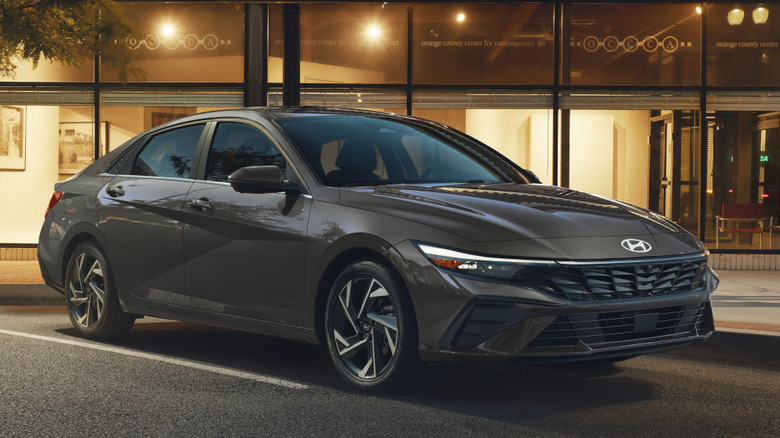
The Hyundai Elantra is not really a tuner car, unless you pick the high-performance Elantra N model, which our review praised for its usable turbo power, agility, and cabin space. But even with the lower-level models, the Elantra has become a car known for being easy to maintain yourself, with reasonably-priced parts. It's also because of the Hyundai Elantra's engine bay, providing easy access to DIY mechanics for the most frequently used service-related parts. Also benefitting the DIY community is the fact that the Elantra also features components, including those in its fuel injection and braking systems, that simply need less servicing than others in its competitive set.
The 2026 Hyundai Elantra lineup includes a 139-horsepower hybrid, a 147-horsepower standard model, and the sportier Elantra N Line, which uses a turbocharged 1.6-liter four-cylinder engine producing 201 horsepower. At the top of the performance range, the Elantra N delivers 276 horsepower from its turbocharged 2.0-liter four-cylinder engine. Transmission options vary by model, including an intelligent variable transmission (IVT), a six-speed dual-clutch transmission in the hybrid, and a seven-speed dual-clutch transmission in the N Line. The Elantra N is available with a six-speed manual or an eight-speed wet dual-clutch automatic.
The many different Elantra versions perform at varying levels, as documented and estimated by Car and Driver. For the zero to 60 mph run, the Elantra hybrid does it in 8.4 seconds, the non-hybrid manages 8.1 seconds, the N-line turbo cuts it down to 6.5 seconds, and the Elantra N beats them all at 4.8 seconds. The quarter-mile time recorded by the Elantra hybrid was 16.5 seconds at 84 mph, while the Elantra N improved this time to 13.4 seconds at 106 mph. Roadholding was measured at up to 0.99g. Trunk space is 14 cu. ft.
Honda Civic
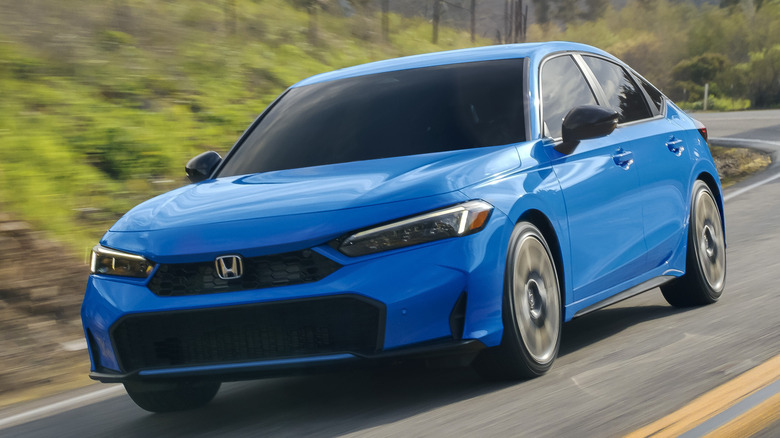
The 2026 Honda Civic is a car that goes both ways, serving tuners and DIYers. While the Civic has a significant aftermarket tuning tradition built over many years, its simplicity and utmost reliability has also endeared it to DIY mechanics who appreciate the ease of maintaining it, even in stock condition. High resale values of the Honda Civic attest to the car's durability. Our review of the Honda Civic Hybrid hatchback found it to be the low price, high economy hero we need.
The Civic gives you a large choice of engines. This includes a 150-horsepower non-hybrid or a 200-horsepower hybrid mated to a CVT, a 200-horsepower turbocharged engine and six-speed manual combo in the Civic Si, and the range-topping, 315-horsepower Civic Type R with its six-speed manual transmission. Every Honda Civic is front-wheel drive.
This provides Civic owners with different levels of performance, as tested by Car and Driver. For zero to 60 mph times, the Civic non-hybrid did 8.9 seconds, the Si did 6.6 seconds, the Hybrid did 6.1 seconds, and the Type R won with a 4.9-second time. Quarter-mile times ranged from 16.9 seconds at 87 mph for the non-hybrid to 15.0 seconds at 91 mph for the Hybrid to 14.9 seconds for the Si to the Type R's quickest run of 13.5 seconds at 106 mph. Roadholding on the 300-foot skidpad was measured at from 0.85g in the Hybrid to 1.02g in the Type R. Cargo capacity is 15 cu. ft. in the sedan's trunk and 24.5 cu. ft. behind the second row in the hatchback.
Toyota Corolla
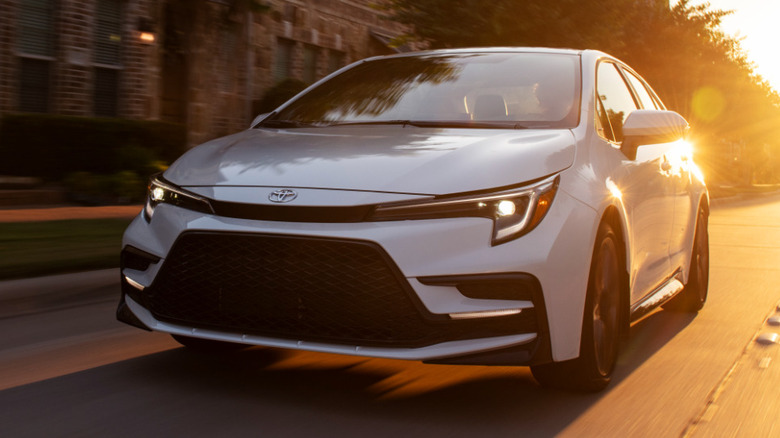
The Toyota Corolla has been chosen by legions of car shoppers because it is a very safe and popular choice. It offers abundantly high levels of reliability, safety, ride quality, and low running costs. The Corolla's appeal to the DIY community comes from its supreme ease of access to the engine for both maintenance and repairs. The Toyota Corolla has also gotten an exceptional response from the aftermarket, with both service items and replacement parts available at reasonable prices. Our review of the Toyota Corolla showed us that it'll get you there, just like it always did.
The Toyota Corolla is available as either a four-door sedan or a four-door hatchback. Both 169-horsepower non-hybrid and 138-horsepower hybrid drivetrains are available in the sedan, with the hatchback coming only in non-hybrid form. The Corolla Hybrid sedan is also available with all-wheel drive, thanks to an electrically-motorized rear axle. Otherwise, the Corolla is a front-wheel drive vehicle, with a CVT placed between the engine and the wheels.
The performance of the Toyota Corolla sedan and hatchback have been tested by Car and Driver. The hatchback with the non-hybrid powertrain did a zero to 60 mph time of 8.2 seconds and got through the quarter-mile with a time of 16.4 seconds at 85 mph. The sedan with all-wheel drive took 9.0 seconds for the zero to 60 mph run, making it through the traps in the quarter-mile in 16.9 seconds at 80 mph. Cargo capacity in the hatchback is 18 cu. ft. behind the second row, while the sedan's trunk provides 13 cu. ft. of space.