

5 Drawbacks Of Using All-Weather Tires
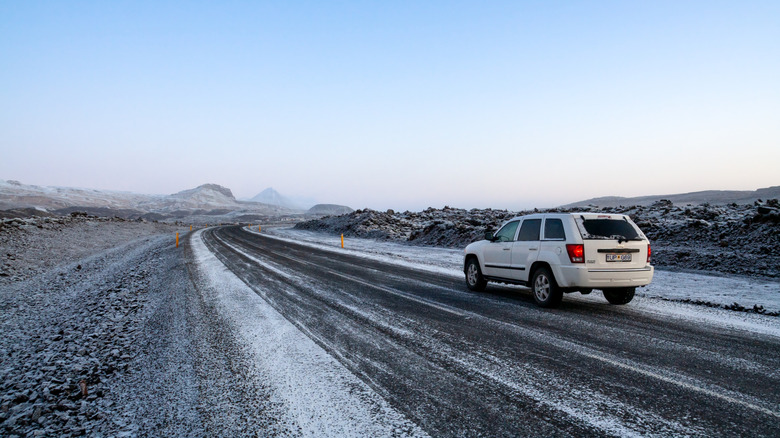
There are plenty of different types of tires on the market, and it can sometimes be tricky to choose which type suits your needs. It is easy with stuff like snow tires and mud tires because the name itself tells you where they excel, but that also means they are compromised in other areas. Snow tires are fantastic on ice and packed powder, yet they wear out quickly and feel vague on warm, dry pavement. Conversely, mud tires will claw through a trail, but they can be loud and unpleasant on the highway.
That is exactly why all-weather tires have become so popular. They are built to be the one set that handles nearly everything, and for a lot of drivers that is a seriously appealing idea. You mount them once, skip the twice-a-year swap, and avoid paying for storage space or a second set of wheels. It is worth clearing up a common mix-up, though: all-weather tires are not the same thing as all-season tires. All-season tires are designed for mild conditions, and all-seasons have their own drawbacks, including that they typically carry only the mud and snow M+S rating, not the Three-Peak Mountain Snowflake (3PMSF) symbol, which means they are not certified for severe snow service. All-weather typically tires do carry it.
All-weathers use a more aggressive tread pattern and a softer rubber compound that stays pliable as temperatures drop, so they can actually be trusted when winter shows up while still being fine to run year-round. On paper, that sounds like the best of both worlds, and in plenty of situations it is. Still, a tire that tries to do everything rarely does everything perfectly. Here are five drawbacks of using all-weather tires you should know about before you commit to a set.
Weaker grip on ice than dedicated winter tires
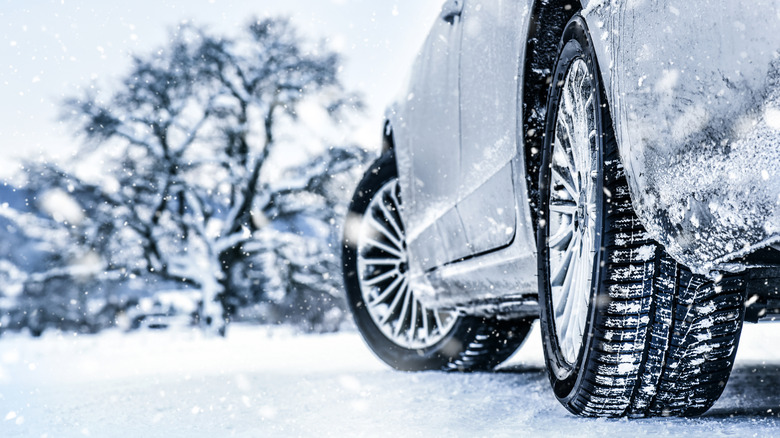
As previously noted, all-weather tires typically carry the 3PMSF symbol, meaning that they are legitimately winter-capable. However, that certification is based on snow traction, not ice, and that is where the first compromise of the all-weather tire shows up. Ice is a trickier surface because there is almost nothing for a tire to dig into. Grip largely comes down to the rubber compound and the design and size of the sipes clearing the thin film of water on top.
A dedicated winter is built for that. An all-weather tire also has to stay firm enough to handle a hot July, and that firmness costs it bite once the surface turns to ice. The numbers show it. A 2026 Tire Rack test covered by TyreReviews measured ice braking on three all-weather tires and five winter tires, with the best all-weather result was 50.6 feet, set by the Vredestein Quatrac. The best winter result, meanwhile, was 38.7 feet, set by the Bridgestone Blizzak WS90. That is 11.9 feet of extra stopping distance, roughly 31 percent longer, even from the top all-weather performer. What makes the ice gap stand out is how small the difference is elsewhere. On snow, the best all-weather tire, the Bridgestone WeatherPeak, stopped in 58.6 feet against 56.1 feet for the best winter tire, the Michelin X-Ice Snow.
If your winters regularly involve glare ice, like a shaded bridge deck or a steep driveway, 12 extra feet can be the difference between stopping at the intersection and sliding into it. Regardless of the tire, driving slowly and carefully is one of the most important winter driving tips to keep in mind to stay safe.
Higher cost per mile and shorter tread life

When Consumer Reports looked at the best all-weather tires on the market, it said plainly: "Some all-weather tires cost more than the all-season tires they typically replace." Michelin's lineup is a clean example. In size 205/55R16, the Defender2 is $166 per tire and the all-weather CrossClimate2 is $174. That is $8 more per tire, or $32 per set ($696 versus $664).
The tread life numbers point the same way. The CrossClimate2 has a 60,000-mile treadwear warranty and a Uniform Tire Quality Grade (UTQG) treadwear rating of 640. The Defender2 is one of many tires that come with an 80,000 mile warranty, and the longest-lasting all-seasons go up to 90,000 miles. The Defender2 also has a UTQG treadwear rating of 840.
That is 20,000 fewer warrantied miles, a warranty that's 25 percent shorter, and a treadwear rating about 24 percent lower. Dividing price by warranty widens the gap. The CrossClimate2 works out to $2.90 per 1,000 warrantied miles, while the Defender2 comes to about $2.08. That is roughly 40 percent more per 1,000 miles of advertised treadwear warranty. Put another way, $696 buys 60,000 warrantied miles on the CrossClimate2, while $664 buys 80,000 on the Defender2.
It is not just Michelin. The Car Talk top all-weather picks from Michelin, Goodyear, Kumho and Pirelli all carry 60,000-mile warranties, and the Falken Aklimate carries 65,000. If we look back at our 80,000-mile warranty tire list, each and every tire we mentioned was an all-season tire, and none were all-weather tires.
Directional tread limits all-weather tire rotation
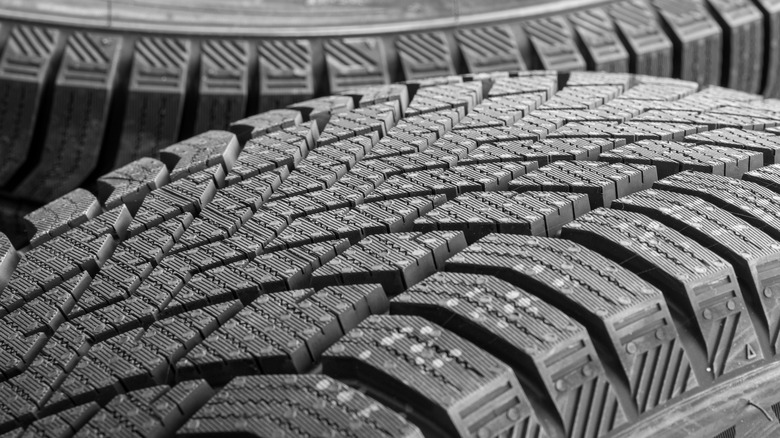
The idea behind directional tires is that they use a V-shaped groove pattern which helps with pushing water outwards while the tire is rotating. A non-directional tire is typically worse at this because it does not push water in one direction. That is why, according to CarTalk, "most all-weather tires use a V-grooved, directional pattern.." We already mentioned Michelin's CrossClimate2, but Pirelli lists the Scorpion WeatherActive as an all-weather directional tire, and Goodyear lists its Assurance WeatherReady 2 as an all-weather directional tire.
Rotation is routine maintenance for all tires. Consumer Reports recommends it every 5,000 to 7,500 miles, and one of its tire technicians says, "spreading wear around all four tires ensures even tread depth and grip." However, directional tires don't leave much room because they must roll in a specific direction. Crossing directional tires from one side of the car to the other is off the table, which leaves front-to-back swaps as the only way to rotate them. That rules out any cross pattern. On a car with different front and rear tire sizes, it leaves no simple rotation option at all, since front-to-rear swaps are impossible and side-to-side swaps would turn the tread the wrong way.
Put those together with all-weather tires being a bit more expensive and having a lower warranty, this can further shorten their lifespan. None of this makes all-weather tires unusable, and front-to-rear rotation works fine for most drivers, but for anyone with a staggered setup, or a manual that calls for a cross pattern, the tread design gets in the way.
The 3PMSF symbol is a lower bar than it looks
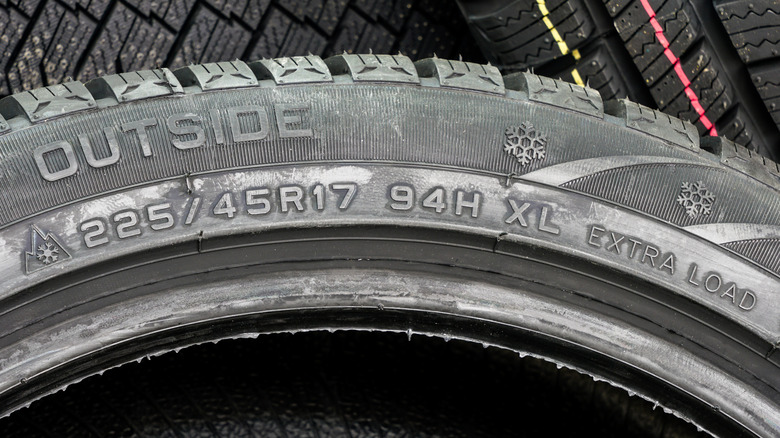
In the intro, we mentioned how all-weather tires typically carry the 3PMSF symbol while all-season tires do not, but the meaning behind the tire symbol on an all-weather tire certifies one rather narrow result. The symbol goes to tires that post 12 percent more acceleration traction than a reference tire in the ASTM F1805 spin test on medium-packed snow.
The test only runs with the air at or below 38 degrees Fahrenheit and the snow surface between 5 degrees and 25 degrees. Braking on ice is covered by a different marking, the Ice Grip symbol, which requires 18 percent better grip than the reference tire under ISO 19447:2021. None of that tells you how a specific tire handles real roads, and Tire Rack's winter testing found a real twist: "some non-3PMSF marked, all-season tires outperform other, all-weather tires."
TyreReviews saw the same pattern in a snow test of all-terrain tires, where "some of the three peak marked tires were beaten by non-three peak marked tires." The Continental TerrainContact AT, which has no snowflake, stopped from 20 mph to 5 mph in 157 feet, while the snowflake-marked Toyo Open Country AT III needed 166 feet, the 3PMSF Pirelli Scorpion All Terrain Plus needed 168 feet, and the 3PMSF Yokohama Geolandar AT G015 needed 169 feet.
We do have to mention that Tire Rack's testing also found 3PMSF tires "do generally outperform standard all-season products," but the difference is not always black and white, and it should not be taken as such. Treat the snowflake as the minimum requirement, then look for real-world braking results on the exact tire before you buy.
A jack of all trades, master of none

All-weather tires are the jack of all trades in the tire world, and the master of none. The author of TyreReviews' seven-tire all-weather test wrote, "all weather tires are a bunch of compromises by default." That test also included a reference summer tire, and it beat every all-weather tire in both dry and wet braking. It stopped in 113 feet on dry pavement, while the best all-weather tire needed 122 feet.
On wet pavement, the summer tire needed 96 feet, against 108 feet for the best of the all-weather group. The compromise runs the other way too. In our breakdown of winter vs. all-season tires, we pointed out that all-weather tires are "not designed for use in severe snow or ice," which lines up with the ice braking gap we covered earlier. That is the price of skipping the twice-a-year tire swap.
Giving up the top spot in any single condition is the trade, because you get one tire that does most things, not all things. All-weather tires also vary from model to model, since tire makers balance the trade-offs in different ways. Still, for someone who lives in a very hot climate or faces season-long snow and ice, all-weather tires will not be the best option, and by design they can't be.