

5 Of The Highest-Flying Combat Aircraft Of WWII
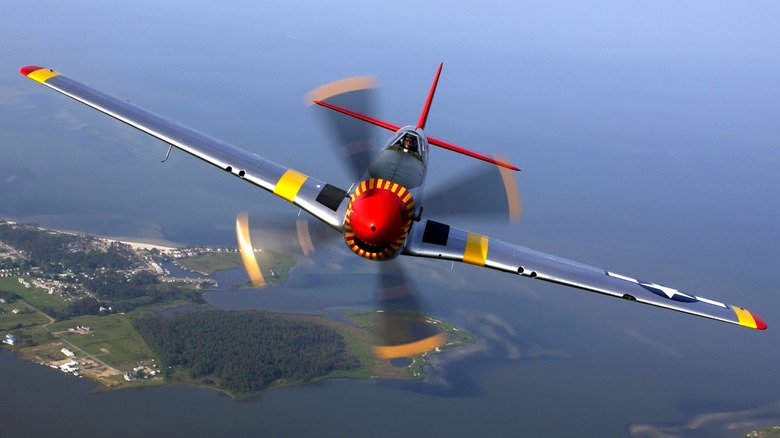
Looking back at World War II, many different aircraft flew the unfriendly skies. With all kinds of fighters, attack aircraft, interceptors, bombers, and more, the Axis and Allied powers produced thousands of aircraft. While some WWII fighter planes were the fastest of the era, speed isn't the only advantage in aerial combat. Another important factor is altitude, as gaining higher ground in a dogfight lets you outflank an enemy plane, attack from above, and use the sun to obscure yourself from an enemy pilot.
Pilots often have to trade speed for altitude, though the fastest- and highest-flying plane often dominates the skies. As one former pilot revealed, altitude is a bank balance you can withdraw from when needed, converting that potential energy into speed, especially when you point your nose to the ground. Many high-flying aircraft were used throughout WWII, and while you might assume they were all bombers, that's not the case. WWII bombers required heaters as they didn't have pressurized cabins, which was a limiting factor in how high they could fly.
Still, several bombers managed to climb high enough to deliver their payloads, which helped them avoid some enemy air defenses. The service ceiling advantage of one aircraft over another had numerous benefits, and engineers never stopped pushing the envelope. Long after WWII ended, modern fighters like the F-35 Lightning II have a service ceiling of 50,000+ feet, showing that altitude remains as important as speed despite the lack of modern aerial dogfighting.
North American P-51 Mustang
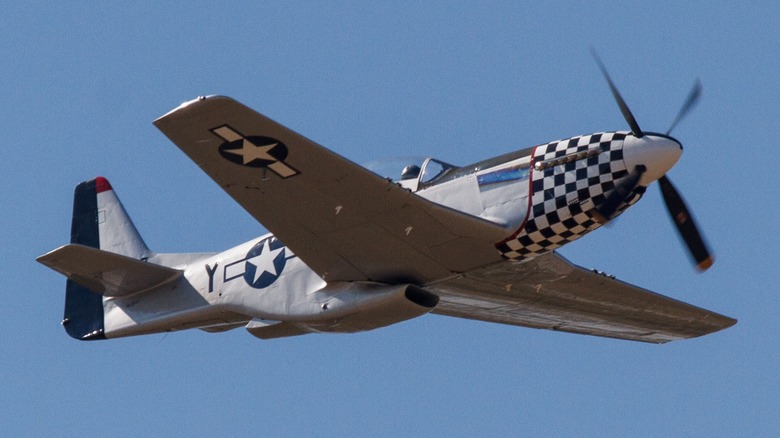
The United States began flying the North American P-51 Mustang in 1942, and over the course of its time in service, a total of 15,686 rolled off the assembly lines. The aircraft came in different models, but they all shared one thing: speed. The P-51 Mustang had a top speed of 437 mph, making it one of the fastest fighters of WWII. While speed helped the P-51 become a legendary aircraft of the conflict, it wasn't its only claim to fame, as it also had a remarkably high service ceiling.
The P-51 boasted a service ceiling of 41,900 feet coupled with a rate of climb of 3,200 feet per minute. Depending on the variant, as there were several, it could carry multiple types of ordnance and even a tail warning radar system before the war came to an end. The P-51 was powered by a Packard V-1650-7, which was a licensed version of the Rolls-Royce Merlin 61, a 12-cylinder, liquid-cooled engine. This provided 1,490 horsepower, helping the P-51 achieve its top speed and high service ceiling.
These specifications helped make the P-51 a legendary aircraft, especially as a bomber escort. Between 1942 and 1944, the 8th Air Force's bomber units had a 77% casualty rate. When the P-51 entered the fray, it picked off German fighters, allowing more bombers to successfully deliver their payloads and safely return to base. They were also flown by the Tuskegee Airmen, and the P-51 Mustang is arguably the most legendary and iconic American fighter of the war.
Republic P-47 Thunderbolt
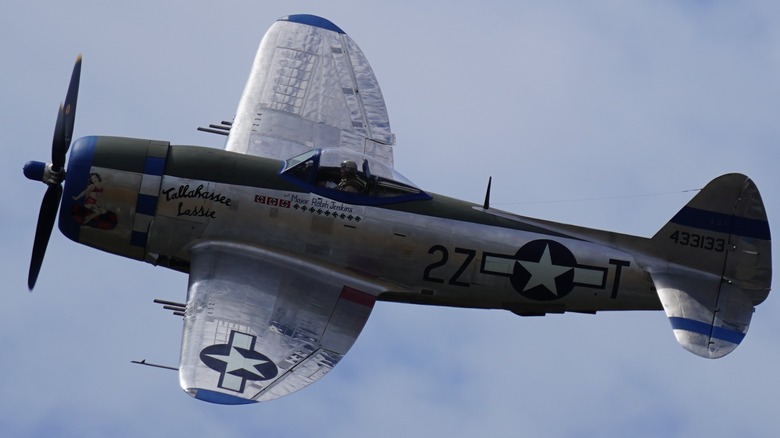
Republic Aviation produced the P-47 Thunderbolt in 1941, and it remained in production throughout the war, though the aircraft wasn't used in combat operations until April 1943. By the end of the conflict, more than 15,600 P-47s had been constructed, making it one of the most-used fighter-bombers flown by U.S. pilots during the war. Wherever it flew, the P-47 Thunderbolt ruled the skies, and it was an excellent platform for a variety of weapons.
It could carry between six and eight .50-caliber machine guns, and in addition to that, it could hold either 10 rockets or 2,500 pounds of bombs. The P-47 was powered by a single Pratt & Whitney R-2800-59 engine that produced 2,430 horsepower. This helped the aircraft reach a maximum speed of 433 mph, just a bit slower than the P-51. It had a service ceiling of 42,000 feet, giving it a significant altitude advantage for different types of missions.
The aircraft was known for its rugged design, which could take damage and remain operational to complete the mission. It flew in nearly every active theater of WWII, and it was also flown by American allies. Eventually, variants were outfitted with bubble canopies that improved pilot situational awareness, and the P-47 saw heavy use between 1943 and 1945. It excelled at ground attack missions, thanks to its speed, ruggedness, and onboard weapons systems. The war's top-scoring American ace in the European theater, Francis "Gabby" Gabreski, scored 28 aerial victories behind the stick of a P-47.
Supermarine Spitfire Mk. VII
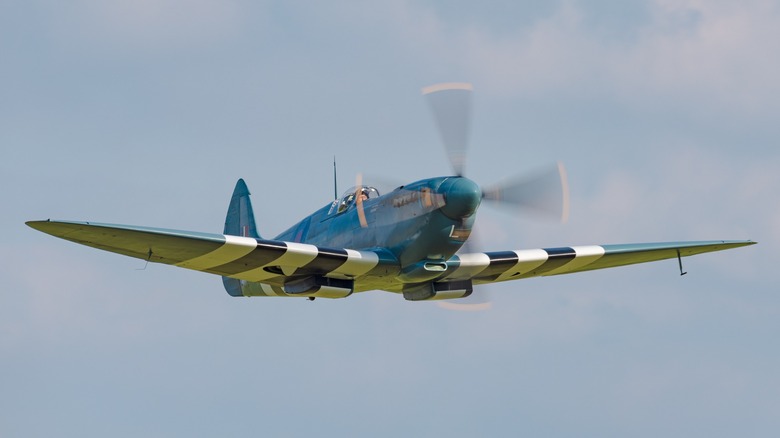
While American aircraft had several speed and altitude advantages, they fell short of faster European-made planes like the Supermarine Spitfire. The Royal Air Force and some allied nations operated the British-made fighter as an interceptor, and it performed well in this role. The Spitfire predates WWII, entering service in 1938, and it continued to serve until 1950. By the end of the fighter's service life, 20,351 were built. As the aircraft evolved, 24 Spitfire variants were developed, and some performed better than others.
The fastest Spitfire variants could reach up to 621 mph, making it an incredibly fast aircraft. The Spitfire with the highest service ceiling was the Spitfire Mk. VII. The high-altitude Spitfire variant existed in small numbers, as only 140 were produced. The Spitfire Mk. VII had a service ceiling of 45,100 feet, outperforming most fighters of the era. It achieved this with its Merlin 71, a two-speed, two-stage supercharged engine capable of 1,710 horsepower.
The high-altitude single-seat fighter may not have been produced in large numbers, but it nonetheless proved its worth alongside other variants throughout the war. Spitfires flew in numerous large-scale operations, including engagements against the Luftwaffe during the Battle of Britain. It saw combat on every major front of the war, and whichever variant flew, it posed a significant challenge to any enemy aircraft within its 660-mile range. The aircraft has an estimated kill ratio of 3.5:1, which is impressive.
Junkers Ju 86P/R
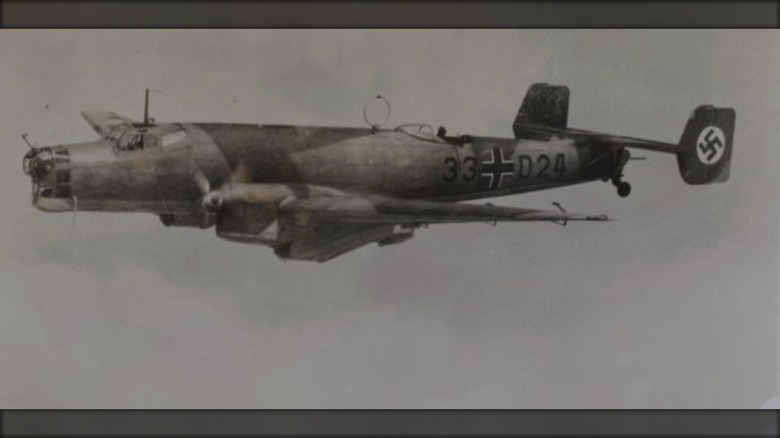
To understand WWII's truly impressive altitude achievements, you have to look at what the Germans flew throughout the conflict. After all, it was Germany that introduced the first fighter jet in the Messerschmitt Me 262. While it was an impressive aircraft, it had a service ceiling of 37,600 feet. The Junkers Ju 86P/R, on the other hand, could reach an altitude of 47,000 feet, though some sources indicate it was higher at 48,500 feet. The diesel-powered propeller plane was exceptionally powerful, thanks to its dual supercharged Junkers Jumo 207 D-V2 inline-six diesel engines.
These were outfitted with a nitrous oxide injection system that aided its performance at extreme altitudes. Germany began operating the Junkers Ju 86 in 1936, and it remained in service throughout the conflict in Europe. One reason it reached such impressive altitudes was its pressurized cabin and other systems designed for high-altitude performance. The highest-altitude variants were the Ju 86P and 86R.
Both the Junkers Ju 86P and R reconnaissance and bomber aircraft had an absolute ceiling of approximately 49,000 feet, though this remains unconfirmed. Most sources place the aircraft's service ceiling at 47,000 feet, which remains the consensus among most experts. After the war, the Ju 86 didn't entirely disappear, as it ended up serving Sweden as a commercial airliner capable of carrying 10 passengers. The last of these converted aircraft left service in 1958, and a beautifully restored one resides at the Swedish Air Force Museum in Linköping, Sweden.
Focke-Wulf Ta 152
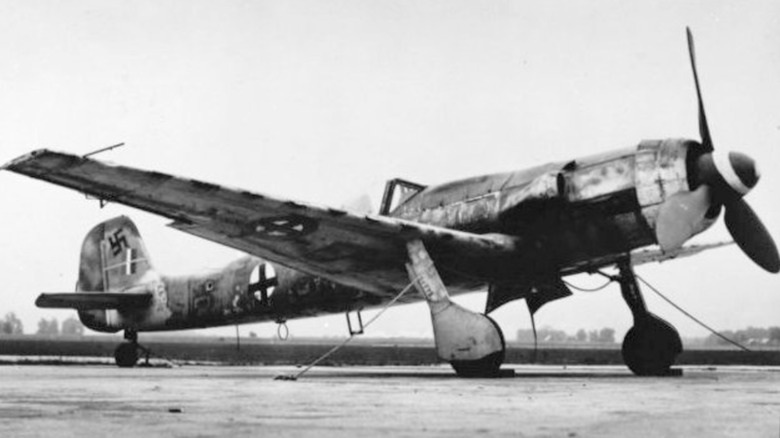
Toward the end of the war, Germany began flying the Focke-Wulf Ta 152, a high-altitude interceptor. It didn't enter service until early 1945, by which point it was too late to make a difference, as the Allies already had air superiority over Europe. As a result, only 67 were produced, but that wasn't the only problem: several were lost to engine fires and other engine-related issues that couldn't be resolved because of a lack of parts and supply chain disruptions, so the Luftwaffe grounded them all before the war ended.
While the Ta 152 didn't accomplish any major feats during WWII, it was capable of flying incredibly high. The Ta 152 had a service ceiling of 48,556 feet, which outperformed every other fighter during the war. No bombers could reach that height either, which made the Ta 152 an impressive machine. It failed only because of limited fuel supplies, a lack of qualified pilots, and the Allies' overwhelming number of aircraft, which maintained air superiority over Europe when it was introduced.
Had it been introduced earlier in the conflict and undergone some improvements, it might have made a difference. Fortunately for the Allies, that didn't happen, and the aircraft never achieved much in the name of impressive aerial victories. The Ta 152 and similar fighters managed impressive feats during one of humanity's darkest times, showing how ingenuity and necessity can combine to create machines capable of reaching higher and flying faster than anything that preceded them.