

The US Navy Primarily Uses These 5 Aircraft To Train New Aviators
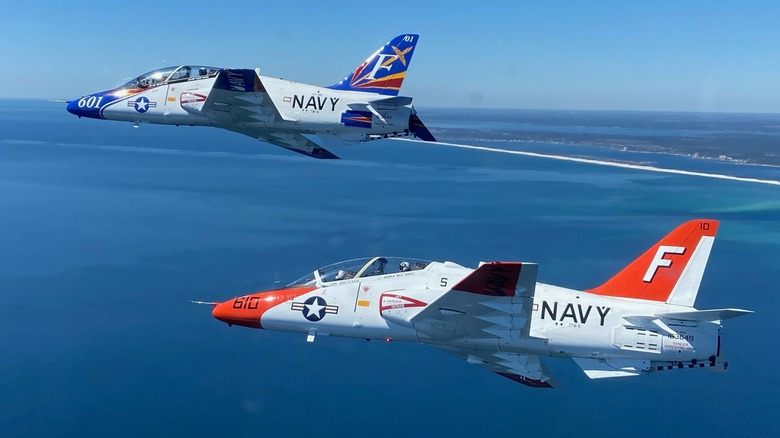
When the United States Navy formed in 1775, none involved could have imagined that in 136 years, the service would begin sending its sailors up into the air as naval aviators. The first of these personnel was Theodore Gordon "Spuds" Ellyson, who earned his wings in 1911, becoming Naval Aviator No. 1. Thousands of aviators followed in Ellyson's footsteps, taking up biplanes, fighters, bombers, and more as technology progressed to what it is today.
These days, the Navy has a more standardized flight training program than in Ellyson's era, and only the best of the best get to become naval aviators. To do so, they must first learn the basics of flying, but the Navy isn't in the habit of throwing a new student into something like an F-35C Lightning II, which is the Navy variant of that platform. Instead, there are several different types of aircraft that the Navy uses to train its personnel, ranging from propeller-driven military planes to a single-engine jet, and a helicopter.
These aircraft are designed for training, so they utilize tandem seating so an instructor can take students up in the air. This is certainly safer than keeping the instructor on the ground, and it ensures both the personnel and the aircraft can return to Earth without succumbing to inexperience. Training is conducted first at the Cradle of Naval Aviation, Naval Air Station Pensacola, Florida, and continues in different locations, depending on the type of training and aircraft required. These are the five aircraft used to train naval aviators.
The T-6A/B Texan II
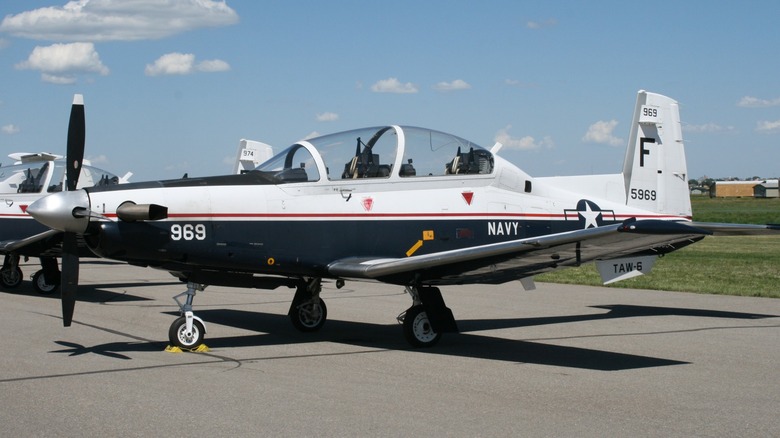
The Navy uses two versions of the T-6 Texan, designated the T-6A Texan II and the T-6B Texan II. The T-6A is a tandem-seat turboprop aircraft used to train both Marine Corps pilots and Navy aviators. They've been in use since November 1, 2002, and are designed for training. The stepped-tandem seating allows the instructor and student to swap places, though it can be fully flown by whoever sits in the forward seat.
The aircraft features a Pratt & Whitney Canada PT6A-68 turboprop engine that provides 1,100 horsepower. This gives it the power needed to climb 3,100 feet per minute, reaching 18,000 feet in under six minutes. The T-6A has a maximum ceiling of 31,000 feet, a range of 1,036 miles, and can reach a maximum speed of 311 mph at 1,000 feet. The T-6B is a newer model of the aircraft, having been introduced on April 19, 2010. It utilizes the same engine and is fully operable in either seat.
Other specifications remain the same between both aircraft, and they also include ejection seats, a fully pressurized cockpit, an anti-G system, and advanced avionics. Regardless of which version is used, the T-6 Texan II is one of the leading military training aircraft, as it's also used by at least 14 different nations' militaries. This is largely due to their relatively low cost, the speed at which they're produced, and the reduced costs in their continued operation and maintenance.
The T-44C Pegasus
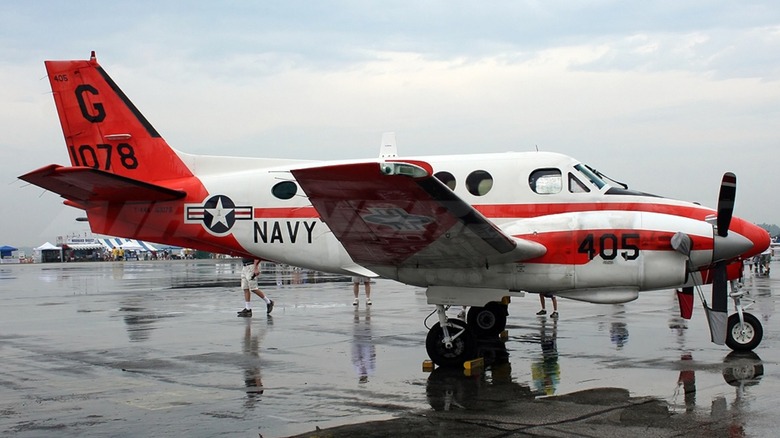
The U.S. Navy has been flying the T-44C Pegasus for decades, as its first operational flight was completed in April 1977. The twin-engine, pressurized aircraft puts potential naval aviators through advanced turboprop training. It's also used for intermediate carrier-based training at Naval Air Station Corpus Christi, Texas. Unlike the T-6 Texan II, the T-44C features two engines instead of one, both of which are Pratt & Whitney 550-shp PT6A-34B turboprop engines, providing 1,100 shaft horsepower combined.
While the aircraft was introduced decades ago as the T-44 Pegasus, the current version flown by the Navy, the T-44C, is significantly upgraded with modern technology, including digital displays, an integrated flight management system, and an updated glass avionics suite. The T-44C can reach a ceiling of 31,300 feet, has a range of 1,496 miles, and has a maximum airspeed of 281.94 mph. It also features an audio control panel, enabling the second student to monitor all radio communications while not flying the aircraft.
The plane accommodates one instructor and two students who learn advanced skills while flying the T-44C Pegasus. It also features an anti-icing system, an autopilot, and room for up to three additional passengers. These days, the training aircraft is maintained by Contractor Logistics Support (CLD), and while the Navy operates 54 T-44Cs, it's phasing them out in favor of the T-54A Marlin II, with the first of the newer and more advanced aircraft having arrived at NAS Corpus Christi in April 2024.
The T-54A Marlin II
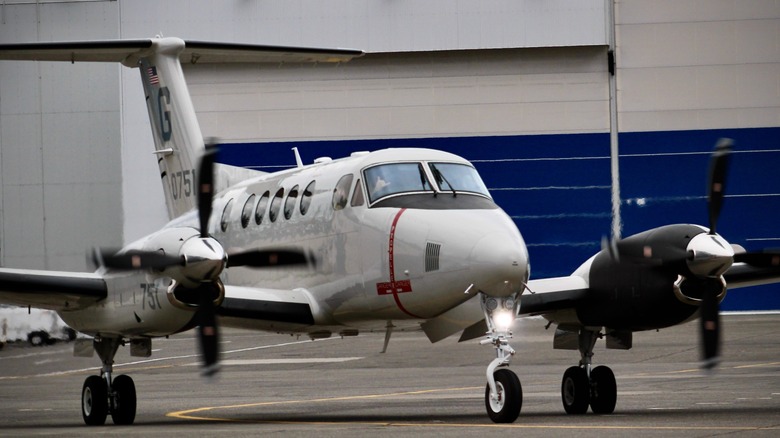
As the Navy continues to phase out the T-44C Pegasus, the T-54A Marlin II is actively taking its place. The aircraft reached initial operating capability and began training future naval aviators on June 10, 2025. Like its predecessor, the T-54A is a multi-engine training aircraft, but because it's considerably newer, it features the latest avionics technology, updates to its navigational systems, and a pressurized, state-of-the-art cockpit used in side-by-side seating for a student and instructor.
The aircraft enables students to learn advanced instrument and asymmetric engine handling, which prepares them for multi-engine and tilt-rotor aircraft operation. Other improvements include data capture, which helps to keep the T-54A flying for as long as possible by reducing the need for maintenance. As of writing, the Navy has procured at least 15 of the ordered 64 aircraft used to train aviators.
On September 12, 2025, the first four naval aviators trained on the T-54A graduated from the program. The aircraft provides the training needed for future aviators to operate aircraft like the E-2 Hawkeye Airborne Early Warning and Control aircraft and the P-8A Poseidon Maritime Patrol and Anti-Submarine Warfare aircraft. It's unclear when the T-54A will fully replace the aging T-44C, but given the speed of production, future naval aviators won't have to wait for too long, as it's already in operation training students.
The T-45C Goshawk
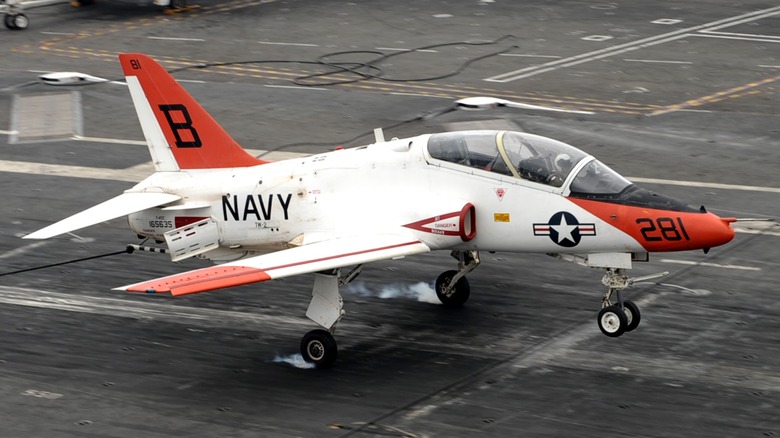
When it's time to move a student's instruction away from propeller-driven aircraft to jets, the Navy uses the T-45C Goshawk. The tandem-seat aircraft is carrier-capable, making it ideal for training both Marine Corps pilots and naval aviators in carrier-based flight operations. It's also the only fixed-wing jet trainer used by the U.S. military for that purpose. Additionally, the T-45C is used to train aviators on tactical strike missions and the Advanced Tactical Maneuvering Stage (ATMS) of a naval flight officer's training.
The T-45C became operational in 1999, and it's significantly faster and more capable than the other two fixed-wing aircraft used to train aviators. It's powered by a single Rolls-Royce Turbomeca F405-RR-401 non-afterburning turbofan engine that provides the power needed to reach 645 mph. That's Mach 0.84, which is much faster than the aforementioned trainers' top speeds. The T-45C has a ceiling of 42,500 feet and a range of 805 miles.
The Navy operates close to 200 aircraft, which are maintained by the Vertex Company and BAE Systems. They're operated out of Naval Air Stations in Texas, Mississippi, Florida, and at Vertex's headquarters in Madison, Mississippi. The aircraft is built around a digital "glass cockpit," which is similar to what a naval aviator would experience while flying something like the F-35C Lightning II or an F/A-18 Super Hornet, the Navy's primary carrier-based multirole fighter.
The TH-73A Thrasher
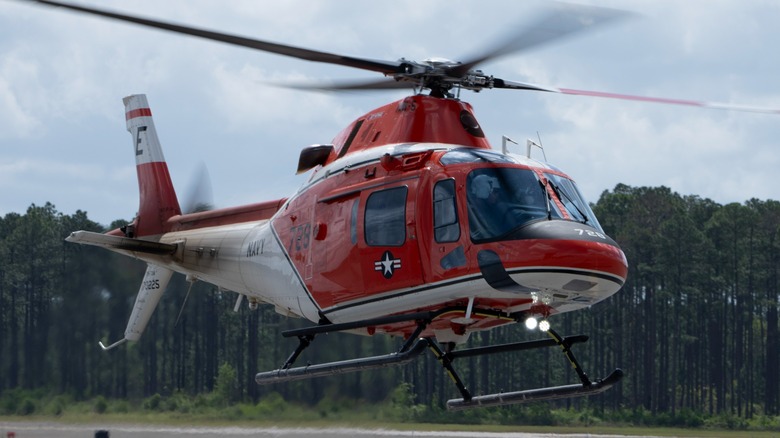
While the U.S. Army is well known for its massive fleet of helicopters, the other branches also utilize many for a variety of tasks. Flying a helicopter is nothing like flying a fixed-wing aircraft, so the Navy utilizes a helicopter to train its personnel. For 57 years, it was the TH-57 Sea Ranger, but that aircraft, first introduced in 1968, was retired in October 2025 in favor of its successor, the TH-73A Thresher. The Navy began using the TH-73A in 2021, so it's considerably newer than its predecessor.
The TH-73A is used for rotary and tilt-rotor pilot training for the Navy, Marine Corps, and the U.S. Coast Guard. That means that any pilot who operates the V-22 Osprey must first learn helicopter mechanics in a TH-73A. It's taught to students in the Advanced Helicopter Training System (AHTS), which uses more modern training and hardware to bring undergraduate students up to speed for helicopter operations. The helicopter is powered by a single Pratt & Whitney PT6B-37A turboshaft engine, which provides the power needed to reach a maximum airspeed of 175 mph.
It also has a ceiling of 15,000 feet and a range of 411 miles. The Navy uses the TH-73A for advanced instrument flight rules training at Naval Air Station Whiting Field in Milton, Florida. In October 2024, the Navy accepted delivery of the 100th TH-73A Thrasher, and it continues to put its prospective pilots through the paces to teach the fundamentals of rotary flight to students each and every year.