

Skip The Michelin Tires - These Alternatives Are Cheaper & Ride Just As Smooth
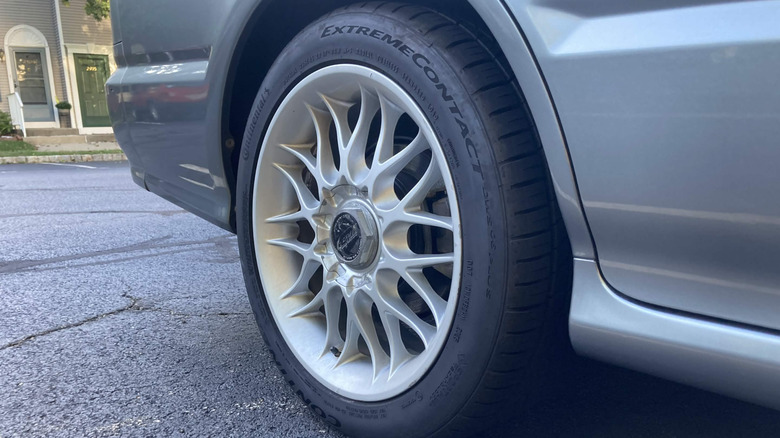
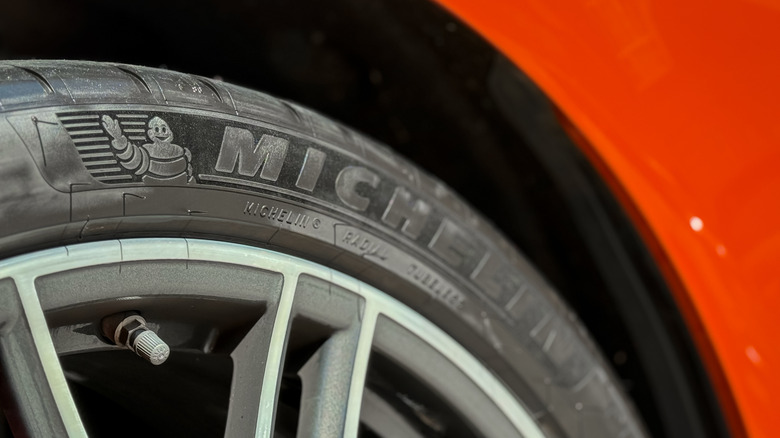
You're spoiled for choice when it comes to tires, as evidenced by the racks filled with different options at places like Costco, which already offers five different options. Other specialized tire shops often break into the dozen or more category, but one tire you'll generally see right in the front is Michelin. And that's no accident; the French tire company holds enough awards and popularity to put the New York Yankees to shame. It fields tires for just about everything on wheels, from bicycles to passenger airliners, and has remained in business for over 130 years. In short, Michelin knows tires. But that knowledge comes at a premium.
For this example, we'll use a fairly high-performance all-season tire meant for sedans and performance vehicles: the Michelin Pilot Sport All-Season 4. Prices generally vary at around the low-$200 region for smaller width and diameter models, so let's go for something fairly basic and say 235/45/17s, an adequate size for a modern regular car. That comes in at $223 per tire on Tire Rack, so what offers similar performance but beats it in price?
Assuming you want to match or exceed the tire's capabilities, the current premiere option and all-round rival to the Pilot All-Season is the Continental ExtremeContact DWS-06 Plus. It's a fairly even matchup, with the Continental edging out against Michelin in many categories and the Michelin clawing back in others, like dry braking consistency. But as far as price goes, the Continental comes in at $26 cheaper than the Michelin. That's more than ten percent savings — but how does it actually perform? Let's discuss.
What the Continental DWS-06 does better
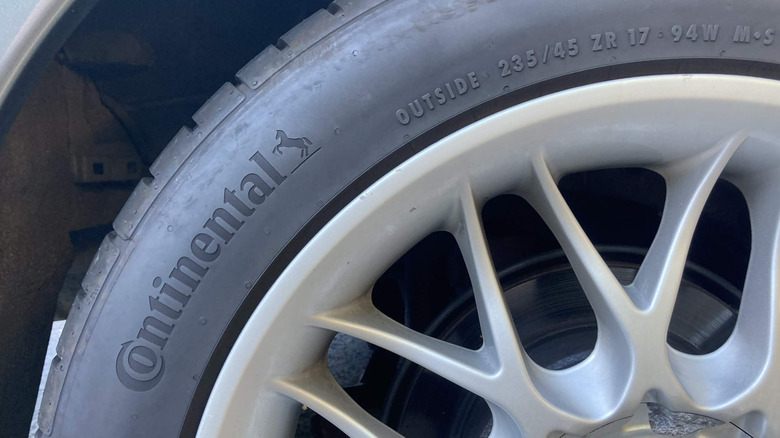
First thing's first: What exactly are we comparing? These are your typical all-season tire, albeit at a higher performance level than many, designed to combine a sportier grip level with everyday usability. They're basically a step down from true high-performance tires like the Michelin Pilot Sport 5 or Continental's equivalent ExtremeContact Sport 02, which themselves are among the best performance for a street tire. So we'll look at metrics that reflect those values — handling, braking, and ride smoothness.
Let's start with the comfort side — reviews hand it to the Continental in this regard. It offers a more refined, if slightly less performance-oriented, ride-quality versus the Michelin, forming a natural benchmark against which all the other tires are measured. Yes, it's still considered a premium, unlike cheaper options like a Sumitomo, but if you want Michelin levels of performance without Michelin prices, that's what you get. Still, it's impressive that the DWS-06 holds up against the Michelin at all considering how far forward both tires are on the scale.
The question of comfort and smoothness is partly subjective, granted, and not strictly measured in a scientific sense like braking distance or G-force load. But as far as the reviews and independent testers are concerned, the Continental is the smoother of the two options, with varying results depending on the climate — some places say it's better in wet conditions and was highly responsive when driving hard, whereas others desired more feel at higher speeds. It's also known as one of the best tires for driving in the rain.
What the Michelin does better
Obviously there's the age-old adage, "you get what you pay for," so in theory you should get about 15 percent better performance from a tire that costs 15 percent more, right? Well, not really. Again, reviews and owners alike state that these two tires are extremely similar in terms of outright performance, with the exception of the Continental being smoother-riding.
But raw data isn't partial, and according to an independent test by Tyre Reviews, the Michelin led the pack in both dry and wet braking performance by around one to three percent, sometimes as much as eight percent. Moreover, the cornering G forces, measured by circle grip, came out to 0.90g for the Michelin versus 0.87g for the Continental, which is a fairly minute difference, granted, but every little bit counts. Lastly, the Michelin performs better in snow and ice conditions by a good margin — the Michelin handled and stopped around 8 to 10 percent better in Tire Rack's 2024 test. So you might want the Michelin if you live in those climates.
Overall, though, is it worth the extra money? That's ultimately for you to decide — do you want the more specialized driving feel of a Michelin, or a more well-rounded and smoother quality from the Continental? That said, for everyday driving that doesn't involve a lot of performance demand, the Continental does make a compelling argument considering how often you realistically need such minute extra levels of grip, especially since the Continentals are among the highest-quality tires for the price.