

5 Fighter Jets With The Most Powerful Radar Systems
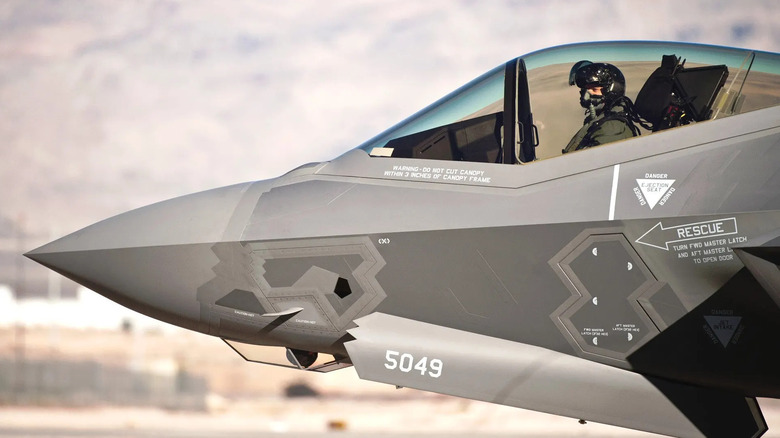
Across the complex technical aspects of electronic warfare, perhaps the most abstruse sub-section is that of radio frequency theory. From its emergence in the latter stages of the Second World War, radio detection and ranging, or radar, has become a widely implemented aspect of numerous components of everyday life, from miniature millimeter-wave radar sensors inside smart toilets to pulse-Doppler units that track the trajectory and velocity of balls in professional sports.
It's this broad range of different applications and varying contexts that makes determining superiority amongst radars difficult. The former Soviet RT-70 radio telescope is undoubtedly a massively powerful radar, capable of tracking asteroids and communicating with deep-space probes, but with a fixed bandwidth of 512 kHz and a radar resolution cell of roughly 300 meters, it would have no hope of achieving the high refresh rates and resolution detail demanded in modern air defense requirements.
That same variation in purpose is present within air combat radar systems. The missions and roles an aircraft is built and optimized for are reflected in the type and functions of its sensor suite. A radar can be powerful because it transmits an enormous pulse, because it can remain agile and track numerous targets in a busy dogfight, because it can detect a small target at extreme range, or because its processing and electronic-warfare architecture allows it to both feed and be fed by wide sensor integration.
So what aspects make a fighter jet's radar powerful? And which jets do those best?
The MiG-25 Foxbat: brute force and the maximization of effective radiated power
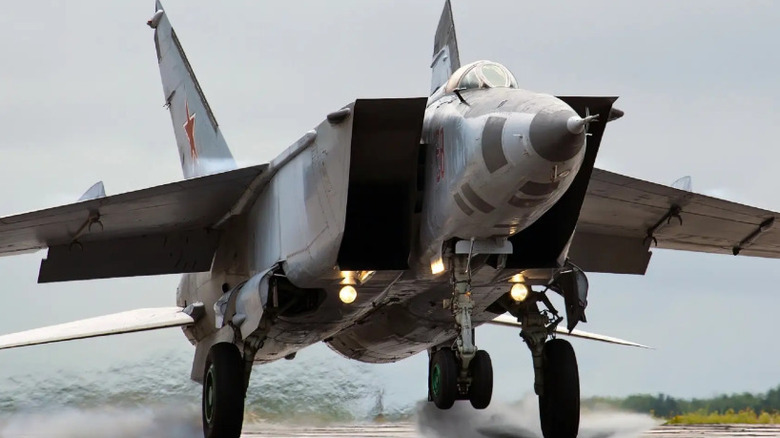
If power in fighter radars is considered in its most literal sense, then the most powerful should be very easy to identify. Raw effective radiated power, expressed as peak power in the technical intelligence domain, is the maximum instantaneous wattage value that can be fed into a single radar pulse.
Using this metric, nothing comes close to competing with the RP-25 Smerch-A Fox Fire, fitted to the Soviet-made MiG-25 Foxbat. Credited with transmitting at a peak power output of roughly 600 kW, this was an extraordinary figure for an airborne radar built in the 1960s. Even in comparison to today's fourth, fourth+, and fifth generation fighters, whose peak power outputs range between 20 kW and 40 kW, the Foxbat remains a titan, and for a good reason.
The Foxbat was built to do one thing well: kill nuke trucks. In the early stages of the Cold War and its nuclear anxiety, American B-52s were expected to approach at high altitudes, and layered with electronic countermeasures. The extreme power output of the RP-25 gave the Foxbat two advantages: an extremely long detection range and an immensely high burn-through range. Burn-through in electronic warfare is the specific distance where an active radar signal becomes stronger than an enemy jammer's noise, allowing the radar to track the target. Because radar waves get weaker as they spread, a lower-powered radar has to be much closer to a target to achieve that burn-through.
In the modern era, signal complexity and demands for low observability have replaced raw power demands. However, for its era, for the mission it was designed to do, and for the amount of raw power the RP-25 could cram into a single pulse, the MiG-25 Foxbat remains a juggernaut of electronic warfare.
The Sukhoi Su-35 Flanker: effective detection performance against unrestricted target types
One of the most common ways to judge a radar's performance is to simply consider how far it can see. This isn't necessarily a bad metric, as it references a number of critical aspects of the radar's operation; transmitted power, antenna gain, and maximum unambiguous range. However, the nature of the target is as critical to radar detection as the capability of the radar itself. A large, reflective bomber or transport aircraft will be detectable at much higher ranges than a sleek fighter. The reflectivity of a target is referred to as its radar cross section (RCS), and is expressed in square meters.
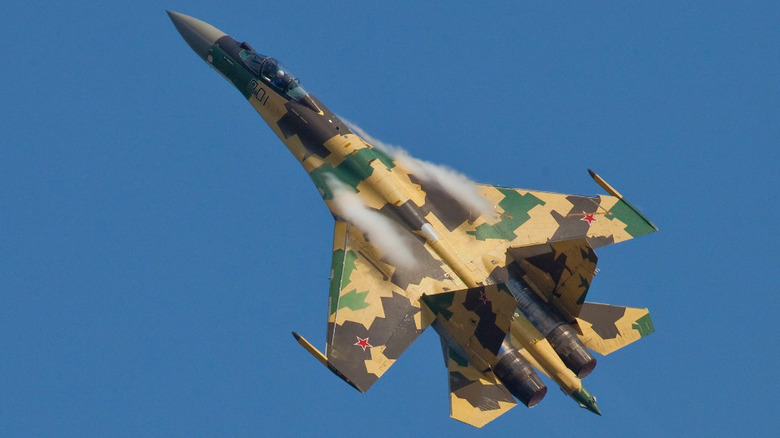
For aircraft designed to hunt and kill big targets like bombers, air battle-space management platforms, tankers, and so on, radars can be optimized with longer wavelengths that suffer less atmospheric absorption and decay over time and distance, but can still detect larger radar cross sections. These radars are generally fitted to larger, interceptor-class jets, and few are as capable as the N035 IRBIS-E built into the Sukhoi Su-35.
With an advertised detection range of up to ~400 km against a target with a 3 meters squared RCS, the Su-35 is the perfect example of a large, heavy interceptor. While that detection range would be substantially lower for smaller RCS targets (a frontal aspect F-16 is roughly 1 meters squared), the Su-35 remains a fantastic platform on which to mount very long or extended range air-to-air missiles capable of striking deep into an adversary's airborne control and logistics functions.
However, the IRBIS-E is limited by a tight field of view. As it concentrates energy and receiver workload into a narrow pencil beam, it does so at the cost of broader situational awareness.
The Eurofighter Typhoon: antenna aperture and beam-forming capability
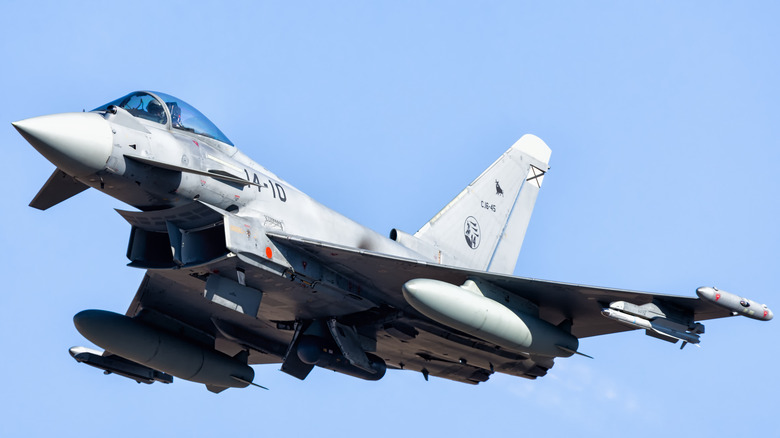
In contrast to the extended lethality of interceptors, a shorter, but wider, field of view, combined with the ability to rapidly shift between search, track, and track-while-scan functions, can be an enormous advantage for agile line fighters. This is of particular note on fighters that look to exploit short skate shots in the final stages of beyond visual range combat.
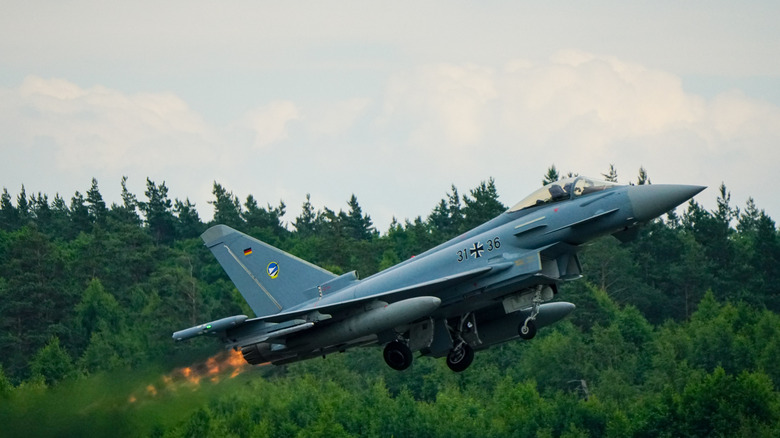
Arguably, very few fighters do this better than the Captor-E ECRS Mk2 scheduled for employment on Tranche 3 variants of the Eurofighter Typhoon. While most aircraft opt for either mechanical or active beam steering, the ECRS Mk2 uses both. A mechanical repositioner moves the entire antenna array, supplementing its electronic beam steering. In total, this provides the Typhoon with a 200-degree field of view over a detection range of approximately 200 km.
This has enormous tactical value. Arguably the most critical point of air combat is the merge. This describes the point at which two aircraft transition from radar-guided munitions and beyond visual range (BVR) tactics to within visual range (WVR) dogfighting. It is at the merge that positioning, how a fighter is located in relation to another, is critical in seizing a maneuver advantage. A radar like the ECRS Mk2 allows the Typhoon to seize advantage through taking up relatively complex azimuth and aspect positioning while still being able to maintain sensor lock.
Ultimately, what makes a radar powerful in air combat is equally a geometric problem as much as it is a wattage or peak power concern. More energy is great, but shaping that energy to the way an aircraft intends to fight is critical.
The F-22 Raptor: detection range against type-specific targets
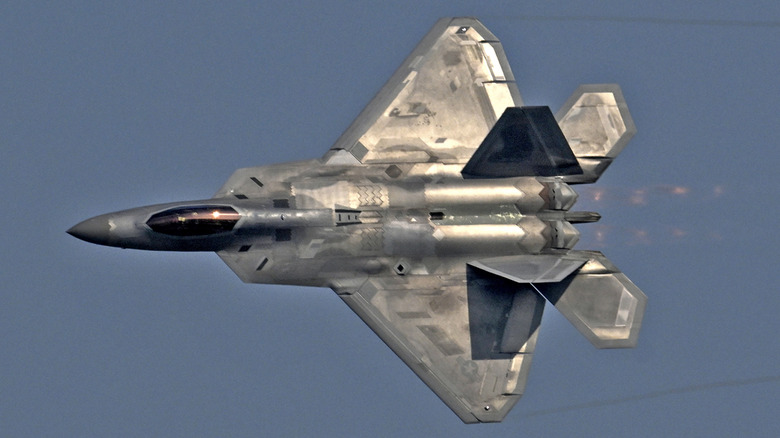
Radars demand compromise. Frequency resonance, or Mie scattering, the tendency of objects to reflect radar waves more strongly when their dimensions correspond to the wavelength, will determine what a radar is best suited to detect. Large aircraft with high RCSs are easy; finding a slick, fighter-sized target is considerably harder.
If a fighter jet's radar is considered powerful based on its ability to detect other fighters, today's benchmark is the AN/APG-77 built into the F-22 Raptor. As a serving fifth-generation jet, exact performance figures remain classified, but open-source estimates place its detection range against a 1 m² target at roughly 200 km. However, what makes the AN/APG-77 so powerful is this optimization for long-range detection and tracking of fighter-sized targets while simultaneously minimizing its probability of detection.
As an air superiority fighter, the F-22 was built to fight things that can fight back. The AN/APG-77 was therefore designed to maximize advantage against other fighter jets. Much like a tracer round working both ways in a gunfight, radar emissions can show you where the enemy is, but radar warning receivers (RWR) can alert the enemy that you are present and whether you have them in a track or a lock. The AN/APG-77 mitigates this, combining long-range, type-specific detection with LPI techniques.
Frequency agility, moving across numerous sections of the radio frequency spectrum, sometimes thousands of times a second, tricks enemy RWRs into thinking tracking emissions are background clutter. Power control measures compute the exact amount of power needed to maintain lock without overloading the target with emissions and revealing that it's being spiked. This gives the Raptor the ability to observe without being observed, and to maintain the element of surprise as it moves to intercept. Clever girl.
The F-35 Lighting II: processing power, information quality, and sensor integration
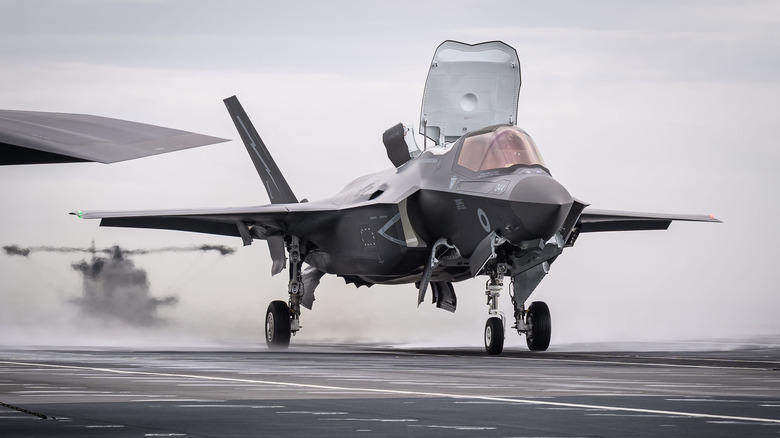
Warfare today is network-centric. No platform operates in isolation; instead, sensors are data-linked together to generate a shared and continuous stream of tactical information. This is true for all modern fighters. Whether they are the U.S.-standard of Link-16/22, Russia's OSNOD, or China's DTS-03 enabled, all dip into a vast pool of networked data. When that pool contains exponentially more information than a single jet's onboard computer could ever possibly ingest or process, it could be argued that that the most powerful fighter would be the one that can access and exploit that data lake most effectively.
In this instance, the F-35 Lightning II represents a superior option, not because of its onboard AN/APG-81 radar, but because how the aircraft can integrate into much larger electronic-warfare and sensor-fusion architectures.
The Lightning II was designed to perform multirole air-to-air and air-to-ground missions. This meant not just air threats, but multi-domain threats, while also contributing to electronic warfare, or suppression and destruction of enemy air defenses. Unlike a purpose-built air-superiority fighter, the Lightning II expects to exist in an exponentially more complex electronic environment and to maintain situational awareness in a fight that demands data management well beyond that which one jet can achieve alone. So the answer is simple: tap into a network that has everything it needs, and more.
The F-35 builds its own operating picture using data from both its own sensors and those networked from elsewhere. So while the AN/APG-81 is a fantastically capable multi-role radar, if the overarching question of which jet has the most powerful radar is expanded beyond their physically carried array to any sensor suite from which the jet can access or receive data, then power simply becomes a byword for processing capacity, and nothing in the sky is smarter than the F-35.
Methodology
To identify aircraft and radar systems that could be deemed as most powerful in the domain of modern air combat operations, five criteria were determined that addressed the linguistic and contextual connotations of power within radio frequency theory. These criteria were drawn from basic linguistic definitions, common non-technical assumptions, and specific mission roles and requirements for modern fighter aircraft.
To verify each aircraft's standing, we used manufacturer and publicly released performance specifications and capabilities, all of which were scrutinized for technical plausibility. Gaps or restrictions in information access were mitigated through open-source analysis of reliable and corroborable data on aircraft operations.