

What Is Hypoid Gear Oil And What Makes It Different From Regular Gear Oil?
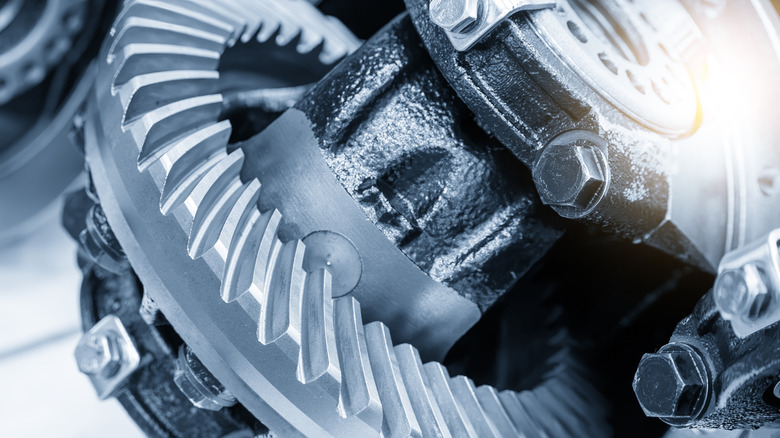
Oil is your car's life blood. From the engine to the transmission to the differential — anywhere with the potential for metal-on-metal contact, you'll need some sort of lubricant to keep it from overheating. Every type of oil is designed for different tasks as well; while some may be theoretically interchangeable, they often have different additives that make them better suited for one task or another. Take hydraulic oil versus motor oil, for instance. Both have a lot of the same qualities, but the former is best suited to accepting high pressure and the latter high thermal loads.
The same thing applies here with hypoid gear oil, such as many API GL-5 oils, versus regular gear oil. In short, hypoid gear oil is meant to be used with steel gears under the pressures inherent to hypoid gearsets, as opposed to regular gearsets.
Generally, gears use the same principle whether it's a transmission or a windmill; you're taking two shafts and meshing them together to transfer torque. The difference comes in how those gears interact. You have shafts that can go laterally or extend sideways, some that are articulated and others that are static. Ring gears, planetary gears, straight-cut or beveled — all these produce different pressures that require different oils, hence why manual transmission fluid (MTF) and automatic transmission fluid (ATF) are different.
But what's special about hypoid gears that you need hypoid oil? Hypoid differentials are arranged differently; you have an input shaft that's lower or higher than the center of the output shaft gear's center, a setup which has its own benefits but also requires specialized lubricants because of the friction involved in laterally sliding two metal surfaces together.
What is a hypoid gearset?
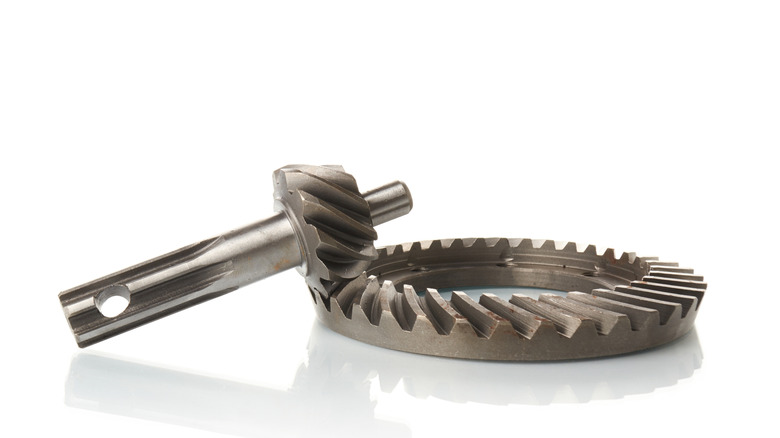
Yes, car axles are complicated, so let's address this first: What is a hypoid gear? To better visualize how this works, ball one hand up into a fist, then place your index finger beside it. Imagine your fist is a gear, and your index finger is an input shaft. That input shaft is spinning, and as it spins, it turns the bigger gear called a ring gear — your fist, in this case, which is how a driveshaft turns your car's wheel in a typical rear-wheel drive car.
Let's assume that the input shaft is perfectly dead-center where the output's axis of rotation is. Your finger has a certain amount touching your fist in that case; that's where your car's input shaft contacts the output shaft. Okay, now for the real trick — rotate your finger so that your whole index finger is touching your fist. You have way more surface area between the two; that's what a hypoid gear is. You're putting the input shaft in a place where more of it is in contact with the ring gear on the output shaft.
Now, when you think about it, you can't just place the two gears offset to one another and have them be cut perfectly straight. It'd be like moving your jaw to one side and trying to close your mouth. The teeth wouldn't be able to mesh, so instead you cut the teeth in a spiral pattern and cut the ring gear with a curve to its teeth. That way, as the gear rotates, it'll mesh without any friction issues because there's minimal lateral resistance (like grinding your teeth).
Why do hypoid gears need special fluid?
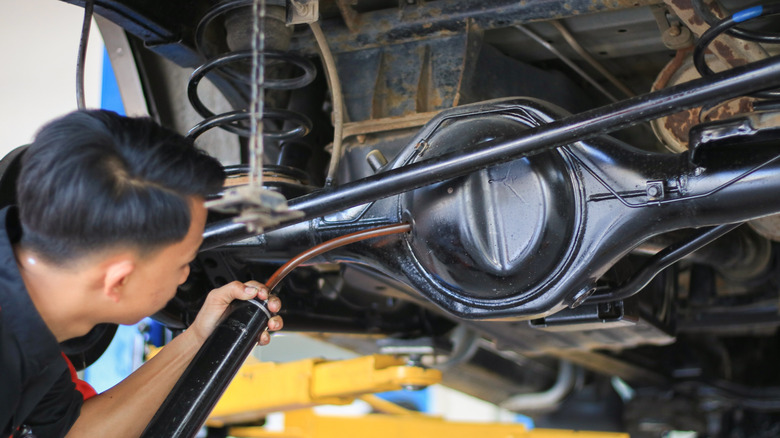
Any gearbox needs fluid, as we've established, and hypoid gears are no exception. You'll frequently see hypoid gears running with API GL-5, but what does that even mean and can you use regular gear oil instead? In short, no. Hypoid gear oil has specialized additives which are toleranced for the pressures placed upon them by the spiraling motion of the beveled gears.
A lot of regular manual gearboxes can also use this fluid as well; look on the back of any bottle of GL-5 and it'll likely say it's rated for use in them. Most modern gearboxes use steel gears, which GL-5 protects by clinging onto the surface and acting as a sacrificial barrier. The oil prevents the metal surfaces from generating friction, therefore helping your transmission last longer. The main difference is the additives. GL-5 has specific sulphur/phosphorous additives that cling onto metal better under pressure, which is why they're so good with hypoid gears. The downside is that this additive is corrosive to brass, so if you have a car with brass synchronizers in the gears, you have to use GL-4 instead — something I have to do personally, as my car has brass synchros.
As for using other gear oils with hypoid gears, you technically can — again, much like using motor oil in hydraulic lines. But it's not a good idea; the point of GL-5 is that it clings to metal surfaces. Without that action, your differential will struggle to lubricate itself, leading to the gears wearing out. Signs of differential failure include ticking or clunking noises when driving, a generally noisy ride coming from the axle, or odd behavior in tight corners — so don't forget to change your diff oil.