

What Makes Hydraulic Oil So Different From Motor Oil?

Machinery oils and fluids are complicated. Sure, they may seem straightforward enough, especially when you look at them in a clear glass; oil is oil, after all. But there's a reason why, if you go to an auto parts store, there are dozens of different weights, mileage recommendations, synthetic versus natural, and other configurations of just engine oil alone. A similar phenomenon exists for hydraulic fluid as well. In short, these fluids are highly specialized for different environments and not interchangeable with something like motor oil. But why is that, exactly? And can they be mixed or even swapped in a pinch anyway?
At first glance, these fluids may appear similar in nature. They both have numbers in the name, for one, and sometimes hydraulic fluid even has a "W" in it. But that W stands for "Weight," as opposed to automotive engine oil where the W stands for "Winter." And that's just scratching the surface between these two, because each fluid has totally different additives that enhance their respective properties.
It's those additives which are the true key to why these fluids are so different. Engine oil is designed to stick to metal surfaces in high temperatures over repeated heat cycles, using additives such as zinc-based ZDDP or ZDTP, oxidation inhibitors, and detergents to prevent carbon buildup. Conversely, hydraulic fluid uses anti-foaming agents alongside minerals like glycol and esters, similar zinc additives, and pour point improvers, all formulated to be incompressible under extreme pressures. Close enough, right? Not really; while they have similar properties, they're actually quite different when we look under the hood. Let's explore more about their chemical compositions and intended roles.
How hydraulic oil and motor oil differ on a chemical level

First and foremost, both hydraulic and engine oils use mineral oil (or a synthetic derivative) as primary ingredients. Ultimately, both types of fluid must provide lubrication in their respective systems. Similarly, both fluids generally have agents designed like wear inhibitors, friction modifiers, and those designed to inhibit rust and oxidation. The main difference lies in their operating limits. Hydraulic fluid is designed to be under far more pressure than engine oil, and engine oil operates under higher temperature ranges.
Engine oil typically hovers around 30-60 PSI, depending on the car you're driving and how hard you're driving it. However, it must contend with extreme temperatures; a combustion chamber is one of the most violent places in everyday life. You have pistons moving up and down hundreds of times a minute even under leisurely driving, producing what's effectively a series of controlled explosions inside of a block of metal. These pistons need lubrication, otherwise they'll scrape along the piston sleeve and generate tremendous levels of heat. Running a car with no oil is an excellent means to ensure an engine's rapid unplanned disassembly.
These heat levels aren't as much of a consideration in hydraulic fluid — what is a concern, however, is compression. The whole point is that hydraulic fluid doesn't compress under load, and so the oil transfers energy from Point A to B, like brake fluid in your car. Therefore, hydraulic fluids contain additives such as anti-foaming and anti-friction agents, along with consistent viscosity across different temperature gradients than engine oil. Moreover, their bases can vary from what's seen in engine oil, with variants including fire-resistant organophosphate ester (fire-resistant), environmentally-friendly polyalphaolefin, and food-grade oils for hydrostatic compositions.
Is hydraulic oil interchangeable with motor oil?
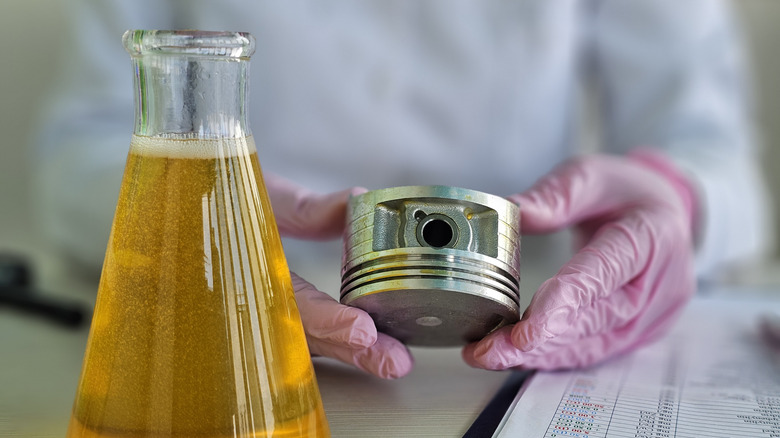
So could you put hydraulic oil in your car in a pinch? Short answer: No. Long answer: Yes, if you straight-up hate your engine — these oils lack any properties to resist the high heat demands and can't deal with things like acids and carbon buildup from an engine's natural processes. You can pour dish soap into your engine and call it "oil" but it still won't work right. It's less about the oil itself and more about its intended purpose, much in the same way that diesel engines don't use the same type of motor oil as gas engines do because of higher heat and compression requirements.
The same thing applies the other way around, albeit slightly less so. You can technically use engine oil in certain types of hydraulic equipment, but only if you run them at low loads and just until you get some actual hydraulic fluid. Engine oil isn't designed to resist factors like cavitation, which is when bubbles form in the fluid. These bubbles are compressible, meaning you'll lose lubrication and can't transfer the work anymore. It's why bleeding brakes is so important — if you bleed the brakes yourself and wind up with bubbles in your brake lines, you'll end up pushing the pedal to the floor and nothing will happen.
As for which are transferrable, that's down to oil weights. Hydraulic fluid and engine oil use two different systems to measure viscosity — ISO for hydraulic and SAE for engine oil. ISO 32 is equivalent to SAE 10; ISO 46 and 68 is SAE 20; ISO 100 is SAE 30. As each of these weights are rated for different machinery, always double-check to make sure you won't risk damage any more than absolutely necessary.